
Verwandte Artikel zu Power, Memory, Architecture: Contested Sited on India's...
Inhaltsangabe
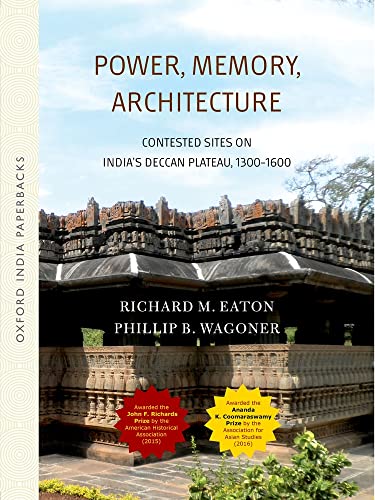
Most studies of the history of the early modern Deccan focus on struggles between the region's primary centers, that is, the great capital cities such as Bijapur, Vijayanagara, or Golconda. This study, by contrast, examines the political histories and material culture of smaller, fortified strongholds both on the plains and atop hills, the control of which was repeatedly contested by rival primary centers. Exceptionally high levels of conflict over such secondary centers occurred between 1300 and 1600, and especially during the turbulent sixteenth century when gunpowder technology had become widespread in the region.
The authors bring two principal objectives to the enquiry. One is to explore how political power, monumental architecture, and collective memory interacted with one another in the period under study. The study's authors - one trained in history, the other in art history and archaeology - argue for systematically integrating the methodologies of history, art history, and archaeology in attempts to reconstruct the past. The study's other aim is to radically rethink the usefulness of Hindu - Muslim relations as the master key by which to interpret this period of South Asian history, and to propose instead a model informed by Sanskrit and the Persian literary traditions.
Die Inhaltsangabe kann sich auf eine andere Ausgabe dieses Titels beziehen.
Über die Autorin bzw. den Autor
Richard M. Eaton, Professor, University of Arizona, Tucson.,Phillip B. Wagoner, Professor of Art History, Wesleyan University.
Richard M. Eaton is Professor in the Department of History at University of Arizona, Tucson.
Phillip B. Wagoner is Professor of Art History in the Archaeology program at Wesleyan University.
„Über diesen Titel“ kann sich auf eine andere Ausgabe dieses Titels beziehen.
Suchergebnisse für Power, Memory, Architecture: Contested Sited on India's...

Beispielbild für diese ISBN
Power, Memory, Architecture
Print-on-DemandAnbieter: Majestic Books, Hounslow, Vereinigtes Königreich
Verkäuferbewertung 4 von 5 Sternen

Zustand: New. Print on Demand. Bestandsnummer des Verkäufers 370469317
Neu kaufen
EUR 27,11
EUR 7,68 Versand
Versand von Vereinigtes Königreich nach USA
Versand von Vereinigtes Königreich nach USA
Anzahl: 4 verfügbar
Beispielbild für diese ISBN
Power, Memory, Architecture
Print-on-DemandAnbieter: Biblios, Frankfurt am main, HESSE, Deutschland
Verkäuferbewertung 4 von 5 Sternen
Zustand: New. PRINT ON DEMAND. Bestandsnummer des Verkäufers 18375608848
Neu kaufen
EUR 25,63
EUR 9,95 Versand
Versand von Deutschland nach USA
Versand von Deutschland nach USA
Anzahl: 4 verfügbar
Beispielbild für diese ISBN
Power, Memory, Architecture
Anbieter: Books Puddle, Woodside, NY, USA
Verkäuferbewertung 4 von 5 Sternen
Zustand: New. Bestandsnummer des Verkäufers 26375608858
Neu kaufen
EUR 33,78
EUR 3,56 Versand
Versand innerhalb von USA
Versand innerhalb von USA
Anzahl: 4 verfügbar
Beispielbild für diese ISBN
Power, Memory, Architecture (Paperback)
Anbieter: Grand Eagle Retail, Bensenville, IL, USA
Verkäuferbewertung 5 von 5 Sternen

Paperback. Zustand: new. Paperback. Most studies of the history of the early modern Deccan focus on struggles between the region's primary centers, that is, the great capital cities such as Bijapur, Vijayanagara, or Golconda. This study, by contrast, examines the political histories and material culture of smaller, fortified strongholds both on the plains and atop hills, the control of which was repeatedly contested by rival primary centers. Exceptionally high levels of conflict over such secondarycenters occurred between 1300 and 1600, and especially during the turbulent sixteenth century when gunpowder technology had become widespread in the region.The authors bring twoprincipal objectives to the enquiry. One is to explore how political power, monumental architecture, and collective memory interacted with one another in the period under study. The study's authors - one trained in history, the other in art history and archaeology - argue for systematically integrating the methodologies of history, art history, and archaeology in attempts to reconstruct the past. The study's other aim is to radically rethink the usefulness of Hindu - Muslim relations as themaster key by which to interpret this period of South Asian history, and to propose instead a model informed by Sanskrit and the Persian literary traditions. Focusing on India's Deccan Plateau in the turbulent sixteenth century, this book examines the political histories and material culture of fortified strongholds that were repeatedly contested by the region's rival primary centers. It explores the many ways that political power, monumental architecture, and collective memory interacted with one another. It also radically rethinks the usefulness of Hindu-Muslim relations as the master key for interpreting this period ofSouth Asian history. Shipping may be from multiple locations in the US or from the UK, depending on stock availability. Bestandsnummer des Verkäufers 9780199477692
Beispielbild für diese ISBN
Power, Memory, Architecture: Contested Sited on India's Deccan Plateau, 1300-1600
Anbieter: Revaluation Books, Exeter, Vereinigtes Königreich
Verkäuferbewertung 5 von 5 Sternen
Paperback. Zustand: Brand New. reprint edition. 395 pages. 9.50x7.00x1.25 inches. In Stock. Bestandsnummer des Verkäufers x-0199477698
Neu kaufen
EUR 68,44
EUR 14,77 Versand
Versand von Vereinigtes Königreich nach USA
Versand von Vereinigtes Königreich nach USA
Anzahl: 1 verfügbar
Beispielbild für diese ISBN
Power, Memory, Architecture (Oip) P: Contested Sites on India's Deccan Plateau
Anbieter: Kennys Bookshop and Art Galleries Ltd., Galway, GY, Irland
Verkäuferbewertung 5 von 5 Sternen
Zustand: New. 2017. UK ed. paperback. . . . . . Bestandsnummer des Verkäufers V9780199477692
Neu kaufen
EUR 75,42
EUR 9,50 Versand
Versand von Irland nach USA
Versand von Irland nach USA
Anzahl: 1 verfügbar
Beispielbild für diese ISBN
Power, Memory, Architecture (Oip) P: Contested Sites on India's Deccan Plateau
Anbieter: Kennys Bookstore, Olney, MD, USA
Verkäuferbewertung 5 von 5 Sternen
Zustand: New. 2017. UK ed. paperback. . . . . . Books ship from the US and Ireland. Bestandsnummer des Verkäufers V9780199477692
Neu kaufen
EUR 80,08
EUR 9,37 Versand
Versand innerhalb von USA
Versand innerhalb von USA
Anzahl: 1 verfügbar
Foto des Verkäufers
Power, Memory, Architecture : Contested Sites on India's Deccan Plateau
Verlag:
Oxford University Press Dez 2017, 2017
ISBN 10: 0199477698
ISBN 13: 9780199477692
Neu
Taschenbuch
Anbieter: AHA-BUCH GmbH, Einbeck, Deutschland
Verkäuferbewertung 5 von 5 Sternen
Taschenbuch. Zustand: Neu. Neuware - Most studies of the history of the early modern Deccan focus on struggles between the region's primary centers, that is, the great capital cities such as Bijapur, Vijayanagara, or Golconda. This study, by contrast, examines the political histories and material culture of smaller, fortified strongholds both on the plains and atop hills, the control of which was repeatedly contested by rival primary centers. Exceptionally high levels of conflict over such secondary centers occurred between 1300 and 1600, and especially during the turbulent sixteenth century when gunpowder technology had become widespread in the region. The authors bring two principal objectives to the enquiry. One is to explore how political power, monumental architecture, and collective memory interacted with one another in the period under study. The study's authors - one trained in history, the other in art history and archaeology - argue for systematically integrating the methodologies of history, art history, and archaeology in attempts to reconstruct the past. The study's other aim is to radically rethink the usefulness of Hindu - Muslim relations as the master key by which to interpret this period of South Asian history, and to propose instead a model informed by Sanskrit and the Persian literary traditions. Bestandsnummer des Verkäufers 9780199477692
Neu kaufen
EUR 70,41
EUR 35,00 Versand
Versand von Deutschland nach USA
Versand von Deutschland nach USA
Anzahl: 1 verfügbar