
Verwandte Artikel zu The Foucault Effect: Studies in Governmentality: With...
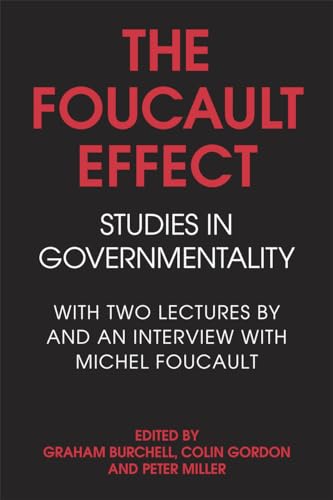
The Foucault Effect: Studies in Governmentality: With Two Lectures by and an Interview with Michel Foucault - Softcover
Inhaltsangabe
Based on Michel Foucault's 1978 and 1979 lectures at the Collège de France on governmental rationalities and his 1977 interview regarding his work on imprisonment, this volume is the long-awaited sequel to Power/Knowledge. In these lectures, Foucault examines the art or activity of government both in its present form and within a historical perspective as well as the different ways governmentality has been made thinkable and practicable.
Foucault's thoughts on political discourse and governmentality are supplemented by the essays of internationally renowned scholars. United by the common influence of Foucault's approach, they explore the many modern manifestations of government: the reason of state, police, liberalism, security, social economy, insurance, solidarity, welfare, risk management, and more. The central theme is that the object and the activity of government are not instinctive and natural things, but things that have been invented and learned.
The Foucault Effect analyzes the thought behind practices of government and argues that criticism represents a true force for change in attitudes and actions, and that extending the limits of some practices allows the invention of others. This unique and extraordinarily useful collection of articles and primary materials will open the way for a whole new set of discussions of the work of Michel Foucault as well as the status of liberalism, social policy, and insurance.
Foucault's thoughts on political discourse and governmentality are supplemented by the essays of internationally renowned scholars. United by the common influence of Foucault's approach, they explore the many modern manifestations of government: the reason of state, police, liberalism, security, social economy, insurance, solidarity, welfare, risk management, and more. The central theme is that the object and the activity of government are not instinctive and natural things, but things that have been invented and learned.
The Foucault Effect analyzes the thought behind practices of government and argues that criticism represents a true force for change in attitudes and actions, and that extending the limits of some practices allows the invention of others. This unique and extraordinarily useful collection of articles and primary materials will open the way for a whole new set of discussions of the work of Michel Foucault as well as the status of liberalism, social policy, and insurance.
Die Inhaltsangabe kann sich auf eine andere Ausgabe dieses Titels beziehen.
Über die Autorin bzw. den Autor
Graham Burchell, a contributor to Radical Philosophy and Ideology and Consciousness, is a freelance researcher and translator. Colin Gordon, a former research assistant to Michel Foucault at the College de France, is the editor and translator of Foucault's Power/Knowledge and translator of The Philosophical Imaginary by Michelle LeDoeuff. Peter Miller serves as convener of the Department of Accounting and Finance at the London School of Economics and Political Science.
Auszug. © Genehmigter Nachdruck. Alle Rechte vorbehalten.
The Foucault Effect
Studies in Governmentality
By Graham Burchell, Colin Gordon, Peter MillerThe University of Chicago Press
Copyright © 1991 Editors and Contributors
All rights reserved.
ISBN: 978-0-226-08045-1All rights reserved.
Contents
Acknowledgements,
Preface,
1. Governmental Rationality: An Introduction Colin Gordon,
2. Politics and the Study of Discourse Michel Foucault,
3. Questions of Method Michel Foucault,
4. Governmentality Michel Foucault,
5. Theatrum Politicum: The Genealogy of Capital – Police and the State of Prosperity Pasquale Pasquino,
6. Peculiar Interests: Civil Society and Governing 'The System of Natural Liberty' Graham Burchell,
7. Social Economy and the Government of Poverty Giovanna Procacci,
8. The Mobilization of Society Jacques Donzelot,
9. How Should We Do the History of Statistics? Ian Hacking,
10. Insurance and Risk François Ewald,
11. 'Popular Life' and Insurance Technology Daniel Defert,
12. Criminology: The Birth of a Special Knowledge Pasquale Pasquino,
13. Pleasure in Work Jacques Donzelot,
14. From Dangerousness to Risk Robert Castel,
Index,
CHAPTER 1
Governmental rationality: an introduction
Colin Gordon
Between 1970 and 1984, Michel Foucault delivered thirteen annual courses of lectures at the Collège de France in Paris. Foucault's duties at the college, as professor in a specially created Chair in the History of Systems of Thought, were not to teach a syllabus but to report on the results of his own researches. Several of these lecture series, Foucault's own official summaries of which have been republished as a volume by the Collège de France,1 are preliminary explorations of themes taken up in various of Foucault's later books. But others contain rich seams of material which he never chose or had time to work up in a final written form. Perhaps the two most remarkable annual courses of which this is true were those of 1978 and 1979, entitled respectively 'Security, territory and population', and 'The birth of biopolitics'. One of the 1978 lectures was published (although not in French) in Foucault's lifetime, and is reprinted in this volume (Chapter 4). A provision in Foucault's will has been interpreted by his literary executors as precluding posthumous publication of the complete lecture series; but the exceptional interest of the 1978 and 1979 courses has been recognized by the recent publication on cassette tape of the initial lectures of the two series, and a complete tape edition of the two series is currently under consideration. Complete recordings of these lectures are available to researchers in the Foucault archive at the Bibliothèque du Saulchoir in Paris.
In these lectures Foucault defined and explored a fresh domain of research into what he called 'governmental rationality', or, in his own neologism, 'governmentality'. This work was not carried out single-handedly. A group of fellow researchers, several of whom are among the contributors to this volume, took part in seminars held at the Collège de France which paralleled and complemented the programme of the lectures. In the subsequent lecture courses in Paris, Foucault shifted his attention away from these governmental themes in the direction of the topics of his final volumes of the History of Sexuality. But he continued to teach and organize research seminars on questions of government on his frequent visits to the United States, particularly at Berkeley. A number of lectures, essays and interviews published in the USA during these later years provide valuable documentation of this area of Foucault's work.
In the present essay I shall attempt a brief outline of the meaning of the theme of 'governmentality' in Foucault's work and the studies which he and others carried out under this heading, constructing a composite picture of the kinds of political and philosophical analysis which this style of working produces in the hands of a number of different and independent researchers. In some ways this is a problematic and even a foolhardy undertaking. A condensed, syncretic account may risk glossing over important differences of perspective between different individual contributions. One is describing a zone of research, not a fully formed product (although happily, it is now possible to refer to major subsequent publications by many of this volume's authors). The inaccessibility and the informal oral structure of the lecture materials makes summarization at once an indispensable and an uncomfortable task. I can only hope that the richness of the material itself will encourage the reader to tolerate these presentational obstacles and their attendant irritations.
As well as summarizing, I shall attempt to connect and to contextualize. We are only gradually becoming aware of, and are still far from having fully documented access to, the astounding range of Foucault's intellectual enterprises, especially in the later years from 1976 to 1984. The governmental theme has a focal place in Foucault's later philosophy; an effort needs to be made to locate this as accurately as possible. To understand the theme's wider resonance, something needs to be said about the interactions between a research agenda and a contemporary political world. To help to situate its distinctive value – and on grounds of good sense – it will be advisable to resist doctrinaire overstatement of this work's unique and unprecedented character, and instead to try to establish lines of communication with twentieth-century enquiries into allied areas of political philosophy and the history of political ideas. Such points of fruitful connection are, as Graham Burchell illustrates (Chapter 6), encouragingly numerous. Finally, and taking due account of widespread extant discussion of Foucault's later published work, something ought to be said about the ethical and political considerations (if any) implicit in this way of working and thinking.
What did Foucault have in mind by the topic 'governmental rationality'? Foucault understood the term 'government' in both a wide and a narrow sense. He proposed a definition of the term 'government' in general as meaning 'the conduct of conduct': that is to say, a form of activity aiming to shape, guide or affect the conduct of some person or persons. 'The government of one's self and of others' was Foucault's title for his last two years' lectures, and for a projected, unpublished book. Government as an activity could concern the relation between self and self, private interpersonal relations involving some form of control or guidance, relations within social institutions and communities and, finally, relations concerned with the exercise of political sovereignty. Foucault was crucially interested in the interconnections between these different forms and meanings of government; but in his lectures specifically on governmental rationality he concerned himself principally with government in the political domain.
Foucault used the term 'rationality of government' almost interchangeably with 'art of government'. He was interested in government as an activity or practice, and in arts of government as ways of knowing what that activity consisted in, and how it might be carried on. A rationality of government will thus mean a way or system of thinking about the nature of the practice of government (who can govern; what governing is; what or who is governed), capable of making some form of that activity thinkable and practicable both to its...
„Über diesen Titel“ kann sich auf eine andere Ausgabe dieses Titels beziehen.
Suchergebnisse für The Foucault Effect: Studies in Governmentality: With...

Beispielbild für diese ISBN
The Foucault Effect: Studies in Governmentality
Verlag:
University of Chicago Press, 1991
ISBN 10: 0226080455
ISBN 13: 9780226080451
Gebraucht
Paperback
Anbieter: Open Books, Chicago, IL, USA
Verkäuferbewertung 5 von 5 Sternen

Paperback. Zustand: Acceptable. Contains some, or all, of the following: highlights, notes, and underlining. Open Books is a nonprofit social venture that provides literacy experiences for thousands of readers each year through inspiring programs and creative capitalization of books. Bestandsnummer des Verkäufers mon0000743752
Gebraucht kaufen
EUR 3,72
EUR 3,48 Versand
Versand innerhalb von USA
Versand innerhalb von USA
Anzahl: 1 verfügbar
Foto des Verkäufers
The Foucault Effect: Studies in Governmentality
Verlag:
University of Chicago Press, 1991
ISBN 10: 0226080455
ISBN 13: 9780226080451
Gebraucht
Softcover
Anbieter: Blue Vase Books, Interlochen, MI, USA
Verkäuferbewertung 5 von 5 Sternen
Zustand: good. The item shows wear from consistent use, but it remains in good condition and works perfectly. All pages and cover are intact including the dust cover, if applicable . Spine may show signs of wear. Pages may include limited notes and highlighting. May NOT include discs, access code or other supplemental materials. Bestandsnummer des Verkäufers BVV.0226080455.G
Gebraucht kaufen
EUR 7,31
Versand gratis
Versand innerhalb von USA
Versand innerhalb von USA
Anzahl: 1 verfügbar
Beispielbild für diese ISBN
The Foucault Effect: Studies in Governmentality
Verlag:
University of Chicago Press, 1991
ISBN 10: 0226080455
ISBN 13: 9780226080451
Gebraucht
Paperback
Anbieter: HPB-Red, Dallas, TX, USA
Verkäuferbewertung 5 von 5 Sternen
Paperback. Zustand: Good. Connecting readers with great books since 1972! Used textbooks may not include companion materials such as access codes, etc. May have some wear or writing/highlighting. We ship orders daily and Customer Service is our top priority! Bestandsnummer des Verkäufers S_412417477
Gebraucht kaufen
EUR 4,49
EUR 3,27 Versand
Versand innerhalb von USA
Versand innerhalb von USA
Anzahl: 1 verfügbar
Beispielbild für diese ISBN
The Foucault Effect: Studies in Governmentality
Verlag:
University of Chicago Press, 1991
ISBN 10: 0226080455
ISBN 13: 9780226080451
Gebraucht
Paperback
Anbieter: HPB-Red, Dallas, TX, USA
Verkäuferbewertung 5 von 5 Sternen
Paperback. Zustand: Acceptable. Connecting readers with great books since 1972. Used textbooks may not include companion materials such as access codes, etc. May have condition issues including wear and notes/highlighting. We ship orders daily and Customer Service is our top priority! Bestandsnummer des Verkäufers S_416497231
Gebraucht kaufen
EUR 4,49
EUR 3,27 Versand
Versand innerhalb von USA
Versand innerhalb von USA
Anzahl: 1 verfügbar
Beispielbild für diese ISBN
The Foucault Effect: Studies in Governmentality
Verlag:
University of Chicago Press, 1991
ISBN 10: 0226080455
ISBN 13: 9780226080451
Gebraucht
paperback
Erstausgabe
Anbieter: The Maryland Book Bank, Baltimore, MD, USA
Verkäuferbewertung 5 von 5 Sternen
paperback. Zustand: Good. 1st Edition. Corners are slightly bent. Used - Good. Bestandsnummer des Verkäufers 14-G-1-0298
Gebraucht kaufen
EUR 3,76
EUR 4,09 Versand
Versand innerhalb von USA
Versand innerhalb von USA
Anzahl: 1 verfügbar
Beispielbild für diese ISBN
The Foucault Effect: Studies in Governmentality
Verlag:
University of Chicago Press, 1991
ISBN 10: 0226080455
ISBN 13: 9780226080451
Gebraucht
Paperback
Anbieter: Midtown Scholar Bookstore, Harrisburg, PA, USA
Verkäuferbewertung 5 von 5 Sternen
Paperback. Zustand: Very Good. Very Good - Crisp, clean, unread book with some shelfwear/edgewear, may have a remainder mark - NICE PAPERBACK Standard-sized. Bestandsnummer des Verkäufers M0226080455Z2
Gebraucht kaufen
EUR 4,78
EUR 5,23 Versand
Versand innerhalb von USA
Versand innerhalb von USA
Anzahl: 2 verfügbar
Foto des Verkäufers
The Foucault Effect: Studies in Governmentality
Verlag:
University of Chicago Press, 1991
ISBN 10: 0226080455
ISBN 13: 9780226080451
Gebraucht
Softcover
Anbieter: Goodwill of Silicon Valley, SAN JOSE, CA, USA
Verkäuferbewertung 4 von 5 Sternen

Zustand: good. Supports Goodwill of Silicon Valley job training programs. The cover and pages are in Good condition! Any other included accessories are also in Good condition showing use. Use can include some highlighting and writing, page and cover creases as well as other types visible wear. Bestandsnummer des Verkäufers GWSVV.0226080455.G
Gebraucht kaufen
EUR 7,36
EUR 3,48 Versand
Versand innerhalb von USA
Versand innerhalb von USA
Anzahl: 1 verfügbar
Beispielbild für diese ISBN
The Foucault Effect: Studies in Governmentality
Verlag:
University Of Chicago Press August 1991, 1991
ISBN 10: 0226080455
ISBN 13: 9780226080451
Gebraucht
Paper Back
Anbieter: A Cappella Books, Inc., Atlanta, GA, USA
Verkäuferbewertung 5 von 5 Sternen
Paper Back. Zustand: Very Good. Bestandsnummer des Verkäufers 392932
Gebraucht kaufen
EUR 14,37
Versand gratis
Versand innerhalb von USA
Versand innerhalb von USA
Anzahl: 1 verfügbar
Beispielbild für diese ISBN
The Foucault Effect
Verlag:
University of Chicago Press, 1991
ISBN 10: 0226080455
ISBN 13: 9780226080451
Gebraucht
Paperback
Anbieter: Tacoma Book Center, Tacoma, WA, USA
Verkäuferbewertung 4 von 5 Sternen
Paperback. Zustand: Fair. Zustand des Schutzumschlags: No Dustjacket. ISBN 0226080455. Trade Paperback. Later Printing. Tight sound reading copy only due to wave to book from being stored improperly, notations on back free endpaper. No Signature. Bestandsnummer des Verkäufers 9522609
Gebraucht kaufen
EUR 11,04
EUR 4,80 Versand
Versand innerhalb von USA
Versand innerhalb von USA
Anzahl: 1 verfügbar
Beispielbild für diese ISBN
The Foucault Effect: Studies in Governmentality
Verlag:
University Of Chicago Press, 1991
ISBN 10: 0226080455
ISBN 13: 9780226080451
Gebraucht
Paperback
Anbieter: HPB-Ruby, Dallas, TX, USA
Verkäuferbewertung 5 von 5 Sternen
Paperback. Zustand: Very Good. Connecting readers with great books since 1972! Used books may not include companion materials, and may have some shelf wear or limited writing. We ship orders daily and Customer Service is our top priority! Bestandsnummer des Verkäufers S_485551811
Gebraucht kaufen
EUR 12,57
EUR 3,27 Versand
Versand innerhalb von USA
Versand innerhalb von USA
Anzahl: 1 verfügbar