
Verwandte Artikel zu Tennis Science: How Player and Racket Work Together
Inhaltsangabe
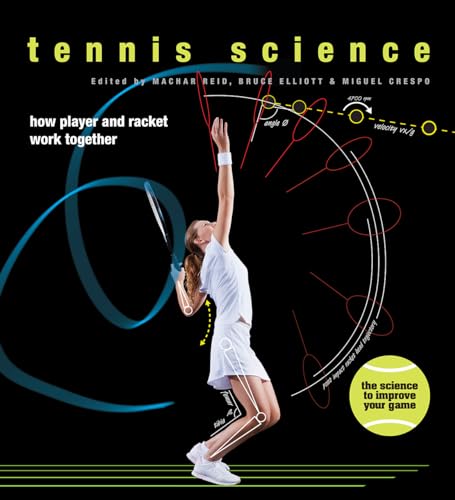
If you have watched a Grand Slam tennis tournament in the past decade, you are probably aware that the game is dominated by just a few international powerhouses. At the conclusion of each tournament, it is likely that you will see Serena Williams atop the women’s podium and a member of the Big Four—Roger Federer, Rafael Nadal, Novak Djokovic, and Andy Murray—hoisting the trophy for the men. And while there is not a lot of variety in the outcome of these matches, the game of tennis itself has changed drastically over the decades, as developments in technology and conditioning regimens, among other factors, have altered the style of play. Underpinning many of these developments is science, and this book explains the scientific wonders that take the ball from racket to racket and back again.
Each chapter explores a different facet of the game—learning, technique, game analysis, the mental edge, physical development, nutrition for performance and recovery, staying healthy, and equipment—and is organized around a series of questions. How do we learn the ins and outs of hitting the ball in and not out? What are the main technological developments and software programs that can be used to assist in performance and notational analysis in tennis? What role does sports psychology play in developing a tennis player? What is the role of fluid replacement for the recreational, junior, and professional player? What rule changes have been made with respect to the racket, ball, and ball-court interaction to maintain the integrity of the game in the face of technological change? Each question is examined with the aid of explanatory diagrams and illustrations, and the book can be used to search for particular topics, or read straight through for a comprehensive overview of how player and equipment work together.
Whether you prefer the grass courts of Wimbledon, the clay courts of the French Open, or the hard courts of the US and Australian Opens, Tennis Science is a must-have for anyone interested in the science behind a winning game.
Each chapter explores a different facet of the game—learning, technique, game analysis, the mental edge, physical development, nutrition for performance and recovery, staying healthy, and equipment—and is organized around a series of questions. How do we learn the ins and outs of hitting the ball in and not out? What are the main technological developments and software programs that can be used to assist in performance and notational analysis in tennis? What role does sports psychology play in developing a tennis player? What is the role of fluid replacement for the recreational, junior, and professional player? What rule changes have been made with respect to the racket, ball, and ball-court interaction to maintain the integrity of the game in the face of technological change? Each question is examined with the aid of explanatory diagrams and illustrations, and the book can be used to search for particular topics, or read straight through for a comprehensive overview of how player and equipment work together.
Whether you prefer the grass courts of Wimbledon, the clay courts of the French Open, or the hard courts of the US and Australian Opens, Tennis Science is a must-have for anyone interested in the science behind a winning game.
Die Inhaltsangabe kann sich auf eine andere Ausgabe dieses Titels beziehen.
Über die Autorin bzw. den Autor
Bruce Elliott is a senior research fellow in biomechanics in the School of Sport Science, Exercise, and Health at the University of Western Australia. He is the author of numerous articles and books on sports biomechanics. Machar Reid is the sports science and medicine manager for Tennis Australia and coauthor of several books on tennis sports science and coaching. Miguel Crespo is the research officer at the International Tennis Federation (ITF) Development Department, Spain. He runs the ITF’s education program and has coauthored and edited many ITF publications.
Auszug. © Genehmigter Nachdruck. Alle Rechte vorbehalten.
Tennis Science
How Player and Racket Work Together
By Machar Reid, Bruce Elliott, Miguel Crespo, Nick RowlandThe University of Chicago Press
Copyright © 2015 The Ivy Press Limited
All rights reserved.
ISBN: 978-0-226-13640-0All rights reserved.
Contents
Introduction,
CHAPTER ONE learning the game Machar Reid, Miguel Crespo, and Damian Farrow,
CHAPTER TWO technique Bruce Elliott and Machar Reid,
CHAPTER THREE performance analysis and game intelligence Mlchael Bane, Bruce Elliott, and Machar Reid,
CHAPTER FOUR the mental edge Miguel Crespo and Paul Lubbers,
CHAPTER FIVE physical development Mark Kovacs, Rob Duffield, and Aaron Kellett,
CHAPTER SIX nutrition and recovery Shona Halson and Louise Burke,
CHAPTER SEVEN staying healthy Todd Ellenbecker and W. Ben Kibler,
CHAPTER EIGHT equipment and technology Duane Knudson,
Notes,
Glossary,
Notes on contributors,
Index,
Table of measurements,
Acknowledgments,
CHAPTER 1
learning the game
Machar Reid, Miguel Crespo, and Damian Farrow
Learning is commonly understood to permeate the careers of most tennis players rather than simply occur at a discrete moment in time, or stop soon after players are able to execute the game's basic skills. When conceptualized in this way, learning can be appreciated as a dynamic process, in which every interaction with the coach and the environment has the potential to shape progress. Individual idiosyncrasies, resulting from differences in physical size and learning styles, can also influence the ways in which players digest information, respond to coach instructions, process feedback and ultimately improve. This chapter therefore considers the growing body of evidence that allows us to explore the interaction between player and coach.
What factors influence learning a skill during practice?
What type of practice will best improve my tennis?
A coach's decision on how to structure practice depends upon factors such as the age and experience of the learner, as well as the complexity of the skill to be learned. Interestingly, research examining how to most effectively structure practice to improve player learning has provided some counterintuitive findings that challenge the accepted coaching practice of "drilling" or "grooving" a stroke — using large numbers of repetitions and minimal variation.
One way of structuring practice is to address the amount of mental effort needed to perform a skill. Low variability or blocked practice — repeating the same shot multiple times before doing the same with a different shot — means that a learner's mental effort to produce each shot is low (also known as low contextual interference). High variability or random practice — varying the shots — means that greater mental effort is required (known as high contextual interference). For example, if a flat tennis serve is practiced and then another flat tennis serve is hit from the same position, the mental effort for the second serve is not as demanding as the first. However, if the player were asked to hit a groundstroke instead of repeating the serve, they would use more mental effort to generate the new movement sequence.
Research into the contextual interference phenomenon reveals that practicing a number of shots in a random manner leads to improved retention of the practiced skills, compared with practicing each task separately for a block of trials. For example, blocked practice would involve practicing one skill (such as the forehand groundstroke
„Über diesen Titel“ kann sich auf eine andere Ausgabe dieses Titels beziehen.
Suchergebnisse für Tennis Science: How Player and Racket Work Together

Foto des Verkäufers
Tennis Science: How Player and Racket Work Together
Verlag:
University of Chicago Press, 2015
ISBN 10: 022613640X
ISBN 13: 9780226136400
Gebraucht
Hardcover
Anbieter: Zoom Books Company, Lynden, WA, USA
Verkäuferbewertung 5 von 5 Sternen

Zustand: very_good. Book is in very good condition and may include minimal underlining highlighting. The book can also include "From the library of" labels. May not contain miscellaneous items toys, dvds, etc. . We offer 100% money back guarantee and 24 7 customer service. Bestandsnummer des Verkäufers ZBV.022613640X.VG
Gebraucht kaufen
EUR 25,25
Versand gratis
Versand innerhalb von USA
Versand innerhalb von USA
Anzahl: 1 verfügbar
Beispielbild für diese ISBN
Tennis Science: How Player and Racket Work Together
Verlag:
University of Chicago Press, 2015
ISBN 10: 022613640X
ISBN 13: 9780226136400
Gebraucht
Hardcover
Anbieter: ThriftBooks-Dallas, Dallas, TX, USA
Verkäuferbewertung 5 von 5 Sternen
Hardcover. Zustand: Good. No Jacket. Pages can have notes/highlighting. Spine may show signs of wear. ~ ThriftBooks: Read More, Spend Less. Bestandsnummer des Verkäufers G022613640XI3N00
Gebraucht kaufen
EUR 27,21
Versand gratis
Versand innerhalb von USA
Versand innerhalb von USA
Anzahl: 1 verfügbar
Beispielbild für diese ISBN
Tennis Science : How Player and Racket Work Together
Verlag:
University of Chicago Press, 2015
ISBN 10: 022613640X
ISBN 13: 9780226136400
Gebraucht
Hardcover
Anbieter: Better World Books: West, Reno, NV, USA
Verkäuferbewertung 5 von 5 Sternen
Zustand: Very Good. Pages intact with possible writing/highlighting. Binding strong with minor wear. Dust jackets/supplements may not be included. Stock photo provided. Product includes identifying sticker. Better World Books: Buy Books. Do Good. Bestandsnummer des Verkäufers 9909071-75
Gebraucht kaufen
EUR 34,21
Versand gratis
Versand innerhalb von USA
Versand innerhalb von USA
Anzahl: 1 verfügbar
Beispielbild für diese ISBN
Tennis Science Format: Hardcover
Anbieter: INDOO, Avenel, NJ, USA
Verkäuferbewertung 5 von 5 Sternen
Zustand: New. Brand New. Bestandsnummer des Verkäufers 9780226136400
Neu kaufen
EUR 39,93
Versand gratis
Versand innerhalb von USA
Versand innerhalb von USA
Anzahl: Mehr als 20 verfügbar
Foto des Verkäufers
Tennis Science : How Player and Racket Work Together
Verlag:
University of Chicago Press, 2015
ISBN 10: 022613640X
ISBN 13: 9780226136400
Gebraucht
Hardcover
Anbieter: GreatBookPrices, Columbia, MD, USA
Verkäuferbewertung 5 von 5 Sternen
Zustand: As New. Unread book in perfect condition. Bestandsnummer des Verkäufers 20994046
Gebraucht kaufen
EUR 48,81
EUR 2,36 Versand
Versand innerhalb von USA
Versand innerhalb von USA
Anzahl: 15 verfügbar
Beispielbild für diese ISBN
Tennis Science: How Player and Racket Work Together
Verlag:
University of Chicago Press, 2015
ISBN 10: 022613640X
ISBN 13: 9780226136400
Gebraucht
Hardcover
Anbieter: PAPER CAVALIER UK, London, Vereinigtes Königreich
Verkäuferbewertung 5 von 5 Sternen
Zustand: very good. Gently used. May include previous owner's signature or bookplate on the front endpaper, sticker on back and/or remainder mark on text block. Bestandsnummer des Verkäufers 9780226136400-3
Gebraucht kaufen
EUR 48,62
EUR 7,16 Versand
Versand von Vereinigtes Königreich nach USA
Versand von Vereinigtes Königreich nach USA
Anzahl: 1 verfügbar
Beispielbild für diese ISBN
Tennis Science: How Player and Racket Work Together
Anbieter: Kennys Bookshop and Art Galleries Ltd., Galway, GY, Irland
Verkäuferbewertung 5 von 5 Sternen
Zustand: New. 2015. Hardcover. . . . . . Bestandsnummer des Verkäufers V9780226136400
Neu kaufen
EUR 52,03
EUR 9,50 Versand
Versand von Irland nach USA
Versand von Irland nach USA
Anzahl: 15 verfügbar
Foto des Verkäufers
Tennis Science : How Player and Racket Work Together
Anbieter: GreatBookPrices, Columbia, MD, USA
Verkäuferbewertung 5 von 5 Sternen
Zustand: New. Bestandsnummer des Verkäufers 20994046-n
Neu kaufen
EUR 62,54
EUR 2,36 Versand
Versand innerhalb von USA
Versand innerhalb von USA
Anzahl: 15 verfügbar
Beispielbild für diese ISBN
Tennis Science: How Player and Racket Work Together
Anbieter: GoldBooks, Denver, CO, USA
Verkäuferbewertung 5 von 5 Sternen
Hardcover. Zustand: new. New Copy. Customer Service Guaranteed. Bestandsnummer des Verkäufers 62I33_82_022613640X
Neu kaufen
EUR 60,24
EUR 4,91 Versand
Versand innerhalb von USA
Versand innerhalb von USA
Anzahl: 1 verfügbar
Beispielbild für diese ISBN
Tennis Science: How Player and Racket Work Together
Anbieter: Kennys Bookstore, Olney, MD, USA
Verkäuferbewertung 5 von 5 Sternen
Zustand: New. 2015. Hardcover. . . . . . Books ship from the US and Ireland. Bestandsnummer des Verkäufers V9780226136400
Neu kaufen
EUR 64,98
EUR 9,37 Versand
Versand innerhalb von USA
Versand innerhalb von USA
Anzahl: 15 verfügbar