
Verwandte Artikel zu The Romantic Machine: Utopian Science and Technology...
Inhaltsangabe
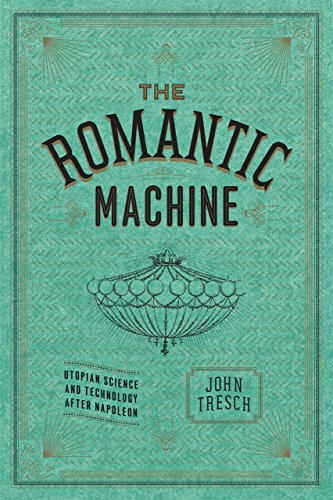
In the years immediately following Napoleon’s defeat, French thinkers in all fields set their minds to the problem of how to recover from the long upheavals that had been set into motion by the French Revolution. Many challenged the Enlightenment’s emphasis on mechanics and questioned the rising power of machines, seeking a return to the organic unity of an earlier age and triggering the artistic and philosophical movement of romanticism. Previous scholars have viewed romanticism and industrialization in opposition, but in this groundbreaking volume John Tresch reveals how thoroughly entwined science and the arts were in early nineteenth-century France and how they worked together to unite a fractured society.
Focusing on a set of celebrated technologies, including steam engines, electromagnetic and geophysical instruments, early photography, and mass-scale printing, Tresch looks at how new conceptions of energy, instrumentality, and association fueled such diverse developments as fantastic literature, popular astronomy, grand opera, positivism, utopian socialism, and the Revolution of 1848. He shows that those who attempted to fuse organicism and mechanism in various ways, including Alexander von Humboldt and Auguste Comte, charted a road not taken that resonates today.
Essential reading for historians of science, intellectual and cultural historians of Europe, and literary and art historians, The Romantic Machine is poised to profoundly alter our understanding of the scientific and cultural landscape of the early nineteenth century.
Die Inhaltsangabe kann sich auf eine andere Ausgabe dieses Titels beziehen.
Über die Autorin bzw. den Autor
John Tresch is associate professor in the Department of History and Sociology of Science at the University of Pennsylvania.
„Über diesen Titel“ kann sich auf eine andere Ausgabe dieses Titels beziehen.
Suchergebnisse für The Romantic Machine: Utopian Science and Technology...

Beispielbild für diese ISBN
The Romantic Machine Format: Paperback
Anbieter: INDOO, Avenel, NJ, USA
Verkäuferbewertung 5 von 5 Sternen

Zustand: New. Brand New. Bestandsnummer des Verkäufers 9780226214801
Neu kaufen
EUR 30,97
Versand gratis
Versand innerhalb von USA
Versand innerhalb von USA
Anzahl: Mehr als 20 verfügbar
Foto des Verkäufers
Romantic Machine : Utopian Science and Technology after Napoleon
Anbieter: GreatBookPrices, Columbia, MD, USA
Verkäuferbewertung 5 von 5 Sternen
Zustand: New. Bestandsnummer des Verkäufers 21439692-n
Neu kaufen
EUR 37,15
EUR 2,36 Versand
Versand innerhalb von USA
Versand innerhalb von USA
Anzahl: Mehr als 20 verfügbar
Foto des Verkäufers
The Romantic Machine (Paperback)
Verlag:
The University of Chicago Press, Chicago, IL, 2014
ISBN 10: 022621480X
ISBN 13: 9780226214801
Neu
Paperback
Anbieter: Grand Eagle Retail, Bensenville, IL, USA
Verkäuferbewertung 5 von 5 Sternen
Paperback. Zustand: new. Paperback. In the years immediately following Napoleons defeat, French thinkers in all fields set their minds to the problem of how to recover from the long upheavals that had been set into motion by the French Revolution. Many challenged the Enlightenments emphasis on mechanics and questioned the rising power of machines, seeking a return to the organic unity of an earlier age and triggering the artistic and philosophical movement of romanticism. Previous scholars have viewed romanticism and industrialization in opposition, but in this groundbreaking volume John Tresch reveals how thoroughly entwined science and the arts were in early nineteenth-century France and how they worked together to unite a fractured society. Focusing on a set of celebrated technologies, including steam engines, electromagnetic and geophysical instruments, early photography, and mass-scale printing, Tresch looks at how new conceptions of energy, instrumentality, and association fueled such diverse developments as fantastic literature, popular astronomy, grand opera, positivism, utopian socialism, and the Revolution of 1848. He shows that those who attempted to fuse organicism and mechanism in various ways, including Alexander von Humboldt and Auguste Comte, charted a road not taken that resonates today. Essential reading for historians of science, intellectual and cultural historians of Europe, and literary and art historians, The Romantic Machine is poised to profoundly alter our understanding of the scientific and cultural landscape of the early nineteenth century. Focusing on a set of celebrated technologies, including steam engines, early photography, and mass-scale printing, the author looks at how new conceptions of energy, instrumentality, and association fueled such diverse developments as fantastic literature, popular astronomy, grand opera, positivism, utopian socialism, and the Revolution of 1848. Shipping may be from multiple locations in the US or from the UK, depending on stock availability. Bestandsnummer des Verkäufers 9780226214801
Beispielbild für diese ISBN
The Romantic Machine
Anbieter: PBShop.store US, Wood Dale, IL, USA
Verkäuferbewertung 5 von 5 Sternen
PAP. Zustand: New. New Book. Shipped from UK. Established seller since 2000. Bestandsnummer des Verkäufers FW-9780226214801
Beispielbild für diese ISBN
The Romantic Machine: Utopian Science and Technology after Napoleon
Anbieter: Kennys Bookshop and Art Galleries Ltd., Galway, GY, Irland
Verkäuferbewertung 5 von 5 Sternen
Zustand: New. Focusing on a set of celebrated technologies, including steam engines, early photography, and mass-scale printing, the author looks at how new conceptions of energy, instrumentality, and association fueled such diverse developments as fantastic literature, popular astronomy, grand opera, positivism, utopian socialism, and the Revolution of 1848. Num Pages: 472 pages, 46 halftones. BIC Classification: 1DDF; 3JH; PDX. Category: (G) General (US: Trade). Dimension: 155 x 229 x 28. Weight in Grams: 646. . 2014. Paperback. . . . . Bestandsnummer des Verkäufers V9780226214801
Neu kaufen
EUR 31,52
EUR 9,50 Versand
Versand von Irland nach USA
Versand von Irland nach USA
Anzahl: Mehr als 20 verfügbar
Beispielbild für diese ISBN
The Romantic Machine: Utopian Science and Technology after Napoleon (eng)
Anbieter: Brook Bookstore On Demand, Napoli, NA, Italien
Verkäuferbewertung 5 von 5 Sternen
Zustand: new. Bestandsnummer des Verkäufers 6bd42579240e04477a03e23bc066c790
Neu kaufen
EUR 33,24
EUR 8,00 Versand
Versand von Italien nach USA
Versand von Italien nach USA
Anzahl: Mehr als 20 verfügbar
Foto des Verkäufers
Romantic Machine : Utopian Science and Technology after Napoleon
Verlag:
University of Chicago Press, 2014
ISBN 10: 022621480X
ISBN 13: 9780226214801
Gebraucht
Softcover
Anbieter: GreatBookPrices, Columbia, MD, USA
Verkäuferbewertung 5 von 5 Sternen
Zustand: As New. Unread book in perfect condition. Bestandsnummer des Verkäufers 21439692
Gebraucht kaufen
EUR 40,98
EUR 2,36 Versand
Versand innerhalb von USA
Versand innerhalb von USA
Anzahl: Mehr als 20 verfügbar
Beispielbild für diese ISBN
The Romantic Machine
Anbieter: PBShop.store UK, Fairford, GLOS, Vereinigtes Königreich
Verkäuferbewertung 5 von 5 Sternen
PAP. Zustand: New. New Book. Shipped from UK. Established seller since 2000. Bestandsnummer des Verkäufers FW-9780226214801
Neu kaufen
EUR 39,31
EUR 6,93 Versand
Versand von Vereinigtes Königreich nach USA
Versand von Vereinigtes Königreich nach USA
Anzahl: 15 verfügbar
Beispielbild für diese ISBN
The Romantic Machine: Utopian Science and Technology after Napoleon
Anbieter: Kennys Bookstore, Olney, MD, USA
Verkäuferbewertung 5 von 5 Sternen
Zustand: New. Focusing on a set of celebrated technologies, including steam engines, early photography, and mass-scale printing, the author looks at how new conceptions of energy, instrumentality, and association fueled such diverse developments as fantastic literature, popular astronomy, grand opera, positivism, utopian socialism, and the Revolution of 1848. Num Pages: 472 pages, 46 halftones. BIC Classification: 1DDF; 3JH; PDX. Category: (G) General (US: Trade). Dimension: 155 x 229 x 28. Weight in Grams: 646. . 2014. Paperback. . . . . Books ship from the US and Ireland. Bestandsnummer des Verkäufers V9780226214801
Neu kaufen
EUR 39,89
EUR 9,37 Versand
Versand innerhalb von USA
Versand innerhalb von USA
Anzahl: Mehr als 20 verfügbar
Beispielbild für diese ISBN
The Romantic Machine Utopian Science and Technology after Napoleon
Anbieter: Revaluation Books, Exeter, Vereinigtes Königreich
Verkäuferbewertung 5 von 5 Sternen
Paperback. Zustand: Brand New. 472 pages. 9.00x6.00x1.25 inches. In Stock. Bestandsnummer des Verkäufers __022621480X
Neu kaufen
EUR 37,62
EUR 14,75 Versand
Versand von Vereinigtes Königreich nach USA
Versand von Vereinigtes Königreich nach USA
Anzahl: 2 verfügbar