
Inhaltsangabe
Scientific breakthroughs have led us to a point where soon we will be able to make specific choices about the genetic makeup of our offspring. In fact, this reality has arrived—and it is only a matter of time before the technology becomes widespread.
Much like past arguments about stem-cell research, the coming debate over these reproductive genetic technologies (RGTs) will be both political and, for many people, religious. In order to understand how the debate will play out in the United States, John H. Evans conducted the first in-depth study of the claims made about RGTs by religious people from across the political spectrum, and Contested Reproduction is the stimulating result.
Some of the opinions Evans documents are familiar, but others—such as the idea that certain genetic conditions produce a “meaningful suffering” that is, ultimately, desirable—provide a fascinating glimpse of religious reactions to cutting-edge science. Not surprisingly, Evans discovers that for many people opinion on the issue closely relates to their feelings about abortion, but he also finds a shared moral language that offers a way around the unproductive polarization of the abortion debate and other culture-war concerns. Admirably evenhanded, Contested Reproduction is a prescient, profound look into the future of a hot-button issue.
Die Inhaltsangabe kann sich auf eine andere Ausgabe dieses Titels beziehen.
Über die Autorinnen und Autoren
John H. Evans is professor of sociology at the University of California, San Diego, and the author of Playing God? Human Genetic Engineering and the Rationalization of Public Bioethical Debate, also published by the University of Chicago Press.
John H. Evans is professor of sociology at the University of California, San Diego, and the author of Playing God? Human Genetic Engineering and the Rationalization of Public Bioethical Debate, also published by the University of Chicago Press.
Auszug. © Genehmigter Nachdruck. Alle Rechte vorbehalten.
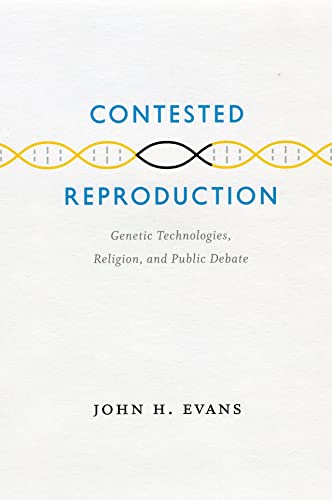
Contested Reproduction
Genetic Technologies, Religion, and Public DebateBy JOHN H. EVANSTHE UNIVERSITY OF CHICAGO PRESS
Copyright © 2010 The University of ChicagoAll right reserved.
ISBN: 978-0-226-22265-3
Contents
Acknowledgments................................................................................................................ixCHAPTER 1. Introduction........................................................................................................1CHAPTER 2. The History of Abortion, Reproductive Genetic Technologies, and the Contemporary Public's Views.....................37CHAPTER 3. Talking about Embryonic Life........................................................................................56CHAPTER 4. Nature, God, Humanity, and Promethean Fatalism......................................................................69CHAPTER 5. Human Dignity and Equality of Treatment.............................................................................105CHAPTER 6. Meaningful Suffering................................................................................................127CHAPTER 7. Will Religious Discourse about Reproductive Genetic Technologies Limit Debate?......................................152CHAPTER 8. Conclusions.........................................................................................................171APPENDIX A. Methodological Appendix............................................................................................193APPENDIX B. Religious Respondent Interview Guide...............................................................................203Notes..........................................................................................................................215Works Cited....................................................................................................................251Index..........................................................................................................................263
Chapter One
Introduction
There is a revolution under way in how babies come into being that may change our entire society. Some commentators assume it will "only" create forms of social inequality built into our bodies. For example, a Republican operative, writing about Republican strategies toward societal inequality, mentions that "the trend to inequality will grow even stronger in the years ahead, if new genetic techniques offer those with sufficient resources the possibility of enhancing the intelligence, health, beauty and strength of children in the womb." Some make stronger claims about this revolution, such as that it will change our ideas about what it means to be human and result in the creation of a posthuman species. This is all because new procedures that I will call reproductive genetic technologies (RGTs) allow parents to influence the genetic qualities of their offspring more precisely than through "normal" fertilization by a sperm and an egg after sex. Among the currently possible and potential technologies are genetic carrier screening, fetal testing followed by abortion, preimplantation genetic diagnosis, sex-determining sperm sorting, human genetic engineering, and reproductive cloning.
I will briefly explain these technologies with an example. Imagine a couple who are both carriers of the Tay-Sachs gene, and they want to ensure that their offspring do not have this gene. (Tay-Sachs is a genetic disorder that causes the destruction of a child's central nervous system by the time the child is five years old.) Choosing one of the simplest technologies, genetic carrier screening, the couple could find out whether they are carriers for the Tay-Sachs gene, before deciding to try to have children. If carriers, they could adopt instead of having biologically related children. Alternatively, the woman could become pregnant and then have fetal testing through amniocentesis to determine whether the fetus has the trait and then have an abortion if the fetus is afflicted with the disease. The woman could also use preimplantation genetic diagnosis by creating multiple embryos through in vitro fertilization and then have the embryos tested for the Tay-Sachs gene. Those embryos that express the Tay-Sachs trait would be discarded and one or more that either lack the gene or would only be a carrier would be implanted in her uterus. Another option in the future might be to simply replace the Tay-Sachs gene with a properly functioning gene in the sperm, egg, or early embryo through human genetic engineering, thus removing Tay-Sachs from the family tree forever. Finally, and equally futuristically, the parents could create an embryo that is a genetic clone of someone they know who does not have Tay-Sachs and bring that embryo to term. (For definitions of these technologies and acronyms, see table 1.)
The least controversial application of RGTs is to make sure that children do not have deadly childhood diseases like Tay-Sachs. But what about using the technologies to ensure that children do not have a gene that would make them slightly more susceptible to cancer as adults? Or to Alzheimer's disease when they are fifty years old? Or, to have children with blue eyes and blonde hair? Or, perhaps one day, using RGTs to make your children taller or more intelligent? These questions refer to a commonly used spectrum of applications of RGTs, with "health" applications on one end and "enhancements" on the other. A health application is one that ensures that the offspring has a normal state of health and fitness, lacking known diseases, disabilities, and impairments. An enhancement augments or improves the capabilities of the child. Each person will have a different notion of what is "normal," a "disease" or an "enhancement." What often matters in public debate, as well as in this book, is where an individual draws the line between health and enhancements.
Given that the same technologies can be used for both health and enhancement applications, it is easy to see why these technologies provoke controversy. The controversy partly derives from advocates of the extensive use of RGTs. For example, British bioethicist John Harris argues that "Darwinian evolution has taken millions of years to create human beings; the next phase of evolution, a phase I call 'enhancement evolution' could occur before the end of the century. The result may be the emergence of a new species that will initially live alongside us and eventually may entirely replace humankind." After noting that many of the technologies are in place for the emergence of the posthuman and talking of how humans in the future may use RGTs to genetically design their children to live longer and be resistant to disease, Harris writes that "the end of humanity then is not in itself a concern; making sure that those who replace us are better than we are is a huge and timely concern." Harris argues that it is often ethically obligatory to enhance our children through RGTs to make them less susceptible to disease, and it can be acceptable to make your children more intelligent. Harris is not some lonely crank, but an influential figure in these debates-influential enough to be a member of the British government's Human Genetics Commission. Moreover, his advocacy of evolving ourselves into a "better" species is increasingly shared by others in these debates.
This controversy will expand as more technologies become available and the genetic basis of more traits is better understood. Already, many of the technologies I discuss in this book are in use. For...
„Über diesen Titel“ kann sich auf eine andere Ausgabe dieses Titels beziehen.
Suchergebnisse für Contested Reproduction: Genetic Technologies, Religion,...

Beispielbild für diese ISBN
Contested Reproduction: Genetic Technologies, Religion, and Public Debate
Verlag:
University of Chicago Press, 2010
ISBN 10: 0226222659
ISBN 13: 9780226222653
Gebraucht
Hardcover
Anbieter: Midtown Scholar Bookstore, Harrisburg, PA, USA
Verkäuferbewertung 5 von 5 Sternen

Hardcover. Zustand: Good. HARDCOVER Good - Bumped and creased book with tears to the extremities, but not affecting the text block, may have remainder mark or previous owner's name - GOOD Standard-sized. Bestandsnummer des Verkäufers M0226222659Z3
Gebraucht kaufen
EUR 3,57
EUR 5,15 Versand
Versand innerhalb von USA
Versand innerhalb von USA
Anzahl: 1 verfügbar
Beispielbild für diese ISBN
Contested Reproduction. Genetic Technologies, Religion, and Public Debate
Verlag:
University of Chicago Press, Chicago, 2010
ISBN 10: 0226222659
ISBN 13: 9780226222653
Gebraucht
Hardcover
Anbieter: Research Ink, Takoma Park, MD, USA
Verkäuferbewertung 4 von 5 Sternen

Zustand: Very Good. x + 267 pp. Dust jacket. Rubber-stamped on front free endpaper. book. Bestandsnummer des Verkäufers 31808
Gebraucht kaufen
EUR 17,69
EUR 3,44 Versand
Versand innerhalb von USA
Versand innerhalb von USA
Anzahl: 1 verfügbar
Beispielbild für diese ISBN
Contested Reproduction: Genetic Technologies, Religion, and Public Debate
Verlag:
University of Chicago Press, 2010
ISBN 10: 0226222659
ISBN 13: 9780226222653
Gebraucht
Hardcover
Anbieter: HPB Inc., Dallas, TX, USA
Verkäuferbewertung 5 von 5 Sternen
hardcover. Zustand: Very Good. Connecting readers with great books since 1972! Used books may not include companion materials, and may have some shelf wear or limited writing. We ship orders daily and Customer Service is our top priority! Bestandsnummer des Verkäufers S_472907674
Gebraucht kaufen
EUR 27,42
EUR 3,22 Versand
Versand innerhalb von USA
Versand innerhalb von USA
Anzahl: 1 verfügbar
Beispielbild für diese ISBN
Contested Reproduction: Genetic Technologies, Religion, and Public Debate
Verlag:
University of Chicago Press, Chicago, 2010
ISBN 10: 0226222659
ISBN 13: 9780226222653
Gebraucht
Hardcover
Anbieter: Daedalus Books, Portland, OR, USA
Verkäuferbewertung 4 von 5 Sternen
Cloth. Zustand: Very Good. Zustand des Schutzumschlags: Very Good. Label affixed to jacket. A nice, solid copy. ; 6 X 0.8 X 9 inches; 267 pages. Bestandsnummer des Verkäufers 330474
Gebraucht kaufen
EUR 25,08
EUR 5,58 Versand
Versand innerhalb von USA
Versand innerhalb von USA
Anzahl: 1 verfügbar
Beispielbild für diese ISBN
Contested Reproduction Genetic Technologies, Religion, and Public Debate
Verlag:
University Of Chicago Press, 2010
ISBN 10: 0226222659
ISBN 13: 9780226222653
Gebraucht
Hardcover
Anbieter: Michener & Rutledge Booksellers, Inc., Baldwin City, KS, USA
Verkäuferbewertung 5 von 5 Sternen
Hardcover. Zustand: Very Good+. Zustand des Schutzumschlags: Very Good+. Text clean and tight; 9.10 X 3.70 X 0.30 inches; 280 pages. Bestandsnummer des Verkäufers 209545
Gebraucht kaufen
EUR 26,54
EUR 5,15 Versand
Versand innerhalb von USA
Versand innerhalb von USA
Anzahl: 1 verfügbar
Beispielbild für diese ISBN
Contested Reproduction Format: Hardcover
Anbieter: INDOO, Avenel, NJ, USA
Verkäuferbewertung 5 von 5 Sternen
Zustand: New. Brand New. Bestandsnummer des Verkäufers 9780226222653
Neu kaufen
EUR 64,32
Versand gratis
Versand innerhalb von USA
Versand innerhalb von USA
Anzahl: Mehr als 20 verfügbar
Beispielbild für diese ISBN
Contested Reproduction
Verlag:
The University of Chicago Press, 2010
ISBN 10: 0226222659
ISBN 13: 9780226222653
Neu
Hardcover
Erstausgabe
Anbieter: Kennys Bookshop and Art Galleries Ltd., Galway, GY, Irland
Verkäuferbewertung 5 von 5 Sternen
Zustand: New. Much like past arguments about stem-cell research, the coming debate over these reproductive genetic technologies (RGTs) will be political and, for many people, religious. In order to understand how the debate will play out in the US, the author conducted a study of the claims made about RGTs by religious people from across the political spectrum. Num Pages: 280 pages, 3 line drawings, 3 tables. BIC Classification: HR; JFMA; JFMG; JHBC. Category: (P) Professional & Vocational; (UP) Postgraduate, Research & Scholarly; (UU) Undergraduate. Dimension: 229 x 152 x 20. Weight in Grams: 340. . 2010. 1st Edition. Hardcover. . . . . Bestandsnummer des Verkäufers V9780226222653
Neu kaufen
EUR 60,11
EUR 10,50 Versand
Versand von Irland nach USA
Versand von Irland nach USA
Anzahl: 1 verfügbar
Beispielbild für diese ISBN
Contested Reproduction
Anbieter: PBShop.store US, Wood Dale, IL, USA
Verkäuferbewertung 5 von 5 Sternen
HRD. Zustand: New. New Book. Shipped from UK. Established seller since 2000. Bestandsnummer des Verkäufers FW-9780226222653
Beispielbild für diese ISBN
Contested Reproduction
Anbieter: PBShop.store UK, Fairford, GLOS, Vereinigtes Königreich
Verkäuferbewertung 5 von 5 Sternen
HRD. Zustand: New. New Book. Shipped from UK. Established seller since 2000. Bestandsnummer des Verkäufers FW-9780226222653
Neu kaufen
EUR 67,94
EUR 5,81 Versand
Versand von Vereinigtes Königreich nach USA
Versand von Vereinigtes Königreich nach USA
Anzahl: 2 verfügbar
Foto des Verkäufers
Contested Reproduction
Verlag:
The University of Chicago Press, US, 2010
ISBN 10: 0226222659
ISBN 13: 9780226222653
Neu
Hardcover
Anbieter: Rarewaves.com USA, London, LONDO, Vereinigtes Königreich
Verkäuferbewertung 5 von 5 Sternen
Hardback. Zustand: New. Scientific breakthroughs have led us to a point where soon we will be able to make specific choices about the genetic makeup of our offspring. In fact, this reality has arrived - and it is only a matter of time before the technology becomes widespread. Much like past arguments about stem-cell research, the coming debate over these reproductive genetic technologies (RGTs) will be both political and, for many people, religious. In order to understand how the debate will play out in the United States, John H. Evans conducted the first in-depth study of the claims made about RGTs by religious people from across the political spectrum, and "Contested Reproduction" is the stimulating result. Some of the opinions Evans documents are familiar, but others - such as the idea that certain genetic conditions produce a 'meaningful suffering' that is, ultimately, desirable - provide a fascinating glimpse of religious reactions to cutting-edge science.Not surprisingly, Evans discovers that for many people opinion on the issue closely relates to their feelings about abortion, but he also finds a shared moral language that offers a way around the unproductive polarization of the abortion debate and other culture-war concerns. "Contested Reproduction" is a prescient, profound look into the future of a hot-button issue. Bestandsnummer des Verkäufers LU-9780226222653
Neu kaufen
EUR 74,07
Versand gratis
Versand von Vereinigtes Königreich nach USA
Versand von Vereinigtes Königreich nach USA
Anzahl: 1 verfügbar