
Verwandte Artikel zu Houston, We Have a Narrative: Why Science Needs Story...
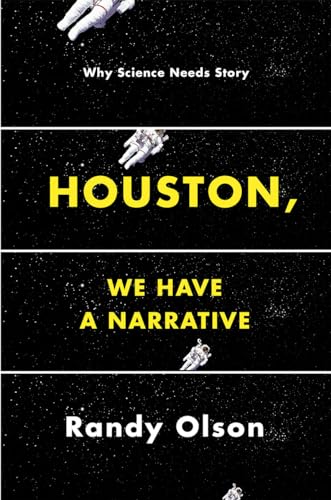
Houston, We Have a Narrative: Why Science Needs Story (Emersion: Emergent Village resources for communities of faith) - Softcover
Inhaltsangabe
Ask a scientist about Hollywood, and you’ll probably get eye rolls. But ask someone in Hollywood about science, and they’ll see dollar signs: moviemakers know that science can be the source of great stories, with all the drama and action that blockbusters require.
That’s a huge mistake, says Randy Olson: Hollywood has a lot to teach scientists about how to tell a story—and, ultimately, how to do science better. With Houston, We Have a Narrative, he lays out a stunningly simple method for turning the dull into the dramatic. Drawing on his unique background, which saw him leave his job as a working scientist to launch a career as a filmmaker, Olson first diagnoses the problem: When scientists tell us about their work, they pile one moment and one detail atop another moment and another detail—a stultifying procession of “and, and, and.” What we need instead is an understanding of the basic elements of story, the narrative structures that our brains are all but hardwired to look for—which Olson boils down, brilliantly, to “And, But, Therefore,” or ABT. At a stroke, the ABT approach introduces momentum (“And”), conflict (“But”), and resolution (“Therefore”)—the fundamental building blocks of story. As Olson has shown by leading countless workshops worldwide, when scientists’ eyes are opened to ABT, the effect is staggering: suddenly, they’re not just talking about their work—they’re telling stories about it. And audiences are captivated.
Written with an uncommon verve and enthusiasm, and built on principles that are applicable to fields far beyond science, Houston, We Have a Narrative has the power to transform the way science is understood and appreciated, and ultimately how it’s done.
Die Inhaltsangabe kann sich auf eine andere Ausgabe dieses Titels beziehen.
Über die Autorinnen und Autoren
Randy Olson was a tenured professor of marine biology at the University of New Hampshire before moving to Hollywood and entering film school at the University of Southern California. He has written and directed a number of films, including the acclaimed Flock of Dodos and he is the author of numerous successful books, including Don’t Be Such A Scientist.
Randy Olson was a tenured professor of marine biology at the University of New Hampshire before moving to Hollywood and entering film school at the University of Southern California. He has written and directed a number of films, including the acclaimed Flock of Dodos and he is the author of numerous successful books, including Don't Be Such A Scientist.
Auszug. © Genehmigter Nachdruck. Alle Rechte vorbehalten.
Houston, We Have a Narrative
Why Science Needs Story
By Randy OlsonThe University of Chicago Press
Copyright © 2015 Randy Olson
All rights reserved.
ISBN: 978-0-226-27084-5All rights reserved.
Contents
I Introduction: Why Science Needs Story,
II Thesis,
1 Science is stuck in a narrative world ...,
2 AND the humanities ought to help ...,
3 BUT the humanities are useless for this ...,
4 THEREFORE Hollywood to the rescue,
III Antithesis,
5 Methods: Narrative Tools — The WSP Model,
6 Methods: Word — The Dobzhansky Template,
7 Methods: Sentence — The ABT Template,
8 Methods: Paragraph — The Hero's Journey,
9 Results: The Narrative Spectrum,
10 Results: Four Case Studies,
IV Synthesis,
11 Science needs story ...,
12 AND Hollywood can help ...,
13 BUT narrative training requires a different mindset ...,
14 THEREFORE I recommend Story Circles,
Appendix 1 The Narrative Tools,
Appendix 2 Narrative Vocabulary,
Appendix 3 Twitter "Stories",
Acknowledgments,
Notes,
Index,
CHAPTER 1
Science is stuck living in a narrative world ...
The Long History of Narrative: Gilgawho?
Raise your hand if you know who Gilgamesh was. This is another demonstration I do with groups of scientists, and again, I'm no better than any of them. I had no clue who Gilgamesh was until a few months ago when I began writing this book — such are the holes in my humanities education.
Gilgamesh is pretty much where the entire concept of narrative begins. His story is humanity's first story, and is the birth of literature. He was a great and mighty leader 4,000 years ago who supposedly ruled Mesopotamia for 126 years. Early storytellers carved his epic tale on stone tablets. After Gilgamesh, the rest is literally history as we became a "storytelling animal," which happens to be the title of a nice book by Jonathan Gottschall published in 2013. Gottschall makes the point that story (or narrative if you prefer) pervades every aspect of our lives today.
From Gilgamesh we jump 2,000 years to the next major story milestone, namely, Aristotle and the Greeks. Aristotle realized that stories have a distinct structure. In the Poetics he talked about the structure of plays and stories. He broke them into five basic parts. The opening he called prologue, the ending he called exodus, and in the middle he described a series of repeating cycles, each consisting of three parts — parados, episode and stasimon. Even today, when we think of a story, we often talk about the middle part being "episodic."
Now here is the major revelation in thinking about storytelling in science. What are the major parts of a scientific project? You start by gathering background knowledge (introduction), then you repeat cycles of posing and testing hypotheses (methods and results), until finally you discover an answer. At that point you pull it all together with a discussion.
Take a look at those two structures side by side in figure 5. This is the first example of the point I will hit on repeatedly: "Dude, it's all the same story" — which is what my Connection coauthor Dorie Barton began saying to me in our workshops as we discussed story structure. Initially the scientist in me bristled at this suggestion — surely there are many, many types of stories. But these days I find myself pretty much in agreement with her and hope you will as well. This stuff really does come down to the same core structure.
The structure that underpins a story, of course, radiated into all sorts of variations over time. There are so many seemingly different types of stories — romance, horror, comedy, fantasy and more. If you choose to do so you can get lost in the infinite complexity of them. Similarly, you can get lost in the infinite complexity of biological diversity — marveling at everything from the bizarre shape of a guitarfish to the roiling, hydra-like living ball of spaghetti that is a basket starfish. You can sit there and marvel, saying, "Wow, each creature is so different from the next — there is so much complexity in the various species of life!"
And yet ... dude, at the core, their DNA is telling the same story. Their genomes track back to the same original primal sequences of base pairs. You can choose to focus on the mesmerizing complexity, or you can seek the simplicity at the center of it all. Finding the simple core allows you to say, "I see how all these various forms branched off from the one original type." The former is exciting but ultimately directionless. The latter makes sense of the world.
It's the same with stories — all variations track back to a common heritage. This is what anthropologist Joseph Campbell realized in the first half of the last century. He brought an analytical perspective — essentially the mind of a scientist — to the traditionally nonanalytical world of storytelling. Just as an evolutionary biologist looks for common descent among organisms, he looked for common structure among stories told by different cultures and religions around the world.
In 1949 he wrote his landmark book The Hero with a Thousand Faces, which he opened by saying, "There are of course differences between the numerous mythologies and religions of mankind, but this is a book about the similarities." That was the prelude to his eventual message: "Dude, it's all the same story."
Campbell saw a single, common structure underlying storytelling around the world. He named this structure the monomyth. And guess how many major parts there are to it — three. Beginning, middle, end. Just as Hegel would have predicted.
Speaking of the number three, guess what else emerged over the centuries in the world of storytelling — the basic structure of plays, novels and eventually movies known as the three-act structure. Today it is at the core of just about every movie you watch — the same tripartite structure, deeply embedded in the programming of the brain. So deep that you can't escape it.
The Short History of Science
Now it's time to think about the history of science. If we know humans have been telling written stories for at least 4,000 years, how long have we been writing scientific papers? The answer is less than 10 percent of that — or about 400 years.
There were scientists long ago. There was Ptolemy in Egypt just 100 years after the time of Christ and the amazing Ibn al-Haytham (nicknamed Ptolemy the Second) in Mesopotamia who, almost 1,000 years later, pioneered optics and experimental physics. But the reporting of scientific research in formal journals began in 1665 with the first volume of Philosophical Transactions of the Royal Society. The early reports of scientific research were written very much in the "literary" style — not broken into sections, but more of a single essay, often written in the third person, along the lines of "Recently Robert Boyle conducted a demonstration in which he ..."
Within 50 years the articles moved from largely descriptive pieces to a form that was beginning to take the shape of reports of experiments written by the investigator. By the late 1800s a clear structure had emerged around the pattern of theory, experiment, discussion (hmm ... three parts, what a coincidence). This eventually gave way in the 1900s to the almost universally agreed upon scientific paper template of today that I...
„Über diesen Titel“ kann sich auf eine andere Ausgabe dieses Titels beziehen.
Suchergebnisse für Houston, We Have a Narrative: Why Science Needs Story...

Foto des Verkäufers
Houston, We Have a Narrative: Why Science Needs Story
Verlag:
University of Chicago Press, 2015
ISBN 10: 022627084X
ISBN 13: 9780226270845
Gebraucht
Softcover
Anbieter: Dream Books Co., Denver, CO, USA
Verkäuferbewertung 5 von 5 Sternen

Zustand: acceptable. This copy has clearly been enjoyedâ"expect noticeable shelf wear and some minor creases to the cover. Binding is strong, and all pages are legible. May contain previous library markings or stamps. Bestandsnummer des Verkäufers DBV.022627084X.A
Gebraucht kaufen
EUR 5,99
Versand gratis
Versand innerhalb von USA
Versand innerhalb von USA
Anzahl: 1 verfügbar
Beispielbild für diese ISBN
Houston, We Have a Narrative: Why Science Needs Story
Verlag:
University of Chicago Press, 2015
ISBN 10: 022627084X
ISBN 13: 9780226270845
Gebraucht
Paperback
Anbieter: HPB-Red, Dallas, TX, USA
Verkäuferbewertung 5 von 5 Sternen
Paperback. Zustand: Acceptable. Connecting readers with great books since 1972. Used textbooks may not include companion materials such as access codes, etc. May have condition issues including wear and notes/highlighting. We ship orders daily and Customer Service is our top priority! Bestandsnummer des Verkäufers S_461014128
Gebraucht kaufen
EUR 4,44
EUR 3,23 Versand
Versand innerhalb von USA
Versand innerhalb von USA
Anzahl: 1 verfügbar
Beispielbild für diese ISBN
Houston, We Have a Narrative : Why Science Needs Story
Verlag:
University of Chicago Press, 2015
ISBN 10: 022627084X
ISBN 13: 9780226270845
Gebraucht
Softcover
Anbieter: Better World Books, Mishawaka, IN, USA
Verkäuferbewertung 5 von 5 Sternen
Zustand: Good. Pages intact with minimal writing/highlighting. The binding may be loose and creased. Dust jackets/supplements are not included. Stock photo provided. Product includes identifying sticker. Better World Books: Buy Books. Do Good. Bestandsnummer des Verkäufers 15253096-6
Gebraucht kaufen
EUR 8,07
Versand gratis
Versand innerhalb von USA
Versand innerhalb von USA
Anzahl: 1 verfügbar
Beispielbild für diese ISBN
Houston, We Have a Narrative: Why Science Needs Story
Verlag:
University of Chicago Press, 2015
ISBN 10: 022627084X
ISBN 13: 9780226270845
Gebraucht
Softcover
Anbieter: World of Books (was SecondSale), Montgomery, IL, USA
Verkäuferbewertung 5 von 5 Sternen
Zustand: Good. Item in good condition. Textbooks may not include supplemental items i.e. CDs, access codes etc. Bestandsnummer des Verkäufers 00109899440
Gebraucht kaufen
EUR 9,64
Versand gratis
Versand innerhalb von USA
Versand innerhalb von USA
Anzahl: 1 verfügbar
Beispielbild für diese ISBN
Houston, We Have a Narrative: Why Science Needs Story
Verlag:
University of Chicago Press, 2015
ISBN 10: 022627084X
ISBN 13: 9780226270845
Gebraucht
Paperback
Anbieter: HPB Inc., Dallas, TX, USA
Verkäuferbewertung 5 von 5 Sternen
Paperback. Zustand: Very Good. Connecting readers with great books since 1972! Used books may not include companion materials, and may have some shelf wear or limited writing. We ship orders daily and Customer Service is our top priority! Bestandsnummer des Verkäufers S_480088033
Gebraucht kaufen
EUR 7,10
EUR 3,23 Versand
Versand innerhalb von USA
Versand innerhalb von USA
Anzahl: 1 verfügbar
Foto des Verkäufers
Houston, We Have a Narrative: Why Science Needs Story
Verlag:
University of Chicago Press, 2015
ISBN 10: 022627084X
ISBN 13: 9780226270845
Gebraucht
Softcover
Anbieter: Zoom Books East, Glendale Heights, IL, USA
Verkäuferbewertung 5 von 5 Sternen
Zustand: good. Book is in good condition and may include underlining highlighting and minimal wear. The book can also include "From the library of" labels. May not contain miscellaneous items toys, dvds, etc. . We offer 100% money back guarantee and 24 7 customer service. Bestandsnummer des Verkäufers ZEV.022627084X.G
Gebraucht kaufen
EUR 10,70
Versand gratis
Versand innerhalb von USA
Versand innerhalb von USA
Anzahl: 1 verfügbar
Beispielbild für diese ISBN
Houston, We Have a Narrative: Why Science Needs Story
Verlag:
The University of Chicago Press, 2015
ISBN 10: 022627084X
ISBN 13: 9780226270845
Gebraucht
Paperback
Anbieter: World of Books Inc, Montgomery, IL, USA
Verkäuferbewertung 2 von 5 Sternen

Paperback. Zustand: Good. Ask a scientist about Hollywood, and you'll probably get eye rolls. But ask someone in Hollywood about science, and they'll see dollar signs: moviemakers know that science can be the source of great stories, with all the drama and action that blockbusters require. That's a huge mistake, says Randy Olson: Hollywood has a lot to teach scientists about how to tell a story-and, ultimately, how to do science better. With Houston, We Have a Narrative, he lays out a stunningly simple method for turning the dull into the dramatic. Drawing on his unique background, which saw him leave his job as a working scientist to launch a career as a filmmaker, Olson first diagnoses the problem: When scientists tell us about their work, they pile one moment and one detail atop another moment and another detail-a stultifying procession of "and, and, and." What we need instead is an understanding of the basic elements of story, the narrative structures that our brains are all but hardwired to look for-which Olson boils down, brilliantly, to "And, But, Therefore," or ABT. At a stroke, the ABT approach introduces momentum ("And"), conflict ("But"), and resolution ("Therefore")-the fundamental building blocks of story. As Olson has shown by leading countless workshops worldwide, when scientists' eyes are opened to ABT, the effect is staggering: suddenly, they're not just talking about their work-they're telling stories about it. And audiences are captivated. Written with an uncommon verve and enthusiasm, and built on principles that are applicable to fields far beyond science, Houston, We Have a Narrative has the power to transform the way science is understood and appreciated, and ultimately how it's done. Bestandsnummer des Verkäufers CIN022627084XG
Gebraucht kaufen
EUR 11,42
Versand gratis
Versand innerhalb von USA
Versand innerhalb von USA
Anzahl: 1 verfügbar
Beispielbild für diese ISBN
Houston, We Have a Narrative: Why Science Needs Story
Verlag:
University of Chicago Press, 2015
ISBN 10: 022627084X
ISBN 13: 9780226270845
Gebraucht
Softcover
Anbieter: Wonder Book, Frederick, MD, USA
Verkäuferbewertung 5 von 5 Sternen
Zustand: Very Good. Very Good condition. A copy that may have a few cosmetic defects. May also contain light spine creasing or a few markings such as an owner's name, short gifter's inscription or light stamp. Bestandsnummer des Verkäufers P14U-00140
Gebraucht kaufen
EUR 12,53
Versand gratis
Versand innerhalb von USA
Versand innerhalb von USA
Anzahl: 1 verfügbar
Beispielbild für diese ISBN
Houston, We Have a Narrative: Why Science Needs Story
Anbieter: Borden's Book Shoppe, Astoria, IL, USA
Verkäuferbewertung 4 von 5 Sternen

paperback. Zustand: Very Good. Bestandsnummer des Verkäufers V-20260513-AB7-S80033
Gebraucht kaufen
EUR 10,79
EUR 3,44 Versand
Versand innerhalb von USA
Versand innerhalb von USA
Anzahl: 1 verfügbar
Foto des Verkäufers
Houston, We Have a Narrative: Why Science Needs Story
Verlag:
University of Chicago Press, 2015
ISBN 10: 022627084X
ISBN 13: 9780226270845
Gebraucht
Softcover
Anbieter: tLighthouse Books, Onekama, MI, USA
Verkäuferbewertung 5 von 5 Sternen
Zustand: acceptable. Acceptable condition. Reading copy. May have signs of wear and previous use scuffs, library copy, highlighting, writing, and underlining . May have foxing, slight water damage or tears. 100% GUARANTEE! Shipped with delivery confirmation. If you're not satisfied with purchase just return it! Bestandsnummer des Verkäufers HSV.022627084X.A
Gebraucht kaufen
EUR 7,98
EUR 6,88 Versand
Versand innerhalb von USA
Versand innerhalb von USA
Anzahl: 1 verfügbar