
Verwandte Artikel zu Works of Hesiod and the Homeric Hymns: Including Theogony...
Inhaltsangabe
The most faithful and lyrical translation of Works and Days, Theogony, and more
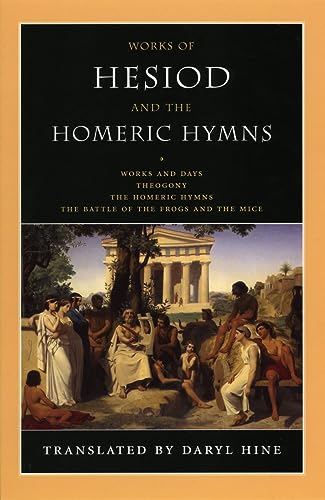
In Works of Hesiod and the Homeric Hymns, highly acclaimed poet and translator Daryl Hine brings to life the words of Hesiod and the world of Archaic Greece. While most available versions of these early Greek writings are rendered in prose, Hine's illuminating translations represent these early classics as they originally appeared, in verse. Since prose was not invented as a literary medium until well after Hesiod's time, presenting these works as poems more closely approximates not only the mechanics but also the melody of the originals.
This volume includes Hesiod's Works and Days and Theogony, two of the oldest non-Homeric poems to survive from antiquity. Works and Days is in part a farmer's almanac—filled with cautionary tales and advice for managing harvests and maintaining a good work ethic—and Theogony is the earliest comprehensive account of classical mythology—including the names and genealogies of the gods (and giants and monsters) of Olympus, the sea, and the underworld. Hine brings out Hesiod's unmistakable personality; Hesiod's tales of his escapades and his gritty and persuasive voice not only give us a sense of the author's own character but also offer up a rare glimpse of the everyday life of ordinary people in the eighth century BCE.
In contrast, the Homeric Hymns are more distant in that they depict aristocratic life in a polished tone that reveals nothing of the narrators' personalities. These hymns (so named because they address the deities in short invocations at the beginning and end of each) are some of the earliest examples of epyllia, or short stories in the epic manner in Greek.
This volume unites Hine's skillful translations of the Works of Hesiod and the Homeric Hymns—along with Hine's rendering of the mock-Homeric epic The Battle of the Frogs and the Mice—in a stunning pairing of these masterful classics.
Die Inhaltsangabe kann sich auf eine andere Ausgabe dieses Titels beziehen.
Über die Autorin bzw. den Autor
Daryl Hine is an award-winning poet and translator. The former editor of Poetry and a MacArthur fellow, he has published more than a dozen volumes of his own poetry and translations, including Theocritus: Idylls and Epigrams; Ovid’s Heroides: A Verse Translation; and Puerilities: Erotic Epigrams of “The Greek Anthology.”
Auszug. © Genehmigter Nachdruck. Alle Rechte vorbehalten.
WORKS OF HESIOD AND THE HOMERIC HYMNS
WORKS AND DAYS THEOGONY THE HOMERIC HYMNS THE BATTLE OF THE FROGS AND THE MICEBy DARYL HINETHE UNIVERSITY OF CHICAGO PRESS
Copyright © 2005 The University of ChicagoAll right reserved.
ISBN: 978-0-226-32966-6
Contents
INTRODUCTION.............................................1HESIOD'S WORKSWorks and Days...........................................23Theogony.................................................53THE HOMERIC HYMNS........................................95THE BATTLE OF THE FROGS AND THE MICE.....................197INDEX....................................................209
Chapter One
WORKS AND DAYS
Come, you Pierian Muses, who give us the glory of music, 1 Tell me of Zeus, your progenitor, make praise-songs in his honor; Through him, moreover, are humankind undistinguished or famous, They are sung or unsung by the will of omnipotent great Zeus. Easily making a man strong, easily he overthrows him, 5 Easily humbles the proud as he lifts up high the obscure, and Easily straightens the crooked as well as deflating the puffed-up- Zeus, who is deathless and thunders aloft and dwells in the highest. Listen to me and behold, make straight your decisions with justice. I would be happy to speak true facts to you, Perses, my brother. 10
There is not only one Discord, for on earth she is twofold: One of them nobody would find fault with on closer acquaintance; One you would deprecate, for they have totally different natures. Wickedly, one promotes all the evils of warfare and slaughter; No one of humankind likes her; out of necessity, at the 15 Will of the blessed immortals, they treat grim Discord with honor. There is, moreover, another, the firstborn daughter of dark Night. Her did the high-throned scion of Cronus whose home is in heaven Place at the roots of the earth; she is certainly better for mankind. This is that Discord that stirs up even the helpless to hard work, 20 Seeing a man gets eager to work on beholding a neighbor Who is exceedingly wealthy and makes haste plowing and sowing, Putting his household in order; so neighbor competing with neighbor Runs after riches, and therefore this Discord benefits mankind. 25 Every potter begrudges another, and artists do likewise; Every beggarman envies a beggar, and poets are rivals.
Perses, be sure you deposit these things in your heart and your spirit, Lest Discord, which is given to mischief, distract you from work and You begin sneaking about, eavesdropping on feuds in the forum. 30 You have no business getting in fights and disputing in public, Not if you haven't sufficient for life laid up in your storeroom, Seasonal fruits of the earth, ripe grain of abundant Demeter. When you have plenty of that, turn freely to fierce competition For the possessions of others; no second chance will be yours to 35 Do so. Let us however decide our disputes by means of impartial Judgments, for justice derives from Zeus and is bound to be perfect. When we had split our inheritance, you grabbed most of it, making Off with it, to enhance the repute of our bribe-hungry royal Masters, who love to adjudge such cases as ours in their courtrooms. 40 Idiots! They don't know how much more is the half than the whole, nor What is the use of a diet of mallow and asphodel, Perses?
Plainly the gods keep secret from humankind the means of survival; Otherwise, you in a day could easily do enough work to Last you a whole year long, and without any further exertion. 45 Soon, very soon you would hang up over the fireplace your rudder; Then would be finished the labors of oxen and hard-working donkeys. No, Zeus kept it a secret because in his heart he was angry, Seeing how devious-minded Prometheus once had fooled him; Therefore did almighty Zeus plot sorrows and troubles for mankind.
He hid fire, which, however, then Iapetus's great-hearted son, to 50 Benefit humankind, pilfered from Zeus, the purveyor of counsel, Hid in a hollowed-out stalk to baffle the lover of thunder.
Then cloud-gathering Zeus to Prometheus said in his anger: "Iapetus's brat, since you're so much smarter than anyone else, you're Happy to outwit me, and rejoice in the fire you have stolen- 55 For yourself a calamity, also for men of the future. For I shall give them a bad thing, too, in exchange for this fire, which Heartily all may delight in, embracing a homegrown evil." Speaking, the father of gods and of mankind exploded in laughter. Then he commanded Hephaestus, the world-famed craftsman, as 60 soon as Possible to mix water and earth, and infuse in it human Speech, also strength, and to make it look like a goddess, and give it Likewise a girl-like form that was pretty and lovesome. Athena Would instruct her in handwork and weaving of intricate fabrics; Furthermore, gold Aphrodite should drip charm over her head to Cause heartsore longing, emotional anguish exhausting the body. Zeus gave instructions to Hermes, the sure guide, slayer of Argus, To put in her the heart of a bitch and a devious nature. Then did the famed lame god manufacture at once from the earth a Fair simulacrum of one shy maiden, according to Zeus's will. 70 Next to her skin did the godlike Graces and gracious Persuasion Carefully place gold necklaces; round her adorable head the Hours who are gorgeously coiffed wove garlands of beautiful spring flowers. Hermes, our sure guide, slayer of Argus, contrived in her breast Lies and misleadingly false words joined to a devious nature, 75
At the behest of the deep-voiced thunderer, Zeus; and the herald God of the gods then gave her a voice. And he called her Pandora, Seeing how all who inhabit lofty Olympus had given Something to pretty Pandora, that giant bane to industrious mankind. 80 When he had finished this downright desperate piece of deception, To Epimetheus Zeus then dispatched the slayer of Argus, Famed swift messenger of the immortals, with her as a present. But Epimetheus had forgotten Prometheus's warning, Not to accept anything from Olympian Zeus, but to send it 85 Back where it came from, lest it become a disaster for mortals. Once he'd accepted it, he, possessing the bane, recognized it.
Formerly dwelt on earth all the various tribes of the human Race, on their own and remote from evils and difficult labor And from distressing diseases that bring doom closer to each one. 90 For in misfortune do humans age rapidly, quicker than ever. Using her fingers, the maid pried open the lid of the great jar, Sprinkling its contents; her purpose, to bring sad hardships to mankind. Nothing but Hope stayed there in her stout, irrefrangible dwelling, Under the lip of the jar, inside, and she never would venture 95 Outdoors, having the lid of the vessel itself to prevent her, Willed there by Zeus, who arranges the storm clouds and carries the aegis. Otherwise, myriad miseries flit round miserable mortals; Furthermore, full is the earth of much mischief, the deep sea also. Illnesses visiting humans daily and nightly at all hours 100 All by themselves bring terrible troubles aplenty to mortals Silently, seeing their power of speech was suppressed by all-wise Zeus. There is no way of escaping from Zeus's implacable mind-set.
If you...
„Über diesen Titel“ kann sich auf eine andere Ausgabe dieses Titels beziehen.
Suchergebnisse für Works of Hesiod and the Homeric Hymns: Including Theogony...

Beispielbild für diese ISBN
Works of Hesiod and the Homeric Hymns
Verlag:
University of Chicago Press, 2007
ISBN 10: 0226329666
ISBN 13: 9780226329666
Gebraucht
Paperback
Anbieter: Midtown Scholar Bookstore, Harrisburg, PA, USA
Verkäuferbewertung 5 von 5 Sternen

Paperback. Zustand: Very Good. Very Good - Crisp, clean, unread book with some shelfwear/edgewear, may have a remainder mark - NICE Standard-sized. Bestandsnummer des Verkäufers M0226329666Z2
Gebraucht kaufen
EUR 5,50
EUR 5,36 Versand
Versand innerhalb von USA
Versand innerhalb von USA
Anzahl: 4 verfügbar
Foto des Verkäufers
Works of Hesiod and the Homeric Hymns: Including Theogony and Works and Days
Verlag:
University of Chicago Press, 2007
ISBN 10: 0226329666
ISBN 13: 9780226329666
Gebraucht
Softcover
Anbieter: Big River Books, Powder Springs, GA, USA
Verkäuferbewertung 5 von 5 Sternen
Zustand: very_good. This book is in Very Good condition. The cover and pages have minor shelf wear. Binding is tight and pages are intact. Bestandsnummer des Verkäufers BRV.0226329666.VG
Gebraucht kaufen
EUR 7,46
EUR 3,56 Versand
Versand innerhalb von USA
Versand innerhalb von USA
Anzahl: 1 verfügbar
Beispielbild für diese ISBN
Works of Hesiod and the Homeric Hymns : Including Theogony and Works and Days
Verlag:
University of Chicago Press, 2007
ISBN 10: 0226329666
ISBN 13: 9780226329666
Gebraucht
Softcover
Anbieter: Better World Books: West, Reno, NV, USA
Verkäuferbewertung 5 von 5 Sternen
Zustand: Very Good. Pages intact with possible writing/highlighting. Binding strong with minor wear. Dust jackets/supplements may not be included. Stock photo provided. Product includes identifying sticker. Better World Books: Buy Books. Do Good. Bestandsnummer des Verkäufers 9803147-6
Gebraucht kaufen
EUR 15,41
Versand gratis
Versand innerhalb von USA
Versand innerhalb von USA
Anzahl: 1 verfügbar
Foto des Verkäufers
Works of Hesiod and the Homeric Hymns
Anbieter: GreatBookPrices, Columbia, MD, USA
Verkäuferbewertung 5 von 5 Sternen
Zustand: New. Bestandsnummer des Verkäufers 4932992-n
Neu kaufen
EUR 17,49
EUR 2,36 Versand
Versand innerhalb von USA
Versand innerhalb von USA
Anzahl: 8 verfügbar
Foto des Verkäufers
Works of Hesiod and the Homeric Hymns: Works and Days/Theogony/The Homeric Hymns/The Battle of the Frogs and the Mice (Paperback or Softback)
Verlag:
University of Chicago Press 8/15/2007, 2007
ISBN 10: 0226329666
ISBN 13: 9780226329666
Neu
Paperback or Softback
Anbieter: BargainBookStores, Grand Rapids, MI, USA
Verkäuferbewertung 5 von 5 Sternen
Paperback or Softback. Zustand: New. Works of Hesiod and the Homeric Hymns: Works and Days/Theogony/The Homeric Hymns/The Battle of the Frogs and the Mice. Book. Bestandsnummer des Verkäufers BBS-9780226329666
Foto des Verkäufers
Works of Hesiod and the Homeric Hymns
Verlag:
The University of Chicago Press, US, 2007
ISBN 10: 0226329666
ISBN 13: 9780226329666
Neu
Paperback
Anbieter: Rarewaves USA, HEBRON, KY, USA
Verkäuferbewertung 5 von 5 Sternen
Paperback. Zustand: New. In "Works of Hesiod and the Homeric Hymns", highly acclaimed poet and translator Daryl Hine brings new life to the words of Hesiod and the world of Archaic Greece. Unlike most available prose renderings of their works, Hine's illuminating translations present these classics as they originally appeared, in verse. This volume includes Hesiod's "Works and Days" and "Theogony", two of the oldest non-Homeric poems to survive. "Works and Days" is filled with cautionary tales and advice for managing harvests and maintaining a good work ethic. "Theogony" is the earliest comprehensive account of classical mythology - including the names and genealogies of the gods and monsters of Olympus, the sea, and the underworld. Hine captures Hesiod's gritty and persuasive voice, which provides a rare glimpse into the everyday life of ordinary people in the eighth century BCE. In contrast, the "Homeric Hymns" depict aristocratic life in voices whose polished tones reveal little of the narrators' personalities.These hymns (so named because they address the deities in short invocations at the beginning and end of each) are among the earliest examples of Greek epyllia, or short stories in the epic manner. Bestandsnummer des Verkäufers LU-9780226329666
Neu kaufen
EUR 20,71
Versand gratis
Versand innerhalb von USA
Versand innerhalb von USA
Anzahl: Mehr als 20 verfügbar
Foto des Verkäufers
Works of Hesiod and the Homeric Hymns
Verlag:
University of Chicago Press, 2007
ISBN 10: 0226329666
ISBN 13: 9780226329666
Gebraucht
Softcover
Anbieter: GreatBookPrices, Columbia, MD, USA
Verkäuferbewertung 5 von 5 Sternen
Zustand: As New. Unread book in perfect condition. Bestandsnummer des Verkäufers 4932992
Gebraucht kaufen
EUR 18,80
EUR 2,36 Versand
Versand innerhalb von USA
Versand innerhalb von USA
Anzahl: 8 verfügbar
Foto des Verkäufers
Works of Hesiod and the Homeric Hymns
Verlag:
The University of Chicago Press, US, 2007
ISBN 10: 0226329666
ISBN 13: 9780226329666
Neu
Paperback
Anbieter: Rarewaves.com USA, London, LONDO, Vereinigtes Königreich
Verkäuferbewertung 5 von 5 Sternen
Paperback. Zustand: New. In "Works of Hesiod and the Homeric Hymns", highly acclaimed poet and translator Daryl Hine brings new life to the words of Hesiod and the world of Archaic Greece. Unlike most available prose renderings of their works, Hine's illuminating translations present these classics as they originally appeared, in verse. This volume includes Hesiod's "Works and Days" and "Theogony", two of the oldest non-Homeric poems to survive. "Works and Days" is filled with cautionary tales and advice for managing harvests and maintaining a good work ethic. "Theogony" is the earliest comprehensive account of classical mythology - including the names and genealogies of the gods and monsters of Olympus, the sea, and the underworld. Hine captures Hesiod's gritty and persuasive voice, which provides a rare glimpse into the everyday life of ordinary people in the eighth century BCE. In contrast, the "Homeric Hymns" depict aristocratic life in voices whose polished tones reveal little of the narrators' personalities.These hymns (so named because they address the deities in short invocations at the beginning and end of each) are among the earliest examples of Greek epyllia, or short stories in the epic manner. Bestandsnummer des Verkäufers LU-9780226329666
Neu kaufen
EUR 24,89
Versand gratis
Versand von Vereinigtes Königreich nach USA
Versand von Vereinigtes Königreich nach USA
Anzahl: Mehr als 20 verfügbar
Beispielbild für diese ISBN
Works of Hesiod and the Homeric Hymns Format: Paperback
Anbieter: INDOO, Avenel, NJ, USA
Verkäuferbewertung 5 von 5 Sternen
Zustand: New. Brand New. Bestandsnummer des Verkäufers 9780226329666
Neu kaufen
EUR 32,62
Versand gratis
Versand innerhalb von USA
Versand innerhalb von USA
Anzahl: Mehr als 20 verfügbar
Beispielbild für diese ISBN
Works of Hesiod and the Homeric Hymns Including Theogony and Works and Days
Anbieter: Revaluation Books, Exeter, Vereinigtes Königreich
Verkäuferbewertung 5 von 5 Sternen
Paperback. Zustand: Brand New. new edition edition. 230 pages. 8.00x5.25x0.50 inches. In Stock. Bestandsnummer des Verkäufers x-0226329666
Neu kaufen
EUR 24,37
EUR 11,94 Versand
Versand von Vereinigtes Königreich nach USA
Versand von Vereinigtes Königreich nach USA
Anzahl: 2 verfügbar