
Verwandte Artikel zu Debating Darwin
Inhaltsangabe
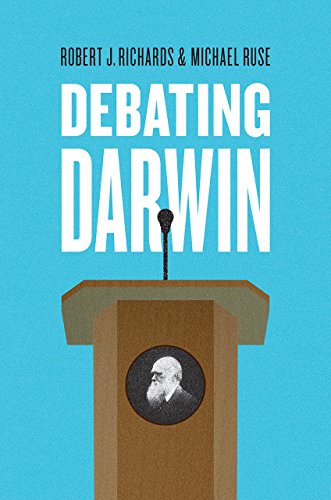
Charles Darwin is easily the most famous scientist of the modern age, and his theory of evolution is constantly referenced in many contexts by scientists and nonscientists alike. And yet, despite how frequently his ideas are evoked, there remains a surprising amount we don’t know about the father of modern evolutionary thinking, his intellectual roots, and the science he produced. Debating Darwin seeks to change that, bringing together two leading Darwin scholars—Robert J. Richards and Michael Ruse—to engage in a spirited and insightful dialogue, offering their interpretations of Darwin and their critiques of each other’s thinking.
Examining key disagreements about Darwin that continue to confound even committed Darwinists, Richards and Ruse offer divergent views on the origins and nature of Darwin and his ideas. Ruse argues that Darwin was quintessentially British and that the roots of his thought can be traced back to the eighteenth century, particularly to the Industrial Revolution and thinkers such as Adam Smith and Thomas Robert Malthus. Ruse argues that when these influences are appreciated, we can see how Darwin’s work in biology is an extension of their theories. In contrast, Richards presents Darwin as a more cosmopolitan, self-educated man, influenced as much by French and particularly German thinkers. Above all, argues Richards, it was Alexander von Humboldt who both inspired Darwin and gave him the conceptual tools that he needed to find and formulate his evolutionary hypotheses. Together, the authors show how the reverberations of the contrasting views on Darwin’s influences can be felt in theories about the nature of natural selection, the role of metaphor in science, and the place of God in Darwin’s thought.
Revealing how much there still is to investigate and interrogate about Darwin’s ideas, Debating Darwin contributes to our understanding of evolution itself. The book concludes with a jointly authored chapter that brings this debate into the present, focusing on human evolution, consciousness, religion, and morality. This will be powerful, essential reading for anyone seeking a comprehensive understanding of modern-day evolutionary science and philosophy.
Examining key disagreements about Darwin that continue to confound even committed Darwinists, Richards and Ruse offer divergent views on the origins and nature of Darwin and his ideas. Ruse argues that Darwin was quintessentially British and that the roots of his thought can be traced back to the eighteenth century, particularly to the Industrial Revolution and thinkers such as Adam Smith and Thomas Robert Malthus. Ruse argues that when these influences are appreciated, we can see how Darwin’s work in biology is an extension of their theories. In contrast, Richards presents Darwin as a more cosmopolitan, self-educated man, influenced as much by French and particularly German thinkers. Above all, argues Richards, it was Alexander von Humboldt who both inspired Darwin and gave him the conceptual tools that he needed to find and formulate his evolutionary hypotheses. Together, the authors show how the reverberations of the contrasting views on Darwin’s influences can be felt in theories about the nature of natural selection, the role of metaphor in science, and the place of God in Darwin’s thought.
Revealing how much there still is to investigate and interrogate about Darwin’s ideas, Debating Darwin contributes to our understanding of evolution itself. The book concludes with a jointly authored chapter that brings this debate into the present, focusing on human evolution, consciousness, religion, and morality. This will be powerful, essential reading for anyone seeking a comprehensive understanding of modern-day evolutionary science and philosophy.
Die Inhaltsangabe kann sich auf eine andere Ausgabe dieses Titels beziehen.
Über die Autorin bzw. den Autor
Robert J. Richards is the Morris Fishbein Distinguished Service Professor in History of Science at the University of Chicago, where he is professor in the departments of history, philosophy, and psychology and in the Committee on Conceptual and Historical Studies of Science and directs the Fishbein Center for the History of Science and Medicine. His books include, most recently, Was Hitler a Darwinian? Disputed Questions in the History of Evolutionary Theory, also published by the University of Chicago Press. Michael Ruse is director of the Program in the History and Philosophy of Science at Florida State University. His books include The Gaia Hypothesis: Science on a Pagan Planet, also published by the University of Chicago Press.
Auszug. © Genehmigter Nachdruck. Alle Rechte vorbehalten.
Debating Darwin
By Robert J. Richards, Michael RuseThe University of Chicago Press
Copyright © 2016 The University of Chicago
All rights reserved.
ISBN: 978-0-226-38442-9All rights reserved.
Contents
Preface,
Timeline,
Charles Darwin: Great Briton (Michael Ruse),
Prologue,
Britain before Darwin,
A Child of His Class,
Evolution and Natural Selection,
On the Origin of Species,
Humans,
Envoi,
Charles Darwin: Cosmopolitan Thinker (Robert J. Richards),
Introduction,
Sketch of Darwin's Life and Works,
Literature of Significance for Darwin: Romanticism and Natural Theology,
The Romantic Foundations of Darwin's Theory,
Darwin's Scientific Theology,
Darwin's Construction of His Theory,
Man, the Moral Animal,
Conclusion,
Response to Ruse,
The Language of Metaphor,
Teleology,
Evolutionary Development as Progressive,
Individual versus Group Selection,
The Evolution of Morality,
Conclusion,
Reply to Richards,
Levels of Selection,
Embryology,
The Romantic Influence,
Alexander von Humboldt,
Paradise Lost,
Epilogue,
History of Evolutionary Biology since the Origin of Species,
Human Consciousness,
Religion and God,
Notes,
Bibliography,
Index,
Illustrations,
CHAPTER 1
Charles Darwin: Great Briton
Prologue
Charles Darwin was first and foremost a scientist, a very great scientist, who not only made scientifically plausible the idea of organic evolutionary change but who came up with natural selection, what today's professional scientists generally consider to be the chief motive force of such change. Yet from the first, as Darwin himself recognized, his thinking was always more than just about scientific explanations of the organisms occupying the physical world. His thinking pointed the way to a new or revived philosophical perspective on reality. A harsher, less-comfortable one than that he inherited. The popular-science writer and ardent atheist Richard Dawkins has written:
In a universe of blind physical forces and genetic replication, some people are going to get hurt, other people are going to get lucky, and you won't find any rhyme or reason in it, nor any justice. The universe we observe has precisely the properties we should expect if there is, at bottom, no design, no purpose, no evil and no good, nothing but blind, pitiless indifference. As that unhappy poet A. E. Houseman put it:
For Nature, heartless, witless Nature
Will neither know nor care.
DNA neither knows nor cares. DNA just is. And we dance to its music.
As a staid and very respectable Victorian, Charles Darwin would have been horrified at the frenzied polemics that characterize the writings of the so-called New Atheists. Whatever his personal beliefs, he would never have flaunted his thinking in such a crude and public way. It is doubtful also whether Darwin ever reached quite the state of naturalistic nihilism expressed by Dawkins. Even if he took us all of the way, it is certainly not my claim that Darwin unaided took us to this new world. Internal issues in religion like so-called higher criticism (looking at the Bible as a human-written document) played a crucial role, as did social factors like the move from the land to the city demanding new ideologies for new types of existence. But Darwin's work pointed that way, and he knew it and pursued it. If like Moses and the Promised Land he never quite arrived, he beat the path toward it, consciously and intentionally. Darwin changed not just science; he changed philosophy also, and this is the world in which we now live.
Such is my claim in this, my section of this book. Moreover I argue that Darwin did all of this within a tradition on which he drew. A tradition that in many respects was quintessentially English, the land of his birth, but that was more broadly British, not only because Darwin was in part educated north of the border, but because Darwin always drew heavily on thinking that came from the so-called Scottish Enlightenment. In short, I argue that although Darwin was a great revolutionary — and I bow to no one in my belief that he made major advances in our understanding of the empirical world — he was not a rebel. He did not repudiate his past, hating and trying to destroy and eliminate that from whence he came. It was rather that he took what was offered and then rearranged and transformed the elements into an altogether new picture. Darwin's work was like a kaleidoscope. The pieces were there. Darwin shook them up and made something different. But where did the pieces come from that I claim were so important in Darwin's past? I argue — and here I would stress that I am being totally unoriginal and simply drawing on what one finds in any good textbook — that the Britain into which Darwin was born at the beginning of the nineteenth century had two major elements or themes or traditions. It was his good fortune to be able to draw on both elements and his genius to do with them what he did.
The one element is what we might with reason call the conservative element, the Tory side to Britain. This is the world of the king (George III and the Prince Regent, the future George IV) and of his supporters, political, military (including naval), and most of all clerical. It is the world of landowners, but usually not the biggest men. They were more the leaders in the villages that one finds in the novels of Anthony Trollope (although he was writing a little later), men like Wilfred Thorne, the squire of St. Ewold's in Barchester Towers. It is the world of the Church of England parson, the world (again in Barchester Towers) of Archdeacon Theophilus Grantly. And it is very much the world of England's two ancient universities, Oxford and Cambridge. The clerical world and the academic world were truly but one, for to graduate from the universities one had to be a paid-up, believing member of the Church of England and most of the teachers, the "dons," at Oxford and Cambridge had taken holy orders. To refer one more time to Trollope's great novel, remember that the man who becomes Dean of Barchester, Francis Arabin, is a fellow of Lazarus College (a thinly veiled portrait of Christchurch) and a sometime professor of poetry at Oxford.
The other element is what we might with equally good reason call the liberal element, the Whig side (after the Reform Bill of 1832 joined by the Radical side) to Britain. Their leaders were the great landowners, men like the Duke of Omnium in Trollope's political novels. Somewhat paradoxically, they were often joined by the bishops of the Church of England. Bishoprics are bestowed by the government of the day, sometime Whig or liberal. The politicians wanted supporters not the thanks of the village priests. The plot of Barchester Towers revolves around the fact that Archdeacon Grantly, firmly Tory, does not get to follow his father into the see of Barchester. The post goes instead to the Whig Bishop Proudie. The leaders of the Whigs were allied with the men of industry. Whereas the Tories inclined toward protectionism, looking to the interests of the rural leaders — the notorious Corn Laws enacted after the Napoleonic Wars were the epitome of such inclinations, designed as they were to keep high the value of homegrown grains — the Whigs inclined toward free trade, something that opened up markets for the products, initially and overwhelmingly cotton but later moving more toward manufactured goods in iron...
„Über diesen Titel“ kann sich auf eine andere Ausgabe dieses Titels beziehen.
Suchergebnisse für Debating Darwin

Beispielbild für diese ISBN
Debating Darwin
Verlag:
University of Chicago Press, 2016
ISBN 10: 022638442X
ISBN 13: 9780226384429
Gebraucht
Hardcover
Anbieter: Midtown Scholar Bookstore, Harrisburg, PA, USA
Verkäuferbewertung 5 von 5 Sternen

Hardcover. Zustand: Acceptable. HARDCOVER Acceptable - This is a significantly damaged book. It should be considered a reading copy only. Please order this book only if you are interested in the content and not the condition. May be ex-library. Standard-sized. Bestandsnummer des Verkäufers M022638442XZ4
Gebraucht kaufen
EUR 2,75
EUR 5,33 Versand
Versand innerhalb von USA
Versand innerhalb von USA
Anzahl: 1 verfügbar
Beispielbild für diese ISBN
Debating Darwin
Verlag:
University of Chicago Press, 2016
ISBN 10: 022638442X
ISBN 13: 9780226384429
Gebraucht
Hardcover
Anbieter: Midtown Scholar Bookstore, Harrisburg, PA, USA
Verkäuferbewertung 5 von 5 Sternen
Hardcover. Zustand: Very Good. Very Good - Crisp, clean, unread book with some shelfwear/edgewear, may have a remainder mark - NICE Standard-sized. Bestandsnummer des Verkäufers M022638442XZ2
Gebraucht kaufen
EUR 2,75
EUR 5,33 Versand
Versand innerhalb von USA
Versand innerhalb von USA
Anzahl: 6 verfügbar
Beispielbild für diese ISBN
Debating Darwin
Verlag:
University of Chicago Press, 2016
ISBN 10: 022638442X
ISBN 13: 9780226384429
Gebraucht
Hardcover
Anbieter: Midtown Scholar Bookstore, Harrisburg, PA, USA
Verkäuferbewertung 5 von 5 Sternen
Hardcover. Zustand: Good. Good - Bumped and creased book with tears to the extremities, but not affecting the text block, may have remainder mark or previous owner's name - GOOD Standard-sized. Bestandsnummer des Verkäufers M022638442XZ3
Gebraucht kaufen
EUR 3,55
EUR 5,33 Versand
Versand innerhalb von USA
Versand innerhalb von USA
Anzahl: 7 verfügbar
Beispielbild für diese ISBN
Debating Darwin
Verlag:
University of Chicago Press, 2016
ISBN 10: 022638442X
ISBN 13: 9780226384429
Gebraucht
Hardcover
Anbieter: Half Price Books Inc., Dallas, TX, USA
Verkäuferbewertung 5 von 5 Sternen
hardcover. Zustand: Very Good. Connecting readers with great books since 1972! Used books may not include companion materials, and may have some shelf wear or limited writing. We ship orders daily and Customer Service is our top priority! Bestandsnummer des Verkäufers S_470033682
Gebraucht kaufen
EUR 6,87
EUR 3,33 Versand
Versand innerhalb von USA
Versand innerhalb von USA
Anzahl: 1 verfügbar
Beispielbild für diese ISBN
Debating Darwin
Verlag:
University of Chicago Press, 2016
ISBN 10: 022638442X
ISBN 13: 9780226384429
Gebraucht
Hardcover
Anbieter: Running Numbers, Grand Rapids, MI, USA
Verkäuferbewertung 5 von 5 Sternen
hardcover. Zustand: Very Good. Book is in used/read but very good condition - expect some shelfwear and possible remainder mark - ships fast! Bestandsnummer des Verkäufers mon0000006001
Gebraucht kaufen
EUR 9,14
EUR 4,44 Versand
Versand innerhalb von USA
Versand innerhalb von USA
Anzahl: 1 verfügbar
Beispielbild für diese ISBN
Debating Darwin
Verlag:
University of Chicago Press, 2016
ISBN 10: 022638442X
ISBN 13: 9780226384429
Gebraucht
Hardcover
Anbieter: Powell's Bookstores Chicago, ABAA, Chicago, IL, USA
Verkäuferbewertung 5 von 5 Sternen
hardcover. Zustand: Used-Very Good. Zustand des Schutzumschlags: dj. Illustrated. Cloth, dj. Minor shelf wear. Else a bright, clean copy. Bestandsnummer des Verkäufers 1968952
Gebraucht kaufen
EUR 16,48
EUR 4,44 Versand
Versand innerhalb von USA
Versand innerhalb von USA
Anzahl: 1 verfügbar
Beispielbild für diese ISBN
Debating Darwin
Verlag:
University of Chicago Press, 2016
ISBN 10: 022638442X
ISBN 13: 9780226384429
Gebraucht
Hardcover
Anbieter: Great Matter Books, Grand Rapids, MI, USA
Verkäuferbewertung 5 von 5 Sternen
Hardcover. Zustand: Fine. Zustand des Schutzumschlags: Fine. Fine condition hardcover book, Fine condition dust jacket. Slightest bumping to spine ends. Minute smudging to text block edges. Dust jacket unclipped. Dust jacket has slightest shelf wear and bumping to edges. Jacket protected by mylar. All books are individually inspected and described. Never X-Library unless specifically described as such. Bestandsnummer des Verkäufers 2507-1837
Gebraucht kaufen
EUR 22,88
EUR 4,43 Versand
Versand innerhalb von USA
Versand innerhalb von USA
Anzahl: 1 verfügbar
Beispielbild für diese ISBN
Debating Darwin
Anbieter: GreatBookPrices, Columbia, MD, USA
Verkäuferbewertung 5 von 5 Sternen
Zustand: New. Bestandsnummer des Verkäufers 26523221-n
Neu kaufen
EUR 32,87
EUR 2,35 Versand
Versand innerhalb von USA
Versand innerhalb von USA
Anzahl: 13 verfügbar
Beispielbild für diese ISBN
Debating Darwin Format: Hardcover
Anbieter: INDOO, Avenel, NJ, USA
Verkäuferbewertung 5 von 5 Sternen
Zustand: New. Brand New. Bestandsnummer des Verkäufers 9780226384429
Neu kaufen
EUR 35,30
Versand gratis
Versand innerhalb von USA
Versand innerhalb von USA
Anzahl: Mehr als 20 verfügbar
Beispielbild für diese ISBN
Debating Darwin
Anbieter: Brook Bookstore On Demand, Napoli, NA, Italien
Verkäuferbewertung 5 von 5 Sternen
Zustand: new. Bestandsnummer des Verkäufers ca1a5830605fced9eecb6eb6c4739171
Neu kaufen
EUR 30,45
EUR 6,80 Versand
Versand von Italien nach USA
Versand von Italien nach USA
Anzahl: 13 verfügbar