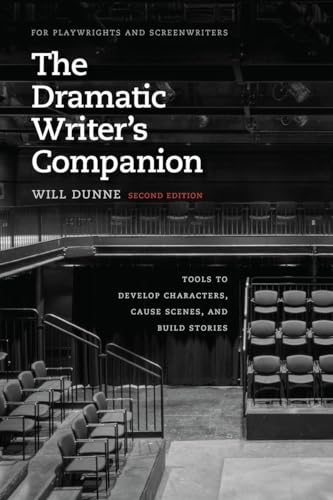
The Dramatic Writer's Companion, Second Edition: Tools to Develop Characters, Cause Scenes, and Build Stories (Chicago Guides to Writing, Editing, and Publishing) - Softcover
Inhaltsangabe
In just eight years, The Dramatic Writer’s Companion has become a classic among playwrights and screenwriters. Thousands have used its self-contained character, scene, and story exercises to spark creativity, hone their writing, and improve their scripts.
Having spent decades working with dramatists to refine and expand their existing plays and screenplays, Dunne effortlessly blends condensed dramatic theory with specific action steps—over sixty workshop-tested exercises that can be adapted to virtually any individual writing process and dramatic script. Dunne’s in-depth method is both instinctual and intellectual, allowing writers to discover new actions for their characters and new directions for their stories. The exercises can be used by those just starting the writing process and by those who have scripts already in development. With each exercise rooted in real-life issues from Dunne’s workshops, readers of this companion will find the combined experiences of more than fifteen hundred workshops in a single guide.
This second edition is fully aligned with a brand-new companion book, Character, Scene, and Story, which offers forty-two additional activities to help writers more fully develop their scripts. The two books include cross-references between related exercises, though each volume can also stand alone.
No ordinary guide to plotting, this handbook centers on the principle that character is key. “The character is not something added to the scene or to the story,” writes Dunne. “Rather, the character is the scene. The character is the story.” With this new edition, Dunne’s remarkable creative method will continue to be the go-to source for anyone hoping to take their story to the stage.
Die Inhaltsangabe kann sich auf eine andere Ausgabe dieses Titels beziehen.
Über die Autorin bzw. den Autor
Will Dunne is resident playwright and faculty member at Chicago Dramatists. He is the author of numerous plays and recipient of many writing awards and honors. His third companion book, The Architecture of Story: A Technical Guide for the Dramatic Writer, is also available from the University of Chicago Press.
Auszug. © Genehmigter Nachdruck. Alle Rechte vorbehalten.
The Dramatic Writer's Companion
Tools to Develop Characters, Cause Scenes, and Build Stories
By Will DunneThe University of Chicago Press
Copyright © 2017 Will Dunne
All rights reserved.
ISBN: 978-0-226-49408-1All rights reserved.
Contents
About This Guide,
Exercises at a Glance,
DEVELOPING YOUR CHARACTER,
STAGE 1: FLESHING OUT THE BONES,
Basic Character Builder,
What the Character Believes,
Where the Character Works,
Getting Emotional,
Into the Past,
Defining Trait,
STAGE 2: GETTING TO KNOW THE CHARACTER BETTER,
Allies: Then and Now,
Adversaries: Then and Now,
Characters in Contrast,
Finding the Character's Voice,
Three Characters in One,
The Secret Lives of Characters,
STAGE 3: UNDERSTANDING WHO THE CHARACTER REALLY IS,
The Noble Character,
Seven Deadly Sins,
The Dramatic Triangle,
Spinal Tap,
Character as Paradox,
The Character You Like Least,
In So Many Words,
CAUSING A SCENE,
STAGE 1: MAKING THINGS HAPPEN,
Basic Scene Starter,
Where in the World Are We?,
The Roots of Action,
What Does the Character Want?,
What's the Problem?,
Good Intentions,
How It Happens,
Character Adjustments,
Scene in a Sentence,
STAGE 2: REFINING THE ACTION,
Seeing the Scene,
There and Then,
The Aha!s of the Story,
Heating Things Up,
The Emotional Storyboard,
In the Realm of the Senses,
The Voice of the Setting,
Thinking in Beats,
STAGE 3: REFINING THE DIALOGUE,
Talking and Listening,
Unspeakable Truths,
Universal Truths and Lies,
The Bones of the Lines,
BUILDING YOUR STORY,
STAGE 1: TRIGGERING THE CHAIN OF EVENTS,
Whose Story Is It?,
How Will the Tale Be Told?,
As the World Turns,
Inciting Event,
The Art of Grabbing,
STAGE 2: DEVELOPING THE THROUGHLINE,
Step by Step,
Turning Points,
What Happens Next?,
Pointing and Planting,
Crisis Decision,
Picturing the Arc of Action,
Before and After,
Twelve-Word Solution,
STAGE 3: SEEING THE BIG PICTURE,
Main Event,
Your Story as a Dog,
The Incredible Shrinking Story,
What's the Big Idea?,
What's in a Name?,
The Forest of Your Story,
Ready, Aim, Focus,
Six Steps of Revision,
FIXING COMMON SCRIPT PROBLEMS,
Glossary,
Acknowledgments,
CHAPTER 1
BASIC CHARACTER BUILDER
THE QUICK VERSION
Start to flesh out a character
BEST TIME FOR THIS
During early story development or any time you add a new character
CHARACTER: A MIX OF PHYSICAL, PSYCHOLOGICAL, AND SOCIAL TRAITS
You won't understand what your story is about until you understand who your characters are. Dramatist Henrik Ibsen felt he could not begin writing a play until he knew the characters inside out — as if he had lived with them for a month. To know a character is to know the complex blend of physical, psychological, and social traits that make him or her unique. The most important of these traits will be revealed to us through the character's actions under the increasing pressure of story events.
Great stories create extreme circumstances where characters are tested — and usually changed — and where they may do things, for better or for worse, that they never thought possible. To write such stories, you need to know your characters well enough to understand where in life they have come from, how they usually behave day-to-day, in what unexpected ways they might act under stress, and in what ways they would never under any circumstances behave.
ABOUT THE EXERCISE
Try this first with your main character. You can repeat it later with other principal characters in less detail. Don't overdevelop minor characters. They may steal the show if, after they come and go, we are waiting for them to return.
You don't need to write volumes as you answer the exercise questions. It's more about making choices and knowing what they are. For best results:
Set up a personal palette. For each character you build, choose one or two people whom you can use — in combination with yourself — as a source of information. Pick people who trigger strong positive or negative feelings. Give the character a name that embodies your choices and has special meaning for you.
Look for what matters most. The importance of each question will depend on the unique character you are developing. Try to find character facts that may influence story events. Don't waste time on details that will have no impact.
Focus on when the story begins. The character will undergo changes as the dramatic journey unfolds. The exercise is designed to help you flesh out who the character is before those changes begin to occur.
When basing a character on someone from your life, you may find the best material by using his or her real name in the early private stages of writing. Once you establish the character — and before others see your script — switch to a fictitious name.
* YOUR CHARACTER'S PHYSICAL LIFE
Remember that "now" and "today" refer to when the story begins.
1. When was the character born and what is the character's age now?
2. Think about his or her other vital stats, such as gender, ethnicity, height, and weight. Which of these, if any, might matter in the story?
3. How would most people describe the character's physical appearance?
4. Good or bad, what is the character's most striking physical feature?
5. How would you describe the character's strength, endurance, and coordination when it comes to physical activity and sports?
6. What is the character's favorite sport or physical activity?
7. How is the character's health now, and what has most contributed to this?
8. Is the character on any medication now? If so, what is it, why is the character taking it, and how does it affect his or her behavior?
9. What significant diseases, if any, has the character had in the past and what impact does this medical history have on the character now?
10. Has the character ever sustained a serious physical injury? If so, what happened and how has this affected the character?
11. Does the character have any permanent physical defects, such as nearsightedness, or temporary ones, such as a broken leg? If so, what are they?
12. Of the character's most defining traits, which ones run in the family?
13. Does the character use nicotine, alcohol, or recreational drugs? If so, what is used in what quantities and how important is this in the character's daily life?
14. What is the character's greatest physical asset?
15. What is the character's greatest physical weakness or liability?
* YOUR CHARACTER'S INNER LIFE
1. What is the character's IQ and how has this affected the character?
2. How would you describe the character's imagination?
3. How does the character rate in terms of common sense and sound judgment?
4. How would you describe the character's outlook on life?
5. Does the character tend to be dominant or submissive with others, and why?
6. How does the character usually approach major problems?
7. What is the character's greatest talent?
8. What is the character's greatest lack of talent?
9. What is the character's biggest success in life so far?
10. What is the character's biggest failure in life so far?
11. Up to now, what has been the character's main ambition?
12. What is the character's biggest delusion?
13. In order of importance, identify the character's three greatest fears.
14. In order of importance, name three things that make the character really angry.
15. What would make the character feel embarrassed, ashamed, or guilty?
16. How would you describe the character's moral standards?
17. What are three things that your character most values?
18. What are three things that your character least values?
19. What is the character's greatest virtue?
20. What is the character's greatest vice?
21. What are the spiritual and religious beliefs of the character?
22. Identify something unusual that the character might do — but only if most people would not know about it.
23. Name three things the character would never, ever do.
24. What is the character's biggest secret and why has this stayed hidden?
25. What turns the character on sexually?
26. What is the character's greatest psychological strength?
27. What is the character's greatest psychological weakness?
* YOUR CHARACTER'S LIFE WITH OTHERS
1. Where did the character grow up and in what kind of home?
2. What was the character's social class and how did this affect the character?
3. During the character's early years, who was in the family and how did the character fit in with them?
4. What did the character's parents do for a living and how much did they earn?
5. What was the greatest strength and weakness of the character's father?
6. What was the greatest strength and weakness of the character's mother?
7. In a nutshell, how would you describe the character's childhood?
8. Inside or outside the family, positive or negative, who had the greatest impact on the character as a child and how would you describe this influence?
9. What kind of schools did the character attend and how well did he or she do?
10. What were the character's best and worst subjects in school?
11. How popular was the character through childhood and teenage years?
12. How actively did the character participate in social organizations at school?
13. Inside or outside the family, positive or negative, who had the greatest impact on the character as a teenager and how would you describe this influence?
14. Who was the character's first love, how did this relationship get started, and — if the character is no longer in that relationship — what ended it?
15. What was the character's first real job, why did the character get hired, and — if the character is no longer at that job — what caused it to end?
16. What does the character do now for a living, how much does he or she earn, and how well suited is the character to this line of work?
17. What is the character's social class and marital status now?
18. Where does the character live now and with whom (if anyone)?
19. How would you describe the character's home life now?
20. How has the character's sex life been lately?
21. Publicly or secretly, whom does the character find most sexually attractive?
22. Who is the character's best friend today, and why?
23. Who is the character's worst enemy today, and why?
24. Does the character have any hobbies now and, if so, what?
25. Other than hobbies, what does the character usually do for fun?
26. What is the last book that the character read?
27. What is the last film, if any, that the character saw?
28. When is the last time the character went to a party, whose party was it, and what kind of time did the character have there?
29. Whether spouse, lover, best friend, coworker, family member, or mentor, who is the most significant other person in the character's life today, and why?
30. What is the happiest moment the character has shared with that person?
31. What is the unhappiest moment the character has shared with that person?
32. How would you describe the character's politics?
33. How would you describe the character's position or role in society today?
34. If the character could change one thing about the world, what would it be?
35. Positive or negative, what were three of the most significant turning points in the character's life and how has each affected the character whom we first meet?
WRAP-UP
You've begun to create a unique identity by making specific choices about the character's physical life, inner life, and life with others. As you develop your story, continue asking questions like these so that your character can keep growing. Look for answers that are relevant to the dramatic journey and can help you better understand how this character will feel and act as the journey unfolds.
Other exercises in this section can help you flesh out specific aspects of your character — such as belief system, home life, and work life — in more depth. In some cases, you may be asked similar questions about the same character and find yourself wanting to give different answers. Know that your character is dynamic and will continue to evolve in new and often unexpected ways as you write and rewrite your story.
CHAPTER 2WHAT THE CHARACTER BELIEVES
THE QUICK VERSION
Learn more about your character by fleshing out his or her personal credo
BEST TIME FOR THIS
Any time you need to know a character better
THE CHARACTER'S CREDO: A DEEP SOURCE OF ACTION
To figure out the events of your story, you need to understand your character's belief system. This includes how your character sees the world, what your character values and doesn't value, what pushes your character's buttons, and why your character is likely to behave a certain way under certain circumstances.
ABOUT THE EXERCISE
Choose a character whom you wish to explore in more depth and imagine him or her around the time the story begins. Then use free associations to answer the following exercise questions from this character's perspective and in this character's voice, as if you were writing dialogue. Tell the truth as best you can. "Truth" here is whatever you, the character, believe is true when the story begins.
YOUR CHARACTER'S BELIEF SYSTEM
When the story begins, how do you, the character, feel about the following twenty topics? For each one, try to say as much as you can in one minute of fast writing.
Money
Children
Church
Technology
Freedom
Sin
Success
Family
Politics
Love
Violence
Marriage
Drugs
Justice
Sex
Beauty
Death
Friendship
Failure
God
A DEEPER LOOK AT THREE KEY BELIEFS
To you, the character, when the story begins:
1. Review your quick responses to the twenty exercise topics. Choose any three topics to explore in more detail.
2. For each topic you chose, take five more minutes to continue where you left off and express your unique point of view. Remember that there is no right or wrong way to do this. Just be specific and stay true to what you, the character, believe. Try to include specific examples from your life to support your beliefs.
WRAP-UP
Your character's belief system is a key component of who the character is and what makes the character tick. This system is based on what the character has experienced in life, what the character has been taught by others, and how the character feels and thinks as a result of all this.
Like people, no two characters have identical belief systems. Each therefore will act in a unique way, especially under stress when true values tend to show themselves — whether the character likes it or not.
CHAPTER 3WHERE THE CHARACTER LIVES
THE QUICK VERSION
Find important clues to your character's identity by exploring his or her home
BEST TIME FOR THIS
Any time you need to know a character better
YOUR CHARACTER'S HOME: A GOLD MINE OF PERSONAL INFORMATION
The more you know your characters, the more your story will write itself. This exercise helps you flesh out your principal characters by exploring their most personal domains: their homes. Whether or not these dwellings figure directly into the story action, they are telling places that can reveal a lot about who your characters really are.
ABOUT THE EXERCISE
Choose a character whom you wish to explore in more depth and imagine him or her around the time the story begins. Then answer the exercise questions from this character's perspective and in this character's voice, as if you were writing dialogue. Tell the truth as best you can. "Truth" here is whatever you, the character, believe is true when the story begins.
* YOUR CHARACTER'S HOME LIFE
To you, the character: when the story begins:
1. Where is your home located? If you were to get mail there, what information would be on it: your name and full mailing address.
2. What type of place is it — for example, house, apartment, trailer, hotel room, palace, cave, tent, forest, or space station — and how long have you lived there?
3. Identify the different rooms or distinct areas of your home — for example, living room, kitchenette, bathroom, patio.
4. How would you describe your neighborhood or immediate surroundings?
5. What is your financial relationship to your home — for example, do you own, rent, or stay there for free?
• If you pay, what's the monthly cost and how easily do you manage this?
• If it's "free," what are you expected to provide instead of money?
6. Who else, if anyone, lives with you? Write each one's name and relationship — for example, lover, husband, or cellmate. If you have pets, include them, too.
7. Briefly describe your home relationships:
• If you live alone, how do you like being by yourself?
• If you live with others, how well do you get along?
8. Briefly describe how your home usually looks — for example, neat or messy, immaculate or filthy, cluttered or sparse, fixed up or run down.
9. Which is your favorite room or area at home, and why?
10. What room or area of your home do you like least, and why?
11. Name three of your favorite possessions at home. Tell what each one is, where you keep it, and why you like it so much.
12. Name three of the possessions that you most want to get rid of someday. Tell what each one is, where you keep it, and why you dislike it.
13. What was the most memorable intimate encounter you've ever had in your home? Include when this happened and who was involved.
14. Aside from that, what's one of the happiest experiences you've ever had in your home? Include when this happened and who was involved.
15. What was the most memorable violent, criminal, or terrible act in your home? Include when this happened and who was involved.
16. Aside from that, what's one of the most frightening experiences you've ever had in your home? Include when this happened and who was involved.
17. What's one of the saddest experiences you've ever had in your home? Include when this happened and who was involved.
18. Name an object in your home — a physical item — that you keep secret from most people. Include where you have it now and why it's hidden.
19. Name something you do — or have done — in your home that most people don't know about. Tell who else, if anyone, was involved, and why it's a secret.
20. Summing it all up, how do you feel about your home?
• If you're happy living there, what do you most enjoy about it?
• If you're unhappy there, what's wrong and where would you rather live?
WRAP-UP
The character's home is an often overlooked source of important character information. By answering these questions — even the simplest ones about address, living unit, and rooms — you've had to make many specific and complex choices about your character's life. By responding as the character, you've also taken this research out of the realm of the academic and into the world of your story. This has given you a chance not only to search for leads to new story ideas, but also to develop more of your character's unique outlook, personality, and voice.
(Continues...)
Excerpted from The Dramatic Writer's Companion by Will Dunne. Copyright © 2017 Will Dunne. Excerpted by permission of The University of Chicago Press.
All rights reserved. No part of this excerpt may be reproduced or reprinted without permission in writing from the publisher.
Excerpts are provided by Dial-A-Book Inc. solely for the personal use of visitors to this web site.
„Über diesen Titel“ kann sich auf eine andere Ausgabe dieses Titels beziehen.
Weitere beliebte Ausgaben desselben Titels

Suchergebnisse für The Dramatic Writer's Companion, Second Edition:...

Beispielbild für diese ISBN
The Dramatic Writer's Companion, Second Edition: Tools to Develop Characters, Cause Scenes, and Build Stories (Chicago Guides to Writing, Editing, and Publishing)
Verlag:
University of Chicago Press, 2017
ISBN 10: 022649408X
ISBN 13: 9780226494081
Gebraucht
Paperback
Anbieter: HPB-Emerald, Dallas, TX, USA
Verkäuferbewertung 5 von 5 Sternen

Paperback. Zustand: Very Good. Connecting readers with great books since 1972! Used books may not include companion materials, and may have some shelf wear or limited writing. We ship orders daily and Customer Service is our top priority! Bestandsnummer des Verkäufers S_455704336
Gebraucht kaufen
EUR 8,79
EUR 3,20 shipping
Versand innerhalb von USA
Versand innerhalb von USA
Anzahl: 1 verfügbar
Beispielbild für diese ISBN
The Dramatic Writer's Companion, Second Edition: Tools to Develop Characters, Cause Scenes, and Build Stories (Chicago Guides to Writing, Editing, and Publishing)
Verlag:
University of Chicago Press, 2017
ISBN 10: 022649408X
ISBN 13: 9780226494081
Gebraucht
Paperback
Anbieter: Midtown Scholar Bookstore, Harrisburg, PA, USA
Verkäuferbewertung 5 von 5 Sternen
Paperback. Zustand: Good. Good - Bumped and creased book with tears to the extremities, but not affecting the text block, may have remainder mark or previous owner's name - GOOD Standard-sized. Bestandsnummer des Verkäufers M022649408XZ3
Gebraucht kaufen
EUR 8,88
EUR 5,13 shipping
Versand innerhalb von USA
Versand innerhalb von USA
Anzahl: 11 verfügbar
Beispielbild für diese ISBN
The Dramatic Writer's Companion, Second Edition: Tools to Develop Characters, Cause Scenes, and Build Stories (Chicago Guides to Writing, Editing, and Publishing)
Verlag:
University of Chicago Press, 2017
ISBN 10: 022649408X
ISBN 13: 9780226494081
Gebraucht
Paperback
Anbieter: Midtown Scholar Bookstore, Harrisburg, PA, USA
Verkäuferbewertung 5 von 5 Sternen
Paperback. Zustand: Acceptable. Acceptable - This is a significantly damaged book. It should be considered a reading copy only. Please order this book only if you are interested in the content and not the condition. May be ex-library. PAPERBACK Standard-sized. Bestandsnummer des Verkäufers M022649408XZ4
Gebraucht kaufen
EUR 9,10
EUR 5,13 shipping
Versand innerhalb von USA
Versand innerhalb von USA
Anzahl: 4 verfügbar
Foto des Verkäufers
Dramatic Writer's Companion : Tools to Develop Characters, Cause Scenes, and Build Stories
Verlag:
University of Chicago Press, 2017
ISBN 10: 022649408X
ISBN 13: 9780226494081
Gebraucht
Softcover
Anbieter: GreatBookPrices, Columbia, MD, USA
Verkäuferbewertung 5 von 5 Sternen
Zustand: As New. Unread book in perfect condition. Bestandsnummer des Verkäufers 29605877
Gebraucht kaufen
EUR 16,23
EUR 2,26 shipping
Versand innerhalb von USA
Versand innerhalb von USA
Anzahl: 2 verfügbar
Foto des Verkäufers
Dramatic Writer's Companion : Tools to Develop Characters, Cause Scenes, and Build Stories
Anbieter: GreatBookPrices, Columbia, MD, USA
Verkäuferbewertung 5 von 5 Sternen
Zustand: New. Bestandsnummer des Verkäufers 29605877-n
Neu kaufen
EUR 17,27
EUR 2,26 shipping
Versand innerhalb von USA
Versand innerhalb von USA
Anzahl: 2 verfügbar
Beispielbild für diese ISBN
The Dramatic Writer's Companion, Second Edition: Tools to Develop Characters, Cause Scenes, and Build Stories (Chicago Guides to Writing, Editing, and Publishing)
Verlag:
University of Chicago Press, 2017
ISBN 10: 022649408X
ISBN 13: 9780226494081
Gebraucht
Paperback
Anbieter: WorldofBooks, Goring-By-Sea, WS, Vereinigtes Königreich
Verkäuferbewertung 5 von 5 Sternen
Paperback. Zustand: Very Good. The book has been read, but is in excellent condition. Pages are intact and not marred by notes or highlighting. The spine remains undamaged. Bestandsnummer des Verkäufers GOR010446800
Gebraucht kaufen
EUR 13,18
EUR 6,41 shipping
Versand von Vereinigtes Königreich nach USA
Versand von Vereinigtes Königreich nach USA
Anzahl: 2 verfügbar
Foto des Verkäufers
The Dramatic Writer's Companion, Second Edition (Paperback)
Verlag:
The University of Chicago Press, Chicago, IL, 2017
ISBN 10: 022649408X
ISBN 13: 9780226494081
Neu
Paperback
Anbieter: Grand Eagle Retail, Bensenville, IL, USA
Verkäuferbewertung 5 von 5 Sternen
Paperback. Zustand: new. Paperback. In just eight years, The Dramatic Writers Companion has become a classic among playwrights and screenwriters. Thousands have used its self-contained character, scene, and story exercises to spark creativity, hone their writing, and improve their scripts. Having spent decades working with dramatists to refine and expand their existing plays and screenplays, Dunne effortlessly blends condensed dramatic theory with specific action stepsover sixty workshop-tested exercises that can be adapted to virtually any individual writing process and dramatic script. Dunnes in-depth method is both instinctual and intellectual, allowing writers to discover new actions for their characters and new directions for their stories. The exercises can be used by those just starting the writing process and by those who have scripts already in development. With each exercise rooted in real-life issues from Dunnes workshops, readers of this companion will find the combined experiences of more than fifteen hundred workshops in a single guide. This second edition is fully aligned with a brand-new companion book, Character, Scene, and Story, which offers forty-two additional activities to help writers more fully develop their scripts. The two books include cross-references between related exercises, though each volume can also stand alone. No ordinary guide to plotting, this handbook centers on the principle that character is key. The character is not something added to the scene or to the story, writes Dunne. Rather, the character is the scene. The character is the story. With this new edition, Dunnes remarkable creative method will continue to be the go-to source for anyone hoping to take their story to the stage. Shipping may be from multiple locations in the US or from the UK, depending on stock availability. Bestandsnummer des Verkäufers 9780226494081
Beispielbild für diese ISBN
The Dramatic Writer's Companion, Second Edition Format: Paperback
Anbieter: INDOO, Avenel, NJ, USA
Verkäuferbewertung 5 von 5 Sternen
Zustand: New. Brand New. Bestandsnummer des Verkäufers 9780226494081
Neu kaufen
EUR 19,79
Versand gratis
Versand innerhalb von USA
Versand innerhalb von USA
Anzahl: Mehr als 20 verfügbar
Beispielbild für diese ISBN
The Dramatic Writer's Companion, Second Edition: Tools to Develop Characters, Cause Scenes, and Build Stories (Chicago Guides to Writing, Editing, and Publishing)
Anbieter: Textbooks_Source, Columbia, MO, USA
Verkäuferbewertung 5 von 5 Sternen
paperback. Zustand: New. 2nd Edition. Ships same day or next business day! UPS shipping available (Priority Mail for AK/HI/APO/PO Boxes). Bestandsnummer des Verkäufers 002085676N
Neu kaufen
EUR 18,36
EUR 3,41 shipping
Versand innerhalb von USA
Versand innerhalb von USA
Anzahl: 5 verfügbar
Beispielbild für diese ISBN
The Dramatic Writer's Companion, Second Edition
Anbieter: PBShop.store US, Wood Dale, IL, USA
Verkäuferbewertung 5 von 5 Sternen
PAP. Zustand: New. New Book. Shipped from UK. Established seller since 2000. Bestandsnummer des Verkäufers WG-9780226494081