
Verwandte Artikel zu Wolves: Behavior, Ecology and Conservation
Inhaltsangabe
Wolves are some of the world's most charismatic and controversial animals, capturing the imaginations of their friends and foes alike. Highly intelligent and adaptable, they hunt and play together in close-knit packs, sometimes roaming over hundreds of square miles in search of food. Once teetering on the brink of extinction across much of the United States and Europe, wolves have made a tremendous comeback in recent years, thanks to legal protection, changing human attitudes, and efforts to reintroduce them to suitable habitats in North America.
As wolf populations have rebounded, scientific studies of them have also flourished. But there hasn't been a systematic, comprehensive overview of wolf biology since 1970. In Wolves, many of the world's leading wolf experts provide state-of-the-art coverage of just about everything you could want to know about these fascinating creatures. Individual chapters cover wolf social ecology, behavior, communication, feeding habits and hunting techniques, population dynamics, physiology and pathology, molecular genetics, evolution and taxonomy, interactions with nonhuman animals such as bears and coyotes, reintroduction, interactions with humans, and conservation and recovery efforts. The book discusses both gray and red wolves in detail and includes information about wolves around the world, from the United States and Canada to Italy, Romania, Saudi Arabia, Israel, India, and Mongolia. Wolves is also extensively illustrated with black and white photos, line drawings, maps, and fifty color plates. Unrivalled in scope and comprehensiveness, Wolves will become the definitive resource on these extraordinary animals for scientists and amateurs alike. "An excellent compilation of current knowledge, with contributions from all the main players in wolf research. . . . It is designed for a wide readership, and certainly the language and style will appeal to both scientists and lucophiles alike. . . . This is an excellent summary of current knowledge and will remain the standard reference work for a long time to come."--Stephen Harris, New Scientist"This is the place to find almost any fact you want about wolves."--Stephen Mills, BBC Wildlife Magazine
Die Inhaltsangabe kann sich auf eine andere Ausgabe dieses Titels beziehen.
Über die Autorin bzw. den Autor
L. David Mech is a senior research scientist with the Biological Resources Division, U.S. Geological Survey and adjunct professor in the Department of Fisheries, Wildlife, and Conservation Biology and the Department of Ecology and Behavioral Biology at the University of Minnesota. He is the author of The Wolf: The Ecology and Behavior of an Endangered Species, The Way of the Wolf, and The Arctic Wolf, among other books, and is coauthor of The Wolves of Denali. Luigi Boitani is a professor of vertebrate zoology and animal ecology at the University of Rome. He is the author of Dalla parte del lupo, coauthor of Simon and Schuster's Guide to Mammals, and coeditor of Research Techniques in Animal Ecology.
Von der hinteren Coverseite
Wolves are some of the world's most charismatic and controversial animals, capturing the imaginations of their friends and foes alike. Highly intelligent and adaptable, they hunt and play together in close-knit packs, sometimes roaming over hundreds of square miles in search of food. Once teetering on the brink of extinction across much of the United States and Europe, wolves have made a tremendous comeback in recent years, thanks to legal protection, changing human attitudes, and efforts to reintroduce them to suitable habitats in North America.
As wolf populations have rebounded, scientific studies of them have also flourished. But there hasn't been a systematic, comprehensive overview of wolf biology since 1970. In Wolves, many of the world's leading wolf experts provide state-of-the-art coverage of just about everything you could want to know about these fascinating creatures. Individual chapters cover wolf social ecology, behavior, communication, feeding habits and hunting techniques, population dynamics, physiology and pathology, molecular genetics, evolution and taxonomy, interactions with nonhuman animals such as bears and coyotes, reintroduction, interactions with humans, and conservation and recovery efforts. The book discusses both gray and red wolves in detail and includes information about wolves around the world, from the United States and Canada to Italy, Romania, Saudi Arabia, Israel, India, and Mongolia. Wolves is also extensively illustrated with black and white photos, line drawings, maps, and fifty color plates.
Unrivalled in scope and comprehensiveness, Wolves will become the definitive resource on these extraordinary animals for scientists and amateurs alike.
As wolf populations have rebounded, scientific studies of them have also flourished. But there hasn't been a systematic, comprehensive overview of wolf biology since 1970. In Wolves, many of the world's leading wolf experts provide state-of-the-art coverage of just about everything you could want to know about these fascinating creatures. Individual chapters cover wolf social ecology, behavior, communication, feeding habits and hunting techniques, population dynamics, physiology and pathology, molecular genetics, evolution and taxonomy, interactions with nonhuman animals such as bears and coyotes, reintroduction, interactions with humans, and conservation and recovery efforts. The book discusses both gray and red wolves in detail and includes information about wolves around the world, from the United States and Canada to Italy, Romania, Saudi Arabia, Israel, India, and Mongolia. Wolves is also extensively illustrated with black and white photos, line drawings, maps, and fifty color plates.
Unrivalled in scope and comprehensiveness, Wolves will become the definitive resource on these extraordinary animals for scientists and amateurs alike.
Aus dem Klappentext
Wolves are some of the world's most charismatic and controversial animals, capturing the imaginations of their friends and foes alike. Highly intelligent and adaptable, they hunt and play together in close-knit packs, sometimes roaming over hundreds of square miles in search of food. Once teetering on the brink of extinction across much of the United States and Europe, wolves have made a tremendous comeback in recent years, thanks to legal protection, changing human attitudes, and efforts to reintroduce them to suitable habitats in North America.
As wolf populations have rebounded, scientific studies of them have also flourished. But there hasn't been a systematic, comprehensive overview of wolf biology since 1970. In Wolves, many of the world's leading wolf experts provide state-of-the-art coverage of just about everything you could want to know about these fascinating creatures. Individual chapters cover wolf social ecology, behavior, communication, feeding habits and hunting techniques, population dynamics, physiology and pathology, molecular genetics, evolution and taxonomy, interactions with nonhuman animals such as bears and coyotes, reintroduction, interactions with humans, and conservation and recovery efforts. The book discusses both gray and red wolves in detail and includes information about wolves around the world, from the United States and Canada to Italy, Romania, Saudi Arabia, Israel, India, and Mongolia. Wolves is also extensively illustrated with black and white photos, line drawings, maps, and fifty color plates.
Unrivalled in scope and comprehensiveness, Wolves will become the definitive resource on these extraordinary animals for scientists and amateurs alike.
As wolf populations have rebounded, scientific studies of them have also flourished. But there hasn't been a systematic, comprehensive overview of wolf biology since 1970. In Wolves, many of the world's leading wolf experts provide state-of-the-art coverage of just about everything you could want to know about these fascinating creatures. Individual chapters cover wolf social ecology, behavior, communication, feeding habits and hunting techniques, population dynamics, physiology and pathology, molecular genetics, evolution and taxonomy, interactions with nonhuman animals such as bears and coyotes, reintroduction, interactions with humans, and conservation and recovery efforts. The book discusses both gray and red wolves in detail and includes information about wolves around the world, from the United States and Canada to Italy, Romania, Saudi Arabia, Israel, India, and Mongolia. Wolves is also extensively illustrated with black and white photos, line drawings, maps, and fifty color plates.
Unrivalled in scope and comprehensiveness, Wolves will become the definitive resource on these extraordinary animals for scientists and amateurs alike.
Auszug. © Genehmigter Nachdruck. Alle Rechte vorbehalten.
Wolves
Behavior, Ecology, and ConservationBy L. David MechUniversity of Chicago Press
Copyright © 2007 L. David MechAll right reserved.
ISBN: 9780226516974
1 - Wolf Social Ecology
L. David Mech and Luigi Boitani
THE FIRST REAL BEGINNING to our understanding of wolf social ecology came from wolf 2204 on 23 May 1972. State depredation control trapper Lawrence Waino, of Duluth, Minnesota, had caught this female wolf 112 km (67 mi) south of where L. D. Mech had radio-collared her in the Superior National Forest 2 years earlier. A young lone wolf, nomadic over 100 km2 (40 mi2) during the 9 months Mech had been able to keep track of her, she had then disappeared until Waino caught her. From her nipples it was apparent that she had just been nursing pups.
?This was the puzzle piece I needed,? stated Mech. ?I had already radio-tracked lone wolves long distances, and I had observed pack members splitting off and dispersing. My hunch was that the next step was for loners to find a new area and a mate, settle down, produce pups, and start their own pack. Wolf 2204 had done just that.?
During the decades since, we have seen this process many times, and it represents one of the primary ways in which wolves become breeders (Rothman and Mech 1979). However, there are several other ways, and it is only now, after 25 years of study and the wedding of wolf radio-tracking with biochemical analyses of wolf genetics (see Wayne and Vila, chap. 8 in this volume), that we seem to have a reasonably complete picture of wolf social ecology (Meier et al. 1995; D. Smith et al. 1997; Mech et al. 1998).The basic social unit of a wolf population is the mated pair. Known variations include a mature male and two mature females; a mature male, his yearling son from a previous mating, and a new mate; and a mature female with a new mate and his younger brother (Mech and Nelson 1990b). There is no reason to believe that other similar combinations of a mated pair with various relatives of one or both members are not also possible.
There are two reports of packs of males, but these packs are not well documented or understood, and presumably are temporary until a mate is found. Ballard et al. (1987) reported without documentation that a pack of three males occupied a 3,077 km2 (1,200 mi2) area of Alaska for over a year. Two radio-collared males split off from a Montana pack and lived together from June to September before being joined by a third animal of unknown age and sex (Ream et al. 1991).
The most unusual type of pack ever recorded formed in Yellowstone National Park 7 years after wolf reintroduction (D. W. Smith, unpublished data). During winter 2001?2002, three packs were formed of various assortments of at least twelve dispersers from four packs. Each new pack included a Druid Peak pack female born in 1997. Individuals moved among these packs, sometimes daily. By late spring, one pack contained two males from the Chief Joseph pack and four Druid Peak females. These wolves produced two litters in separate dens, merged in midsummer into six adults and four pups, and remained such at least into winter. Less is known about the other two new packs.
Mech also once recorded an adult male, his yearling son, and his three pups remaining together for 10 weeks after his mate (wolf 5091) was killed by other wolves (Rothman and Mech 1979). This situation can be considered a temporary exception; a new mature female (5079) joined the pack after 10 weeks and remained with it, producing pups the next spring.
The natural extension of the mated wolf pair is the pair with its collection of offspring, or family, as earlier workers surmised (Olson 1938; Murie 1944; Young and Goldman 1944) and numerous radio-tracking studies have documented. In a thriving population, a wolf pair produces pups every year (Fritts and Mech 1981; Mech and Hertel 1983; Peterson, Woolington, and Bailey 1984; but cf. Mech 1995d). The offspring usually remain with their parents for 10?54 months, but except under special circumstances, all offspring disperse (Gese and Mech 1991; Mech et al. 1998). Packs therefore may include the offspring of as many as 4 years. A wolf pack, then, is some variation on a mated pair, and packs have contained as many as forty-two members, although most include far fewer (see table 1.1).
Adoptees
One poorly understood exception to the above basic rule is that strange wolves sometimes join packs already containing a breeding pair, at least temporarily (Fritts and Mech 1981; Peterson, Woolington, and Bailey 1984; Messier 1985b; Ballard et al. 1987; Mech 1991b; Boyd et al. 1995; Meier et al. 1995). We will refer to these animals as ?adoptees? (Meier et al. 1995) to distinguish them from wolves that enter a pack to replace a lost breeder (see below). Most adoptees are males, and most adoptions take place from February through May (Messier 1985b; Meier et al. 1995).
One of the main mysteries of this behavior is why strange wolves are sometimes allowed to join packs, whereas in so many other cases they are chased, attacked, or killed (Mech 1993a, 1994a; Mech et al. 1998). A clue may be the fact that most adoptees are 1?3 years old (Messier 1985b; Meier et al. 1995), whereas a high percentage of wolves killed by other wolves are adults (Mech 1994a; Mech et al. 1998). Tests with captive wolves confirm that degree of aggressiveness depends on the rank, age, and residency status of the wolves involved (Fox et al. 1974).
The incidence of packs adopting strange wolves would be very difficult to measure without sampling each wolf in every pack of a population and resampling over time. Based on genetic determinations, nine of twenty-seven packs from three study areas included apparent adoptees (Lehman et al. 1992). However, most members of most packs were not sampled, and the sampling was done over several years. In an Alaskan population subject to harvesting by humans, over 21% of the wolves that dispersed over a 7-year period were accepted into other packs (Ballard et al. 1987). These diverse sampling schemes, plus the fact that adoptees remain in packs for periods of only a few days to over a year, preclude an estimate of the proportion of adoptees at any given moment. A rough guess might be 10?20%, and this proportion could well vary by time and place. (Additional information about adoptees can be found in the discussion of multiple breeding below.)
Pair Formation
As in the case of wolf 2204, described above, one of the main methods of pair formation is for dispersing wolves of the opposite sex to find each other. However, there are several other methods (?strategies?) of pair formation.
To understand the various breeding strategies wolves use, we must first make it clear that every wolf is a potential breeder, and as each begins to mature (see Kreeger, chap. 7 in this volume), its tendency will be to try to breed. This idea is contrary to earlier views that some wolves relinquish breeding ?for the good of the species? (Rabb et al. 1967; Woolpy 1968; Mech 1970; Van Ballenberghe et al. 1975; Haber 1977).
Detailed studies of captive (Packard and Mech 1980; Packard et al. 1983, 1985) and wild wolves (Mech 1979a; Fritts and Mech 1981) show that many young wolves merely defer reproduction while still in their natal packs. In the basic social life of the wolf, this strategy can now be seen as merely a natural result of breeding competition, much like the failure to breed of many young male ungulates that lose in their competition with mature...
„Über diesen Titel“ kann sich auf eine andere Ausgabe dieses Titels beziehen.
Suchergebnisse für Wolves: Behavior, Ecology and Conservation

Beispielbild für diese ISBN
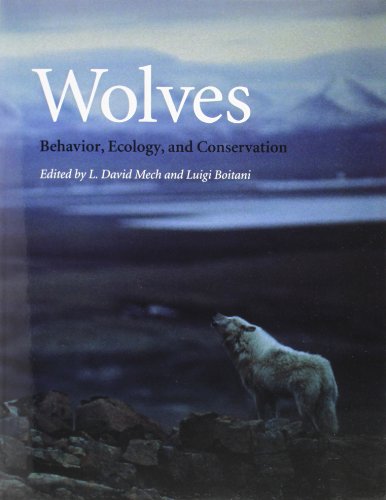
Wolves: Behavior, Ecology, and Conservation
Verlag:
The University of Chicago Press, 2007
ISBN 10: 0226516970
ISBN 13: 9780226516974
Gebraucht
Paperback
Anbieter: World of Books (was SecondSale), Montgomery, IL, USA
Verkäuferbewertung 5 von 5 Sternen

Paperback. Zustand: Good. Wolves are some of the world's most charismatic and controversial animals, capturing the imaginations of their friends and foes alike. Highly intelligent and adaptable, they hunt and play together in close-knit packs, sometimes roaming over hundreds of square miles in search of food. Once teetering on the brink of extinction across much of the United States and Europe, wolves have made a tremendous comeback in recent years, thanks to legal protection, changing human attitudes, and efforts to reintroduce them to suitable habitats in North America.As wolf populations have rebounded, scientific studies of them have also flourished. But there hasn't been a systematic, comprehensive overview of wolf biology since 1970. In Wolves, many of the world's leading wolf experts provide state-of-the-art coverage of just about everything you could want to know about these fascinating creatures. Individual chapters cover wolf social ecology, behavior, communication, feeding habits and hunting techniques, population dynamics, physiology and pathology, molecular genetics, evolution and taxonomy, interactions with nonhuman animals such as bears and coyotes, reintroduction, interactions with humans, and conservation and recovery efforts. The book discusses both gray and red wolves in detail and includes information about wolves around the world, from the United States and Canada to Italy, Romania, Saudi Arabia, Israel, India, and Mongolia. Wolves is also extensively illustrated with black and white photos, line drawings, maps, and fifty color plates.Unrivalled in scope and comprehensiveness, Wolves will become the definitive resource on these extraordinary animals for scientists and amateurs alike. ?An excellent compilation of current knowledge, with contributions from all the main players in wolf research. . . . It is designed for a wide readership, and certainly the language and style will appeal to both scientists and lucophiles alike. . . . This is an excellent summary of current knowledge and will remain the standard reference work for a long time to come.??Stephen Harris, New Scientist ?This is the place to find almost any fact you want about wolves.??Stephen Mills, BBC Wildlife Magazine. Bestandsnummer des Verkäufers 00107538699
Gebraucht kaufen
EUR 23,61
Versand gratis
Versand innerhalb von USA
Versand innerhalb von USA
Anzahl: 2 verfügbar
Beispielbild für diese ISBN
Wolves: Behavior, Ecology, and Conservation
Verlag:
The University of Chicago Press, 2007
ISBN 10: 0226516970
ISBN 13: 9780226516974
Gebraucht
Paperback
Anbieter: World of Books Inc, Montgomery, IL, USA
Verkäuferbewertung 4 von 5 Sternen

Paperback. Zustand: Good. Wolves are some of the world's most charismatic and controversial animals, capturing the imaginations of their friends and foes alike. Highly intelligent and adaptable, they hunt and play together in close-knit packs, sometimes roaming over hundreds of square miles in search of food. Once teetering on the brink of extinction across much of the United States and Europe, wolves have made a tremendous comeback in recent years, thanks to legal protection, changing human attitudes, and efforts to reintroduce them to suitable habitats in North America.As wolf populations have rebounded, scientific studies of them have also flourished. But there hasn't been a systematic, comprehensive overview of wolf biology since 1970. In Wolves, many of the world's leading wolf experts provide state-of-the-art coverage of just about everything you could want to know about these fascinating creatures. Individual chapters cover wolf social ecology, behavior, communication, feeding habits and hunting techniques, population dynamics, physiology and pathology, molecular genetics, evolution and taxonomy, interactions with nonhuman animals such as bears and coyotes, reintroduction, interactions with humans, and conservation and recovery efforts. The book discusses both gray and red wolves in detail and includes information about wolves around the world, from the United States and Canada to Italy, Romania, Saudi Arabia, Israel, India, and Mongolia. Wolves is also extensively illustrated with black and white photos, line drawings, maps, and fifty color plates.Unrivalled in scope and comprehensiveness, Wolves will become the definitive resource on these extraordinary animals for scientists and amateurs alike. ?An excellent compilation of current knowledge, with contributions from all the main players in wolf research. . . . It is designed for a wide readership, and certainly the language and style will appeal to both scientists and lucophiles alike. . . . This is an excellent summary of current knowledge and will remain the standard reference work for a long time to come.??Stephen Harris, New Scientist ?This is the place to find almost any fact you want about wolves.??Stephen Mills, BBC Wildlife Magazine. Bestandsnummer des Verkäufers CIN0226516970G
Gebraucht kaufen
EUR 25,44
Versand gratis
Versand innerhalb von USA
Versand innerhalb von USA
Anzahl: 2 verfügbar
Beispielbild für diese ISBN
Wolves: Behavior, Ecology, and Conservation
Verlag:
University of Chicago Press, 2007
ISBN 10: 0226516970
ISBN 13: 9780226516974
Gebraucht
Paperback
Anbieter: ThriftBooks-Dallas, Dallas, TX, USA
Verkäuferbewertung 5 von 5 Sternen
Paperback. Zustand: Very Good. No Jacket. May have limited writing in cover pages. Pages are unmarked. ~ ThriftBooks: Read More, Spend Less. Bestandsnummer des Verkäufers G0226516970I4N00
Gebraucht kaufen
EUR 27,27
Versand gratis
Versand innerhalb von USA
Versand innerhalb von USA
Anzahl: 1 verfügbar
Beispielbild für diese ISBN
Wolves: Behavior, Ecology, and Conservation
Verlag:
University of Chicago Press, 2007
ISBN 10: 0226516970
ISBN 13: 9780226516974
Gebraucht
Paperback
Anbieter: ThriftBooks-Atlanta, AUSTELL, GA, USA
Verkäuferbewertung 5 von 5 Sternen
Paperback. Zustand: Very Good. No Jacket. May have limited writing in cover pages. Pages are unmarked. ~ ThriftBooks: Read More, Spend Less. Bestandsnummer des Verkäufers G0226516970I4N00
Gebraucht kaufen
EUR 27,27
Versand gratis
Versand innerhalb von USA
Versand innerhalb von USA
Anzahl: 1 verfügbar
Foto des Verkäufers
Wolves: Behavior, Ecology, and Conservation
Verlag:
University of Chicago Press, 2007
ISBN 10: 0226516970
ISBN 13: 9780226516974
Gebraucht
Softcover
Anbieter: Greenworld Books, Arlington, TX, USA
Verkäuferbewertung 5 von 5 Sternen
Zustand: very_good. Fast Free Shipping â" Very Good condition book with a firm cover and clean pages. Shows normal use and some light wear or limited notes markings. A solid, nice copy to enjoy. Bestandsnummer des Verkäufers GWV.0226516970.VG
Gebraucht kaufen
EUR 27,27
Versand gratis
Versand innerhalb von USA
Versand innerhalb von USA
Anzahl: 1 verfügbar
Beispielbild für diese ISBN
Wolves: Behavior, Ecology, and Conservation
Anbieter: Russell Books, Victoria, BC, Kanada
Verkäuferbewertung 5 von 5 Sternen
paperback. Zustand: Good. Bestandsnummer des Verkäufers FORT945546
Gebraucht kaufen
EUR 13,75
EUR 17,81 Versand
Versand von Kanada nach USA
Versand von Kanada nach USA
Anzahl: 1 verfügbar
Beispielbild für diese ISBN
Wolves: Behavior, Ecology, and Conservation
Verlag:
University of Chicago Press, 2007
ISBN 10: 0226516970
ISBN 13: 9780226516974
Gebraucht
Paperback
Anbieter: Midtown Scholar Bookstore, Harrisburg, PA, USA
Verkäuferbewertung 5 von 5 Sternen
Paperback. Zustand: Very Good. Very Good - Crisp, clean, unread book with some shelfwear/edgewear, may have a remainder mark - NICE Oversized. PAPERBACK. Bestandsnummer des Verkäufers M0226516970Z2
Gebraucht kaufen
EUR 27,96
EUR 5,34 Versand
Versand innerhalb von USA
Versand innerhalb von USA
Anzahl: 1 verfügbar
Beispielbild für diese ISBN
Wolves: Behavior, Ecology, and Conservation [Paperback] Mech, L. David and Boitani, Luigi
Verlag:
University of Chicago Press, 2007
ISBN 10: 0226516970
ISBN 13: 9780226516974
Gebraucht
paperback
Anbieter: Melville Park Books, Northfield, MA, USA
Verkäuferbewertung 5 von 5 Sternen
paperback. Zustand: Very Good. Clean and sound copy. Bestandsnummer des Verkäufers AA4WOL
Gebraucht kaufen
EUR 31,20
EUR 4,23 Versand
Versand innerhalb von USA
Versand innerhalb von USA
Anzahl: 1 verfügbar
Beispielbild für diese ISBN
Wolves : Behavior, Ecology, And Conservation
Verlag:
University of Chicago Press, 2007
ISBN 10: 0226516970
ISBN 13: 9780226516974
Gebraucht
Softcover
Anbieter: GreatBookPrices, Columbia, MD, USA
Verkäuferbewertung 5 von 5 Sternen
Zustand: As New. Unread book in perfect condition. Bestandsnummer des Verkäufers 4293445
Gebraucht kaufen
EUR 42,46
EUR 2,35 Versand
Versand innerhalb von USA
Versand innerhalb von USA
Anzahl: 3 verfügbar
Beispielbild für diese ISBN
Wolves
Anbieter: PBShop.store UK, Fairford, GLOS, Vereinigtes Königreich
Verkäuferbewertung 5 von 5 Sternen
PAP. Zustand: New. New Book. Shipped from UK. Established seller since 2000. Bestandsnummer des Verkäufers GB-9780226516974
Neu kaufen
EUR 37,45
EUR 9,09 Versand
Versand von Vereinigtes Königreich nach USA
Versand von Vereinigtes Königreich nach USA
Anzahl: 1 verfügbar