
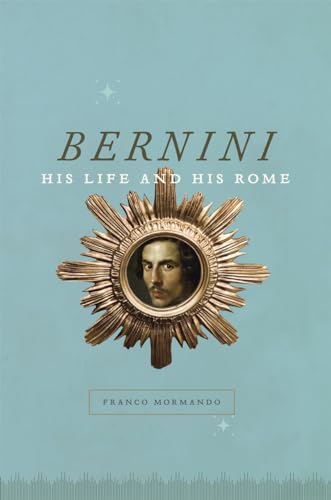
Bernini: His Life and His Rome (Emersion: Emergent Village resources for communities of faith) - Hardcover
Inhaltsangabe
Sculptor, architect, painter, playwright, and scenographer, Gian Lorenzo Bernini (1598–1680) was the last of the great universal artistic geniuses of early modern Italy, placed by both contemporaries and posterity in the same exalted company as Leonardo, Raphael, and Michelangelo. And his artistic vision remains palpably present today, through the countless statues, fountains, and buildings that transformed Rome into the Baroque theater that continues to enthrall tourists today.
It is perhaps not surprising that this artist who defined the Baroque should have a personal life that itself was, well, baroque. As Franco Mormando’s dazzling biography reveals, Bernini was a man driven by many passions, possessed of an explosive temper and a hearty sex drive, and he lived a life as dramatic as any of his creations. Drawing on archival sources, letters, diaries, and—with a suitable skepticism—a hagiographic account written by Bernini’s son (who portrays his father as a paragon of virtue and piety), Mormando leads us through Bernini’s many feuds and love affairs, scandals and sins. He sets Bernini’s raucous life against a vivid backdrop of Baroque Rome, bustling and wealthy, and peopled by churchmen and bureaucrats, popes and politicians, schemes and secrets.
The result is a seductively readable biography, stuffed with stories and teeming with life—as wild and unforgettable as Bernini’s art. No one who has been bewitched by the Baroque should miss it.
Die Inhaltsangabe kann sich auf eine andere Ausgabe dieses Titels beziehen.
Über die Autorin bzw. den Autor
Franco Mormando is associate professor of Italian at Boston College and the author of several books.
Auszug. © Genehmigter Nachdruck. Alle Rechte vorbehalten.
BERNINI
HIS LIFE AND HIS ROMEBy FRANCO MORMANDOUniversity of Chicago Press
Copyright © 2011 The University of ChicagoAll right reserved.
ISBN: 978-0-226-53852-5
Contents
Preface: The First English-Language Biography of Bernini.....................ixAcknowledgments..............................................................xiiiWebsite Information..........................................................xvMoney, Wages, and Cost of Living in Baroque Rome.............................xviiAbbreviations................................................................xxi1. THE NEAPOLITAN METEOR.....................................................12. IMPRESARIO SUPREME........................................................663. BERNINI'S AGONY AND ECSTASY...............................................1444. BERNINI AND ALEXANDER.....................................................1955. A ROMAN ARTIST IN KING LOUIS'S COURT......................................2456. "MY STAR WILL LOSE ITS ASCENDANCY"........................................289Notes........................................................................353Works Cited..................................................................377Index........................................................................391
Chapter One
THE NEAPOLITAN METEOR
A Twelve-Year-Old Pregnant Bride
Pedophilia is what we would call it today—a man of twenty-five marrying a twelve-year-old girl—but in premodern Europe, it was, if not common, nonetheless perfectly legal. It had been perfectly legal as far back as anyone could remember and was to remain so for generations to come in the eyes of both church and state. Once the two parties had reached puberty—twelve for girls, fourteen for boys—the law allowed the contracting of marriage, no matter how great the difference in years between husband and wife. And so, in a private, at-home ceremony in Naples, on January 17, 1587, Gian Lorenzo Bernini's father, Tuscan sculptor Pietro, born in 1562, was joined in matrimony with the Neapolitan maiden Angelica di Giovanni Galante. Angelica, according to their marriage registration, was "about twelve years old." Choosing for one's spouse a much younger girl, a child-bride with an impressionable mind and pliable will, was in those days considered by men to be practical and praiseworthy: all the easier to shape her into the perfect wife—silent, submissive, patient. The chances were that her virtue was also intact—in other words, she would still be a virgin. Furthermore, her youth and vigor would guarantee years of successful childbearing and efficient housekeeping, especially given the frightfully low life expectancy for women back then. The church, too, seemed to actively encourage marriage between a young girl and a vastly older man. After all, did it not unceasingly offer as marital role models the "perfect" wedded couple, Saint Joseph and his bride Mary, mother of Jesus Christ? Today with the Christ Child, they can be seen depicted in ecclesiastical art in every corner of Catholic Europe as "The Holy Family," he an old man with white hair and wrinkled skin and, she hardly more than a blushing adolescent.
However, though legal in the eyes of the state and licit in the eyes of the church, marriage at twelve (or fourteen) years old was in fact not common at the time and would have raised some eyebrows, to be sure. So why did Pietro risk public ridicule by robbing the cradle to secure a bride? What was it about her charm, or perhaps, her dowry? The record is silent on the latter question, but a small detail in the surviving documentation suggests a compelling scenario: the obligatory banns announcing a future marriage between engaged persons are normally published on three separate occasions over a broad stretch of time. But here, in the case of Pietro and Angelica, these notices were hurriedly compressed by the parish priest into the brief span of just one week, right before the ceremony itself: January 4, 6, and 11. In this Catholic time and place, in the absence of imminent death or departure for war, this could only mean one thing: the bride was already pregnant and the marriage was one of face-saving reparation. This is never a happy way to begin a marriage. Yet, despite its hasty beginning, the union between Pietro and Angelica proved long-lasting and was, we presume, reasonably content; it ended only with death (his in 1629, hers in 1647), having produced thirteen children. How ironically fitting, nonetheless, that one of the first things we know about Gian Lorenzo Bernini's family history should be this fact of slightly disordered sexual conduct. The artist himself would play out a similar dynamic in his own adult life.
Having been rushed perhaps unwillingly into marriage, poor Pietro was soon to learn that his first-born child was not a son who would proudly carry his name forward and hopefully marry into a rich family higher up on the social scale. Instead it was a daughter, a burden of a child, who would need to be married off at the price of an exorbitant dowry or else sent off, kicking and screaming if necessary, to a nunnery—which even then meant paying out a dowry, albeit somewhat smaller. Pietro could not have been pleased. In any case, the infant girl was baptized Agnese and, like the early Christian martyr whose name she bore, was unfortunately to have a short life: she died in Rome in October 1609, as wife of a Tuscan painter of note, Agostino Ciampelli, future collaborator and foe of Gian Lorenzo's on major projects such as the Baldacchino in St. Peter's Basilica. Poor Pietro for not having gotten immediately his first-born son, but poorer even still Angelica, who had to keep producing children until the arrival of a male heir, and then some. After Agnese came an unbroken, anxiety-raising series of four more daughters (Emiliana, Dorotea, Eugenia, and Giuditta) and then, at long last, on December 7, 1598, the first boy, our Gian Lorenzo. He was followed by two more girls, Camilla and Beatrice, but the final issue was all male: Francesco, Vincenzo, Luigi, Ignazio, and Domenico. These last four children were born in Rome, where the family had moved in late 1606, Angelica giving birth to the last of her thirteen children, Domenico, in December 1616. Of all his siblings, Bernini would be closest to his younger brother Luigi (born 1610), at least professionally. The talented engineer-sculptor Luigi would serve as Gian Lorenzo's indispensable right-hand man throughout his career, despite the violent emotional storms that erupted in their relationship at a couple of junctures.
Since Gian Lorenzo was born after a series of five daughters, Pietro, fearing he would get no further male heirs, gave his first son two names, that of his own grandfather and father, Giovanni (John) and Lorenzo (Lawrence). However, as an adult, our artist seems to have considered his real name simply Lorenzo. The most detailed contemporary biography of Bernini—compiled during the last years of his life by his youngest son, Domenico—tells us that one of the first, mature sculptures of Bernini's early artistic adulthood was executed (in 1617) as an "act of pious devotion" in honor of his patron saint, Saint Lawrence on the fiery grill. Saint Lawrence's feast, August 10, Bernini considered his "name day," as he was to later mention to his Parisian friend, the diarist Paul Fréart de Chantelou. Bernini's first name, Giovanni, in the surviving documentation, is usually reduced to the...
„Über diesen Titel“ kann sich auf eine andere Ausgabe dieses Titels beziehen.
Weitere beliebte Ausgaben desselben Titels

Suchergebnisse für Bernini: His Life and His Rome (Emersion: Emergent...

Beispielbild für diese ISBN
Bernini : His Life and His Rome
Verlag:
University of Chicago Press, 2011
ISBN 10: 0226538524
ISBN 13: 9780226538525
Gebraucht
Hardcover
Anbieter: Better World Books, Mishawaka, IN, USA
Verkäuferbewertung 5 von 5 Sternen

Zustand: Very Good. Former library copy. Pages intact with possible writing/highlighting. Binding strong with minor wear. Dust jackets/supplements may not be included. Includes library markings. Stock photo provided. Product includes identifying sticker. Better World Books: Buy Books. Do Good. Bestandsnummer des Verkäufers GRP77001958
Gebraucht kaufen
EUR 13,15
Versand gratis
Versand innerhalb von USA
Versand innerhalb von USA
Anzahl: 1 verfügbar
Beispielbild für diese ISBN
Bernini : His Life and His Rome
Verlag:
University of Chicago Press, 2011
ISBN 10: 0226538524
ISBN 13: 9780226538525
Gebraucht
Hardcover
Anbieter: Better World Books, Mishawaka, IN, USA
Verkäuferbewertung 5 von 5 Sternen
Zustand: Good. Former library copy. Pages intact with minimal writing/highlighting. The binding may be loose and creased. Dust jackets/supplements are not included. Includes library markings. Stock photo provided. Product includes identifying sticker. Better World Books: Buy Books. Do Good. Bestandsnummer des Verkäufers 347859-6
Gebraucht kaufen
EUR 13,15
Versand gratis
Versand innerhalb von USA
Versand innerhalb von USA
Anzahl: 2 verfügbar
Foto des Verkäufers
Bernini: His Life and His Rome
Verlag:
University of Chicago Press, 2011
ISBN 10: 0226538524
ISBN 13: 9780226538525
Gebraucht
Hardcover
Erstausgabe
Anbieter: Turn-The-Page Books, Skyway, WA, USA
Verkäuferbewertung 5 von 5 Sternen
Hardcover. Zustand: Very Good. Zustand des Schutzumschlags: Very Good. First Edition. 1st printing. Unmarked copy in full cloth binding. Shows light reading wear. 429pp. Jacket has a crease to front flap. Size: 8vo - 8" - 9" Tall. Bestandsnummer des Verkäufers 074276
Gebraucht kaufen
EUR 15,67
EUR 4,56 Versand
Versand innerhalb von USA
Versand innerhalb von USA
Anzahl: 1 verfügbar
Beispielbild für diese ISBN
Bernini His Life and His Rome
Anbieter: Revaluation Books, Exeter, Vereinigtes Königreich
Verkäuferbewertung 5 von 5 Sternen
Hardcover. Zustand: Brand New. 456 pages. 9.10x6.20x1.40 inches. In Stock. Bestandsnummer des Verkäufers 0226538524
Neu kaufen
EUR 99,88
EUR 14,29 Versand
Versand von Vereinigtes Königreich nach USA
Versand von Vereinigtes Königreich nach USA
Anzahl: 1 verfügbar