
Verwandte Artikel zu Justice Scalia: Rhetoric and the Rule of Law
Inhaltsangabe
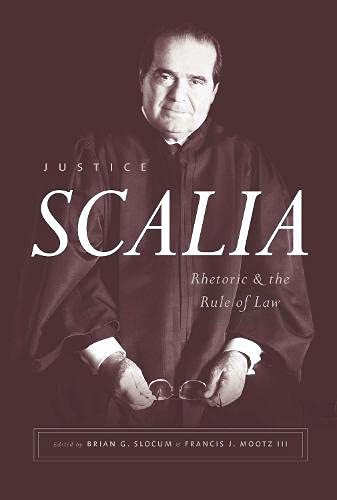
Justice Antonin Scalia (1936&;2016) was the single most important figure in the emergence of the &;new originalist&; interpretation of the US Constitution, which sought to anchor the court&;s interpretation of the Constitution to the ordinary meaning of the words at the time of drafting. For Scalia, the meaning of constitutional provisions and statutes was rigidly fixed by their original meanings with little concern for extratextual considerations. While some lauded his uncompromising principles, others argued that such a rigid view of the Constitution both denies and attempts to limit the discretion of judges in ways that damage and distort our system of law.
In this edited collection, leading scholars from law, political science, philosophy, rhetoric, and linguistics look at the ways Scalia framed and stated his arguments. Focusing on rhetorical strategies rather than the logic or validity of Scalia&;s legal arguments, the contributors collectively reveal that Scalia enacted his rigidly conservative vision of the law through his rhetorical framing.
In this edited collection, leading scholars from law, political science, philosophy, rhetoric, and linguistics look at the ways Scalia framed and stated his arguments. Focusing on rhetorical strategies rather than the logic or validity of Scalia&;s legal arguments, the contributors collectively reveal that Scalia enacted his rigidly conservative vision of the law through his rhetorical framing.
Die Inhaltsangabe kann sich auf eine andere Ausgabe dieses Titels beziehen.
Über die Autorin bzw. den Autor
Brian G. Slocum and Francis J. Mootz III are professors of law at the University of the Pacific, McGeorge School of Law in Sacramento, California.
Auszug. © Genehmigter Nachdruck. Alle Rechte vorbehalten.
Justice Scalia
Rhetoric and the Rule of Law
By Brian G. Slocum, Francis J. Mootz IIIThe University of Chicago Press
Copyright © 2019 The University of Chicago
All rights reserved.
ISBN: 978-0-226-60165-6All rights reserved.
Contents
Introduction Francis J. Mootz III and Brian G. Slocum,
PART 1 The Rhetoric of Constitutional Adjudication,
1 Scalia as Procrustes for the Majority, Scalia as Cassandra in Dissent Mary Anne Case,
2 Justice Scalia's Philosophy of Interpretation: From Textualism to Deferentialism Scott Soames,
3 Power Victoria Nourse,
PART 2 The Rhetoric of Statutory Textualism,
4 No Vehicles on Mars Brian G. Slocum,
5 The Two Justice Scalias Lawrence M. Solan,
6 Textualism without Formalism: Justice Scalia's Statutory Interpretation Legacy Abbe R. Gluck,
7 Party Like It's 1989: Justice Scalia's Rhetoric of Certainty Francis J. Mootz III,
PART 3 Applied Rhetorical Theory,
8 God's Justice, Scalia's Rhetoric, and Interpretive Politics Steven Mailloux,
9 Rhetoric, Jurisprudence, and the Case of Justice Scalia; Or, Why Did Justice Scalia, of All Judges, Write Like That? Darien Shanske,
10 No Reasonable Person George H. Taylor, Matthew L. Jockers, and Fernando Nascimento,
11 Justice Scalia and Family Law Brian H. Bix,
PART 4 Rhetorical Criticism of Heller,
12 Guns and Preludes Eugene Garver,
13 Of Guns and Grammar: Justice Scalia's Rhetoric Peter Brooks,
PART 5 The Rhetoric of the Past,
14 A Separate, Abridged Edition of the First Amendment Colin Starger,
15 Rhetorical Constructions of Precedent: Justice Scalia's Free-Exercise Opinion Linda L. Berger,
16 Justice Scalia's Rhetoric of Overruling: Throwing Out the (Institutional) Baby with the Bathwater Clarke Rountree,
Notes,
Contributors,
Index of Cases,
Index of Subjects,
CHAPTER 1
Scalia as Procrustes for the Majority, Scalia as Cassandra in Dissent
Mary Anne Case
The late U.S. Supreme Court Justice Antonin Scalia was infamous for the prose style of his dissenting opinions, frequently described with adjectives such as "vitriolic," "derisive," and, putting it mildly, "colorful." In a single, not unrepresentative, dissent — that in the Affordable Care Act (Obamacare) case of King v. Burwell — Scalia characterized the majority opinion, written by Chief Justice John Roberts, as "quite absurd," "with no semblance of shame," "feeble," full of "interpretive jiggery-pokery," and "pure applesauce." His description of opinions written by more liberal and more junior justices could be even more intemperate.
In this essay, I want to focus on another, less frequently remarked upon quality of Scalia's dissents, which is their tendency to warn prophetically of the consequences that would follow from the logic of the decision just taken or the rule just articulated by a majority of his fellow justices, consequences denied or ignored at the time by the majority. In these dissents, Scalia behaves somewhat like the Trojan princess Cassandra, whose gift of prophecy came with the curse that she would not be believed, and whose clear-eyed warnings as a consequence went unheeded until the time when what they predicted came to pass. Like Cassandra, Scalia is on the losing side of many of his prophecies — what he is predicting is the exact opposite of what he wants to see happen. Every battle, however, is necessarily both "lost and won," so that what is bad news for the Trojans is good news for the Greeks, and what Scalia sees as the catastrophic consequences of a decision are most welcome from the perspective of his ideological opponents. In describing what for him are the horrors that will follow from the majority's logic, he often paints a prophetic picture which in time comes true, perhaps in part because of rather than in spite of his dramatic articulation of an opinion's implications.
The essay then uses another Greek myth, that of Procrustes, to shed light on a tendency in Scalia's majority opinions. Just as Procrustes forced his guests to fit snugly into an iron bed, stretching out their bodies or chopping off their limbs as necessary, so Scalia frequently forced all prior doctrine in a given area of law into the shape he needed for the new rule he announces in a majority opinion. As with Procrustes's unfortunate guests, so with Scalia's procrustean majority opinions: the result, I shall argue, is often that the operation is a success, but the patient dies. Subsequent decisions, whether by courts or legislatures, tend to back away from the implications of the categorical rule Scalia had gone through such pains to fashion. The paradoxical result is that Scalia as Cassandra dissenting has sometimes been more effective in illuminating the path to results he deplores than Scalia as Procrustes has been in bringing about results he favors. This is so notwithstanding that Scalia in procrustean mode does his rhetorical best to minimize the innovative or controversial character of his holding for the majority, whereas Scalia in dissent seeks rhetorically to maximize the unprecedented and revolutionary character of the majority position to which he objects.
The Cassandra of Gay Rights
The clearest example of Scalia as Cassandra is in the progression of the U.S. Supreme Court's gay rights cases from Romer v. Evans through Obergefell v. Hodges, and I use these to illustrate the phenomenon. In Romer, the Supreme Court struck down an amendment to the Colorado constitution that disadvantaged gays, lesbians, and bisexuals, without so much as mentioning its own prior precedent of Bowers v. Hardwick, which had upheld criminal penalties for homosexual sex. For Scalia, this was a "contradict[ion]" because "[i]f the Court [in Bowers] was unwilling to object to state laws that criminalize the behavior that defines the class, it is hardly open ... to conclude that state sponsored discrimination against the class is invidious. After all, there can hardly be more palpable discrimination against a class than making the conduct that defines the class criminal.'" Although there were good reasons for the Court to see Colorado's Amendment 2 as constitutionally problematic, even with respect to a class whose behavior could be criminalized, within a decade the Court, in Lawrence v. Texas, agreed with Scalia that the "foundations of Bowers have sustained serious erosion from ... Romer," and the decision should be overruled. While it held in Lawrence that private, consensual, adult homosexual sex could no longer constitutionally be criminalized, the Court insisted its decision "[did] not involve whether the government must give formal recognition to any relationship that homosexual persons seek to enter." Scalia's responded in dissent:
Do not believe it. More illuminating than this bald, unreasoned disclaimer is the progression of thought displayed by an earlier passage in the Court's opinion, which notes the constitutional protections afforded to "personal decisions relating to marriage, procreation, contraception, family relationships, child rearing, and education," and then declares that "persons in a homosexual relationship may seek autonomy for these purposes, just as heterosexual persons do." ... Today's opinion dismantles the structure of constitutional law that has permitted a distinction to be made between heterosexual and homosexual unions, insofar as formal recognition in marriage is concerned.
He was proven right by...
„Über diesen Titel“ kann sich auf eine andere Ausgabe dieses Titels beziehen.
Suchergebnisse für Justice Scalia: Rhetoric and the Rule of Law

Beispielbild für diese ISBN
Justice Scalia: Rhetoric and the Rule of Law
Verlag:
University of Chicago Press, 2019
ISBN 10: 022660165X
ISBN 13: 9780226601656
Gebraucht
Hardcover
Anbieter: Midtown Scholar Bookstore, Harrisburg, PA, USA
Verkäuferbewertung 5 von 5 Sternen

Hardcover. Zustand: Good. HARDCOVER Good - Bumped and creased book with tears to the extremities, but not affecting the text block, may have remainder mark or previous owner's name - GOOD Standard-sized. Bestandsnummer des Verkäufers M022660165XZ3
Gebraucht kaufen
EUR 73,48
EUR 5,30 Versand
Versand innerhalb von USA
Versand innerhalb von USA
Anzahl: 2 verfügbar