
Verwandte Artikel zu A Fistful of Shells: West Africa from the Rise of the...
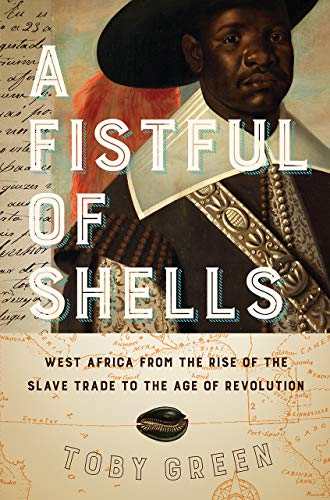
A Fistful of Shells: West Africa from the Rise of the Slave Trade to the Age of Revolution - Hardcover
Inhaltsangabe
By the time the &;Scramble for Africa&; among European colonial powers began in the late nineteenth century, Africa had already been globally connected for centuries. Its gold had fueled the economies of Europe and the Islamic world for nearly a millennium, and the sophisticated kingdoms spanning its west coast had traded with Europeans since the fifteenth century. Until at least 1650, this was a trade of equals, using a variety of currencies&;most importantly, cowrie shells imported from the Maldives and nzimbu shells imported from Brazil. But, as the slave trade grew, African kingdoms began to lose prominence in the growing global economy. We have been living with the effects of this shift ever since. 
With A Fistful of Shells, Toby Green transforms our view of West and West-Central Africa by reconstructing the world of these kingdoms, which revolved around trade, diplomacy, complex religious beliefs, and the production of art. Green shows how the slave trade led to economic disparities that caused African kingdoms to lose relative political and economic power. The concentration of money in the hands of Atlantic elites in and outside these kingdoms brought about a revolutionary nineteenth century in Africa, parallel to the upheavals then taking place in Europe and America. Yet political fragmentation following the fall of African aristocracies produced radically different results as European colonization took hold.
Drawing not just on written histories, but on archival research in nine countries, art, oral history, archaeology, and letters, Green lays bare the transformations that have shaped world politics and the global economy since the fifteenth century and paints a new and masterful portrait of West Africa, past and present.
Die Inhaltsangabe kann sich auf eine andere Ausgabe dieses Titels beziehen.
Über die Autorinnen und Autoren
Toby Green is a senior lecturer in Lusophone African history and culture at King&;s College London and is author of The Rise of the Trans-Atlantic Slave Trade in Western Africa, 1300&;1589.
Toby Green is a senior lecturer in Lusophone African history and culture at King's College London and is author of The Rise of the Trans-Atlantic Slave Trade in Western Africa, 1300'1589.
Auszug. © Genehmigter Nachdruck. Alle Rechte vorbehalten.
A Fistful of Shells
West Africa from the Rise of the Slave Trade to the Age of Revolution
By Toby GreenThe University of Chicago Press
Copyright © 2019 Toby Green
All rights reserved.
ISBN: 978-0-226-64457-8All rights reserved.
Contents
List of Maps,
Foreword,
Note on Spellings/Names,
Glossary,
Introduction,
PART ONE,
Causes: Economic Divergence in West and West-Central Africa,
Timelines for Part One,
1. 'Three Measures of Gold': The Rise and Fall of the Great Empires of the Sahel,
2. Causeways across the Savannah: From Senegambia to Sierra Leone,
3. Ready Money: The Gold Coast and the Gold Trade,
4. Rivers of Cloth, Masks of Bronze: The Bights of Benin and Biafra,
5. The Kingdom of Kongo: From Majesty to Revolt,
Coda to Part One,
PART TWO,
Consequences: Politics, Belief and Revolutions from Below,
Timeline for Part Two: West African Political History, c. 1680–1850,
Prologue to Part Two,
6. 'With Boots Worth 3 Slaves': Slavery and Value in the Eighteenth Century,
7. On a War Footing: The 'Fiscal-Military State' in West African Politics,
8. Feeding Power: New Societies, New Worldviews,
9. Transnational Africas, Struggle and the Rising of Modernity,
10. Warrior Aristocracies and Pushback from Below,
11. Let them Drink Rum! Islam, Revolution and the Aristocracy,
Conclusion,
Bibliography,
Notes,
List of Illustrations,
Index,
CHAPTER 1
'Three Measures of Gold': The Rise and Fall of the Great Empires of the Sahel
The landscape of West Africa is filled with relics of a past that few today in or outside Africa know much about. On the north bank of the Gambia River lie the Wassu stone circles, built sometime in the last few thousand years by cultures of which there is very little awareness today. In the region of Dô, in what is now south-central Mali, huge fields of tumuli lie scattered across a wide area, some of them 50 feet in diameter. The large walled fortress of Loropéni, perhaps dating from the seventeenth century, or perhaps earlier, now lies scattered in the bush of southern Burkina Faso. In southern Nigeria, earthen defences known as eredos, 33 feet tall and over 100 miles in length, and dating from the fourteenth century, are found in Ijebu. In many coastal and riverine regions, it is easy to come across enormous shellfish middens, piled up over the centuries by peoples whose names and beliefs have by and large been forgotten.
For decades, outside a small circle of passionately dedicated scholars, these African pasts have suffered neglect. Yet they reveal ancient civilizations and a history whose relevance is absolutely contemporary. As early as the seventh century BCE, the Nok culture that grew around the plateau region of what is now central and northern Nigeria had developed agriculture and iron production. The settlement of Jenne-jenò in the inland delta of the Niger River had grown to a population of around 4,000 people by 400 CE, and had grown to as many as 26,000 by 800 CE. This growth was supported by rice production developed through iron tools smelted by local smiths. The iron ore was brought from around 30 miles away, while copper ornaments found in burial chambers probably came from much further afield, in the Sahara. Meanwhile, digs in the Upper Senegal River Valley have shown a similar trade in copper artefacts by around 500–700 CE, where they were traded for cloth produced on spindle-looms.
For most historians, though, Africa has always been 'outside history'. It is, after all, easy enough to dismiss something when you know little or nothing about it. Yet globalization came so early to many parts of Africa that one Chinese chronicle claims that ambassadors from the region of Ethiopia went to the Chinese Court around 150 BCE. It's hard to imagine the Celts or the Jutes before the time of Christ doing the same. African trade connections expanded rapidly, especially after around the year 700 CE. By around 1000, Madagascar was linked to China through the trading town of Kilwa, located on an island off the coast of southern Tanzania and founded by a Persian sultan in the eleventh century. Many artefacts of Chinese porcelain found in recent excavations of Kilwa have confirmed the very extensive long-distance connections here from an early time.
In West Africa, the pattern is similar. Early cave paintings from the era of Jenne-jenò reveal chariots with wheels, suggesting that this was a technology known in West Africa, either from long-distance trade to the Mediterranean or through local use. Analysis by archaeologists of the gold coins used in Tunis and Libya suggests a major change around the ninth century ce, when gold from the forest regions of what are now Ghana and Ivory Coast was dug out in large quantities and exported through networks of local traders. By the eleventh century, there were important mints in cities from Sigilmasa in Morocco to a variety of cities along the Mediterranean coast, and the trans-Saharan trade from the states of West Africa influenced the commercial and cultural worlds of Al-Andalus in Spain.
If this surprises some readers, it is because 'History' as a subject has developed a rather selective memory over the years. There was a time when this was well known to many. One example is the Catalan Atlas, compiled by the Majorcan Jewish cartographer Abraham Cresques in around 1375. Here, the Emperor of Mali (rey Melli) sits enthroned with a sceptre and golden crown, dressed in elegant robes. In his right hand he extends a golden nugget to a North African trader, mounted on horseback, who emerges, his face wrapped in cloth, from the nomadic encampments of the Western Sahara. Across the Atlas Mountains, trade routes crisscross the desert towards North Africa, and some of them extend across the Mediterranean to the Iberian Peninsula. It is a powerful representation of the ways in which West African kings interacted with the Mediterranean worlds through the gold trade almost 650 years ago. It shows us how keen European rulers were to find out about Africa, and that, in fact, some of them already knew quite a bit about it.
From his Majorcan home, Cresques designed the Atlas using information from travellers who knew both North Africa and the trans-Saharan trading routes. Cresques also built on the well-known pilgrimage of the Emperor of Mali, Mansa Musa, to Mecca in 1324–5; and he relied on longstanding trade routes linking Jewish communities in Saharan oases such as Tuwat in Algeria and Sigilmasa in Morocco with both West African kingdoms further south and Jewishcommunities in the Iberian worlds. Looked at like this, the Atlas is the product of centuries of cross-cultural exchange. Cities of the Mediterranean world such as Cairo, Lisbon, Seville and Tripoli did not impose themselves on West Africa and dominate their peoples; instead, West African and Mediterranean societies emerged like the Catalan Atlas, through trade and reciprocal exchanges.
This chapter suggests how the histories of West African peoples and states before the rise of Atlantic trade require a rethink of embedded ideas. The Catalan Atlas speaks of networks and pathways of connection that have been covered over by the dust of time. The idea of Jewish mapmakers from the Balearic Islands having connections in distant Mali startles, just as, fifteen years ago, walking in the backyard of a house in Assomada, in the highlands of the largest Cape Verdean island of Santiago, I was startled to come...
„Über diesen Titel“ kann sich auf eine andere Ausgabe dieses Titels beziehen.
Suchergebnisse für A Fistful of Shells: West Africa from the Rise of the...

Foto des Verkäufers
A Fistful of Shells: West Africa from the Rise of the Slave Trade to the Age of Revolution
Verlag:
University of Chicago Press, 2019
ISBN 10: 022664457X
ISBN 13: 9780226644578
Gebraucht
Hardcover
Anbieter: Goodbooks Company, Springdale, AR, USA
Verkäuferbewertung 5 von 5 Sternen

Zustand: good. Ex library book with stickers and stamps. Bestandsnummer des Verkäufers GBV.022664457X.G
Gebraucht kaufen
EUR 53,22
EUR 4,47 Versand
Versand innerhalb von USA
Versand innerhalb von USA
Anzahl: 1 verfügbar
Beispielbild für diese ISBN
A Fistful of Shells: West Africa from the Rise of the Slave Trade to the Age of Revolution
Verlag:
University of Chicago Press, 2019
ISBN 10: 022664457X
ISBN 13: 9780226644578
Gebraucht
Hardcover
Anbieter: More Than Words, Waltham, MA, USA
Verkäuferbewertung 5 von 5 Sternen
Zustand: Good. A sound copy with only light wear. Overall a solid copy at a great price! Bestandsnummer des Verkäufers BOS-A-10c-0001676
Gebraucht kaufen
EUR 54,20
EUR 3,57 Versand
Versand innerhalb von USA
Versand innerhalb von USA
Anzahl: 1 verfügbar
Beispielbild für diese ISBN
A Fistful of Shells: West Africa from the Rise of the Slave Trade to the Age of Revolution
Verlag:
University of Chicago Press, 2019
ISBN 10: 022664457X
ISBN 13: 9780226644578
Gebraucht
Hardcover
Anbieter: Night Heron Books, Laramie, WY, USA
Verkäuferbewertung 5 von 5 Sternen
hardcover. Zustand: Very Good. Binding tight.Cover clean.Hardcover.Dust jacket included and in fair condition.Minor wear to page edges and corners.Some minor highlighting in the foward, otherwise, No writing, highlighting, or marks in text. Bestandsnummer des Verkäufers 770607
Gebraucht kaufen
EUR 54,39
EUR 3,80 Versand
Versand innerhalb von USA
Versand innerhalb von USA
Anzahl: 1 verfügbar
Beispielbild für diese ISBN
A Fistful of Shells: West Africa from the Rise of the Slave Trade to the Age of Revolution
Verlag:
University of Chicago Press, 2019
ISBN 10: 022664457X
ISBN 13: 9780226644578
Gebraucht
Hardcover
Anbieter: Midtown Scholar Bookstore, Harrisburg, PA, USA
Verkäuferbewertung 5 von 5 Sternen
Hardcover. Zustand: Good. HARDCOVER Good - Bumped and creased book with tears to the extremities, but not affecting the text block, may have remainder mark or previous owner's name - GOOD Standard-sized. Bestandsnummer des Verkäufers M022664457XZ3
Gebraucht kaufen
EUR 53,72
EUR 5,37 Versand
Versand innerhalb von USA
Versand innerhalb von USA
Anzahl: 3 verfügbar
Beispielbild für diese ISBN
A Fistful of Shells: West Africa from the Rise of the Slave Trade to the Age of Revolution
Anbieter: GoldBooks, Denver, CO, USA
Verkäuferbewertung 5 von 5 Sternen
Hardcover. Zustand: new. New Copy. Customer Service Guaranteed. Bestandsnummer des Verkäufers 29N51_42_022664457X
Neu kaufen
EUR 320,13
EUR 4,92 Versand
Versand innerhalb von USA
Versand innerhalb von USA
Anzahl: 1 verfügbar