
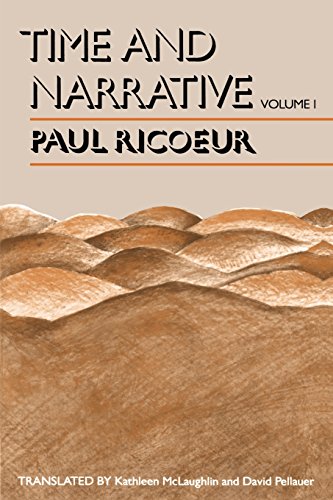
Verwandte Artikel zu Time and Narrative, Volume 1 (Time & Narrative,...
Inhaltsangabe
Time and Narrative builds on Paul Ricoeur's earlier analysis, in The Rule of Metaphor, of semantic innovation at the level of the sentence. Ricoeur here examines the creation of meaning at the textual level, with narrative rather than metaphor as the ruling concern.
Ricoeur finds a "healthy circle" between time and narrative: time is humanized to the extent that it portrays temporal experience. Ricoeur proposes a theoretical model of this circle using Augustine's theory of time and Aristotle's theory of plot and, further, develops an original thesis of the mimetic function of narrative. He concludes with a comprehensive survey and critique of modern discussions of historical knowledge, understanding, and writing from Aron and Mandelbaum in the late 1930s to the work of the Annales school and that of Anglophone philosophers of history of the 1960s and 1970s.
"This work, in my view, puts the whole problem of narrative, not to mention philosophy of history, on a new and higher plane of discussion."—Hayden White, History and Theory
"Superb. . . . A fine point of entrance into the work of one of the eminent thinkers of the present intellectual age."—Joseph R. Gusfield, Contemporary Sociology
Die Inhaltsangabe kann sich auf eine andere Ausgabe dieses Titels beziehen.
Über die Autorin bzw. den Autor
Paul Ricoeur is the John Nuveen Professor Emeritus in the Divinity School, professor of philosophy, and a member of the Committee on Social Thought at the University of Chicago. He was for many years dean of the Faculty of Letters and Human Sciences at the University of Paris X (Nanterre).
Von der hinteren Coverseite
Time and Narrative builds on Paul Ricoeur's earlier analysis, in the The Rule of Metaphor, of semantic innovation at the level of the sentence. Ricoeur here examines the creation of meaning at the textual level, with narrative rather than metaphor as the ruling concern.
Auszug. © Genehmigter Nachdruck. Alle Rechte vorbehalten.
Time and Narrative Volume I
By Paul Ricoeur, Kathleen McLaughlin, David PellauerThe University of Chicago Press
Copyright © 1984 The University of Chicago
All rights reserved.
ISBN: 978-0-226-71332-8All rights reserved.
Contents
Preface,
Part I: The Circle of Narrative and Temporality,
1. The Aporias of the Experience of Time: Book 11 of Augustine's Confessions,
2. Emplotment: A Reading of Aristotle's Poetics,
3. Time and Narrative: Threefold Mimesis,
Part II: History and Narrative,
4. The Eclipse of Narrative,
5. Defenses of Narrative,
6. Historical Intentionality,
Conclusions,
Notes,
Index,
CHAPTER 1
The Aporias of the Experience of Time Book 11 of Augustine's Confessions
The major antithesis around which my reflection will revolve finds its sharpest expression toward the end of Book 11 of Augustine's Confessions. Two features of the human soul are set in opposition to one another, features which the author, with his marked taste for sonorous antithesis, coins intentio and distentio animi. It is this contrast that I shall later compare with that of muthos and peripeteia in Aristotle.
Two prior remarks have to be made. First, I begin my reading of Book 11 of the Confessions at chapter 14:17 with the question: "What, then, is time?" I am not unaware that the analysis of time is set within a meditation on the relations between eternity and time, inspired by the first verse of Genesis, in principio fecit Deus.... In this sense, to isolate the analysis of time from this meditation is to do violence to the text, in a way that is not wholly justified by my intention to situate within the same sphere of reflection the Augustinian antithesis between intentio and distentio and the Aristotelian antithesis between muthos and peripeteia. Nevertheless, a certain justification can be found for this violence in Augustine's own reasoning, which, when it is concerned with time, no longer refers to eternity except to more strongly emphasize the ontological deficiency characteristic of human time and to wrestle directly with the aporias afflicting the conception of time as such. In order to right somewhat this wrong done to Augustine's text, I shall reintroduce the meditation on eternity at a later stage in the analysis with the intention of seeking in it an intensification of the experience of time.
Second, isolated from the meditation on eternity, due to the artifice in method to which I have just admitted, the Augustinian analysis of time offers a highly interrogative and even aporetical character which none of the ancient theories of time, from Plato to Plotinus, had carried to such a degree of acuteness. Not only does Augustine, like Aristotle, always proceed on the basis of aporias handed down by the tradition, but the resolution of each aporia gives rise to new difficulties which never cease to spur on his inquiry. This style, where every advance in thinking gives rise to a new difficulty, places Augustine by turns in the camp of the skeptics, who do not know, and in that of the Platonists and Neoplatonists, who do know. Augustine is seeking (the verb quaerere, we shall see, appears repeatedly throughout the text). Perhaps one must go so far as to say that what is called the Augustinian thesis on time, and which I intentionally term a psychological thesis in order to distinguish it from that of Aristotle and even from that of Plotinus, is itself more aporetical than Augustine would admit. This, in any case, is what I shall attempt to show.
These two initial remarks have to be joined together. Inserting an analysis of time within a meditation on eternity gives the Augustinian search the peculiar tone of a "lamentation" full of hope, something which disappears in an analysis that isolates what is properly speaking the argument on time. But it is precisely in separating the analysis of time from its backdrop of eternity that its aporetical features can be brought out. Of course, this aporetical mode differs from that of the skeptics in that it does not disallow some sort of firm certitude. But it also differs from that of the Neoplatonists in that the assertive core can never be apprehended simply in itself outside of the aporias it engenders.
This aporetical character of the pure reflection on time is of the utmost importance for all that follows in the present investigation. And this is so in two respects.
First, it must be admitted that in Augustine there is no pure phenomenology of time. Perhaps there never will be one. Hence, the Augustinian "theory" of time is inseparable from the argumentative operation by which this thinker chops off, one after the other, the continually self-regenerating heads of the hydra of skepticism. As a result, there is no description without a discussion. This is why it is extremely difficult—and perhaps impossible—to isolate a phenomenological core from the mass of argumentation. The "psychological solution" attributed to Augustine is perhaps neither a "psychology" which could be isolated from the rhetoric of argumentation nor even a "solution" which could be removed once and for all from the aporetical domain.
This aporetical style, in addition, takes on a special significance in the overall strategy of the present work. A constant thesis of this book will be that speculation on time is an inconclusive rumination to which narrative activity alone can respond. Not that this activity solves the aporias through substitution. If it does resolve them, it is in a poetical and not a theoretical sense of the word. Emplotment, I shall say below, replies to the speculative aporia with a poetic making of something capable, certainly, of clarifying the aporia (this will be the primary sense of Aristotelian catharsis), but not of resolving it theoretically. In one sense Augustine himself moves toward a resolution of this sort. The fusion of argument and hymn in Part I of Book 11—which I am at first going to bracket—already leads us to understand that a poetical transfiguration alone, not only of the solution but of the question itself, will free the aporia from the meaninglessness it skirts.
The Aporia of the Being and the Nonbeing of Time
The notion of distentio animi, coupled with that of intentio, is only slowly and painfully sifted out from the major aporia with which Augustine is struggling, that of the measurement of time. This aporia itself, however, is inscribed within the circle of an aporia that is even more fundamental, that of the being or the nonbeing of time. For what can be measured is only what, in some way, exists. We may deplore the fact if we like, but the phenomenology of time emerges out of an ontological question: quid est enim tempus? ("What, then, is time?" [11 14:17].) As soon as this question is posed, all the ancient difficulties regarding the being and the nonbeing of time surge forth. But it is noteworthy that, from the start, Augustine's inquisitive style imposes itself. On the one hand, the skeptical argument leans toward non-being, while on the other hand a guarded confidence in the everyday use of language forces us to say that, in some way, which we do not yet know how to account for, time exists. The skeptical argument is well-known: time has no being since the future is not yet, the past is no longer, and the present does not remain. And yet we do speak of time as having being. We say that things to come will be, that things past were, and that things present...
„Über diesen Titel“ kann sich auf eine andere Ausgabe dieses Titels beziehen.
Suchergebnisse für Time and Narrative, Volume 1 (Time & Narrative,...

Beispielbild für diese ISBN
Time and Narrative, Volume 1
Verlag:
The University of Chicago Press, 1990
ISBN 10: 0226713326
ISBN 13: 9780226713328
Gebraucht
Paperback
Anbieter: World of Books (was SecondSale), Montgomery, IL, USA
Verkäuferbewertung 5 von 5 Sternen

Paperback. Zustand: Very Good. In the first two volumes of this work, Paul Ricoeur examined the relations between time and narrative in historical writing, fiction, and theories of literature. This final volume, a comprehensive reexamination and synthesis of the ideas developed in volumes 1 and 2, stands as Ricoeur's most complete and satisfying presentation of his own philosophy. Bestandsnummer des Verkäufers CIN0226713326VG
Gebraucht kaufen
EUR 13,79
Versand gratis
Versand innerhalb von USA
Versand innerhalb von USA
Anzahl: 1 verfügbar
Beispielbild für diese ISBN
Time and Narrative, Volume 1
Verlag:
The University of Chicago Press, 1990
ISBN 10: 0226713326
ISBN 13: 9780226713328
Gebraucht
Paperback
Anbieter: World of Books Inc, Montgomery, IL, USA
Verkäuferbewertung 4 von 5 Sternen

Paperback. Zustand: Very Good. In the first two volumes of this work, Paul Ricoeur examined the relations between time and narrative in historical writing, fiction, and theories of literature. This final volume, a comprehensive reexamination and synthesis of the ideas developed in volumes 1 and 2, stands as Ricoeur's most complete and satisfying presentation of his own philosophy. Bestandsnummer des Verkäufers CIN0226713326VG
Gebraucht kaufen
EUR 15,62
Versand gratis
Versand innerhalb von USA
Versand innerhalb von USA
Anzahl: 1 verfügbar
Beispielbild für diese ISBN
Time and Narrative, Volume 1
Verlag:
University of Chicago Press (edition 1), 1990
ISBN 10: 0226713326
ISBN 13: 9780226713328
Gebraucht
Paperback
Anbieter: BooksRun, Philadelphia, PA, USA
Verkäuferbewertung 5 von 5 Sternen
Paperback. Zustand: Very Good. 1. It's a well-cared-for item that has seen limited use. The item may show minor signs of wear. All the text is legible, with all pages included. It may have slight markings and/or highlighting. Bestandsnummer des Verkäufers 0226713326-8-1
Gebraucht kaufen
EUR 16,86
Versand gratis
Versand innerhalb von USA
Versand innerhalb von USA
Anzahl: 2 verfügbar
Beispielbild für diese ISBN
Time and Narrative, Volume 1 (Time & Narrative)
Verlag:
University Of Chicago Press, 1990
ISBN 10: 0226713326
ISBN 13: 9780226713328
Gebraucht
Paperback
Anbieter: Half Price Books Inc., Dallas, TX, USA
Verkäuferbewertung 5 von 5 Sternen
Paperback. Zustand: Very Good. Connecting readers with great books since 1972! Used books may not include companion materials, and may have some shelf wear or limited writing. We ship orders daily and Customer Service is our top priority! Bestandsnummer des Verkäufers S_481728971
Gebraucht kaufen
EUR 13,59
EUR 3,34 Versand
Versand innerhalb von USA
Versand innerhalb von USA
Anzahl: 1 verfügbar
Beispielbild für diese ISBN
Time and Narrative, Volume 1 Format: Paperback
Anbieter: INDOO, Avenel, NJ, USA
Verkäuferbewertung 5 von 5 Sternen
Zustand: New. Brand New. Bestandsnummer des Verkäufers 9780226713328
Neu kaufen
EUR 22,20
Versand gratis
Versand innerhalb von USA
Versand innerhalb von USA
Anzahl: Mehr als 20 verfügbar
Foto des Verkäufers
Time and Narrative: Volumes 1 and 2 Complete
Verlag:
University of Chicago Press, 1990
ISBN 10: 0226713326
ISBN 13: 9780226713328
Gebraucht
Soft cover
Erstausgabe
Anbieter: Snowden's Books, Santa Fe, NM, USA
Verkäuferbewertung 5 von 5 Sternen
Soft cover. Zustand: Very Good. 1st Edition. Two volumes complete, 274 pages, index (volume 1) and 208 pages, index, (volume 2). Both volumes solid and bright. Previous owner name in one volume, fading to cover edges. Light reading wear, dust spotting outer page edges. Very good. h3. Bestandsnummer des Verkäufers ABE-1782536183827
Gebraucht kaufen
EUR 18,22
EUR 4,44 Versand
Versand innerhalb von USA
Versand innerhalb von USA
Anzahl: 1 verfügbar
Beispielbild für diese ISBN
Time and Narrative, Volume 1
Anbieter: Anthology Booksellers, Portland, OR, USA
Verkäuferbewertung 2 von 5 Sternen

Wraps. Zustand: Near Fine. Later printing. 8vo, 274 pp. Light edgewear to wrappers. Bestandsnummer des Verkäufers 16021
Gebraucht kaufen
EUR 22,21
EUR 4,01 Versand
Versand innerhalb von USA
Versand innerhalb von USA
Anzahl: 1 verfügbar
Beispielbild für diese ISBN
Time and Narrative, Volume 1: v. 1
Verlag:
University of Chicago Press, 1990
ISBN 10: 0226713326
ISBN 13: 9780226713328
Gebraucht
Paperback
Anbieter: WorldofBooks, Goring-By-Sea, WS, Vereinigtes Königreich
Verkäuferbewertung 5 von 5 Sternen
Paperback. Zustand: Very Good. The book has been read, but is in excellent condition. Pages are intact and not marred by notes or highlighting. The spine remains undamaged. Bestandsnummer des Verkäufers GOR003973386
Gebraucht kaufen
EUR 21,07
EUR 6,65 Versand
Versand von Vereinigtes Königreich nach USA
Versand von Vereinigtes Königreich nach USA
Anzahl: 4 verfügbar
Foto des Verkäufers
Time and Narrative
Anbieter: GreatBookPrices, Columbia, MD, USA
Verkäuferbewertung 5 von 5 Sternen
Zustand: New. Bestandsnummer des Verkäufers 486333-n
Neu kaufen
EUR 25,96
EUR 2,35 Versand
Versand innerhalb von USA
Versand innerhalb von USA
Anzahl: 1 verfügbar
Beispielbild für diese ISBN
Time and Narrative, Volume 1 (Paperback)
Verlag:
The University of Chicago Press, Chicago, IL, 1990
ISBN 10: 0226713326
ISBN 13: 9780226713328
Neu
Paperback
Anbieter: Grand Eagle Retail, Bensenville, IL, USA
Verkäuferbewertung 5 von 5 Sternen
Paperback. Zustand: new. Paperback. Time and Narrative builds on Paul Ricoeur's earlier analysis, in The Rule of Metaphor, of semantic innovation at the level of the sentence. Ricoeur here examines the creation of meaning at the textual level, with narrative rather than metaphor as the ruling concern. Ricoeur finds a "healthy circle" between time and narrative: time is humanized to the extent that it portrays temporal experience. Ricoeur proposes a theoretical model of this circle using Augustine's theory of time and Aristotle's theory of plot and, further, develops an original thesis of the mimetic function of narrative. He concludes with a comprehensive survey and critique of modern discussions of historical knowledge, understanding, and writing from Aron and Mandelbaum in the late 1930s to the work of the Annales school and that of Anglophone philosophers of history of the 1960s and 1970s. "This work, in my view, puts the whole problem of narrative, not to mention philosophy of history, on a new and higher plane of discussion."Hayden White, History and Theory "Superb. . . . A fine point of entrance into the work of one of the eminent thinkers of the present intellectual age."Joseph R. Gusfield, Contemporary Sociology In the first two volumes of this work, Paul Ricoeur examined the relations between time and narrative in historical writing, fiction, and theories of literature. This final volume, a comprehensive reexamination and synthesis of the ideas developed in volumes 1 and 2, stands as Ricoeur's most complete and satisfying presentation of his own philosophy. Shipping may be from multiple locations in the US or from the UK, depending on stock availability. Bestandsnummer des Verkäufers 9780226713328