
Verwandte Artikel zu The Concept of Mind
Inhaltsangabe
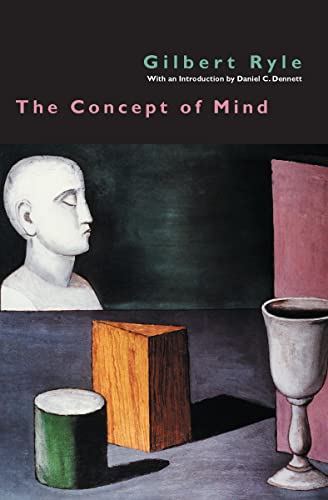
This now-classic work challenges what Ryle calls philosophy's "official theory," the Cartesians "myth" of the separation of mind and matter. Ryle's linguistic analysis remaps the conceptual geography of mind, not so much solving traditional philosophical problems as dissolving them into the mere consequences of misguided language. His plain language and esstentially simple purpose place him in the traditioin of Locke, Berkeley, Mill, and Russell.
Die Inhaltsangabe kann sich auf eine andere Ausgabe dieses Titels beziehen.
Über die Autorin bzw. den Autor
Gilbert Ryle (1900-1976) was the Waynflete Professor of Metaphysical Philosophy at Oxford University from 1947-1971.
Von der hinteren Coverseite
This now-classic work challenges what Ryle calls philosophy's "official theory," the Cartesians "myth" of the separation of mind and matter. Ryle's linguistic analysis remaps the conceptual geography of mind, not so much solving traditional philosophical problems as dissolving them into the mere consequences of misguided language. His plain language and esstentially simple purpose place him in the traditioin of Locke, Berkeley, Mill, and Russell.
Aus dem Klappentext
This now-classic work challenges what Ryle calls philosophy's "official theory," the Cartesians "myth" of the separation of mind and matter. Ryle's linguistic analysis remaps the conceptual geography of mind, not so much solving traditional philosophical problems as dissolving them into the mere consequences of misguided language. His plain language and esstentially simple purpose place him in the traditioin of Locke, Berkeley, Mill, and Russell.
Auszug. © Genehmigter Nachdruck. Alle Rechte vorbehalten.
The Concept of Mind
By Gilbert RyleThe University of Chicago Press
Copyright © 2000 Daniel C. Dennett
All rights reserved.
ISBN: 978-0-226-73296-1All rights reserved.
Contents
INTRODUCTION: RE-INTRODUCING THE CONCEPT OF MIND,
INTRODUCTION,
Chapter,
I. DESCARTES' MYTH,
II. KNOWING HOW AND KNOWING THAT,
III. THE WILL,
IV. EMOTION,
V. DISPOSITIONS AND OCCURRENCES,
VI. SELF-KNOWLEDGE,
VII. SENSATION AND OBSERVATION,
VIII. IMAGINATION,
IX. THE INTELLECT,
X. PSYCHOLOGY,
INDEX,
CHAPTER 1
DESCARTES' MYTH
(1) The Official Doctrine.
There is a doctrine about the nature and place of minds which is so prevalent among theorists and even among laymen that it deserves to be described as the official theory. Most philosophers, psychologists and religious teachers subscribe, with minor reservations, to its main articles and, although they admit certain theoretical difficulties in it, they tend to assume that these can be overcome without serious modifications being made to the architecture of the theory. It will be argued here that the central principles of the doctrine are unsound and conflict with the whole body of what we know about minds when we are not speculating about them.
The official doctrine, which hails chiefly from Descartes, is something like this. With the doubtful exceptions of idiots and infants in arms every human being has both a body and a mind. Some would prefer to say that every human being is both a body and a mind. His body and his mind are ordinarily harnessed together, but after the death of the body his mind may continue to exist and function.
Human bodies are in space and are subject to the mechanical laws which govern all other bodies in space. Bodily processes and states can be inspected by external observers. So a man's bodily life is as much a public affair as are the lives of animals and reptiles and even as the careers of trees, crystals and planets.
But minds are not in space, nor are their operations subject to mechanical laws. The workings of one mind are not witnessable by other observers; its career is private. Only I can take direct cognisance of the states and processes of my own mind. A person therefore lives through two collateral histories, one consisting of what happens in and to his body, the other consisting of what happens in and to his mind. The first is public, the second private. The events in the first history are events in the physical world, those in the second are events in the mental world.
It has been disputed whether a person does or can directly monitor all or only some of the episodes of his own private history; but, according to the official doctrine, of at least some of these episodes he has direct and unchallengeable cognisance. In consciousness, self-consciousness and introspection he is directly and authentically apprised of the present states and operations of his mind. He may have great or small uncertainties about concurrent and adjacent episodes in the physical world, but he can have none about at least part of what is momentarily occupying his mind.
It is customary to express this bifurcation of his two lives and of his two worlds by saying that the things and events which belong to the physical world, including his own body, are external, while the workings of his own mind are internal. This antithesis of outer and inner is of course meant to be construed as a metaphor, since minds, not being in space, could not be described as being spatially inside anything else, or as having things going on spatially inside themselves. But relapses from this good intention are common and theorists are found speculating how stimuli, the physical sources of which are yards or miles outside a person's skin, can generate mental responses inside his skull, or how decisions framed inside his cranium can set going movements of his extremities.
Even when 'inner' and 'outer' are construed as metaphors, the problem how a person's mind and body influence one another is notoriously charged with theoretical difficulties. What the mind wills, the legs, arms and the tongue execute; what affects the ear and the eye has something to do with what the mind perceives; grimaces and smiles betray the mind's moods and bodily castigations lead, it is hoped, to moral improvement. But the actual transactions between the episodes of the private history and those of the public history remain mysterious, since by definition they can belong to neither series. They could not be reported among the happenings described in a person's autobiography of his inner life, but nor could they be reported among those described in some one else's biography of that person's overt career. They can be inspected neither by introspection nor by laboratory experiment. They are theoretical shuttlecocks which are forever being bandied from the physiologist back to the psychologist and from the psychologist back to the physiologist
Underlying this partly metaphorical representation of the bifurcation of a person's two lives there is a seemingly more profound and philosophical assumption. It is assumed that there are two different kinds of existence or status. What exists or happens may have the status of physical existence, or it may have the status of mental existence. Somewhat as the faces of coins are either heads or tails, or somewhat as living creatures are either male or female, so, it is supposed, some existing is physical existing, other existing is mental existing. It is a necessary feature of what has physical existence that it is in space and time; it is a necessary feature of what has mental existence that it is in time but not in space. What has physical existence is composed of matter, or else is a function of matter; what has mental existence consists of consciousness, or else is a function of consciousness.
There is thus a polar opposition between mind and matter, an opposition which is often brought out as follows. Material objects are situated in a common field, known as 'space', and what happens to one body in one part of space is mechanically connected with what happens to other bodies in other parts of space. But mental happenings occur in insulated fields, known as 'minds', and there is, apart maybe from telepathy, no direct causal connection between what happens in one mind and what happens in another. Only through the medium of the public physical world can the mind of one person make a difference to the mind of another. The mind is its own place and in his inner life each of us lives the life of a ghostly Robinson Crusoe. People can see, hear and jolt one another's bodies, but they are irremediably blind and deaf to the workings of one another's minds and inoperative upon them.
What sort of knowledge can be secured of the workings of a mind? On the one side, according to the official theory, a person has direct knowledge of the best imaginable kind of the workings of his own mind. Mental states and processes are (or are normally) conscious states and processes, and the consciousness which irradiates them can engender no illusions and leaves the door open for no doubts. A person's present thinkings, feelings and willings, his perceivings, rememberings and imaginings are intrinsically 'phosphorescent'; their existence and their nature are inevitably betrayed to their owner. The inner life is a stream of consciousness of such a sort that it would be absurd to suggest that the mind whose life is that stream might be unaware of what is passing down it.
True, the evidence adduced recently by Freud seems to show that there...
„Über diesen Titel“ kann sich auf eine andere Ausgabe dieses Titels beziehen.
Suchergebnisse für The Concept of Mind

Beispielbild für diese ISBN
The Concept of Mind
Verlag:
University of Chicago Press, 2000
ISBN 10: 0226732967
ISBN 13: 9780226732961
Gebraucht
Softcover
Anbieter: World of Books (was SecondSale), Montgomery, IL, USA
Verkäuferbewertung 5 von 5 Sternen

Zustand: Acceptable. Item in acceptable condition! Textbooks may not include supplemental items i.e. CDs, access codes etc. Bestandsnummer des Verkäufers 00108698196
Gebraucht kaufen
EUR 10,38
Versand gratis
Versand innerhalb von USA
Versand innerhalb von USA
Anzahl: 1 verfügbar
Beispielbild für diese ISBN
The Concept of Mind
Verlag:
University of Chicago Press, 2000
ISBN 10: 0226732967
ISBN 13: 9780226732961
Gebraucht
Softcover
Anbieter: World of Books (was SecondSale), Montgomery, IL, USA
Verkäuferbewertung 5 von 5 Sternen
Zustand: Good. Item in good condition. Textbooks may not include supplemental items i.e. CDs, access codes etc. Bestandsnummer des Verkäufers 00110460858
Gebraucht kaufen
EUR 10,38
Versand gratis
Versand innerhalb von USA
Versand innerhalb von USA
Anzahl: 1 verfügbar
Beispielbild für diese ISBN
The Concept of Mind
Verlag:
University of Chicago Press (edition 1), 2000
ISBN 10: 0226732967
ISBN 13: 9780226732961
Gebraucht
Paperback
Anbieter: BooksRun, Philadelphia, PA, USA
Verkäuferbewertung 5 von 5 Sternen
Paperback. Zustand: Very Good. 1. It's a well-cared-for item that has seen limited use. The item may show minor signs of wear. All the text is legible, with all pages included. It may have slight markings and/or highlighting. Bestandsnummer des Verkäufers 0226732967-11-1
Gebraucht kaufen
EUR 10,39
Versand gratis
Versand innerhalb von USA
Versand innerhalb von USA
Anzahl: 1 verfügbar
Beispielbild für diese ISBN
The Concept of Mind
Verlag:
University of Chicago Press (edition 1), 2000
ISBN 10: 0226732967
ISBN 13: 9780226732961
Gebraucht
Paperback
Anbieter: BooksRun, Philadelphia, PA, USA
Verkäuferbewertung 5 von 5 Sternen
Paperback. Zustand: Fair. 1. The item might be beaten up but readable. May contain markings or highlighting, as well as stains, bent corners, or any other major defect, but the text is not obscured in any way. Bestandsnummer des Verkäufers 0226732967-7-1
Gebraucht kaufen
EUR 10,68
Versand gratis
Versand innerhalb von USA
Versand innerhalb von USA
Anzahl: 1 verfügbar
Beispielbild für diese ISBN
The Concept of Mind
Verlag:
University Of Chicago Press, 2000
ISBN 10: 0226732967
ISBN 13: 9780226732961
Gebraucht
Paperback
Anbieter: Bookmans, Tucson, AZ, USA
Verkäuferbewertung 5 von 5 Sternen
Paperback. Zustand: Good. / Satisfaction 100% guaranteed. Bestandsnummer des Verkäufers mon0002770196
Gebraucht kaufen
EUR 8,20
EUR 3,47 Versand
Versand innerhalb von USA
Versand innerhalb von USA
Anzahl: 1 verfügbar
Foto des Verkäufers
The Concept of Mind
Verlag:
University of Chicago Press, 2000
ISBN 10: 0226732967
ISBN 13: 9780226732961
Gebraucht
Softcover
Anbieter: Windflower Bookstore, Rockford, IL, USA
Verkäuferbewertung 4 von 5 Sternen

Zustand: good. Bestandsnummer des Verkäufers WFBV.0226732967.G
Gebraucht kaufen
EUR 8,30
EUR 3,47 Versand
Versand innerhalb von USA
Versand innerhalb von USA
Anzahl: 1 verfügbar
Beispielbild für diese ISBN
The Concept of Mind
Verlag:
The University of Chicago Press, 2000
ISBN 10: 0226732967
ISBN 13: 9780226732961
Gebraucht
Paperback
Anbieter: World of Books Inc, Montgomery, IL, USA
Verkäuferbewertung 4 von 5 Sternen
Paperback. Zustand: Good. This work challenges what Glbert Ryle calls philosophy's official theory, the Cartesian myth of the separation of mind and matter. Bestandsnummer des Verkäufers CIN0226732967G
Gebraucht kaufen
EUR 12,17
Versand gratis
Versand innerhalb von USA
Versand innerhalb von USA
Anzahl: 1 verfügbar
Beispielbild für diese ISBN
The Concept of Mind
Verlag:
University of Chicago Press, 2000
ISBN 10: 0226732967
ISBN 13: 9780226732961
Gebraucht
Softcover
Anbieter: Better World Books, Mishawaka, IN, USA
Verkäuferbewertung 5 von 5 Sternen
Zustand: Good. (rev)00 Edition. Pages intact with minimal writing/highlighting. The binding may be loose and creased. Dust jackets/supplements are not included. Stock photo provided. Product includes identifying sticker. Better World Books: Buy Books. Do Good. Bestandsnummer des Verkäufers 9006589-6
Gebraucht kaufen
EUR 14,84
Versand gratis
Versand innerhalb von USA
Versand innerhalb von USA
Anzahl: 1 verfügbar
Beispielbild für diese ISBN
The Concept of Mind
Verlag:
University Of Chicago Press, 2000
ISBN 10: 0226732967
ISBN 13: 9780226732961
Gebraucht
Paperback
Anbieter: HPB-Ruby, Dallas, TX, USA
Verkäuferbewertung 5 von 5 Sternen
Paperback. Zustand: Very Good. Connecting readers with great books since 1972! Used books may not include companion materials, and may have some shelf wear or limited writing. We ship orders daily and Customer Service is our top priority! Bestandsnummer des Verkäufers S_484054560
Gebraucht kaufen
EUR 12,55
EUR 3,26 Versand
Versand innerhalb von USA
Versand innerhalb von USA
Anzahl: 1 verfügbar
Beispielbild für diese ISBN
The Concept of Mind
Verlag:
University Of Chicago Press, 2000
ISBN 10: 0226732967
ISBN 13: 9780226732961
Gebraucht
Paperback
Anbieter: HPB-Emerald, Dallas, TX, USA
Verkäuferbewertung 5 von 5 Sternen
Paperback. Zustand: Very Good. Connecting readers with great books since 1972! Used books may not include companion materials, and may have some shelf wear or limited writing. We ship orders daily and Customer Service is our top priority! Bestandsnummer des Verkäufers S_483228668
Gebraucht kaufen
EUR 12,55
EUR 3,26 Versand
Versand innerhalb von USA
Versand innerhalb von USA
Anzahl: 1 verfügbar