
Verwandte Artikel zu Victory: An Island Tale (Penguin Classics)
Inhaltsangabe
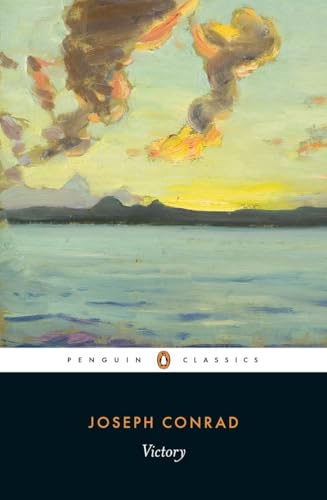
Axel Heyst, a dreamer and a restless drifter, believes he can avoid suffering by cutting himself off from others. Then he becomes involved in the operation of a coal company on a remote island in the Malay Archipelago, and when it fails he turns his back on humanity once more. But his life alters when he rescues a young English girl, Lena, from Zangiacomo's Ladies' Orchestra and the evil innkeeper Schomberg, taking her to his island retreat. The affair between Heyst and Lena begins with her release, but the relationship shifts as Lena struggles to save Heyst from detachment and isolation.
Featuring arguably the most interesting hero created by Conrad, Victory is both a compelling tale of adventure and a perceptive study of the power of love.
Die Inhaltsangabe kann sich auf eine andere Ausgabe dieses Titels beziehen.
Über die Autorin bzw. den Autor
Joseph Conrad's major works (all published by Penguin Classics) include Heart of Darkness, Nostromo, Lord Jim, Under Western Eyes, The Secret Agent and Typhoon.
Auszug. © Genehmigter Nachdruck. Alle Rechte vorbehalten.
I
There is, as every schoolboy knows in this scientific age, a very close chemical relation between coal and diamonds. It is the reason, I believe, why some people allude to coal as “black diamonds.” Both these commodities represent wealth; but coal is a much less portable form of property. There is, from that point of view, a deplorable lack of concentration in coal. Now, if a coal-mine could be put into one’s waistcoat pocket—but it can’t! At the same time, there is a fascination in coal, the supreme commodity of the age in which we are camped like bewildered travellers in a garish, unrestful hotel. And I suppose those two considerations, the practical and the mystical, prevented Heyst—Axel Heyst—from going away.
The Tropical Belt Coal Company went into liquidation. The world of finance is a mysterious world in which, incredible as the fact may appear, evaporation precedes liquidation. First the capital evaporates, and then the company goes into liquidation. These are very unnatural physics, but they account for the persistent inertia of Heyst, at which we “out there” used to laugh among ourselves—but not inimically. An inert body can do no harm to any one, provokes no hostility, is scarcely worth derision. It may, indeed, be in the way sometimes; but this could not be said of Axel Heyst. He was out of everybody’s way, as if he were perched on the highest peak of the Himalayas, and in a sense as conspicuous. Every one in that part of the world knew of him, dwelling on his little island. An island is but the top of a mountain. Axel Heyst, perched on it immovably, was surrounded, instead of the imponderable stormy and transparent ocean of air merging into infinity, by a tepid, shallow sea; a passionless offshoot of the great waters which embrace the continents of this globe. His most frequent visitors were shadows, the shadows of clouds, relieving the monotony of the inanimate, brooding sunshine of the tropics. His nearest neighbour—I am speaking now of things showing some sort of animation—was an indolent volcano which smoked faintly all day with its head just above the northern horizon, and at night levelled at him, from amongst the clear stars, a dull red glow, expanding and collapsing spasmodically like the end of a gigantic cigar puffed at intermittently in the dark. Axel Heyst was also a smoker; and when he lounged out on his veranda with his cheroot, the last thing before going to bed, he made in the night the same sort of glow and of the same size as that other one so many miles away.
In a sense, the volcano was company to him in the shades of the night—which were often too thick, one would think, to let a breath of air through. There was seldom enough wind to blow a feather along. On most evenings of the year Heyst could have sat outside with a naked candle to read one of the books left him by his late father. It was not a mean store. But he never did that. Afraid of mosquitoes, very likely. Neither was he ever tempted by the silence to address any casual remarks to the companion glow of the volcano. He was not mad. Queer chap—yes, that may have been said, and in fact was said; but there is a tremendous difference between the two, you will allow.
On the nights of full moon the silence around Samburan—the “Round Island” of the charts—was dazzling; and in the flood of cold light Heyst could see his immediate surroundings, which had the aspect of an abandoned settlement invaded by the jungle: vague roofs above low vegetation, broken shadows of bamboo fences in the sheen of long grass, something like an overgrown bit of road slanting among ragged thickets toward the shore only a couple of hundred yards away, with a black jetty and a mound of some sort, quite inky on its unlighted side. But the most conspicuous object was a gigantic blackboard raised on two posts and presenting to Heyst, when the moon got over that side, the white letters “T. B. C. Co.” in a row at least two feet high. These were the initials of the Tropical Belt Coal Company, his employers—his late employers, to be precise.
According to the unnatural mysteries of the financial world, the T. B. C. Company’s capital having evaporated in the course of two years, the company went into liquidation—forced, I believe, not voluntary. There was nothing forcible in the process, however. It was slow; and while the liquidation—in London and Amsterdam—pursued its languid course, Axel Heyst, styled in the prospectus “manager in the tropics,” remained at his post on Samburan, the No. 1 coaling-station of the company.
And it was not merely a coaling-station. There was a coal-mine there, with an outcrop in the hillside less than five hundred yards from the rickety wharf and the imposing blackboard. The company’s object had been to get hold of all the outcrops on tropical islands and exploit them locally. And, Lord knows, there were any amount of outcrops. It was Heyst who had located most of them in this part of the tropical belt during his rather aimless wanderings, and being a ready letter-writer had written pages and pages about them to his friends in Europe. At least, so it was said.
We doubted whether he had any visions of wealth—for himself, at any rate. What he seemed mostly concerned for was the “stride forward,” as he expressed it, in the general organisation of the universe, apparently. He was heard by more than a hundred persons in the islands talking of a “great stride forward for these regions.” The convinced wave of the hand which accompanied the phrase suggested tropical distances being impelled onward. In connection with the finished courtesy of his manner, it was persuasive, or at any rate silencing—for a time, at least. Nobody cared to argue with him when he talked in this strain. His earnestness could do no harm to anybody. There was no danger of any one taking seriously his dream of tropical coal, so what was the use of hurting his feelings?
Thus reasoned men in reputable business offices where he had his entrée as a person who came out East with letters of introduction—and modest letters of credit, too—some years before these coal- outcrops began to crop up in his playfully courteous talk. From the first there was some difficulty in making him out. He was not a traveller. A traveller arrives and departs, goes on somewhere. Heyst did not depart. I met a man once—the manager of the branch of the Oriental Banking Corporation in Malacca—to whom Heyst exclaimed, in no connection with anything in particular (it was in the billiard-room of the club):
“I am enchanted with these islands!”
He shot it out suddenly, à propos de bottes, as the French say, and while chalking his cue. And perhaps it was some sort of enchantment. There are more spells than your commonplace magicians ever dreamed of.
Roughly speaking, a circle with a radius of eight hundred miles drawn round a point in North Borneo was in Heyst’s case a magic circle. It just touched Manila, and he had been seen there. It just touched Saigon, and he was likewise seen there once. Perhaps these were his attempts to break out. If so, they were failures. The enchantment must have been an unbreakable one. The manager—the man who heard the exclamation—had been so impressed by the tone, fervour, rapture, what you will, or perhaps by the incongruity of it that he had related the experience to more than one person.
“Queer chap, that Swede,” was his only comment; but this is the origin of the name “Enchanted Heyst” which some fellows fastened on our man.
He also had other names. In his early years, long before he got so becomingly bald on the top,...
„Über diesen Titel“ kann sich auf eine andere Ausgabe dieses Titels beziehen.
Suchergebnisse für Victory: An Island Tale (Penguin Classics)

Beispielbild für diese ISBN
Victory: An Island Tale (Penguin Classics)
Anbieter: HPB Inc., Dallas, TX, USA
Verkäuferbewertung 5 von 5 Sternen

Paperback. Zustand: Very Good. Connecting readers with great books since 1972! Used books may not include companion materials, and may have some shelf wear or limited writing. We ship orders daily and Customer Service is our top priority! Bestandsnummer des Verkäufers S_485006208
Gebraucht kaufen
EUR 7,77
EUR 3,33 Versand
Versand innerhalb von USA
Versand innerhalb von USA
Anzahl: 1 verfügbar
Beispielbild für diese ISBN
Victory: An Island Tale (Penguin Classics)
Anbieter: HPB-Diamond, Dallas, TX, USA
Verkäuferbewertung 5 von 5 Sternen
paperback. Zustand: Very Good. Connecting readers with great books since 1972! Used books may not include companion materials, and may have some shelf wear or limited writing. We ship orders daily and Customer Service is our top priority! Bestandsnummer des Verkäufers S_478753572
Gebraucht kaufen
EUR 10,35
EUR 3,33 Versand
Versand innerhalb von USA
Versand innerhalb von USA
Anzahl: 1 verfügbar
Beispielbild für diese ISBN
Victory: An Island Tale (Penguin Classics)
Anbieter: HPB-Ruby, Dallas, TX, USA
Verkäuferbewertung 5 von 5 Sternen
paperback. Zustand: Very Good. Connecting readers with great books since 1972! Used books may not include companion materials, and may have some shelf wear or limited writing. We ship orders daily and Customer Service is our top priority! Bestandsnummer des Verkäufers S_480246696
Gebraucht kaufen
EUR 10,35
EUR 3,33 Versand
Versand innerhalb von USA
Versand innerhalb von USA
Anzahl: 1 verfügbar
Foto des Verkäufers
Victory : An Island Tale
Anbieter: GreatBookPrices, Columbia, MD, USA
Verkäuferbewertung 5 von 5 Sternen
Zustand: New. Bestandsnummer des Verkäufers 23732736-n
Neu kaufen
EUR 11,73
EUR 2,35 Versand
Versand innerhalb von USA
Versand innerhalb von USA
Anzahl: 7 verfügbar
Foto des Verkäufers
Victory
Anbieter: Rarewaves USA, HEBRON, KY, USA
Verkäuferbewertung 5 von 5 Sternen
Paperback. Zustand: New. Axel Heyst, a dreamer and a restless drifter, believes he can avoid suffering by cutting himself off from others. Then he becomes involved in the operation of a coal company on a remote island in the Malay Archipelago, and when it fails he turns his back on humanity once more. But his life alters when he rescues a young English girl, Lena, from Zangiacomo's Ladies' Orchestra and the evil innkeeper Schomberg, taking her to his island retreat. The affair between Heyst and Lena begins with her release, but the relationship shifts as Lena struggles to save Heyst from detachment and isolation. Featuring arguably the most interesting hero created by Conrad, Victory is both a compelling tale of adventure and a perceptive study of the power of love. Bestandsnummer des Verkäufers LU-9780241189658
Beispielbild für diese ISBN
Victory: An Island Tale
Verlag:
Penguin Classics February 2016, 2016
ISBN 10: 0241189659
ISBN 13: 9780241189658
Gebraucht
Paper Back
Anbieter: A Cappella Books, Inc., Atlanta, GA, USA
Verkäuferbewertung 5 von 5 Sternen
Paper Back. Zustand: Very Good. Bestandsnummer des Verkäufers 379704
Gebraucht kaufen
EUR 14,64
Versand gratis
Versand innerhalb von USA
Versand innerhalb von USA
Anzahl: 1 verfügbar
Beispielbild für diese ISBN
Victory: An Island Tale (Penguin Classics)
Anbieter: Chiron Media, Wallingford, Vereinigtes Königreich
Verkäuferbewertung 5 von 5 Sternen
paperback. Zustand: New. Brand new book, sourced directly from publisher. Dispatch time is 24-48 hours from our warehouse. Book will be sent in robust, secure packaging to ensure it reaches you securely. Bestandsnummer des Verkäufers 6666-GRD-9780241189658
Neu kaufen
EUR 9,07
EUR 5,87 Versand
Versand von Vereinigtes Königreich nach USA
Versand von Vereinigtes Königreich nach USA
Anzahl: 7 verfügbar
Foto des Verkäufers
Victory : An Island Tale
Anbieter: GreatBookPrices, Columbia, MD, USA
Verkäuferbewertung 5 von 5 Sternen
Zustand: As New. Unread book in perfect condition. Bestandsnummer des Verkäufers 23732736
Gebraucht kaufen
EUR 12,74
EUR 2,35 Versand
Versand innerhalb von USA
Versand innerhalb von USA
Anzahl: 7 verfügbar
Beispielbild für diese ISBN
Victory Format: Paperback
Anbieter: INDOO, Avenel, NJ, USA
Verkäuferbewertung 5 von 5 Sternen
Zustand: As New. Unread copy in mint condition. Bestandsnummer des Verkäufers RH9780241189658
Gebraucht kaufen
EUR 15,16
Versand gratis
Versand innerhalb von USA
Versand innerhalb von USA
Anzahl: Mehr als 20 verfügbar
Beispielbild für diese ISBN
Victory Format: Paperback
Anbieter: INDOO, Avenel, NJ, USA
Verkäuferbewertung 5 von 5 Sternen
Zustand: New. Brand New. Bestandsnummer des Verkäufers 9780241189658
Neu kaufen
EUR 15,25
Versand gratis
Versand innerhalb von USA
Versand innerhalb von USA
Anzahl: Mehr als 20 verfügbar