
Verwandte Artikel zu The Moral Menagerie: PHILOSOPHY and ANIMAL RIGHTS
Inhaltsangabe
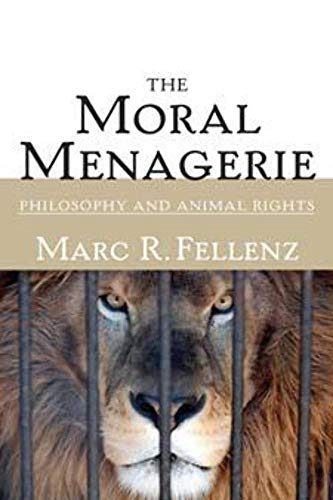
The Moral Menagerie offers a broad philosophical analysis of the recent debate over animal rights. Marc Fellenz locates the debate in its historical and social contexts, traces its roots in the history of Western philosophy, and analyzes the most important arguments that have been offered on both sides.
Fellenz argues that the debate has been philosophically valuable for focusing attention on fundamental problems in ethics and other areas of philosophy, and for raising issues of concern to both Anglo-American and continental thinkers. More provocatively, he also argues that the form the debate often takes--attempting to extend our traditional human-centered moral categories to cover other animals--is ultimately inadequate. Making use of the critical perspectives found in environmentalism, feminism and post-modernism, he concludes that taking animals seriously requires a more radical reassessment our moral framework than the concept of 'animal rights' implies.
Die Inhaltsangabe kann sich auf eine andere Ausgabe dieses Titels beziehen.
Über die Autorin bzw. den Autor
Marc Fellenz is an associate professor in the Department of Philosophy, Suffolk Community College, as well as an adjunct instructor in the Department of Philosophy at Nassau Community College and in the Department of Social Sciences at the New York Institute of Technology.
Auszug. © Genehmigter Nachdruck. Alle Rechte vorbehalten.
The Moral Menagerie
PHILOSOPHY AND ANIMAL RIGHTSBy MARC R. FELLENZUNIVERSITY OF ILLINOIS PRESS
Copyright © 2007 Board of Trustees of the University of IllinoisAll right reserved.
ISBN: 978-0-252-07360-1
Contents
Acknowledgments.....................................................................ixIntroduction........................................................................1PART I: FOUNDATIONS OF THE RECENT DEBATE1. Why Care about Animals?..........................................................112. Broader Philosophical Considerations.............................................33PART II: SURVEY OF EXTENSIONIST ARGUMENTS3. Utilitarian Arguments: The Value of Animal Experience............................574. Deontological Arguments: Do Animals Have Natural Rights?.........................735. Aristotelian Arguments: Animal Telos and Human Aretem............................896. Contractarian Arguments: Animals outside the State of Nature.....................104PART III: THE ANIMAL OR THE GOOD?7. Extensionism and Its Limits......................................................1218. The Call and the Circle: The Animal in Postmodern Thought........................1389. Ecophilosophy: Deep Ecology and Ecofeminism......................................158PART IV: THE HUMAN ANIMALS IN THE MENAGERIE10. Sacrifice and Self-Overcoming...................................................18911. The Child, the Hunter, and the Artist...........................................211Conclusion..........................................................................233Notes...............................................................................237Bibliography........................................................................285Index...............................................................................291
Chapter One
Why Care about Animals?
The Uses of the Animal
As outlined in the Introduction, this work is an analysis of the attention Western philosophy has paid to the issue of the moral standing of animals. In this chapter, I address the question of why the nature of animals and their possible claim to our moral attention constitute a topic worthy of philosophical exploration. The path to answering this question begins with an intriguing thought experiment proposed by medievalist Dorothy Yamamoto: "Suppose (in a parallel universe) Homo sapiens was the only animate species on a planet. What sense of their 'humanity' would the people on that planet have?"
Yamamoto's query brings attention to the fact that interaction with other animals has been a constitutive part of the human species' entire history, in spite of some persistent efforts to stress the distance between humans and nonhumans. Worked, farmed, and hunted, the animal has always provided human beings with material benefits. But as recorded culture bears witness-from Paleolithic cave art to twenty-first-century science-the animal also has always fascinated the human mind. The world's mythological, religious, and literary traditions are steeped in our ancestors' attempts to understand and define this mysterious other. To this day, human iconography is pervaded by animal themes: we see them in the constellations, inscribe them on our children's toys, invoke them in the names of our athletic teams and social clubs, and use them for hundreds of idioms in every language. Invariably, throughout its various cultural manifestations, humanity has incorporated its relationships with other species into its understanding of itself and the world. Thus, while Yamamoto terms her question "unanswerable," one plausible response (to be defended later in this chapter) is that a humanity unconnected to other animate life would not be recognizably human.
Understanding why humans are so bound to other animals proves to be challenging. An appeal to biological need will not settle the matter. Strictly speaking, few humans in the developed world today need to use animals for sustenance; indeed, in the Information Age it seems anachronistic to rely upon animals for material goods. Nonetheless, in the West alone billions of animals are still slaughtered every year for food, the fur and leather industries are booming, and hunting and fishing (and other blood-sports, such as cock-fighting) continue to attract a following. Even allowing that the exploitation of animals is still a material necessity in some societies, the relationships between humans and other animals are rarely comparable to those exhibited between other species. In the modern world there are very few extant hunting cultures, so the human/animal dynamic is only infrequently analogous to a predator's pursuit of prey. Likewise, scavenging and parasitism are occasionally practiced by humans (carrion is in some quarters an accepted food source, and some herding peoples bleed rather than slaughter their stock), but they are not typical of human beings' general comportment toward the animals they use.
The uniquely human manner of relating to other animals through domestication-the context in which much of our contact with other animals occurs today-is occasionally analogized to symbiosis, inasmuch as most domesticated animals receive their sustenance from the humans who use them. But in truly symbiotic relationships there is a roughly equal exchange of benefit, which is something either impossible to assess or clearly lacking in our use of draught animals, pets, and agricultural livestock. Indeed, the very nature of domestication-the attempt to make the animal our own, to transmute animal reality into a creature of our own design-is emblematic of the fact that something more than material need and desire is at work in our use of animals. The exploitation of the animal provides a perennial source of meaning for human cultures, where the animal functions as an object with as much symbolic psychological value as material use-value.
For example, when Native American peoples fight against environmentalists and government bureaucrats for the right to hunt whales or other endangered species, doubtless they are seeking something more than an efficient means of meeting their protein requirements. Likewise, one suspects that the derision with which animal advocates are often met indicates something besides the preference most persons have for the taste of beef over soy, or the feel of fur over polyester. Human beings certainly desire the various material goods that animals provide, but the use of animals as the means to these pleasures is itself enjoyed as a good. As literary critic Marian Scholtmeijer argues, human exploitation of the animal "is in all likelihood foundational to culture and civilization"; as a result, the continued use of the animal gives expression to drives that are deeply embedded in culture and perhaps human consciousness itself, and which therefore will resist both pragmatic and morally based efforts to displace them.
The author and critic Maureen Duffy explains this phenomenon by asserting that "we have always used animals not simply for practical purposes but as metaphors for our own emotional requirements, and it's this that we are unwilling to give up by considering them as creatures with rights and lives of their own." However, while we may try to justify the practical use of animals by noting their otherness, the exploitation of the animal cannot be psychologically effective in the way Duffy describes if its existence is completely alien; the consideration that animals do have lives of...
„Über diesen Titel“ kann sich auf eine andere Ausgabe dieses Titels beziehen.
Suchergebnisse für The Moral Menagerie: PHILOSOPHY and ANIMAL RIGHTS

Beispielbild für diese ISBN
The Moral Menagerie: PHILOSOPHY AND ANIMAL RIGHTS
Verlag:
University of Illinois Press, 2007
ISBN 10: 0252073606
ISBN 13: 9780252073601
Gebraucht
paperback
Anbieter: HPB-Emerald, Dallas, TX, USA
Verkäuferbewertung 5 von 5 Sternen

paperback. Zustand: Very Good. Connecting readers with great books since 1972! Used books may not include companion materials, and may have some shelf wear or limited writing. We ship orders daily and Customer Service is our top priority! Bestandsnummer des Verkäufers S_470698268
Gebraucht kaufen
EUR 7,14
EUR 3,26 Versand
Versand innerhalb von USA
Versand innerhalb von USA
Anzahl: 1 verfügbar
Beispielbild für diese ISBN
The Moral Menagerie : Philosophy and Animal Rights
Verlag:
University of Illinois Press, 2007
ISBN 10: 0252073606
ISBN 13: 9780252073601
Gebraucht
Softcover
Erstausgabe
Anbieter: Better World Books, Mishawaka, IN, USA
Verkäuferbewertung 5 von 5 Sternen
Zustand: Very Good. 1st Edition. Former library copy. Pages intact with possible writing/highlighting. Binding strong with minor wear. Dust jackets/supplements may not be included. Includes library markings. Stock photo provided. Product includes identifying sticker. Better World Books: Buy Books. Do Good. Bestandsnummer des Verkäufers GRP89151881
Gebraucht kaufen
EUR 11,45
Versand gratis
Versand innerhalb von USA
Versand innerhalb von USA
Anzahl: 1 verfügbar
Beispielbild für diese ISBN
The Moral Menagerie: PHILOSOPHY AND ANIMAL RIGHTS
Verlag:
University of Illinois Press, 2007
ISBN 10: 0252073606
ISBN 13: 9780252073601
Gebraucht
Paperback
Anbieter: Midtown Scholar Bookstore, Harrisburg, PA, USA
Verkäuferbewertung 5 von 5 Sternen
Paperback. Zustand: Very Good. No dust jacket. Very Good hardcover with light shelfwear - NICE! Standard-sized. Bestandsnummer des Verkäufers mon0000340069
Gebraucht kaufen
EUR 6,24
EUR 5,22 Versand
Versand innerhalb von USA
Versand innerhalb von USA
Anzahl: 1 verfügbar
Beispielbild für diese ISBN
The Moral Menagerie: PHILOSOPHY AND ANIMAL RIGHTS
Verlag:
University of Illinois Press, 2007
ISBN 10: 0252073606
ISBN 13: 9780252073601
Gebraucht
Paperback
Anbieter: WorldofBooks, Goring-By-Sea, WS, Vereinigtes Königreich
Verkäuferbewertung 5 von 5 Sternen
Paperback. Zustand: Very Good. The book has been read, but is in excellent condition. Pages are intact and not marred by notes or highlighting. The spine remains undamaged. Bestandsnummer des Verkäufers GOR006048269
Gebraucht kaufen
EUR 24,21
EUR 6,53 Versand
Versand von Vereinigtes Königreich nach USA
Versand von Vereinigtes Königreich nach USA
Anzahl: 1 verfügbar
Beispielbild für diese ISBN
The Moral Menagerie: PHILOSOPHY AND ANIMAL RIGHTS (eng)
Anbieter: Brook Bookstore On Demand, Napoli, NA, Italien
Verkäuferbewertung 5 von 5 Sternen
Zustand: new. Bestandsnummer des Verkäufers 78ffab42f85298c75cad2c0cde01adb3
Neu kaufen
EUR 29,04
EUR 5,50 Versand
Versand von Italien nach USA
Versand von Italien nach USA
Anzahl: Mehr als 20 verfügbar
Beispielbild für diese ISBN
The Moral Menagerie
Anbieter: PBShop.store UK, Fairford, GLOS, Vereinigtes Königreich
Verkäuferbewertung 5 von 5 Sternen
PAP. Zustand: New. New Book. Shipped from UK. Established seller since 2000. Bestandsnummer des Verkäufers FW-9780252073601
Neu kaufen
EUR 28,77
EUR 5,85 Versand
Versand von Vereinigtes Königreich nach USA
Versand von Vereinigtes Königreich nach USA
Anzahl: 15 verfügbar
Foto des Verkäufers
Moral Menagerie : Philosophy And Animal Rights
Verlag:
University of Illinois Press, 2007
ISBN 10: 0252073606
ISBN 13: 9780252073601
Gebraucht
Softcover
Anbieter: GreatBookPrices, Columbia, MD, USA
Verkäuferbewertung 5 von 5 Sternen
Zustand: As New. Unread book in perfect condition. Bestandsnummer des Verkäufers 4237062
Gebraucht kaufen
EUR 33,00
EUR 2,30 Versand
Versand innerhalb von USA
Versand innerhalb von USA
Anzahl: Mehr als 20 verfügbar
Foto des Verkäufers
Moral Menagerie : Philosophy And Animal Rights
Anbieter: GreatBookPrices, Columbia, MD, USA
Verkäuferbewertung 5 von 5 Sternen
Zustand: New. Bestandsnummer des Verkäufers 4237062-n
Neu kaufen
EUR 33,28
EUR 2,30 Versand
Versand innerhalb von USA
Versand innerhalb von USA
Anzahl: Mehr als 20 verfügbar
Foto des Verkäufers
The Moral Menagerie: PHILOSOPHY AND ANIMAL RIGHTS
Verlag:
University of Illinois Press, 2007
ISBN 10: 0252073606
ISBN 13: 9780252073601
Gebraucht
Soft cover
Erstausgabe
Anbieter: K Books Ltd ABA ILAB, York, YORKS, Vereinigtes Königreich
Verkäuferbewertung 5 von 5 Sternen
Soft cover. Zustand: Very Good. 1st Edition. First Edition, (8) + 301pp, softcover, very good condition - no markings or annotations, University of Illinois Press, Urbana and Chicago, 2007. * the author locates the animal rights debate within it historical and social context, traces its roots in the history of Western philosophy, and analyses the important arguments that have been offered on both sides. Anyone who thinks at all about our treatment of animals should read this book. Bestandsnummer des Verkäufers PHIL/447
Gebraucht kaufen
EUR 14,41
EUR 22,74 Versand
Versand von Vereinigtes Königreich nach USA
Versand von Vereinigtes Königreich nach USA
Anzahl: 1 verfügbar
Beispielbild für diese ISBN
The Moral Menagerie: PHILOSOPHY AND ANIMAL RIGHTS
Verlag:
University of Illinois Press, 2007
ISBN 10: 0252073606
ISBN 13: 9780252073601
Neu
Softcover
Erstausgabe
Anbieter: Kennys Bookshop and Art Galleries Ltd., Galway, GY, Irland
Verkäuferbewertung 5 von 5 Sternen
Zustand: New. 2007. 1st Edition. Paperback. . . . . . Bestandsnummer des Verkäufers V9780252073601
Neu kaufen
EUR 31,25
EUR 9,50 Versand
Versand von Irland nach USA
Versand von Irland nach USA
Anzahl: Mehr als 20 verfügbar