
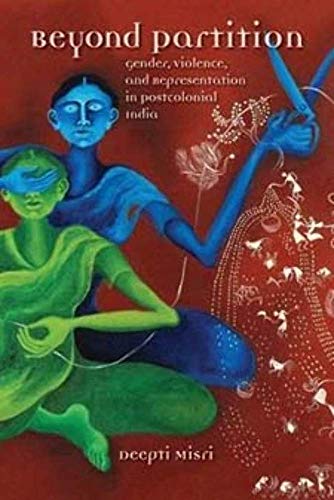
Beyond Partition: Gender, Violence, and Representation in Postcolonial India (Dissident Feminisms) - Softcover
Inhaltsangabe
Communal violence, ethnonationalist insurgencies, terrorism, and state violence have marred the Indian natio- state since its inception. These phenomena frequently intersect with prevailing forms of gendered violence complicated by caste, religion, regional identity, and class within communities.
Deepti Misri shows how Partition began a history of politicized animosity associated with the differing ideas of ""India"" held by communities and in regions on one hand, and by the political-military Indian state on the other. She moves beyond that formative national event, however, in order to examine other forms of gendered violence in the postcolonial life of the nation, including custodial rape, public stripping, deturbanning, and enforced disappearances. Assembling literary, historiographic, performative, and visual representations of gendered violence against women and men, Misri establishes that cultural expressions do not just follow violence but determine its very contours, and interrogates the gendered scripts underwriting the violence originating in the contested visions of what ""India"" means.
Ambitious and ranging across disciplines, Beyond Partition offers both an overview of and nuanced new perspectives on the ways caste, identity, and class complicate representations of violence, and how such representations shape our understandings of both violence and India.
Die Inhaltsangabe kann sich auf eine andere Ausgabe dieses Titels beziehen.
Über die Autorin bzw. den Autor
Deepti Misri is an assistant professor of women and gender studies at University of Colorado Boulder.
Auszug. © Genehmigter Nachdruck. Alle Rechte vorbehalten.
Beyond Partition
Gender, Violence, and Representation in Postcolonial India
By Deepti MisriUNIVERSITY OF ILLINOIS PRESS
Copyright © 2014 the Board of Trustees of the University of Illinois
All rights reserved.
ISBN: 978-0-252-08039-5All rights reserved.
Contents
Acknowledgments, ix,
Introduction, 1,
1. Anatomy of a Riot: Vulnerable Male Bodies in Manto and Other Fictions, 25,
2. The Violence of Memory: Women's Re-narrations of the Partition, 55,
3. Atrocious Encounters: Caste Violence and State Violence, 87,
4. "Are You a Man?": Performing Naked Protest in India, 113,
5. "This Is Not a Performance!": Public Mourning and Visual Spectacle in Kashmir, 133,
Epilogue: The Violence of the Oppressed, 161,
Notes, 169,
Bibliography, 185,
Index, 195,
CHAPTER 1
Anatomy of a Riot
Vulnerable Male Bodies in Manto and Other Fictions
When the neighbourhood was set on fire, everything burnt down with the exception of one shop and its sign.
It said, "All building and construction materials sold here."
—Saadat Hasan Manto, "Daawat e amal" (Invitation to Action), Mottled Dawn
The two-line vignette above first appeared in 1948 in Black Marginalia (Siyah Haashiye), a slim volume of thirty-two literary sketches penned by the well-known Urdu writer Saadat Hasan Manto. Written even as the fires of Partition still burned, the sketches in Black Marginalia unwaveringly profiled the looting, arson, murder, religious defilement, and sexual violence that marked the violence of 1947, the double-edged moment of the Partition and Independence of India and Pakistan. In "Invitation to Action," the lone shop and its inviting sign may be read as embodying the ironic promise of the new nation-state—the only standing structure in the midst of utter demolition, offering materials for reconstruction to absent buyers dispossessed of all the purchases they might once have had in the world. As such, the sign appears as a taunt, a bogus "invitation to action," the wryly mocking title drawing from the reader the cheerless laugh that resounds throughout the collection, as sketch after sketch dramatizes the cosmic irony of a bloody Partition that had been proposed as a solution to communal tensions.
In this chapter I want to consider the violence of the communal riot—that staple form of postcolonial violence so deeply imbricated with ideas of India —through an exploration of Manto's post-Partition opus. I approach Manto's Partition writings with a special focus on the sketches in Black Marginalia, which puzzlingly remain underexamined in critical scholarship on Manto despite being widely recognized as among the most scathing literary critiques of communal violence even to date. Given Manto's stature as the "enfant terrible" of Urdu literature and the ideological work his fiction is so frequently made to perform in the contemporary secular critique of communal violence in India, it seems that any cultural exploration of communal violence in India must inevitably return to this fabled literary figure, whose acerbic persona and writings form the subject of countless news features, academic theses, theatrical adaptations, and translations in India today. Furthermore, in the vast archive of Partition writing, Manto's fiction offers a rare representation of the riot that focuses on the male perpetrator, as well as an unusual fictional exploration of the gendered vulnerability of male bodies in the communal riot. I begin by reading Manto's fiction for the brilliant insights it provides about the form and contradictions of communal violence, but I wish here to draw attention also to the limits of his critical vision, particularly the brand of secularism promoted in his fiction. I question in particular Manto's dismissal of all investment in embodied religious markers and his singling out of the Sikh male figure as representative of what he saw as a puerile investment in embodied practices, such as the strict maintenance of uncut hair or the commitment to wearing the turban, sometimes at cost to one's own life. In Manto's defense it might be said that he was writing in a moment of transition where it was perhaps less clear what position the Sikh minority would eventually come to be assigned in a putatively secular postcolonial India (although Sikh leaders of the time fully anticipated this future). Regardless, contemporary readers of Manto must ask whether this is an attitude we can afford to inherit, particularly in the aftermath of the anti-Sikh violence of 1984. In that year, Hindu mobs, in violence orchestrated by political leaders following the assassination of Prime Minister Indira Gandhi by her Sikh bodyguards, hunted down Sikh civilians and subjected Sikh men in particular to ritual forms of violence, central among which was the deturbanning and cutting of Sikh men's hair before burning the victims to death or killing them in other ways. Toward the end of this chapter, I offer some post-1984 fictional accounts that provide more complex representations than Manto's of the violence of "painless" practices such as the deturbanning and cutting of hair of Sikh men, either forced upon them as a gesture of "conversion" or undertaken by them in order to pass as non-Sikh. These latter fictions, I suggest, might provide a more productive path for an accommodation of minority citizenship in India. They also offer a way of reading Manto via a critical apparatus endorsed by Priyamvada Gopal, one "that evades both the celebratory and the condemnatory," in line with Manto's own wishes that he not be posthumously deified (Gopal 2005, 122).
"A Story of Blood and Fire"
I'm at a loss about what to do with Manto's Siyah Haashiye: should I catalogue it as a work of literature or should I find an entirely new classification for it? Manto is very fond of things that create an uproar and awaken with a start even those who are fast asleep....
Usually this tactic pays off, and Manto has managed to receive a lot of applause, but the arrow has missed its mark this time. Siyah Haashiye is neither a masterpiece nor a timeless marvel, but it's not garbage either.
—Ismat Chughtai, "Communal Violence and Literature"
Black Marginalia was published in Pakistan in October 1948 after several months of creative inertia on the part of Manto following Partition, his dislocation from his beloved city of Bombay, and his move to Lahore. The volume, comprising his first effort at writing after his move to Pakistan, was not well received upon its publication: the critic Leslie Flemming writes that it went "virtually unnoticed," but by Manto's own account the collection suffered from too much unfavorable notice. By the time the volume appeared, Manto, while at the height of his career, had been at odds both with the British government, which had repeatedly charged him with obscenity, and with some members of the leftist Progressive Writers Association (PWA), a group of radical writers with whom Manto had broadly aligned himself despite his always-uneasy relationship with the Progressive movement. In an essay written in 1951, Manto complained to his readers of the harsh criticism Black Marginalia had received at the hands of some members of the PWA: "Believe me, it caused me great pain when some of my literary friends made cruel fun of my book, denouncing me as an irresponsible carrier of tales, a jokester, a nuisance, a cynic and a reactionary. One of them, a close friend, accused me of having robbed the...
„Über diesen Titel“ kann sich auf eine andere Ausgabe dieses Titels beziehen.
Weitere beliebte Ausgaben desselben Titels

Suchergebnisse für Beyond Partition: Gender, Violence, and Representation...

Beispielbild für diese ISBN
Beyond Partition: Gender, Violence and Representation in Postcolonial India (Dissident Feminisms)
Verlag:
University of Illinois Press, 2014
ISBN 10: 0252080394
ISBN 13: 9780252080395
Gebraucht
paperback
Anbieter: HPB-Red, Dallas, TX, USA
Verkäuferbewertung 5 von 5 Sternen

paperback. Zustand: Good. Connecting readers with great books since 1972! Used textbooks may not include companion materials such as access codes, etc. May have some wear or writing/highlighting. We ship orders daily and Customer Service is our top priority! Bestandsnummer des Verkäufers S_341134775
Gebraucht kaufen
EUR 20,36
EUR 3,28 Versand
Versand innerhalb von USA
Versand innerhalb von USA
Anzahl: 1 verfügbar
Foto des Verkäufers
Beyond Partition : Gender, Violence, and Representation in Postcolonial India
Verlag:
University of Illinois Press, 2014
ISBN 10: 0252080394
ISBN 13: 9780252080395
Gebraucht
Softcover
Anbieter: GreatBookPrices, Columbia, MD, USA
Verkäuferbewertung 5 von 5 Sternen
Zustand: As New. Unread book in perfect condition. Bestandsnummer des Verkäufers 21575950
Gebraucht kaufen
EUR 27,19
EUR 2,31 Versand
Versand innerhalb von USA
Versand innerhalb von USA
Anzahl: 2 verfügbar
Foto des Verkäufers
Beyond Partition : Gender, Violence, and Representation in Postcolonial India
Anbieter: GreatBookPrices, Columbia, MD, USA
Verkäuferbewertung 5 von 5 Sternen
Zustand: New. Bestandsnummer des Verkäufers 21575950-n
Neu kaufen
EUR 27,39
EUR 2,31 Versand
Versand innerhalb von USA
Versand innerhalb von USA
Anzahl: 2 verfügbar
Foto des Verkäufers
Beyond Partition
Verlag:
University of Illinois Press, US, 2014
ISBN 10: 0252080394
ISBN 13: 9780252080395
Neu
Paperback
Anbieter: Rarewaves.com USA, London, LONDO, Vereinigtes Königreich
Verkäuferbewertung 5 von 5 Sternen
Paperback. Zustand: New. Communal violence, ethnonationalist insurgencies, terrorism, and state violence have marred the Indian natio- state since its inception. These phenomena frequently intersect with prevailing forms of gendered violence complicated by caste, religion, regional identity, and class within communities. Deepti Misri shows how Partition began a history of politicized animosity associated with the differing ideas of ""India"" held by communities and in regions on one hand, and by the political-military Indian state on the other. She moves beyond that formative national event, however, in order to examine other forms of gendered violence in the postcolonial life of the nation, including custodial rape, public stripping, deturbanning, and enforced disappearances. Assembling literary, historiographic, performative, and visual representations of gendered violence against women and men, Misri establishes that cultural expressions do not just follow violence but determine its very contours, and interrogates the gendered scripts underwriting the violence originating in the contested visions of what ""India"" means.Ambitious and ranging across disciplines, Beyond Partition offers both an overview of and nuanced new perspectives on the ways caste, identity, and class complicate representations of violence, and how such representations shape our understandings of both violence and India. Bestandsnummer des Verkäufers LU-9780252080395
Neu kaufen
EUR 29,77
Versand gratis
Versand von Vereinigtes Königreich nach USA
Versand von Vereinigtes Königreich nach USA
Anzahl: 1 verfügbar
Beispielbild für diese ISBN
Beyond Partition Format: Paperback
Anbieter: INDOO, Avenel, NJ, USA
Verkäuferbewertung 5 von 5 Sternen
Zustand: New. Brand New. Bestandsnummer des Verkäufers 9780252080395
Neu kaufen
EUR 30,26
Versand gratis
Versand innerhalb von USA
Versand innerhalb von USA
Anzahl: Mehr als 20 verfügbar
Beispielbild für diese ISBN
Beyond Partition
Anbieter: PBShop.store UK, Fairford, GLOS, Vereinigtes Königreich
Verkäuferbewertung 5 von 5 Sternen
PAP. Zustand: New. New Book. Shipped from UK. Established seller since 2000. Bestandsnummer des Verkäufers FW-9780252080395
Neu kaufen
EUR 29,09
EUR 4,89 Versand
Versand von Vereinigtes Königreich nach USA
Versand von Vereinigtes Königreich nach USA
Anzahl: 2 verfügbar
Beispielbild für diese ISBN
Beyond Partition: Gender, Violence, and Representation in Postcolonial India
Anbieter: Revaluation Books, Exeter, Vereinigtes Königreich
Verkäuferbewertung 5 von 5 Sternen
Paperback. Zustand: Brand New. 201 pages. 9.25x6.25x0.50 inches. In Stock. Bestandsnummer des Verkäufers __0252080394
Neu kaufen
EUR 27,23
EUR 11,76 Versand
Versand von Vereinigtes Königreich nach USA
Versand von Vereinigtes Königreich nach USA
Anzahl: 2 verfügbar
Beispielbild für diese ISBN
Beyond Partition
Anbieter: Kennys Bookshop and Art Galleries Ltd., Galway, GY, Irland
Verkäuferbewertung 5 von 5 Sternen
Zustand: New. Bestandsnummer des Verkäufers V9780252080395
Neu kaufen
EUR 30,04
EUR 10,50 Versand
Versand von Irland nach USA
Versand von Irland nach USA
Anzahl: 1 verfügbar
Beispielbild für diese ISBN
Beyond Partition
Anbieter: Kennys Bookstore, Olney, MD, USA
Verkäuferbewertung 5 von 5 Sternen
Zustand: New. Bestandsnummer des Verkäufers V9780252080395
Neu kaufen
EUR 36,44
EUR 9,18 Versand
Versand innerhalb von USA
Versand innerhalb von USA
Anzahl: 1 verfügbar
Foto des Verkäufers
Beyond Partition : Gender, Violence, and Representation in Postcolonial India
Anbieter: GreatBookPricesUK, Woodford Green, Vereinigtes Königreich
Verkäuferbewertung 5 von 5 Sternen
Zustand: New. Bestandsnummer des Verkäufers 21575950-n
Neu kaufen
EUR 28,21
EUR 17,64 Versand
Versand von Vereinigtes Königreich nach USA
Versand von Vereinigtes Königreich nach USA
Anzahl: 2 verfügbar