
Verwandte Artikel zu Spain Unmoored: Migration, Conversion, and the Politics...
Spain Unmoored: Migration, Conversion, and the Politics of Islam (New Anthropolgies of Europe) - Softcover
Buch 23 von 35: New Anthropologies of Europe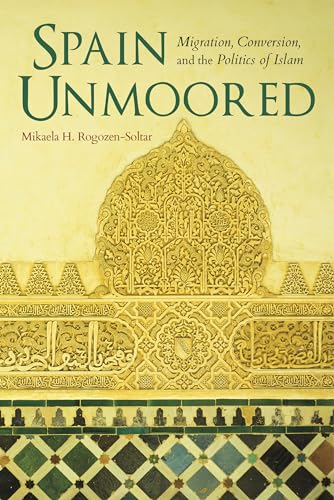
Inhaltsangabe
Long viewed as Spain's "most Moorish city," Granada is now home to a growing Muslim population of Moroccan migrants and European converts to Islam. Mikaela Rogozen-Soltar examines how various residents of Granada mobilize historical narratives about the city's Muslim past in order to navigate tensions surrounding contemporary ethnic and religious pluralism. Focusing particular attention on the gendered, racial, and political dimensions of this new multiculturalism, Rogozen-Soltar explores how Muslim-themed tourism and Islamic cultural institutions coexist with anti-Muslim sentiments.
Die Inhaltsangabe kann sich auf eine andere Ausgabe dieses Titels beziehen.
Über die Autorin bzw. den Autor
Mikaela H. Rogozen-Soltar is Assistant Professor of Anthropology at the University of Nevada Reno. Her research focuses on the intersections of religion, migration, historical memory, and gender in the Mediterranean. .Click here to view her faculty bio.
Auszug. © Genehmigter Nachdruck. Alle Rechte vorbehalten.
Spain Unmoored
Migration, Conversion, and the Politics of Islam
By Mikaela H. Rogozen-SoltarIndiana University Press
Copyright © 2017 Mikaela H. Rogozen-Soltar
All rights reserved.
ISBN: 978-0-253-02489-3All rights reserved.
Contents
Acknowledgments, ix,
Preface: Between Convivencia and Malafollá: Coexistence or Exclusion?, xiii,
Introduction: Andalusian Encounters and the Politics of Islam, 1,
1. Historical Anxiety and Everyday Historiography, 41,
2. Paradoxes of Muslim Belonging and Difference, 75,
3. Muslim Disneyland and Moroccan Danger Zones: Islam, Race, and Space, 115,
4. A Reluctant Convivencia: Minority Representation and Unequal Multiculturalism, 158,
5. Embodied Encounters: Gender, Islam, and Public Space, 189,
Conclusion: Granada Moored and Unmoored, 225,
Bibliography, 239,
Index, 255,
CHAPTER 1
Historical Anxiety and Everyday Historiography
INVOKING AL-ANDALUS
Much recent scholarship on Islam and migration in Spain takes as its starting point the late 1970s, when Spain became a democracy and transitioned from being a "labor-exporting" country to a "labor-importing" country, with the first migrants to Spain coming mainly from Morocco (Cornelius 2004, 387). Perusing a random stack of books and articles on migration and Islam in Spain, one finds that nearly all begin with a proclamation of this demographic shift. As a result, scholars and politicians alike often consider the Muslim minority in Spain a "new" phenomenon, a fresh challenge of democracy and Europeanization. However, in the course of conducting ethnographic fieldwork, I have been consistently struck by the fact that people in Granada overwhelmingly understand questions of migration and religious pluralism as being shaped by encounters between Spain and Morocco not since the 1970s, but since the 700s. Through longue-durée historical narratives that foreground cultural connections and population movements between Spain and Morocco since the eighth century, my research participants conceptualize North Africa and southern Iberia as a semicontiguous space of Mediterranean entanglement. Ideas about local Muslim history are central to understandings of what it means to be Granadino and Andalusian today, with high stakes for the politics of multiculturalism.
These stakes are clearly expressed in popular Andalusian music. In October 2009 the beloved Andalusian pop star David Bisbal released the hit song "Al-Andalus," in which he serenades medieval Islamic Spain and contemporary Andalusia, conflating them in an exotic, powerful goddess he calls al-Andalus. See the lyrics that follow.
Esta es la historia de una diosa
como nunca hubo ninguna.
Corría el arte en su mirada de color
verde aceituna.
De padre moro y de mujer Cristiana,
con piel de reina y cuerpo de
sultana, movía sus manos como
una gitana, y su embrujo te
robaba el alma.
Dicen que hubo muchos que intentaron
conquistarla, y otros
tantos se quedaron hechizados
solo por mirarla.
Aunque hace tiempo nadie ha
vuelto a verla yo sé que ella no
es una leyenda
y sé muy bien donde podré encontrarla,
a esa que todos llamaban:
Al-Andalus, Al-Andalus.
This is the story of a goddess like
no other.
With artistry running through her
olive green gaze.
From a "moro" father and a Christian
mother, with the skin of a
queen and the body of a sultan's
wife, she would move her hands
like a Gypsy, and her spell
would steal your soul.
They say there were many who
tried to conquer her, and still
others were bewitched simply
by looking at her.
Although no one has seen her in a
long time, I know that she is not
just a legend. And I know exactly
where I can find her,
That woman who everyone used
to call:
Al-Andalus, Al-Andalus.
Bisbal's ode to al-Andalus nicely captures the competing historiographies of medieval Islam that pervade social life in Granada. First, his lyrics demonstrate the enduring centrality of Andalusia's Muslim past, transposing historical al-Andalus onto the contemporary region. As Bisbal searches for the goddess al-Andalus, he casually lists the Moorish monuments of each modern Andalusian city in passing. By mentioning that "no one has seen her in a long time," Bisbal acknowledges the official silencing of medieval Islam in dominant Castilian history telling. But he intimates the limitations of that silence by insisting that it is nevertheless obvious where he "can find her," since Andalusia is simply a present-day incarnation of al-Andalus. Second, the song indexes Andalusians' profound ambivalence about this legacy. The protagonist unequivocally celebrates al-Andalus but also makes clear her alterity — referencing her mixed parentage, likening her to "a Gypsy," and personifying her in markedly orientalist and gendered fashion with references to her desirability (later lyrics state outright: "You are desire, al-Andalus") and unnatural danger (she bewitches onlookers and robs them of their souls).
In sum, Bisbal's song is both an ode to the marginality of al-Andalus and an anthem of southern pride. Bisbal is known for trumpeting his regional pride in other songs about modern Andalusian identity as well. His earlier hits included "Corazón Latino" (Latin Heart), a dance number that unabashedly advertises Andalusia as a playground for northern Europeans, inviting them to visit the "nonstop party by the shore" to enjoy "wine," "rum," "hot-bloodedness," and "tanned bodies" (Vale Music 2002). The song "Al-Andalus" invokes the imprint of medieval Islam on Andalusia, while "Corazón Latino" offers up Andalusia as a place for Europeans to consume southern difference and debauchery.
These two images — of an Andalusia marked by its Islamic past and of the contemporary region's otherness within Spain and Europe — are intimately connected. Together, Bisbal's songs tell a story familiar to many Andalusians, linking marginality today to the region's disproportionately long Muslim period. In this chapter, I pick up this conceptual link, examining both historical memories of al-Andalus and historical narratives of more recent Andalusian experiences of poverty, mass emigration, and regional stigma. While these "old" and "new" histories are separated by centuries, I unite them here because, like Bisbal's lyrics, my research participants predominantly understood Andalusia's medieval and modern histories as intertwined, and this "structuring narrative" (e.g., Bourdieu 1977) set the parameters for discussions of Islam in the city.
To explore this discursive linkage, I trace "everyday historiography," that is, the ways in which Granada's nonacademic public engages in the same kinds of fierce debates about the meaning of Spain's Muslim past that have animated the historical scholarship of Spain discussed in the introduction. While their narratives may not be canonized or institutionalized as a part of official history, in the course of everyday social interactions, they commonly drew on the city's Muslim past to make sense of religious pluralism in the present. They did so in ambivalent narratives that involved both historical description and political prescription and expressed both Islamophilic and Islamophobic sensibilities. "Everyday historiography" ultimately refers to the ways people in Granada marshaled history to...
„Über diesen Titel“ kann sich auf eine andere Ausgabe dieses Titels beziehen.
Suchergebnisse für Spain Unmoored: Migration, Conversion, and the Politics...

Beispielbild für diese ISBN
Spain Unmoored: Migration, Conversion, and the Politics of Islam (New Anthropologies of Europe)
Verlag:
Indiana University Press, 2017
ISBN 10: 0253024897
ISBN 13: 9780253024893
Gebraucht
Paperback
Anbieter: Midtown Scholar Bookstore, Harrisburg, PA, USA
Verkäuferbewertung 5 von 5 Sternen

Paperback. Zustand: Good. Good - Bumped and creased book with tears to the extremities, but not affecting the text block, may have remainder mark or previous owner's name - GOOD PAPERBACK Standard-sized. Bestandsnummer des Verkäufers M0253024897Z3
Gebraucht kaufen
EUR 11,98
EUR 5,38 Versand
Versand innerhalb von USA
Versand innerhalb von USA
Anzahl: 20 verfügbar
Beispielbild für diese ISBN
Spain Unmoored: Migration, Conversion, and the Politics of Islam (New Anthropologies of Europe)
Verlag:
Indiana University Press, 2017
ISBN 10: 0253024897
ISBN 13: 9780253024893
Gebraucht
paperback
Anbieter: Textbooks_Source, Columbia, MO, USA
Verkäuferbewertung 5 von 5 Sternen
paperback. Zustand: Good. Ships in a BOX from Central Missouri! May not include working access code. Will not include dust jacket. Has used sticker(s) and some writing or highlighting. UPS shipping for most packages, (Priority Mail for AK/HI/APO/PO Boxes). Bestandsnummer des Verkäufers 002190456U
Gebraucht kaufen
EUR 20,38
EUR 3,58 Versand
Versand innerhalb von USA
Versand innerhalb von USA
Anzahl: 2 verfügbar
Foto des Verkäufers
Spain Unmoored : Migration, Conversion, and the Politics of Islam
Verlag:
Indiana University Press, 2017
ISBN 10: 0253024897
ISBN 13: 9780253024893
Gebraucht
Softcover
Anbieter: GreatBookPrices, Columbia, MD, USA
Verkäuferbewertung 5 von 5 Sternen
Zustand: good. May show signs of wear, highlighting, writing, and previous use. This item may be a former library book with typical markings. No guarantee on products that contain supplements Your satisfaction is 100% guaranteed. Twenty-five year bookseller with shipments to over fifty million happy customers. Bestandsnummer des Verkäufers 27826358-5
Gebraucht kaufen
EUR 21,61
EUR 2,37 Versand
Versand innerhalb von USA
Versand innerhalb von USA
Anzahl: 2 verfügbar
Foto des Verkäufers
Spain Unmoored : Migration, Conversion, and the Politics of Islam
Anbieter: GreatBookPrices, Columbia, MD, USA
Verkäuferbewertung 5 von 5 Sternen
Zustand: New. Bestandsnummer des Verkäufers 27826358-n
Neu kaufen
EUR 28,91
EUR 2,37 Versand
Versand innerhalb von USA
Versand innerhalb von USA
Anzahl: Mehr als 20 verfügbar
Beispielbild für diese ISBN
Spain Unmoored
Anbieter: PBShop.store UK, Fairford, GLOS, Vereinigtes Königreich
Verkäuferbewertung 5 von 5 Sternen
PAP. Zustand: New. New Book. Shipped from UK. Established seller since 2000. Bestandsnummer des Verkäufers FW-9780253024893
Neu kaufen
EUR 26,40
EUR 4,92 Versand
Versand von Vereinigtes Königreich nach USA
Versand von Vereinigtes Königreich nach USA
Anzahl: 15 verfügbar
Foto des Verkäufers
Spain Unmoored: Migration, Conversion, and the Politics of Islam (Paperback or Softback)
Verlag:
Indiana University Press 2/27/2017, 2017
ISBN 10: 0253024897
ISBN 13: 9780253024893
Neu
Paperback or Softback
Anbieter: BargainBookStores, Grand Rapids, MI, USA
Verkäuferbewertung 5 von 5 Sternen
Paperback or Softback. Zustand: New. Spain Unmoored: Migration, Conversion, and the Politics of Islam. Book. Bestandsnummer des Verkäufers BBS-9780253024893
Foto des Verkäufers
Spain Unmoored
Anbieter: Rarewaves.com USA, London, LONDO, Vereinigtes Königreich
Verkäuferbewertung 5 von 5 Sternen
Paperback. Zustand: New. Long viewed as Spain's "most Moorish city," Granada is now home to a growing Muslim population of Moroccan migrants and European converts to Islam. Mikaela H. Rogozen-Soltar examines how various residents of Granada mobilize historical narratives about the city's Muslim past in order to navigate tensions surrounding contemporary ethnic and religious pluralism. Focusing particular attention on the gendered, racial, and political dimensions of this new multiculturalism, Rogozen-Soltar explores how Muslim-themed tourism and Islamic cultural institutions coexist with anti-Muslim sentiments. Bestandsnummer des Verkäufers LU-9780253024893
Neu kaufen
EUR 32,02
Versand gratis
Versand von Vereinigtes Königreich nach USA
Versand von Vereinigtes Königreich nach USA
Anzahl: 18 verfügbar
Beispielbild für diese ISBN
Spain Unmoored: Migration, Conversion, and the Politics of Islam (New Anthropologies of Europe)
Anbieter: California Books, Miami, FL, USA
Verkäuferbewertung 5 von 5 Sternen
Zustand: New. Bestandsnummer des Verkäufers I-9780253024893
Neu kaufen
EUR 33,23
Versand gratis
Versand innerhalb von USA
Versand innerhalb von USA
Anzahl: Mehr als 20 verfügbar
Foto des Verkäufers
Spain Unmoored : Migration, Conversion, and the Politics of Islam
Verlag:
Indiana University Press, 2017
ISBN 10: 0253024897
ISBN 13: 9780253024893
Gebraucht
Softcover
Anbieter: GreatBookPrices, Columbia, MD, USA
Verkäuferbewertung 5 von 5 Sternen
Zustand: As New. Unread book in perfect condition. Bestandsnummer des Verkäufers 27826358
Gebraucht kaufen
EUR 31,13
EUR 2,37 Versand
Versand innerhalb von USA
Versand innerhalb von USA
Anzahl: Mehr als 20 verfügbar
Beispielbild für diese ISBN
Spain Unmoored: Migration, Conversion, and the Politics of Islam (eng)
Anbieter: Brook Bookstore On Demand, Napoli, NA, Italien
Verkäuferbewertung 5 von 5 Sternen
Zustand: new. Bestandsnummer des Verkäufers c808aee1f91b162e5a6f314503859c18
Neu kaufen
EUR 30,80
EUR 5,50 Versand
Versand von Italien nach USA
Versand von Italien nach USA
Anzahl: Mehr als 20 verfügbar