
Verwandte Artikel zu Discovering Complexity: Decomposition and Localization...
Discovering Complexity: Decomposition and Localization as Strategies in Scientific Research - Softcover
Inhaltsangabe
An analysis of two heuristic strategies for the development of mechanistic models, illustrated with historical examples from the life sciences.
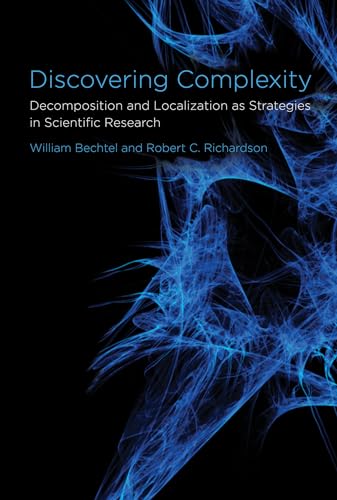
In Discovering Complexity, William Bechtel and Robert Richardson examine two heuristics that guided the development of mechanistic models in the life sciences: decomposition and localization. Drawing on historical cases from disciplines including cell biology, cognitive neuroscience, and genetics, they identify a number of "choice points" that life scientists confront in developing mechanistic explanations and show how different choices result in divergent explanatory models. Describing decomposition as the attempt to differentiate functional and structural components of a system and localization as the assignment of responsibility for specific functions to specific structures, Bechtel and Richardson examine the usefulness of these heuristics as well as their fallibility—the sometimes false assumption underlying them that nature is significantly decomposable and hierarchically organized.
When Discovering Complexity was originally published in 1993, few philosophers of science perceived the centrality of seeking mechanisms to explain phenomena in biology, relying instead on the model of nomological explanation advanced by the logical positivists (a model Bechtel and Richardson found to be utterly inapplicable to the examples from the life sciences in their study). Since then, mechanism and mechanistic explanation have become widely discussed. In a substantive new introduction to this MIT Press edition of their book, Bechtel and Richardson examine both philosophical and scientific developments in research on mechanistic models since 1993.
Die Inhaltsangabe kann sich auf eine andere Ausgabe dieses Titels beziehen.
Über die Autorin bzw. den Autor
William Bechtel is Professor of Philosophy at the University of California, San Diego, and a Fellow of the American Association for the Advancement of Science. He is the author of Mental Mechanisms: Philosophical Perspectives on Cognitive Neuroscience and other books.
Robert C. Richardson is Charles Phelps Taft Professor of Philosophy and a University Distinguished Research Professor at the University of Cincinnati, and a Fellow of the American Association for the Advancement of Science. He is the author of Evolutionary Psychology as Maladapted Psychology (MIT Press, 2007).
„Über diesen Titel“ kann sich auf eine andere Ausgabe dieses Titels beziehen.
Suchergebnisse für Discovering Complexity: Decomposition and Localization...

Foto des Verkäufers
Discovering Complexity: Decomposition and Localization as Strategies in Scientific Research
Anbieter: Birkitt's Books, SARASOTA, FL, USA
Verkäuferbewertung 4 von 5 Sternen

paperback. Zustand: Very Good. Minor shelf wear, binding tight, pages have occasional markings in pen. Discovering Complexity: Decomposition and Localization as Strategies in Scientific Research by William Bechtel and Robert C. Richardson.An important work in the philosophy of science examining how scientists develop mechanistic explanations of complex biological systems. Bechtel and Richardson focus on two major research strategies?decomposition, breaking complex systems into functional and structural components, and localization, assigning particular functions to particular structures.Using historical examples from cell biology, genetics, biochemistry, cognitive neuroscience and related life sciences, the authors examine both the usefulness and limitations of these approaches and how different methodological choices can produce competing scientific models.Originally published by Princeton University Press in 1993, this 2010 MIT Press edition includes a substantive new introduction addressing developments in the philosophy and science of mechanistic explanation since the original publication. Bestandsnummer des Verkäufers 260920014
Gebraucht kaufen
EUR 20,80
EUR 5,93 Versand
Versand innerhalb von USA
Versand innerhalb von USA
Anzahl: 1 verfügbar
Foto des Verkäufers
Discovering Complexity : Decomposition and Localization as Strategies in Scientific Research
Anbieter: GreatBookPrices, Columbia, MD, USA
Verkäuferbewertung 5 von 5 Sternen

Zustand: New. Bestandsnummer des Verkäufers 9093679-n
Neu kaufen
EUR 35,26
EUR 2,32 Versand
Versand innerhalb von USA
Versand innerhalb von USA
Anzahl: Mehr als 20 verfügbar
Foto des Verkäufers
Discovering Complexity: Decomposition and Localization as Strategies in Scientific Research (Paperback or Softback)
Verlag:
MIT Press 8/6/2010, 2010
ISBN 10: 0262514737
ISBN 13: 9780262514736
Neu
Paperback or Softback
Anbieter: BargainBookStores, Grand Rapids, MI, USA
Verkäuferbewertung 5 von 5 Sternen
Paperback or Softback. Zustand: New. Discovering Complexity: Decomposition and Localization as Strategies in Scientific Research. Book. Bestandsnummer des Verkäufers BBS-9780262514736
Foto des Verkäufers
Discovering Complexity : Decomposition and Localization as Strategies in Scientific Research
Anbieter: GreatBookPrices, Columbia, MD, USA
Verkäuferbewertung 5 von 5 Sternen
Zustand: As New. Unread book in perfect condition. Bestandsnummer des Verkäufers 9093679
Gebraucht kaufen
EUR 37,80
EUR 2,32 Versand
Versand innerhalb von USA
Versand innerhalb von USA
Anzahl: Mehr als 20 verfügbar
Beispielbild für diese ISBN
Discovering Complexity
Anbieter: PBShop.store US, Wood Dale, IL, USA
Verkäuferbewertung 5 von 5 Sternen
PAP. Zustand: New. New Book. Shipped from UK. Established seller since 2000. Bestandsnummer des Verkäufers L2-9780262514736
Neu kaufen
EUR 40,36
Versand gratis
Versand innerhalb von USA
Versand innerhalb von USA
Anzahl: Mehr als 20 verfügbar
Beispielbild für diese ISBN
Discovering Complexity
Anbieter: PBShop.store UK, Fairford, GLOS, Vereinigtes Königreich
Verkäuferbewertung 5 von 5 Sternen
PAP. Zustand: New. New Book. Shipped from UK. Established seller since 2000. Bestandsnummer des Verkäufers L2-9780262514736
Neu kaufen
EUR 37,27
EUR 4,84 Versand
Versand von Vereinigtes Königreich nach USA
Versand von Vereinigtes Königreich nach USA
Anzahl: Mehr als 20 verfügbar
Foto des Verkäufers
Discovering Complexity
Anbieter: Rarewaves.com USA, London, LONDO, Vereinigtes Königreich
Verkäuferbewertung 5 von 5 Sternen
Paperback. Zustand: New. Bestandsnummer des Verkäufers LU-9780262514736
Neu kaufen
EUR 42,57
Versand gratis
Versand von Vereinigtes Königreich nach USA
Versand von Vereinigtes Königreich nach USA
Anzahl: Mehr als 20 verfügbar
Foto des Verkäufers
Discovering Complexity (Paperback)
Verlag:
MIT Press Ltd, Cambridge, Mass., 2010
ISBN 10: 0262514737
ISBN 13: 9780262514736
Neu
Paperback
Anbieter: Grand Eagle Retail, Bensenville, IL, USA
Verkäuferbewertung 5 von 5 Sternen
Paperback. Zustand: new. Paperback. An analysis of two heuristic strategies for the development of mechanistic models, illustrated with historical examples from the life sciences.In Discovering Complexity, William Bechtel and Robert Richardson examine two heuristics that guided the development of mechanistic models in the life sciences- decomposition and localization. Drawing on historical cases from disciplines including cell biology, cognitive neuroscience, and genetics, they identify a number of "choice points" that life scientists confront in developing mechanistic explanations and show how different choices result in divergent explanatory models. Describing decomposition as the attempt to differentiate functional and structural components of a system and localization as the assignment of responsibility for specific functions to specific structures, Bechtel and Richardson examine the usefulness of these heuristics as well as their fallibility-the sometimes false assumption underlying them that nature is significantly decomposable and hierarchically organized.When Discovering Complexity was originally published in 1993, few philosophers of science perceived the centrality of seeking mechanisms to explain phenomena in biology, relying instead on the model of nomological explanation advanced by the logical positivists (a model Bechtel and Richardson found to be utterly inapplicable to the examples from the life sciences in their study). Since then, mechanism and mechanistic explanation have become widely discussed. In a substantive new introduction to this MIT Press edition of their book, Bechtel and Richardson examine both philosophical and scientific developments in research on mechanistic models since 1993. An analysis of two heuristic strategies for the development of mechanistic models, illustrated with historical examples from the life sciences. This item is printed on demand. Shipping may be from multiple locations in the US or from the UK, depending on stock availability. Bestandsnummer des Verkäufers 9780262514736
Beispielbild für diese ISBN
Discovering Complexity
Anbieter: Kennys Bookshop and Art Galleries Ltd., Galway, GY, Irland
Verkäuferbewertung 5 von 5 Sternen
Zustand: New. An analysis of two heuristic strategies for the development of mechanistic models, illustrated with historical examples from the life sciences. Num Pages: 340 pages, 33 b&w illus. BIC Classification: PDA. Category: (P) Professional & Vocational. Dimension: 230 x 156 x 20. Weight in Grams: 520. . 2010. Reissue. Paperback. . . . . Bestandsnummer des Verkäufers V9780262514736
Neu kaufen
EUR 43,03
EUR 9,50 Versand
Versand von Irland nach USA
Versand von Irland nach USA
Anzahl: Mehr als 20 verfügbar
Beispielbild für diese ISBN
Discovering Complexity: Decomposition and Localization as Strategies in Scientific Research
Anbieter: Ria Christie Collections, Uxbridge, Vereinigtes Königreich
Verkäuferbewertung 5 von 5 Sternen
Zustand: New. In English. Bestandsnummer des Verkäufers ria9780262514736_new
Neu kaufen
EUR 40,81
EUR 13,13 Versand
Versand von Vereinigtes Königreich nach USA
Versand von Vereinigtes Königreich nach USA
Anzahl: Mehr als 20 verfügbar