
Verwandte Artikel zu The Atlas of Economic Complexity: Mapping Paths to...
Inhaltsangabe
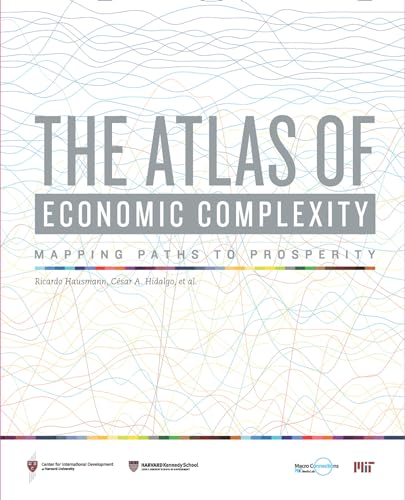
Maps capture data expressing the economic complexity of countries from Albania to Zimbabwe, offering current economic measures and as well as a guide to achieving prosperity
Why do some countries grow and others do not? The authors of The Atlas of Economic Complexity offer readers an explanation based on "Economic Complexity," a measure of a society's productive knowledge. Prosperous societies are those that have the knowledge to make a larger variety of more complex products. The Atlas of Economic Complexity attempts to measure the amount of productive knowledge countries hold and how they can move to accumulate more of it by making more complex products.
Through the graphical representation of the "Product Space," the authors are able to identify each country's "adjacent possible," or potential new products, making it easier to find paths to economic diversification and growth. In addition, they argue that a country's economic complexity and its position in the product space are better predictors of economic growth than many other well-known development indicators, including measures of competitiveness, governance, finance, and schooling.
Using innovative visualizations, the book locates each country in the product space, provides complexity and growth potential rankings for 128 countries, and offers individual country pages with detailed information about a country's current capabilities and its diversification options. The maps and visualizations included in the Atlas can be used to find more viable paths to greater productive knowledge and prosperity.
Die Inhaltsangabe kann sich auf eine andere Ausgabe dieses Titels beziehen.
Über die Autorin bzw. den Autor
Ricardo Hausmann is Director of the Center for International Development at Harvard University, Professor of the Practice of Economic Development at Harvard Kennedy School, and George Cowan Professor at the Santa Fe Institute.
César A Hidalgo is ABC Career Development Professor at the MIT Media Lab.
„Über diesen Titel“ kann sich auf eine andere Ausgabe dieses Titels beziehen.
Suchergebnisse für The Atlas of Economic Complexity: Mapping Paths to...

Beispielbild für diese ISBN
The Atlas of Economic Complexity: Mapping Paths to Prosperity (Mit Press)
Verlag:
The MIT Press (edition Revised), 2014
ISBN 10: 0262525429
ISBN 13: 9780262525428
Gebraucht
Paperback
Anbieter: BooksRun, Philadelphia, PA, USA
Verkäuferbewertung 5 von 5 Sternen

Paperback. Zustand: Fair. Revised. The item might be beaten up but readable. May contain markings or highlighting, as well as stains, bent corners, or any other major defect, but the text is not obscured in any way. Bestandsnummer des Verkäufers 0262525429-7-1
Gebraucht kaufen
EUR 50,94
Versand gratis
Versand innerhalb von USA
Versand innerhalb von USA
Anzahl: 1 verfügbar
Beispielbild für diese ISBN
The Atlas of Economic Complexity
Anbieter: Books Puddle, Woodside, NY, USA
Verkäuferbewertung 4 von 5 Sternen

Zustand: New. pp. 368. Bestandsnummer des Verkäufers 2654483454
Neu kaufen
EUR 63,45
EUR 3,51 Versand
Versand innerhalb von USA
Versand innerhalb von USA
Anzahl: 3 verfügbar
Beispielbild für diese ISBN
Atlas of Economic Complexity : Mapping Paths to Prosperity
Anbieter: GreatBookPrices, Columbia, MD, USA
Verkäuferbewertung 5 von 5 Sternen
Zustand: New. Bestandsnummer des Verkäufers 19663754-n
Neu kaufen
EUR 79,11
EUR 2,32 Versand
Versand innerhalb von USA
Versand innerhalb von USA
Anzahl: Mehr als 20 verfügbar
Beispielbild für diese ISBN
The Atlas of Economic Complexity (Paperback)
Verlag:
MIT Press Ltd, Cambridge, Mass., 2014
ISBN 10: 0262525429
ISBN 13: 9780262525428
Neu
Paperback
Anbieter: Grand Eagle Retail, Bensenville, IL, USA
Verkäuferbewertung 5 von 5 Sternen
Paperback. Zustand: new. Paperback. Maps capture data expressing the economic complexity of countries from Albania to Zimbabwe, offering current economic measures and as well as a guide to achieving prosperityWhy do some countries grow and others do not? The authors of The Atlas of Economic Complexity offer readers an explanation based on "Economic Complexity," a measure of a society's productive knowledge. Prosperous societies are those that have the knowledge to make a larger variety of more complex products. The Atlas of Economic Complexity attempts to measure the amount of productive knowledge countries hold and how they can move to accumulate more of it by making more complex products.Through the graphical representation of the "Product Space," the authors are able to identify each country's "adjacent possible," or potential new products, making it easier to find paths to economic diversification and growth. In addition, they argue that a country's economic complexity and its position in the product space are better predictors of economic growth than many other well-known development indicators, including measures of competitiveness, governance, finance, and schooling.Using innovative visualizations, the book locates each country in the product space, provides complexity and growth potential rankings for 128 countries, and offers individual country pages with detailed information about a country's current capabilities and its diversification options. The maps and visualizations included in the Atlas can be used to find more viable paths to greater productive knowledge and prosperity.Maps capture data expressing the economic complexity of countries from Albania to Zimbabwe, offering current economic measures and as well as a guide to achieving prosperityWhy do some countries grow and others do not? The authors of The Atlas of Economic Complexity offer readers an explanation based on "Economic Complexity," a measure of a society's productive knowledge. Prosperous societies are those that have the knowledge to make a larger variety of more complex products. The Atlas of Economic Complexity attempts to measure the amount of productive knowledge countries hold and how they can move to accumulate more of it by making more complex products.Through the graphical representation of the "Product Space," the authors are able to identify each country's "adjacent possible," or potential new products, making it easier to find paths to economic diversification and growth. In addition, they argue that a country's economic complexity and its position in the product space are better predictors of economic growth than many other well-known development indicators, including measures of competitiveness, governance, finance, and schooling.Using innovative visualizations, the book locates each country in the product space, provides complexity and growth potential rankings for 128 countries, and offers individual country pages with detailed information about a country's current capabilities and its diversification options. The maps and visualizations included in the Atlas can be used to find more viable paths to greater productive knowledge and prosperity. Maps capture data expressing the economic complexity of countries from Albania to Zimbabwe, offering current economic measures and as well as a guide to achieving prosperity Shipping may be from multiple locations in the US or from the UK, depending on stock availability. Bestandsnummer des Verkäufers 9780262525428
Foto des Verkäufers
The Atlas of Economic Complexity
Anbieter: Rarewaves USA, HEBRON, KY, USA
Verkäuferbewertung 5 von 5 Sternen
Paperback. Zustand: New. Bestandsnummer des Verkäufers LU-9780262525428
Neu kaufen
EUR 90,17
Versand gratis
Versand innerhalb von USA
Versand innerhalb von USA
Anzahl: Mehr als 20 verfügbar
Beispielbild für diese ISBN
The Atlas of Economic Complexity
Anbieter: PBShop.store UK, Fairford, GLOS, Vereinigtes Königreich
Verkäuferbewertung 5 von 5 Sternen
PAP. Zustand: New. New Book. Shipped from UK. Established seller since 2000. Bestandsnummer des Verkäufers GO-9780262525428
Neu kaufen
EUR 82,02
EUR 10,91 Versand
Versand von Vereinigtes Königreich nach USA
Versand von Vereinigtes Königreich nach USA
Anzahl: 1 verfügbar
Beispielbild für diese ISBN
The Atlas of Economic Complexity
Anbieter: PBShop.store US, Wood Dale, IL, USA
Verkäuferbewertung 5 von 5 Sternen
PAP. Zustand: New. New Book. Shipped from UK. Established seller since 2000. Bestandsnummer des Verkäufers GO-9780262525428
Beispielbild für diese ISBN
Atlas of Economic Complexity : Mapping Paths to Prosperity
Anbieter: GreatBookPrices, Columbia, MD, USA
Verkäuferbewertung 5 von 5 Sternen
Zustand: As New. Unread book in perfect condition. Bestandsnummer des Verkäufers 19663754
Gebraucht kaufen
EUR 92,52
EUR 2,32 Versand
Versand innerhalb von USA
Versand innerhalb von USA
Anzahl: Mehr als 20 verfügbar
Beispielbild für diese ISBN
Atlas of Economic Complexity : Mapping Paths to Prosperity
Anbieter: GreatBookPricesUK, Woodford Green, Vereinigtes Königreich
Verkäuferbewertung 5 von 5 Sternen
Zustand: New. Bestandsnummer des Verkäufers 19663754-n
Neu kaufen
EUR 82,01
EUR 17,48 Versand
Versand von Vereinigtes Königreich nach USA
Versand von Vereinigtes Königreich nach USA
Anzahl: Mehr als 20 verfügbar
Beispielbild für diese ISBN
The Atlas of Economic Complexity
Anbieter: Biblios, Frankfurt am main, HESSE, Deutschland
Verkäuferbewertung 4 von 5 Sternen
Zustand: New. pp. 368. Bestandsnummer des Verkäufers 1854483444
Neu kaufen
EUR 95,96
EUR 9,95 Versand
Versand von Deutschland nach USA
Versand von Deutschland nach USA
Anzahl: 3 verfügbar