
Verwandte Artikel zu Electing to Fight: Why Emerging Democracies Go to War...
Electing to Fight: Why Emerging Democracies Go to War (Belfer Center Studies in International Security) - Softcover
Inhaltsangabe
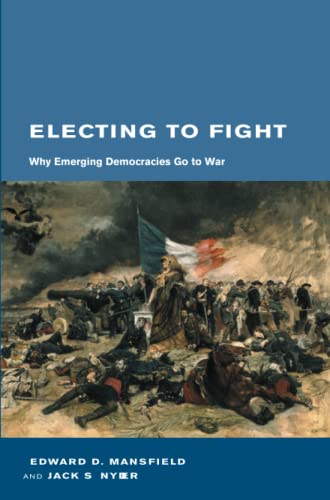
Does the spread of democracy really contribute to international peace? Successive U. S. administrations have justified various policies intended to promote democracy not only by arguing that democracy is intrinsically good but by pointing to a wide range of research concluding that democracies rarely, if ever, go to war with one another. To promote democracy, the United States has provided economic assistance, political support, and technical advice to emerging democracies in Eastern and Central Europe, and it has attempted to remove undemocratic regimes through political pressure, economic sanctions, and military force. In Electing to Fight, Edward Mansfield and Jack Snyder challenge the widely accepted basis of these policies by arguing that states in the early phases of transitions to democracy are more likely than other states to become involved in war.
Drawing on both qualitative and quantitative analysis, Mansfield and Snyder show that emerging democracies with weak political institutions are especially likely to go to war. Leaders of these countries attempt to rally support by invoking external threats and resorting to belligerent, nationalist rhetoric. Mansfield and Snyder point to this pattern in cases ranging from revolutionary France to contemporary Russia. Because the risk of a state's being involved in violent conflict is high until democracy is fully consolidated, Mansfield and Snyder argue, the best way to promote democracy is to begin by building the institutions that democracy requires—such as the rule of law—and only then encouraging mass political participation and elections. Readers will find this argument particularly relevant to prevailing concerns about the transitional government in Iraq. Electing to Fight also calls into question the wisdom of urging early elections elsewhere in the Islamic world and in China.
Die Inhaltsangabe kann sich auf eine andere Ausgabe dieses Titels beziehen.
Über die Autorinnen und Autoren
Edward D. Mansfield is Hum Rosen Professor of Political Science at the University of Pennsylvania. He is the author of Power, Trade, and War and International Conflict and the Global Economy.
Jack Snyder is the Robert and Renée Belfer Professor of International Relations at Columbia University. He is the author of From Voting to Violence: Democratization and Nationalist Conflict; Myths of Empire: Domestic Politics and International Ambition; and The Ideology of the Offensive: Military Decision Making and the Disasters of 1914.
„Über diesen Titel“ kann sich auf eine andere Ausgabe dieses Titels beziehen.
Suchergebnisse für Electing to Fight: Why Emerging Democracies Go to War...

Beispielbild für diese ISBN
Electing to Fight: Why Emerging Democracies Go to War (Belfer Center Studies in International Security)
Anbieter: Your Online Bookstore, Houston, TX, USA
Verkäuferbewertung 5 von 5 Sternen

Paperback. Zustand: Fair. Bestandsnummer des Verkäufers 0262633477-4-16995553
Gebraucht kaufen
EUR 6,35
Versand gratis
Versand innerhalb von USA
Versand innerhalb von USA
Anzahl: 1 verfügbar
Beispielbild für diese ISBN
Electing to Fight: Why Emerging Democracies Go to War (Belfer Center Studies in International Security)
Anbieter: Orion Tech, Kingwood, TX, USA
Verkäuferbewertung 5 von 5 Sternen
paperback. Zustand: Fair. Bestandsnummer des Verkäufers 0262633477-4-35398164
Gebraucht kaufen
EUR 6,35
Versand gratis
Versand innerhalb von USA
Versand innerhalb von USA
Anzahl: 1 verfügbar
Beispielbild für diese ISBN
Electing to Fight : Why Emerging Democracies Go to War
Anbieter: Better World Books, Mishawaka, IN, USA
Verkäuferbewertung 5 von 5 Sternen
Zustand: Good. New Ed. Former library copy. Pages intact with minimal writing/highlighting. The binding may be loose and creased. Dust jackets/supplements are not included. Includes library markings. Stock photo provided. Product includes identifying sticker. Better World Books: Buy Books. Do Good. Bestandsnummer des Verkäufers 9776055-6
Gebraucht kaufen
EUR 6,36
Versand gratis
Versand innerhalb von USA
Versand innerhalb von USA
Anzahl: 1 verfügbar
Beispielbild für diese ISBN
Electing to Fight : Why Emerging Democracies Go to War
Anbieter: Better World Books: West, Reno, NV, USA
Verkäuferbewertung 5 von 5 Sternen
Zustand: Very Good. New Ed. Former library copy. Pages intact with possible writing/highlighting. Binding strong with minor wear. Dust jackets/supplements may not be included. Includes library markings. Stock photo provided. Product includes identifying sticker. Better World Books: Buy Books. Do Good. Bestandsnummer des Verkäufers 13008004-75
Gebraucht kaufen
EUR 6,36
Versand gratis
Versand innerhalb von USA
Versand innerhalb von USA
Anzahl: 1 verfügbar
Beispielbild für diese ISBN
Electing to Fight: Why Emerging Democracies Go to War (Belfer Center Studies in International Security)
Anbieter: Wonder Book, Frederick, MD, USA
Verkäuferbewertung 5 von 5 Sternen
Zustand: As New. Like New condition. A near perfect copy that may have very minor cosmetic defects. Bestandsnummer des Verkäufers H09K-00387
Gebraucht kaufen
EUR 6,43
Versand gratis
Versand innerhalb von USA
Versand innerhalb von USA
Anzahl: 1 verfügbar
Beispielbild für diese ISBN
Electing to Fight: Why Emerging Democracies Go to War (Belfer Center Studies in International Security)
Anbieter: Wonder Book, Frederick, MD, USA
Verkäuferbewertung 5 von 5 Sternen
Zustand: Good. Good condition. A copy that has been read but remains intact. May contain markings such as bookplates, stamps, limited notes and highlighting, or a few light stains. Bestandsnummer des Verkäufers D08P-00454
Gebraucht kaufen
EUR 6,43
Versand gratis
Versand innerhalb von USA
Versand innerhalb von USA
Anzahl: 1 verfügbar
Beispielbild für diese ISBN
Electing to Fight: Why Emerging Democracies Go to War (Belfer Center Studies in International Security)
Anbieter: HPB-Diamond, Dallas, TX, USA
Verkäuferbewertung 5 von 5 Sternen
Paperback. Zustand: Very Good. Connecting readers with great books since 1972! Used books may not include companion materials, and may have some shelf wear or limited writing. We ship orders daily and Customer Service is our top priority! Bestandsnummer des Verkäufers S_441298532
Gebraucht kaufen
EUR 3,58
EUR 3,35 Versand
Versand innerhalb von USA
Versand innerhalb von USA
Anzahl: 1 verfügbar
Beispielbild für diese ISBN
Electing to Fight: Why Emerging Democracies Go to War
Anbieter: ThriftBooks-Atlanta, AUSTELL, GA, USA
Verkäuferbewertung 5 von 5 Sternen
Paperback. Zustand: Good. No Jacket. Pages can have notes/highlighting. Spine may show signs of wear. ~ ThriftBooks: Read More, Spend Less. Bestandsnummer des Verkäufers G0262633477I3N00
Gebraucht kaufen
EUR 7,26
Versand gratis
Versand innerhalb von USA
Versand innerhalb von USA
Anzahl: 1 verfügbar
Beispielbild für diese ISBN
Electing to Fight: Why Emerging Democracies Go to War (Belfer Center Studies in International Security)
Anbieter: HPB-Red, Dallas, TX, USA
Verkäuferbewertung 5 von 5 Sternen
paperback. Zustand: Good. Connecting readers with great books since 1972! Used textbooks may not include companion materials such as access codes, etc. May have some wear or writing/highlighting. We ship orders daily and Customer Service is our top priority! Bestandsnummer des Verkäufers S_413365652
Gebraucht kaufen
EUR 4,60
EUR 3,35 Versand
Versand innerhalb von USA
Versand innerhalb von USA
Anzahl: 1 verfügbar
Beispielbild für diese ISBN
Electing to Fight: Why Emerging Democracies Go to War (Belfer Center Studies in International Security)
Anbieter: Bahamut Media, Reading, Vereinigtes Königreich
Verkäuferbewertung 4 von 5 Sternen

Paperback. Zustand: Very Good. Shipped within 24 hours from our UK warehouse. Clean, undamaged book with no damage to pages and minimal wear to the cover. Spine still tight, in very good condition. Remember if you are not happy, you are covered by our 100% money back guarantee. Bestandsnummer des Verkäufers 6545-9780262633475
Gebraucht kaufen
EUR 10,49
EUR 8,25 Versand
Versand von Vereinigtes Königreich nach USA
Versand von Vereinigtes Königreich nach USA
Anzahl: 1 verfügbar