
Verwandte Artikel zu On Disarmament: The Role of Conventional Arms Control...
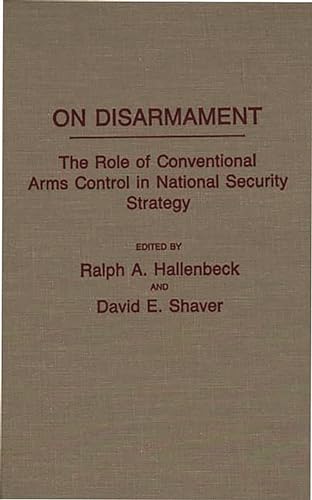
On Disarmament: The Role of Conventional Arms Control in National Security Strategy (Literature; 12) - Hardcover
Inhaltsangabe
The Revolution of 1989 propels European arms control initiatives into a new context. This book presents a concise analysis of arms reduction efforts, putting crucial issues back into focus. Unique in its field, this U.S. Army War College text incorporates the work of practitioners, academics, and members of the U.S. negotiating team. It is written for an audience that will use it to make decisions. Within the first five chapters the reader will understand conventional arms control history: objectives, political procedures, and definitional and external strategic issues affecting negotiations. Successive chapters address: the role of partial disarmament; CFE proposals, data, and military implications of a successful agreement; the U.S. Interagency Group process; the High Level Task Force; and updates on both Vienna negotiations. A clear hard-headed text designed for policy makers, it provides a valuable analysis for courses in foreign policy, negotiation, political theory and practice, and public policy.
This volume opens with a chronology of conventional arms control events from 1967 to 1990. Chapter 2 offers an academic discussion on how and why we developed the general objectives for ongoing CFE and CSBM negotiations in Vienna. Chapter 3 supplies the political insight necessary to comprehend current negotiations. Conventional arms control issues are presented as mini-historical vignettes in Chapter 4. A chapter follows on definitional disarmament. Three successive chapters describe current proposals and progress in the CFE and CSBM talks. Chapter 9 concerns the post-CFE environment--the authors provide a thought-provoking article on a future nonauthoritarian world which looks beyond our current European fixation. The stage is then set for discussion of post-CFE alternative defense strategies and architecture. In closing, the authors reflect on what the effect of U.S. and NATO forces might be after successful conclusions in CFE and CSBM negotiations. The CFE Mandate, NATO's formal proposals, and the Western CSBM proposal are all appended as well as a glossary of terms.
Die Inhaltsangabe kann sich auf eine andere Ausgabe dieses Titels beziehen.
Über die Autorin bzw. den Autor
COLONEL RALPH A. HALLENBECK is Chief of the Army's Conventional Arms Negotiation Division. He has served as Chief of Current Operations, U.S. European Command, Assistant Professor of Political Science at the U.S. Military Academy, Mlitary Adviser to the U.S. Delegation to SALT II and Acting Deputy Assistant Secretary of State for Defense and Arms Control. Colonel Hallenbeck has written extensively on issues of conventional arms control.
COLONEL DAVID E. SHAVER is a Strategic Research Analyst with the Strategic Studies Institute at the U.S. Army War College. He is coauthor of Conventional Arms Control in Europe: How to Think about Specialization in NATO. His other books include Force Structures and Flex-Lease. Colonel Shaver currently holds the General Douglas MacArthur Chair of Research at the U.S. Army War College.
„Über diesen Titel“ kann sich auf eine andere Ausgabe dieses Titels beziehen.
Suchergebnisse für On Disarmament: The Role of Conventional Arms Control...

Beispielbild für diese ISBN
On Disarmament
Print-on-DemandAnbieter: PBShop.store US, Wood Dale, IL, USA
Verkäuferbewertung 5 von 5 Sternen

HRD. Zustand: New. New Book. Shipped from UK. THIS BOOK IS PRINTED ON DEMAND. Established seller since 2000. Bestandsnummer des Verkäufers L1-9780275937171
Neu kaufen
EUR 106,04
Versand gratis
Versand innerhalb von USA
Versand innerhalb von USA
Anzahl: Mehr als 20 verfügbar
Beispielbild für diese ISBN
On Disarmament
Print-on-DemandAnbieter: PBShop.store UK, Fairford, GLOS, Vereinigtes Königreich
Verkäuferbewertung 5 von 5 Sternen
HRD. Zustand: New. New Book. Delivered from our UK warehouse in 4 to 14 business days. THIS BOOK IS PRINTED ON DEMAND. Established seller since 2000. Bestandsnummer des Verkäufers L1-9780275937171
Neu kaufen
EUR 101,81
EUR 6,00 Versand
Versand von Vereinigtes Königreich nach USA
Versand von Vereinigtes Königreich nach USA
Anzahl: Mehr als 20 verfügbar
Beispielbild für diese ISBN
On Disarmament: The Role of Conventional Arms Control in National Security Strategy (Literature; 12)
Anbieter: Kennys Bookshop and Art Galleries Ltd., Galway, GY, Irland
Verkäuferbewertung 5 von 5 Sternen
Zustand: New. Bestandsnummer des Verkäufers V9780275937171
Neu kaufen
EUR 110,38
EUR 9,50 Versand
Versand von Irland nach USA
Versand von Irland nach USA
Anzahl: Mehr als 20 verfügbar
Beispielbild für diese ISBN
On Disarmament: The Role of Conventional Arms Control in National Security Strategy
Anbieter: Ria Christie Collections, Uxbridge, Vereinigtes Königreich
Verkäuferbewertung 5 von 5 Sternen
Zustand: New. In English. Bestandsnummer des Verkäufers ria9780275937171_new
Neu kaufen
EUR 110,48
EUR 13,49 Versand
Versand von Vereinigtes Königreich nach USA
Versand von Vereinigtes Königreich nach USA
Anzahl: Mehr als 20 verfügbar
Beispielbild für diese ISBN
On Disarmament (Hardcover)
Verlag:
Bloomsbury Publishing Plc, Westport, 1991
ISBN 10: 0275937178
ISBN 13: 9780275937171
Neu
Hardcover
Anbieter: Grand Eagle Retail, Bensenville, IL, USA
Verkäuferbewertung 5 von 5 Sternen
Hardcover. Zustand: new. Hardcover. The Revolution of 1989 propels European arms control initiatives into a new context. This book presents a concise analysis of arms reduction efforts, putting crucial issues back into focus. Unique in its field, this U.S. Army War College text incorporates the work of practitioners, academics, and members of the U.S. negotiating team. It is written for an audience that will use it to make decisions. Within the first five chapters the reader will understand conventional arms control history: objectives, political procedures, and definitional and external strategic issues affecting negotiations. Successive chapters address: the role of partial disarmament; CFE proposals, data, and military implications of a successful agreement; the U.S. Interagency Group process; the High Level Task Force; and updates on both Vienna negotiations. A clear hard-headed text designed for policy makers, it provides a valuable analysis for courses in foreign policy, negotiation, political theory and practice, and public policy.This volume opens with a chronology of conventional arms control events from 1967 to 1990. Chapter 2 offers an academic discussion on how and why we developed the general objectives for ongoing CFE and CSBM negotiations in Vienna. Chapter 3 supplies the political insight necessary to comprehend current negotiations. Conventional arms control issues are presented as mini-historical vignettes in Chapter 4. A chapter follows on definitional disarmament. Three successive chapters describe current proposals and progress in the CFE and CSBM talks. Chapter 9 concerns the post-CFE environment--the authors provide a thought-provoking article on a future nonauthoritarian world which looks beyond our current European fixation. The stage is then set for discussion of post-CFE alternative defense strategies and architecture. In closing, the authors reflect on what the effect of U.S. and NATO forces might be after successful conclusions in CFE and CSBM negotiations. The CFE Mandate, NATO's formal proposals, and the Western CSBM proposal are all appended as well as a glossary of terms. A clear hard-headed text designed for policy makers, it provides a valuable analysis for courses in foreign policy, negotiation, political theory and practice, and public policy.This volume opens with a chronology of conventional arms control events from 1967 to 1990. This item is printed on demand. Shipping may be from multiple locations in the US or from the UK, depending on stock availability. Bestandsnummer des Verkäufers 9780275937171
Beispielbild für diese ISBN
On Disarmament: The Role of Conventional Arms Control in National Security Strategy
Print-on-DemandAnbieter: THE SAINT BOOKSTORE, Southport, Vereinigtes Königreich
Verkäuferbewertung 5 von 5 Sternen
Hardback. Zustand: New. This item is printed on demand. New copy - Usually dispatched within 5-9 working days. Bestandsnummer des Verkäufers C9780275937171
Neu kaufen
EUR 116,52
EUR 20,25 Versand
Versand von Vereinigtes Königreich nach USA
Versand von Vereinigtes Königreich nach USA
Anzahl: Mehr als 20 verfügbar
Beispielbild für diese ISBN
On Disarmament (Hardcover)
Verlag:
Bloomsbury Publishing Plc, Westport, 1991
ISBN 10: 0275937178
ISBN 13: 9780275937171
Neu
Hardcover
Anbieter: CitiRetail, Stevenage, Vereinigtes Königreich
Verkäuferbewertung 5 von 5 Sternen
Hardcover. Zustand: new. Hardcover. The Revolution of 1989 propels European arms control initiatives into a new context. This book presents a concise analysis of arms reduction efforts, putting crucial issues back into focus. Unique in its field, this U.S. Army War College text incorporates the work of practitioners, academics, and members of the U.S. negotiating team. It is written for an audience that will use it to make decisions. Within the first five chapters the reader will understand conventional arms control history: objectives, political procedures, and definitional and external strategic issues affecting negotiations. Successive chapters address: the role of partial disarmament; CFE proposals, data, and military implications of a successful agreement; the U.S. Interagency Group process; the High Level Task Force; and updates on both Vienna negotiations. A clear hard-headed text designed for policy makers, it provides a valuable analysis for courses in foreign policy, negotiation, political theory and practice, and public policy.This volume opens with a chronology of conventional arms control events from 1967 to 1990. Chapter 2 offers an academic discussion on how and why we developed the general objectives for ongoing CFE and CSBM negotiations in Vienna. Chapter 3 supplies the political insight necessary to comprehend current negotiations. Conventional arms control issues are presented as mini-historical vignettes in Chapter 4. A chapter follows on definitional disarmament. Three successive chapters describe current proposals and progress in the CFE and CSBM talks. Chapter 9 concerns the post-CFE environment--the authors provide a thought-provoking article on a future nonauthoritarian world which looks beyond our current European fixation. The stage is then set for discussion of post-CFE alternative defense strategies and architecture. In closing, the authors reflect on what the effect of U.S. and NATO forces might be after successful conclusions in CFE and CSBM negotiations. The CFE Mandate, NATO's formal proposals, and the Western CSBM proposal are all appended as well as a glossary of terms. A clear hard-headed text designed for policy makers, it provides a valuable analysis for courses in foreign policy, negotiation, political theory and practice, and public policy.This volume opens with a chronology of conventional arms control events from 1967 to 1990. This item is printed on demand. Shipping may be from our UK warehouse or from our Australian or US warehouses, depending on stock availability. Bestandsnummer des Verkäufers 9780275937171
Neu kaufen
EUR 108,26
EUR 44,20 Versand
Versand von Vereinigtes Königreich nach USA
Versand von Vereinigtes Königreich nach USA
Anzahl: 1 verfügbar
Foto des Verkäufers
On Disarmament
Print-on-DemandAnbieter: moluna, Greven, Deutschland
Verkäuferbewertung 5 von 5 Sternen
Gebunden. Zustand: New. Dieser Artikel ist ein Print on Demand Artikel und wird nach Ihrer Bestellung fuer Sie gedruckt. A clear hard-headed text designed for policy makers, it provides a valuable analysis for courses in foreign policy, negotiation, political theory and practice, and public policy. This volume opens with a chronology of conventional arms control events from. Bestandsnummer des Verkäufers 446866800
Neu kaufen
EUR 104,41
EUR 48,99 Versand
Versand von Deutschland nach USA
Versand von Deutschland nach USA
Anzahl: Mehr als 20 verfügbar
Beispielbild für diese ISBN
On Disarmament: The Role of Conventional Arms Control in National Security Strategy (Literature; 12)
Anbieter: Kennys Bookstore, Olney, MD, USA
Verkäuferbewertung 5 von 5 Sternen
Zustand: New. Bestandsnummer des Verkäufers V9780275937171
Neu kaufen
EUR 144,09
EUR 9,36 Versand
Versand innerhalb von USA
Versand innerhalb von USA
Anzahl: Mehr als 20 verfügbar
Beispielbild für diese ISBN
On Disarmament: The Role of Conventional Arms Control in National Security Strategy
Anbieter: Revaluation Books, Exeter, Vereinigtes Königreich
Verkäuferbewertung 5 von 5 Sternen
Hardcover. Zustand: Brand New. 248 pages. 9.75x6.00x0.75 inches. In Stock. Bestandsnummer des Verkäufers x-0275937178
Neu kaufen
EUR 160,98
EUR 14,93 Versand
Versand von Vereinigtes Königreich nach USA
Versand von Vereinigtes Königreich nach USA
Anzahl: 2 verfügbar