
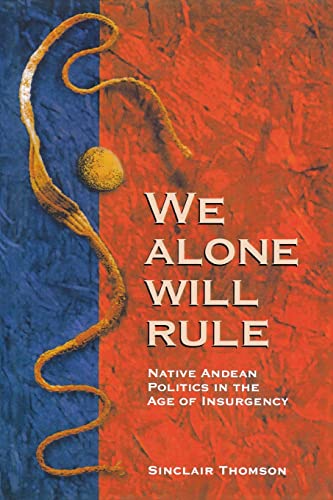
We Alone Will Rule: Native Andean Politics in the Age of Insurgency (Living in Latin America) - Softcover
Inhaltsangabe
In the same era as the American, French, and Haitian revolutions, a powerful anticolonial movement swept across the highland Andes in 1780–1781. Initially unified around Túpac Amaru, a descendant of Inka royalty from Cuzco, it reached its most radical and violent phase in the region of La Paz (present-day Bolivia) where Aymara-speaking Indians waged war against Europeans under the peasant commander Túpaj Katari. The great Andean insurrection has received scant attention by historians of the "Age of Revolution," but in this book Sinclair Thomson reveals the connections between ongoing local struggles over Indian community government and a larger anticolonial movement.
Die Inhaltsangabe kann sich auf eine andere Ausgabe dieses Titels beziehen.
Über die Autorin bzw. den Autor
Sinclair Thomson is assistant professor of history at New York University.
Auszug. © Genehmigter Nachdruck. Alle Rechte vorbehalten.
We Alone Will Rule
Native Andean Politics in the Age of Insurgency By Sinclair ThomsonTHE UNIVERSITY OF WISCONSIN PRESS
Copyright © 2002 The Board of Regents of the University of Wisconsin SystemAll right reserved.
ISBN: 978-0-299-17794-2
Contents
Illustrations............................................................................................................viiPreface and Acknowledgments..............................................................................................ix1. Contours for a History of Power and Political Transformation in the Aymara Highlands..................................32. The Inherited Structure of Authority..................................................................................273. The Crisis of Andean Rule (I): Institutional and Intracommunity Strife................................................644. The Crisis of Andean Rule (II): The Reparto Connection and Breakdown of Mediation.....................................1065. Emancipation Projects and Dynamics of Native Insurgency (I): The Awaited Day of Andean Self-Rule......................1406. Emancipation Projects and Dynamics of Native Insurgency (II): The Storm of War under Tpaj Katari.....................1807. The Aftermath of Insurgency and Renegotiation of Power................................................................2328. Conclusions and Continuations.........................................................................................269Abbreviations............................................................................................................283Notes....................................................................................................................285Bibliography.............................................................................................................351Index....................................................................................................................373
Chapter One
Contours for a History of Power and Political Transformation in the Aymara Highlands
To some, civilization itself seemed to hang in the balance in 1781. To others, it seemed the dawning of a new day, when men and women could live freely and with dignity. In that year, the most powerful anticolonial movement in the history of Spanish rule in the Americas was sweeping across the southern Andes. For Spaniards and the colonial elite as well as for Indian insurgents, it was a decisive time matched only by the sixteenth-century conquest of the continent. Indian leaders imagined now a counterconquest, a "new conquest" of their own; colonial officials likewise saw their campaigns of repression as a "new conquest" or "reconquest" of the realm. One of the two primary theaters of the violent Andean civil war in the early 1780s was La Paz (in present-day Bolivia), a region situated around the southern rim of the Lake Titicaca basin in the heartland of the Aymara-speaking indigenous population. As an exploration of Indian community and peasant politics, this study sets out to recover and illuminate the history of the Aymara people of La Paz in the age that produced the momentous pan-Andean insurrection.
Since the 1720s and 1730s, the Andean region had been the scene of growing turmoil. Local conflicts flared up with increasing frequency throughout the countryside. The exploitative commercial practices of provincial Spanish governors not only wrought hardship among communities but also stirred trenchant opposition. Indian protests poured into the courts. Anticolonial sentiment found expression in prophecies, conspiracies, and occasional revolts. In the 1770s, after Bourbon state officials imposed a set of universally unpopular measures (including higher taxation and stricter control of trade), Andean society reached an explosive conjuncture.
In 1780, a chain of riots expressing Indian, mestizo, and creole discontent with the Bourbon reforms broke out in highland, valley, and coastal cities. In the countryside near Potos, the fabled source of Spain's wealth in silver, local community struggles turned into an armed regional insurgency led by an Aymara-speaking peasant, Toms Katari. In Cuzco, the preconquest capital of Inka territory, Jos Gabriel Condorcanqui Tpac Amaru, an Indian cacique (community governor) and nobleman stepped forth as the direct descendant of the last native sovereign who had been executed by Viceroy Toledo in the sixteenth century. Tpac Amaru called for the expulsion of all Europeans from Peruvian soil and a profound social reordering. The powerful movement that looked to him as its symbolic leader succeeded in liberating a vast expanse of the southern Andean highlands, an area that today encompasses southern Peru and Bolivia. Its repercussions were felt even more broadly, up and down the cordillera ranges from what is today Colombia in the north down to present-day Argentina in the south and from the deserts of the Pacific coast to the tropical lowlands of the Amazonian interior. When the key struggles shifted to La Paz, where the Quechua-speaking commanders from Cuzco teamed up with the Aymara peasant commander Tpaj Katari, the civil war entered its most acute and most violent phase.
From their camps in El Alto, on the rim of the Andean altiplano, or upland plateau, tens of thousands of Aymara peasant warriors looked out over an impressive scene. Below them opened up a wide basin created by the drainage, over tens of thousands of years, of an ancient sea whose waters had flowed down from the highland elevation of thirteen thousand feet (four thousand meters) through highland valleys and lowland foothills out onto the continental floor of the Amazon. Eerily beautiful limestone badlands, in ashen gray, ochre, and reddish earth tones, formed steep walls around the basin. Across the basin and above it, thrusting up into the brilliant Andean skies, the insurgents gazed upon the massive glacial peaks of Mount Illimani (twenty-one thousand feet high, or sixty-four hundred meters), which they worshiped as an awesome ancestral divinity. Beneath its towering tutelary presence, successive waves of settlers over thousands of years had occupied this basin, farming its hillsides, mining its soils for gold, and pasturing native camelids. When the members of the first Spanish expedition arrived in the sixteenth century, they were unaware of the landscape's numinous powers and the layers of human history it had sustained. A Spanish township named La Paz was founded in 1548, in the location that diverse native ethnic groups speaking Aymara, Quechua, and Pukina languages called Choqueyapu.
La Paz served thereafter as the most important commercial nexus between Cuzco and Potos. It was also the main point of Spanish settlement and colonial political control in a highland expanse overwhelmingly occupied by people the Spaniards called "Indians." Yet now, after two and one-half centuries of colonial rule, the city was under full siege and Spanish power was on the verge of destruction.
The Aymara camp was the scene of constant hustle and bustle. Spies brought reports on developments within the city, and messengers conveyed news and letters from northern and southern provinces. The combatants, coming and going from communities around the altiplano, were organized in twenty-four political assemblies (cabildos). At their head, exercising political, military, and spiritual authority, was the fearsome Tpaj Katari, whose name signified "resplendent serpent" in Aymara. Under a vast...
„Über diesen Titel“ kann sich auf eine andere Ausgabe dieses Titels beziehen.
Weitere beliebte Ausgaben desselben Titels

Suchergebnisse für We Alone Will Rule: Native Andean Politics in the Age...

Beispielbild für diese ISBN
We Alone Will Rule: Native Andean Politics in the Age of Insurgency
Verlag:
University of Wisconsin Press, 2003
ISBN 10: 0299177947
ISBN 13: 9780299177942
Gebraucht
Paperback
Anbieter: ThriftBooks-Dallas, Dallas, TX, USA
Verkäuferbewertung 5 von 5 Sternen

Paperback. Zustand: Fair. No Jacket. Readable copy. Pages may have considerable notes/highlighting. ~ ThriftBooks: Read More, Spend Less. Bestandsnummer des Verkäufers G0299177947I5N00
Gebraucht kaufen
EUR 5,89
Versand gratis
Versand innerhalb von USA
Versand innerhalb von USA
Anzahl: 1 verfügbar
Foto des Verkäufers
We Alone Will Rule: Native Andean Politics in the Age of Insurgency (Living in Latin America)
Verlag:
University of Wisconsin Press, 2003
ISBN 10: 0299177947
ISBN 13: 9780299177942
Gebraucht
Softcover
Anbieter: clickgoodwillbooks, Indianapolis, IN, USA
Verkäuferbewertung 5 von 5 Sternen
Zustand: acceptable. Used - Acceptable: All pages and the cover are intact, but shrink wrap, dust covers, or boxed set case may be missing. Pages may include limited notes, highlighting, or minor water damage but the text is readable. Item may be missing bundled media. Bestandsnummer des Verkäufers 3O6XBG000PKA_ns
Gebraucht kaufen
EUR 3,83
EUR 3,46 Versand
Versand innerhalb von USA
Versand innerhalb von USA
Anzahl: 1 verfügbar
Beispielbild für diese ISBN
We Alone Will Rule: Native Andean Politics in the Age of Insurgency (Living in Latin America)
Verlag:
University of Wisconsin Press, 2003
ISBN 10: 0299177947
ISBN 13: 9780299177942
Gebraucht
paperback
Anbieter: HPB-Red, Dallas, TX, USA
Verkäuferbewertung 5 von 5 Sternen
paperback. Zustand: Good. Connecting readers with great books since 1972! Used textbooks may not include companion materials such as access codes, etc. May have some wear or writing/highlighting. We ship orders daily and Customer Service is our top priority! Bestandsnummer des Verkäufers S_410657975
Gebraucht kaufen
EUR 4,47
EUR 3,25 Versand
Versand innerhalb von USA
Versand innerhalb von USA
Anzahl: 1 verfügbar
Beispielbild für diese ISBN
We Alone Will Rule: Native Andean Politics in the Age of Insurgency (Living in Latin America)
Verlag:
University of Wisconsin Press, 2003
ISBN 10: 0299177947
ISBN 13: 9780299177942
Gebraucht
Soft cover
Erstausgabe
Anbieter: Regent College Bookstore, Vancouver, BC, Kanada
Verkäuferbewertung 5 von 5 Sternen
Soft cover. Zustand: Very Good. 1st Edition. 399 pp. Book in very good condition with tight binding, little wear, but occasional pencil markings. Bestandsnummer des Verkäufers ABE-1681508108486
Gebraucht kaufen
EUR 5,76
EUR 9,32 Versand
Versand von Kanada nach USA
Versand von Kanada nach USA
Anzahl: 1 verfügbar
Beispielbild für diese ISBN
We Alone Will Rule: Native Andean Politics in the Age of Insurgency (Living in Latin America)
Verlag:
University of Wisconsin Press, 2003
ISBN 10: 0299177947
ISBN 13: 9780299177942
Gebraucht
Paperback
Anbieter: Book Alley, Pasadena, CA, USA
Verkäuferbewertung 4 von 5 Sternen

Paperback. Zustand: Good. Gently used with pencil underlining on the majority of pages. Binding is tight. Bestandsnummer des Verkäufers mon0000578072
Gebraucht kaufen
EUR 10,28
EUR 5,20 Versand
Versand innerhalb von USA
Versand innerhalb von USA
Anzahl: 1 verfügbar
Foto des Verkäufers
We Alone Will Rule Native Andean Politics in the Age of Insurgency
Verlag:
University of Wisconsin Press, 2003
ISBN 10: 0299177947
ISBN 13: 9780299177942
Gebraucht
Paperback
Anbieter: True Oak Books, Highland, NY, USA
Verkäuferbewertung 5 von 5 Sternen
Paperback. Zustand: Good. Living In Latin America; *Ex-Library copy with usual identifiers. - Great overall condition. Minor cosmetic wear. No major blemishes. No writing.; - We offer free returns for any reason and respond promptly to all inquiries. Your order will be packaged with care and ship on the same or next business day. Buy with confidence. Bestandsnummer des Verkäufers TOB193-19370-A-1.32
Gebraucht kaufen
EUR 17,86
Versand gratis
Versand innerhalb von USA
Versand innerhalb von USA
Anzahl: 1 verfügbar
Beispielbild für diese ISBN
We Along Will Rule: Native Andean Politics in the age of insurgency
Verlag:
University of Wisconsin Press, 2003
ISBN 10: 0299177947
ISBN 13: 9780299177942
Gebraucht
Soft cover
Anbieter: N. Fagin Books, Chicago, IL, USA
Verkäuferbewertung 5 von 5 Sternen
Soft cover. Zustand: Near Fine. 2002. South America, Native Americans. University of Wisconsin Press. Very good - fine paperback 399p. 1/24 crate. Bestandsnummer des Verkäufers 90549
Gebraucht kaufen
EUR 13,40
EUR 5,20 Versand
Versand innerhalb von USA
Versand innerhalb von USA
Anzahl: 1 verfügbar
Beispielbild für diese ISBN
We Alone Will Rule: Native Andean Politics in the Age of Insurgency (Living in Latin America)
Verlag:
University of Wisconsin Press, 2003
ISBN 10: 0299177947
ISBN 13: 9780299177942
Neu
Softcover
Anbieter: Lakeside Books, Benton Harbor, MI, USA
Verkäuferbewertung 5 von 5 Sternen
Zustand: New. Brand New! Not Overstocks or Low Quality Book Club Editions! Direct From the Publisher! We're not a giant, faceless warehouse organization! We're a small town bookstore that loves books and loves it's customers! Buy from Lakeside Books! Bestandsnummer des Verkäufers OTF-S-9780299177942
Neu kaufen
EUR 17,18
EUR 3,46 Versand
Versand innerhalb von USA
Versand innerhalb von USA
Anzahl: Mehr als 20 verfügbar
Foto des Verkäufers
We Alone Will Rule : Native Andean Politics in the Age of Insurgency
Verlag:
University of Wisconsin Press, 2003
ISBN 10: 0299177947
ISBN 13: 9780299177942
Neu
Softcover
Anbieter: GreatBookPrices, Columbia, MD, USA
Verkäuferbewertung 5 von 5 Sternen
Zustand: New. Bestandsnummer des Verkäufers 655773-n
Neu kaufen
EUR 18,38
EUR 2,29 Versand
Versand innerhalb von USA
Versand innerhalb von USA
Anzahl: Mehr als 20 verfügbar
Foto des Verkäufers
We Alone Will Rule: Native Andean Politics in the Age of Insurgency (Paperback or Softback)
Verlag:
University of Wisconsin Press 11/1/2009, 2009
ISBN 10: 0299177947
ISBN 13: 9780299177942
Neu
Paperback or Softback
Anbieter: BargainBookStores, Grand Rapids, MI, USA
Verkäuferbewertung 5 von 5 Sternen
Paperback or Softback. Zustand: New. We Alone Will Rule: Native Andean Politics in the Age of Insurgency. Book. Bestandsnummer des Verkäufers BBS-9780299177942