
Verwandte Artikel zu Making of a Sage: A Study in Rabbinic Ethics
Inhaltsangabe
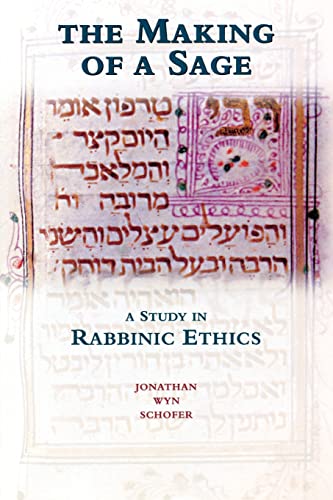
Jonathan Schofer offers the first theoretically framed examination of rabbinic ethics in several decades. Centering on one large and influential anthology, The Fathers According to Rabbi Nathan, Jonathan Schofer situates that text within a broader spectrum of rabbinic thought, while at the same time bringing rabbinic thought into dialogue with current scholarship on the self, ethics, theology, and the history of religions.
Notable Selection, Jordan Schnitzer Book Award for Philosophy and Jewish Thought, Association for Jewish Studies
Die Inhaltsangabe kann sich auf eine andere Ausgabe dieses Titels beziehen.
Über die Autorin bzw. den Autor
Jonathan Wyn Schofer is assistant professor of classical rabbinic literature in the Department of Hebrew and Semitic Studies at the University of Wisconsin–Madison.
Auszug. © Genehmigter Nachdruck. Alle Rechte vorbehalten.
The Making of a Sage
A Study in Rabbinic EthicsBy Jonathan Wyn SchoferTHE UNIVERSITY OF WISCONSIN PRESS
Copyright © 2005 The Board of Regents of the University of Wisconsin SystemAll right reserved.
ISBN: 978-0-299-20464-8
Contents
Preface....................................................viiAcknowledgments............................................xiConventions................................................xiiiIntroduction...............................................3Part 1. The Text and Its Sages.............................231a. Rabbi Nathan and Its Contexts..........................251b. The Text Instructs.....................................421c. Concepts and Tropes....................................541d. The Text and Its Sages: Conclusion.....................65Part 2. Rabbinic Tradition.................................672a. Torah and Transgressive Tendencies.....................712b. The Heart and Its Formation............................842c. Rabbinic Tradition: Conclusion.........................116Part 3. Rabbinic Theology..................................1213a. Divine Reward and Punishment...........................1253b. Motivation and Emotion.................................1473c. Rabbinic Theology: Conclusion..........................161Conclusion.................................................167Notes......................................................175Bibliography...............................................275Index of Sources...........................................295Index of Names, Ancient and Modern.........................299Index of Subjects..........................................305
Chapter One
The Text and Its Sages
The creators of rabbinic texts were editors who received, adapted, expanded, and arranged earlier materials. Contemporary scholars debate the methods we should employ for thematic studies drawing upon such sources, and I am largely a pluralist in these matters. There are many ways one could frame a treatment of a given topic, and each has its possibilities and dangers. Taking a single text as my primary unit of analysis allows me to examine editorial work at various levels, including that of the entire compilation, though a constant risk is overemphasizing the hands of the editors or attributing a false unity to the process of compilation. When I consider the ethics of Rabbi Nathan in relation to rabbinic thought broadly construed, two dangers are overparticularizing (claiming that this text represents the viewpoint of only one school or set of compilers) or overgeneralizing (claiming that this text represents rabbinic thought as such).
Rabbi Nathan is a large and significant anthology of ethical material that represents an important strand of rabbinic ethical thinking and debate. The text includes a diverse range of teachings, and that diversity allows me to examine themes that have wide resonances in rabbinic literature. At the same time, like all rabbinic texts, Rabbi Nathan preserves many features that are specific to its stream of compilation. Despite its size, Rabbi Nathan surely does not represent all of rabbinic thought: its creators were selective and at times contentious. While I treat Rabbi Nathan as a key example for investigating rabbinic ethics broadly construed, I also identify the distinct features of the text in contrast with others produced by the movement. Part of my work will be to discuss the many groups of people that are excluded from its ethics, and one way that I signal that Rabbi Nathan represents a strand and not the totality of rabbinic views is to avoid the use of the definite article before the word "rabbis." Rabbi Nathan reveals what (certain) rabbis state, but not what (all of) "the rabbis" believed.
How, though, do we read a rabbinic text as a whole? What is the relation between this text and the classical rabbinic sages of Roman late antiquity, many of whom are portrayed in the text itself? Rabbi Nathan has an extremely complicated history of composition and editing, and we only understand small parts of it. Within the textual family, we find multiple recensions and a diversity of views and opinions, and beyond Rabbi Nathan there are challenges of contextualization in relation to other rabbinic material as well as to history. This section responds to such problems, first addressing the issues in delineating the text of Rabbi Nathan, situating it in contexts, and identifying the overall picture of a rabbinic community portrayed in the material. Then I examine the genres and literary structure of the text as a whole, including its maxims, their arrangement, the commentary upon them, and narratives within the commentary. My focus is on pedagogical features-how the text instructs its audience. Finally, I consider methodological questions in understanding the thought presented by the text, particularly its concepts and tropes. Everything that I discuss here is crucial for understanding Rabbi Nathan, but the generality of these points in relation to other rabbinic sources varies. My accounts of midrash and narrative probably can be applied to many other rabbinic sources, as can the procedures I set out for studying concepts and tropes. Much of my discussion of text and context, and my analysis of maxims, would be applicable to The Fathers as well as Rabbi Nathan, though the arrangement of maxims, their commentary, and aspects of the communal ideals are particular to Rabbi Nathan.
1a Rabbi Nathan and Its Contexts
What constitutes the text? The Fathers According to Rabbi Nathan really designates a group of texts, as there are a number of writings, often with significant differences, which have that title. Today's academic readers of rabbinic Hebrew likely encounter Rabbi Nathan in one of two sources: the printed edition of the Babylonian Talmud (as part of the extracanonical tractates), and Solomon Schechter's edition of 1887. Most scholars make use of Schechter's compilation, which is the first critical edition ever done of a rabbinic text and an incredible work. He arranged two different versions side by side: one based on printed editions labeled "A," and the other labeled "B." Drawing upon manuscripts, medieval quotations, and other sources, he made some corrections within the main text (at times making this explicit, at other times not), presented comments at the bottom of each page, and included several appendices with further notes and a full manuscript. Schechter's book has many flaws, and it is difficult to navigate, but it is a tremendous achievement and still the standard reference. This marks not the end but the beginning of the challenges. In the years since Schechter, critical studies of manuscripts and geniza fragments have been done by Louis Finkelstein, Marc Bregman, and, most recently and extensively, Menahem Kister. One of the manuscripts that Schechter used for Rabbi Nathan A was lost in the Holocaust, and Finkelstein was able to make use of a manuscript that Schechter did not have. Both Kister and Bregman have given us reason to see complexities in recension beyond the dichotomy of A and B.
My method concerning this diversity of writings is threefold. First, I aim to support all of my fundamental arguments through Rabbi Nathan A, and specifically the printed edition. Why the printed edition? The textual history of Rabbi Nathan is so complex that no one manuscript can be designated as best for identifying some original text. The printed edition surely is flawed, but given that no manuscript is unequivocally superior, I use the writings that came to be disseminated most widely and that the reader can consult most easily. I strive not to base any key interpretation on a passage for which the printed edition is clearly faulty. In cases of textual problems, sometimes I still quote from that edition but do not draw upon the problematic elements in my analysis. Other times, I follow corrections suggested by Schechter or later scholars, and I indicate when I do so. Unless otherwise specified, when I write "Rabbi Nathan," this is shorthand for "the printed edition of Rabbi Nathan A."
Second, when there are interesting points or supplements to my basic arguments, I quote and analyze manuscripts of Rabbi Nathan A and Rabbi Nathan B. Otherwise, much valuable material for understanding rabbinic ethics would be ignored. I specify when I am not drawing from the base text. Third, through footnotes, I aim to cite and reference all relevant materials, so that the reader can have access to the full range of possibilities present in the textual family that is denoted by Rabbi Nathan as well as in other rabbinic texts. My major claims, moreover, are on a level of generalization that should have application beyond Rabbi Nathan, but the form and degree of this application is largely a matter for further research.
Date and Duration
Setting out the context of Rabbi Nathan is no simple matter. The relation between text and context is problematic for any work of literature, and recent scholarship on intellectual and literary history has reflected upon the complexities involved. Dominick LaCapra, for example, sets out six "overlapping areas of investigation," considering the relations of a text to the author's intentions, the author's life, society, culture, the corpus of a writer, and structures or forms of discourse. This consideration of context as multifaceted is an important starting point for studying rabbinic materials, for we cannot presume a uniform standard or method for contextualizing texts across the cultures of Roman late antiquity. Rabbi Nathan can be quite productively contexualized in relation to forms of discourse (such as maxims of instruction, midrash and other forms of commentary, and narrative) and with significant qualifications, in relation to society and culture. However, on the creator's intentions, life, and corpus, the texts I examine differ significantly from much Roman and Christian material of the time, which can be situated in relation to particular authors and speakers, dates, and events. These authors and speakers, moreover, reflected upon themselves, and some were honored publicly through statues. By contrast, the rabbinic movement developed literature through anonymous compilers who avoided reference to history beyond a few key events.
Rabbi Nathan, like other rabbinic sources, was not written by an author. Even if we allow the theoretical point that the author is alive as a function of scholarly discourse, we cannot carry out that function with Rabbi Nathan. Specifically, we should not presume that the text was written at a particular time and place, that it has stylistic unity and conceptual coherence, and that it can be situated in relation to a distinct historical event or situation. We do not even know when or why the text came to be attributed to "Rabbi Nathan," though a figure named Rabbi Nathan appears on the first page, which may have inspired the title. The text was created over centuries by editors who preserved and transmitted teachings from their past, but not in a manner that allows us to treat the material as historically reliable in any simple sense. At the same time, they did not impose their own views strongly enough that we can consider the accounts to be authored compositions.
Some rabbinic sources are more amenable to historical contextualization than others. In certain cases, discrete units can be situated through comparison with Roman or early Christian material. As for entire texts, Saul Lieberman emphasized the importance of the Palestinian Talmud for historical study of second- and third-century Palestine. The Babylonian Talmud brings all sorts of challenges, but at least the editors followed certain conventions for distinguishing earlier from later materials. The Mishnah can be identified as a distinct text from the gemara, or talmudic commentary. The gemara in turn distinguishes tannaitic teachings (first to second centuries CE) from amoraic (third to fifth centuries CE) and later ones. Even if scholars are suspicious concerning the accuracy of the early material, at least there is something with which to work. Also, researchers have often had great success in identifying likely source material in earlier texts such as the Tosephta, Palestinian Talmud, and midrashic collections, comparing them with the Babylonian gemara to identify the work of redaction. Rabbi Nathan, by contrast, appears to be a tannaitic work of Roman Palestine. The text is almost entirely in Hebrew, and most all the sages named in the text are from Palestine during the first and second centuries CE or earlier. However, scholars have long been aware that the final version of the text is much later, and Menahem Kister's recent analysis makes clear that we cannot read Rabbi Nathan in any transparent way as a source for early rabbinic material. At the same time, contextualizing Rabbi Nathan in later periods also presents difficulties. As Kister and others have shown, both internal evidence and comparison between versions indicate a fluid set of texts that went through many stages of editing, not a single compiler at a single time.
While many still take Rabbi Nathan to be the equivalent of a talmudic tractate to the mishnaic text of The Fathers, this analogy fails in ways that are methodologically significant. Since the base text of Rabbi Nathan is a shorter and arguably earlier collection of maxims than The Fathers, the texts probably developed in parallel for a long period of time-perhaps sometimes in competing rabbinic circles and sometimes not. The particular wording and arrangement of the maxims in Rabbi Nathan often differs from that of The Fathers in important ways. The Fathers cannot be treated as the text upon which Rabbi Nathan comments, but as another branch in a textual family whose trunk does not exist except in the scholarly imagination. If there is a "Tosephta" to The Fathers, it is also material found within Rabbi Nathan. The important distinctions between Mishnah and commentary, and between sources and redaction, are then much more difficult to delineate than they are for talmudic sources. As others who have worked on these materials, I treat the maxims that form the base of Rabbi Nathan as being part of that text, not, as Talmudists treat the Mishnah, a different text (though, as I discuss below, Rabbi Nathan has an internal hierarchy of meaning, with the commentary often distinguished from the base text). Comparisons with parallel sources also tend to yield ambiguities. While sometimes we find relatively clear cases of older material reworked in Rabbi Nathan, for many of the passages that I focus upon, the parallels offer differently redacted materials rather than the sources of Rabbi Nathan.
How, then, do we situate Rabbi Nathan in time and space, history and geography? The printed edition and extant manuscripts of Rabbi Nathan all date from the medieval period, starting in the fourteenth century. The earliest genizah fragment may be from the ninth century or earlier. However, there is little in the text that reveals explicit concern with the world of the later Geonic or medieval periods, such as existence in a Mediterranean Islamic or European Christian society. The final editors of the text seem to have been shapers rather than creators of the material we find.
How early is that material? This is a difficult and hotly disputed question. The sages named in the text lived from the second century BCE to the third century CE. Scholars have attempted, with some success, to reconstruct formulations and meanings from that time, but generally Rabbi Nathan is not a reliable source for historical information about rabbis in the first centuries. There are significant disjunctive points in the text, where we can see later commentators preserving, yet struggling with or transforming, earlier viewpoints. I give great attention to these, because they reveal in stark terms the interests of the commentators, but they do not correlate across the text such that we can identify datable strata. Each case has to be treated individually. The text probably was still being compiled during the Christianization of the Roman Empire in the fourth century CE, and it may have undergone changes after the shift to an Islamic context in the seventh century, though we find little if any explicit representation of those contexts. Figures and events of the first two centuries, then, provided the material through which later rabbis reflected upon their own communities as well as imperial culture and power.
Delineating the date of Rabbi Nathan, then, does not lead us to a static point of crystallization or origin. The text primarily indicates a Palestinian setting (though many have noted signs of Babylonian editing, particularly for Rabbi Nathan A). It began to be compiled in the second century CE or earlier, grew by accretion, and attained its full form sometime between the sixth and ninth centuries, perhaps even going through further changes afterwards. Rabbi Nathan can be situated in multiple temporal contexts, depending on whether one is trying to recover early material, identify editorial shaping, or trace the reception of the text through later commentary and transmission. Anthony Saldarini has argued that the overall ethos of the text is probably amoraic, but Kister's emphasis on later features always has to be considered. The most significant source we have for studying classical rabbinic ethics is, in notable respects, postclassical.
(Continues...)
Excerpted from The Making of a Sageby Jonathan Wyn Schofer Copyright © 2005 by The Board of Regents of the University of Wisconsin System. Excerpted by permission.
All rights reserved. No part of this excerpt may be reproduced or reprinted without permission in writing from the publisher.
Excerpts are provided by Dial-A-Book Inc. solely for the personal use of visitors to this web site.
„Über diesen Titel“ kann sich auf eine andere Ausgabe dieses Titels beziehen.
Suchergebnisse für Making of a Sage: A Study in Rabbinic Ethics

Beispielbild für diese ISBN
The Making of a Sage: A Study in Rabbinic Ethics
Verlag:
University of Wisconsin Press, 2005
ISBN 10: 0299204642
ISBN 13: 9780299204648
Gebraucht
Softcover
Anbieter: More Than Words, Waltham, MA, USA
Verkäuferbewertung 5 von 5 Sternen

Zustand: Good. . Former Library book. All orders guaranteed and ship within 24 hours. Before placing your order for please contact us for confirmation on the book's binding. Check out our other listings to add to your order for discounted shipping. Bestandsnummer des Verkäufers WAL-J-1e-002925
Gebraucht kaufen
EUR 9,42
EUR 3,56 Versand
Versand innerhalb von USA
Versand innerhalb von USA
Anzahl: 1 verfügbar
Beispielbild für diese ISBN
The Making of a Sage: A Study in Rabbinic Ethics
Verlag:
University of Wisconsin Press, 2005
ISBN 10: 0299204642
ISBN 13: 9780299204648
Gebraucht
Paperback
Anbieter: Midtown Scholar Bookstore, Harrisburg, PA, USA
Verkäuferbewertung 5 von 5 Sternen
Paperback. Zustand: Very Good. Very Good - Crisp, clean, unread book with some shelfwear/edgewear, may have a remainder mark - NICE PAPERBACK Standard-sized. Bestandsnummer des Verkäufers M0299204642Z2
Gebraucht kaufen
EUR 8,35
EUR 5,36 Versand
Versand innerhalb von USA
Versand innerhalb von USA
Anzahl: 4 verfügbar
Beispielbild für diese ISBN
The Making of a Sage: A Study in Rabbinic Ethics
Verlag:
University of Wisconsin Press, 2005
ISBN 10: 0299204642
ISBN 13: 9780299204648
Gebraucht
Paperback
Anbieter: Midtown Scholar Bookstore, Harrisburg, PA, USA
Verkäuferbewertung 5 von 5 Sternen
Paperback. Zustand: Good. Good - Bumped and creased book with tears to the extremities, but not affecting the text block, may have remainder mark or previous owner's name - GOOD Standard-sized. Bestandsnummer des Verkäufers M0299204642Z3
Gebraucht kaufen
EUR 8,58
EUR 5,36 Versand
Versand innerhalb von USA
Versand innerhalb von USA
Anzahl: 2 verfügbar
Beispielbild für diese ISBN
The Making of a Sage : A Study in Rabbinic Ethics
Verlag:
University of Wisconsin Press, 2005
ISBN 10: 0299204642
ISBN 13: 9780299204648
Gebraucht
Soft cover
Anbieter: JPH Books, Chapel Hill, NC, USA
Verkäuferbewertung 4 von 5 Sternen

Soft cover. Zustand: Fine. Trade paperback. Bestandsnummer des Verkäufers 002504
Gebraucht kaufen
EUR 11,04
EUR 4,46 Versand
Versand innerhalb von USA
Versand innerhalb von USA
Anzahl: 1 verfügbar
Beispielbild für diese ISBN
The Making of a Sage : A Study in Rabbinic Ethics
Verlag:
University of Wisconsin Press, 2005
ISBN 10: 0299204642
ISBN 13: 9780299204648
Gebraucht
Softcover
Anbieter: Better World Books, Mishawaka, IN, USA
Verkäuferbewertung 5 von 5 Sternen
Zustand: Very Good. Pages intact with possible writing/highlighting. Binding strong with minor wear. Dust jackets/supplements may not be included. Stock photo provided. Product includes identifying sticker. Better World Books: Buy Books. Do Good. Bestandsnummer des Verkäufers 17498572-6
Gebraucht kaufen
EUR 15,55
Versand gratis
Versand innerhalb von USA
Versand innerhalb von USA
Anzahl: 1 verfügbar
Foto des Verkäufers
The Making of a Sage: A Study in Rabbinic Ethics
Verlag:
University of Wisconsin Press, 2005
ISBN 10: 0299204642
ISBN 13: 9780299204648
Gebraucht
Soft cover
Erstausgabe
Anbieter: Gordon Kauffman, Bookseller, LLC, Chippewa Falls, WI, USA
Verkäuferbewertung 4 von 5 Sternen
Soft cover. Zustand: Near Fine. 1st Edition. - Inspected, Cleaned, Sealed in Shrink Wrap - FIRST EDITION, FIRST PRINTING - Tight Binding/Sharp Corners - Clean & Unmarked - Returns Accepted / Refunds Given Inspected, Cleaned & Sealed by me, the proprietor. 2005. 1st edition. 1st printing. Softcover book. 310 pp. It has a tight binding with sharp corners. The text part of the book is clean and unmarked. 9.0" x 6.0". Sealed in Shrink Wrap for protection in storage and shipping. Expertly packed. *PROFESSIONAL BOOKSELLER* I try hard to get the descriptions right, sometimes I make a mistake, therefore, Returns accepted. Refunds given. -Gordon. Bestandsnummer des Verkäufers ABE-1765212906319
Gebraucht kaufen
EUR 12,46
EUR 4,91 Versand
Versand innerhalb von USA
Versand innerhalb von USA
Anzahl: 1 verfügbar
Beispielbild für diese ISBN
The Making of a Sage: A Study in Rabbinic Ethics
Verlag:
University of Wisconsin Press, Madison, WI, 2005
ISBN 10: 0299204642
ISBN 13: 9780299204648
Gebraucht
Soft cover
Erstausgabe
Anbieter: Voyageur Book Shop, Milwaukee, WI, USA
Verkäuferbewertung 5 von 5 Sternen
Soft cover. Zustand: Fine. 1st Edition. Complete printing number line. Q14. Bestandsnummer des Verkäufers 022432
Gebraucht kaufen
EUR 14,71
EUR 4,24 Versand
Versand innerhalb von USA
Versand innerhalb von USA
Anzahl: 1 verfügbar
Beispielbild für diese ISBN
The Making Of A Sage: A Study In Rabbinic Ethics
Verlag:
Univ of Wisconsin Pr, Madison, 2005
ISBN 10: 0299204642
ISBN 13: 9780299204648
Gebraucht
Paper Bound
Signiert
Anbieter: Feldman's Books, Menlo Park, CA, USA
Verkäuferbewertung 4 von 5 Sternen
Paper Bound. Zustand: Very Fine. First Edition. Inscription and signed by author: "Jon". Signed by Author(s). Bestandsnummer des Verkäufers 00033163
Gebraucht kaufen
EUR 18,39
EUR 4,02 Versand
Versand innerhalb von USA
Versand innerhalb von USA
Anzahl: 1 verfügbar
Beispielbild für diese ISBN
The Making of a Sage Format: Paperback
Anbieter: INDOO, Avenel, NJ, USA
Verkäuferbewertung 5 von 5 Sternen
Zustand: New. Brand New. Bestandsnummer des Verkäufers 9780299204648
Neu kaufen
EUR 23,54
Versand gratis
Versand innerhalb von USA
Versand innerhalb von USA
Anzahl: Mehr als 20 verfügbar
Beispielbild für diese ISBN
The Making of a Sage
Print-on-DemandAnbieter: PBShop.store UK, Fairford, GLOS, Vereinigtes Königreich
Verkäuferbewertung 5 von 5 Sternen
PAP. Zustand: New. New Book. Delivered from our UK warehouse in 4 to 14 business days. THIS BOOK IS PRINTED ON DEMAND. Established seller since 2000. Bestandsnummer des Verkäufers L0-9780299204648
Neu kaufen
EUR 32,43
EUR 5,92 Versand
Versand von Vereinigtes Königreich nach USA
Versand von Vereinigtes Königreich nach USA
Anzahl: Mehr als 20 verfügbar