
Verwandte Artikel zu How to Increase Your Child's Verbal Intelligence:...
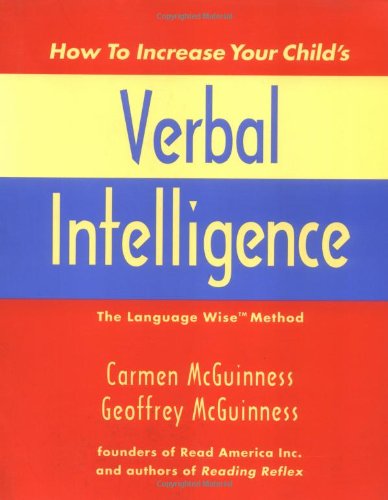
How to Increase Your Child's Verbal Intelligence: The Groundbreaking Language Wise Method - Softcover
Inhaltsangabe
Are there specific ways for parents and teachers to help children better understand what they read and hear? Is it possible to raise a child’s verbal intelligence?
The authors of this book answer with a resounding yes. Carmen and Geoffrey McGuinness, creators of the acclaimed and widely used Phono-Graphix method of reading instruction, explain why it is important to teach children comprehension skills and how to do it. Parents and teachers seeking sound, research-supported advice on ways to improve their children’s reading comprehension will find this book an essential resource. Each of the dozens of exercises and activities in the book is aimed at improving the comprehension—and the writing skills—of children from 6 to 18 years of age.
We can teach our children the skills they need to understand and use the information they read, the authors assure us. McGuinness and McGuinness show how comprehension can be broken down into small components of understanding. They provide a variety of fun-to-do lessons to help readers progress beyond decoding to real comprehension. The lessons include:
• how to use synonyms
• how to read passive voice
• how to anticipate what will happen in a story
• how to define a word by its context in a story
• how to remember key elements in a written passage
• and many more
This book is an essential primer for parents wishing to understand how children learn, process, and use language.
The authors of this book answer with a resounding yes. Carmen and Geoffrey McGuinness, creators of the acclaimed and widely used Phono-Graphix method of reading instruction, explain why it is important to teach children comprehension skills and how to do it. Parents and teachers seeking sound, research-supported advice on ways to improve their children’s reading comprehension will find this book an essential resource. Each of the dozens of exercises and activities in the book is aimed at improving the comprehension—and the writing skills—of children from 6 to 18 years of age.
We can teach our children the skills they need to understand and use the information they read, the authors assure us. McGuinness and McGuinness show how comprehension can be broken down into small components of understanding. They provide a variety of fun-to-do lessons to help readers progress beyond decoding to real comprehension. The lessons include:
• how to use synonyms
• how to read passive voice
• how to anticipate what will happen in a story
• how to define a word by its context in a story
• how to remember key elements in a written passage
• and many more
This book is an essential primer for parents wishing to understand how children learn, process, and use language.
Die Inhaltsangabe kann sich auf eine andere Ausgabe dieses Titels beziehen.
Über die Autorin bzw. den Autor
Carmen and Geoffrey McGuinness are co-founders of the Read America clinic in Orlando, Florida, and coauthors of Reading Reflex.
Auszug. © Genehmigter Nachdruck. Alle Rechte vorbehalten.
Excerpt
"Language Wise" Verbal Intelligence Activities
WORD DETECTIVE
Goals
This activity will help the child learn to build a strategy for figuring outwhat words mean based on the context of the sentence in which they occur.
This activity will help the child learn to build a strategy of questioning thatwill enable her to discover the meaning of a word when the existing informationis not sufficient.
Improves
vocabulary
grammar
logical reasoning
creativity
Age Appropriateness
This activityis appropriate for a mature six year old and older. The challenge is findingvocabulary that is appropriate. Experimentation may benecessary.
Materials
You?ll need a good age appropriatedictionary for reference during this lesson. We suggest Webster?s ElementaryDictionary. Although it presents itself as an elementary grades dictionary,it contains numerous entries of words that the average middle school childdoesn?t know. In all it has 32,000 entries. If you?re dealing with a precociouschild you might want to use a good unabridged dictionary. You might even learn afew new words yourself.
You will also need some paper and apencil.
Presentation
1. Tell the child that you?re going toplay a word detective game. Tell her the game will teach her new words. Explainthat you are going to say a sentence and in it will be the word you want her tofigure out. Tell her she can figure out the word by using the sentence it?s in.Explain that you are going to start with a made-up word for practice.
2. Tell her the word is ?smup?. Say, ?The smup barked at themail man.? (dog)
Continue on with these practice sentences.
?We went on a smittle in the country.? Explain that she needs moreinformation. Say, ?We went on a smittle in the country. We brought ablanket and a smittle basket.? (picnic)
?I like plomet.? Discuss the fact that she can?t exactly tell whatplomet is. It could be anything she likes. Explain that she needs moreinformation. Say, ?I like plomet. My teacher is very nice.? (school)
3. Say, ?Now we are going to use a real word that you don?t know.? The followingis a short list of suggested vocabulary words with sample sentences. These willget you started and give you some examples of sentences that reveal meaning.
The man with the red polka-dot jacket, boots and a skirt looked absurd.
The bird was aloft among the clouds.
I?m going to give you two alternatives. You can go straight to bed oryou can behave.
I want to eradicate the ants from this house.
My friends deluded me into thinking they had forgotten my birthday. Butthey gave me a surprise party.
The mountain climber was very tired, but he knew he must persevere if hewas to reach the top of the mountain.
Oranges are the origin of orange juice.
The mailman brought me a parcel with a gift in it.
The car obscured my view of the robbery, so I wasn?t able to describethe burglar.
I was perplexed to find an apple growing on an orange tree.
Refrain from jumping on the couch or you?ll be in big trouble.
4. Now offer the child some practice figuring out what questions to ask when asentence or two doesn?t provide enough context information to unlock the wordmeaning. Warn her that these are a little harder.
Aren?t you venturesome today.
Say, ?Why can?t you figure out what venturesome means? What?s theproblem?? Your child should say something like, Venturesome could beanything ?you? are today.?
Say, ?That?s right, so we need to know what ?you? did to get the speaker to sayshe or he was venturesome. Well, ?you? climbed all the way to the top ofa big oak tree to rescue a kitten that was stuck up there. What do you thinksomeone is who climbs all the way to the top of a tree?? The child should saysomething like ?brave.?
Say, ?That?s right, and what you needed to know to figure that word out was whatthe person had done, what action he had taken to be called venturesome.
Now we?re going to try another one.
That?s a vibrant color.
This one is different. The color can?t do anything. Colors can?t move or showaction. What do you think would help you figure out what vibrant means??The child should say that seeing the color would help. When you elicit thisanswer, show her a very vibrant color. She will probably say that vibrant meansbright.
FEELINGS AND ACTIONS
Goals
To offer experience at building meaning from a state of being to a verb.
To offer experience surmising the state of being based on the action.
Age Appropriateness
Six and older.
Improves
vocabulary
logical reasoning
creativity
Presentation
1. Tell the child you?re going to provide a word and he should think ofsomething you would do if you felt that way
States of Being
sad cry
happy
mad
lonely
afraid
tired
hungry
confused
itchy
sticky
hot
gone
cold
sick
excited
upset
jealous
whiny
cranky
stupid
embarrassed
smart
proud
anxious
hateful
overwhelmed
loving
strong
lost
dizzy
awful
goofy
Actions
smile happy
vomit
leave
cry
laugh
drink
clap
eat
shout
whisper
jump
sleep
sink
OPERATING ON MEMORY
Goals
To give the child practice at using systematic organization and elaboration toimprove on memory.
To show the child that connections are more valuable thanarbitrary lists.
Age Appropriateness
Eight and older
Improves
logical reasoning
memory
Presentation
1. Ask the child how good his memory is. After he tells you what he thinks, tellhim to try to remember a list of words. Tell him the words. Now ask him what thewords were.
2. Now tell him that you?re going to teach him some tricks to remember things.Invite him to sort the words into groups. Ask him what words might go welltogether. Make a list of the groups. Ask the child to explain the groups to you.(EX) These things all go in the kitchen and these things all go in the bathroom,and these things all go in the living room.
3. Now ask him to recall all the words.
4. Now ask him to write (or dictate to you) a paragraph using all the words.After he has completed this and reread it to you invite him to recall all thewords.
5. Discuss how understanding the relationships between words can help you recallinformation. Use examples of school material that you may recall better if youunderstand the ?story? between the words. History works as a good example ofthis. Other examples might be:
chair, floor, toothpaste, brush, dish, window, fork, TV, mirror
Example of how the child might categorize the above:
things in a bathroom?toothpaste, brush, mirror
things in a living room?TV, chair
Create a list of things from the following as in the above for use in yourlessons. Some suggestions are:
things at the beach
things in the woods
things in your room
sports teams
things in a movie theater
rock bands
parts ofa house
athletic shoes
designer clothes
magazines
makeup
kinds of breakfast cereal
kinds of desserts
bodies of water
types of transportation
emotions
a list of names
Continues...
Excerpted from How to Increase Your Child's Verbal Intelligenceby Carmen McGuinness Copyright © 2000 by Carmen McGuinness. Excerpted by permission.
All rights reserved. No part of this excerpt may be reproduced or...
„Über diesen Titel“ kann sich auf eine andere Ausgabe dieses Titels beziehen.
Suchergebnisse für How to Increase Your Child's Verbal Intelligence:...

Beispielbild für diese ISBN
How to Increase Your Child's Verbal Intelligence: The Groundbreaking Language Wise Method
Anbieter: Orion Tech, Kingwood, TX, USA
Verkäuferbewertung 5 von 5 Sternen

paperback. Zustand: Fair. Bestandsnummer des Verkäufers 0300083203-4-35908150
Gebraucht kaufen
EUR 3,84
Versand gratis
Versand innerhalb von USA
Versand innerhalb von USA
Anzahl: 1 verfügbar
Beispielbild für diese ISBN
How to Increase Your Child's Verbal Intelligence: The Groundbreaking Language Wise Method
Anbieter: World of Books (was SecondSale), Montgomery, IL, USA
Verkäuferbewertung 5 von 5 Sternen
Zustand: Good. Item in good condition. Textbooks may not include supplemental items i.e. CDs, access codes etc. Bestandsnummer des Verkäufers 00102402735
Gebraucht kaufen
EUR 3,85
Versand gratis
Versand innerhalb von USA
Versand innerhalb von USA
Anzahl: 3 verfügbar
Beispielbild für diese ISBN
How to Increase Your Child's Verbal Intelligence: The Groundbreaking Language Wise Method
Anbieter: World of Books (was SecondSale), Montgomery, IL, USA
Verkäuferbewertung 5 von 5 Sternen
Zustand: Good. Item in good condition and has highlighting/writing on text. Used texts may not contain supplemental items such as CDs, info-trac etc. Bestandsnummer des Verkäufers 00107893396
Gebraucht kaufen
EUR 3,85
Versand gratis
Versand innerhalb von USA
Versand innerhalb von USA
Anzahl: 1 verfügbar
Beispielbild für diese ISBN
How to Increase Your Child's Verbal Intelligence: The Groundbreaking Language Wise Method
Anbieter: World of Books (was SecondSale), Montgomery, IL, USA
Verkäuferbewertung 5 von 5 Sternen
Zustand: Acceptable. Item in acceptable condition! Textbooks may not include supplemental items i.e. CDs, access codes etc. Bestandsnummer des Verkäufers 00101586236
Gebraucht kaufen
EUR 3,85
Versand gratis
Versand innerhalb von USA
Versand innerhalb von USA
Anzahl: 1 verfügbar
Beispielbild für diese ISBN
How to Increase Your Child's Verbal Intelligence: The Groundbreaking Language Wise Method
Verlag:
Yale University Press (edition First Edition), 2000
ISBN 10: 0300083203
ISBN 13: 9780300083200
Gebraucht
Paperback
Erstausgabe
Anbieter: BooksRun, Philadelphia, PA, USA
Verkäuferbewertung 5 von 5 Sternen
Paperback. Zustand: Very Good. First Edition. It's a well-cared-for item that has seen limited use. The item may show minor signs of wear. All the text is legible, with all pages included. It may have slight markings and/or highlighting. Bestandsnummer des Verkäufers 0300083203-11-1
Gebraucht kaufen
EUR 5,21
Versand gratis
Versand innerhalb von USA
Versand innerhalb von USA
Anzahl: 1 verfügbar
Foto des Verkäufers
How to Increase Your Child's Verbal Intelligence: The Groundbreaking Language Wise Method
Anbieter: Zoom Books Company, Lynden, WA, USA
Verkäuferbewertung 5 von 5 Sternen
Zustand: very_good. Book is in very good condition and may include minimal underlining highlighting. The book can also include "From the library of" labels. May not contain miscellaneous items toys, dvds, etc. . We offer 100% money back guarantee and 24 7 customer service. Bestandsnummer des Verkäufers ZBV.0300083203.VG
Gebraucht kaufen
EUR 6,76
Versand gratis
Versand innerhalb von USA
Versand innerhalb von USA
Anzahl: 1 verfügbar
Beispielbild für diese ISBN
How to Increase Your Child's Verbal Intelligence: The Language Wise Method
Anbieter: ThriftBooks-Phoenix, Phoenix, AZ, USA
Verkäuferbewertung 5 von 5 Sternen
Paperback. Zustand: Good. No Jacket. Pages can have notes/highlighting. Spine may show signs of wear. ~ ThriftBooks: Read More, Spend Less. Bestandsnummer des Verkäufers G0300083203I3N00
Gebraucht kaufen
EUR 6,98
Versand gratis
Versand innerhalb von USA
Versand innerhalb von USA
Anzahl: 1 verfügbar
Beispielbild für diese ISBN
How to Increase Your Child's Verbal Intelligence: The Language Wise Method
Anbieter: ThriftBooks-Reno, Reno, NV, USA
Verkäuferbewertung 5 von 5 Sternen
Paperback. Zustand: Good. No Jacket. Pages can have notes/highlighting. Spine may show signs of wear. ~ ThriftBooks: Read More, Spend Less. Bestandsnummer des Verkäufers G0300083203I3N00
Gebraucht kaufen
EUR 6,98
Versand gratis
Versand innerhalb von USA
Versand innerhalb von USA
Anzahl: 2 verfügbar
Foto des Verkäufers
How to Increase Your Child's Verbal Intelligence: The Groundbreaking Language Wise Method
Anbieter: Goodwill Books, Hillsboro, OR, USA
Verkäuferbewertung 5 von 5 Sternen
Zustand: good. Signs of wear and consistent use. Bestandsnummer des Verkäufers GICWV.0300083203.G
Gebraucht kaufen
EUR 3,53
EUR 3,47 Versand
Versand innerhalb von USA
Versand innerhalb von USA
Anzahl: 1 verfügbar
Beispielbild für diese ISBN
How to Increase Your Child's Verbal Intelligence: The Language Wise Method
Anbieter: ThriftBooks-Dallas, Dallas, TX, USA
Verkäuferbewertung 5 von 5 Sternen
Paperback. Zustand: Good. No Jacket. Pages can have notes/highlighting. Spine may show signs of wear. ~ ThriftBooks: Read More, Spend Less. Bestandsnummer des Verkäufers G0300083203I3N00
Gebraucht kaufen
EUR 7,00
Versand gratis
Versand innerhalb von USA
Versand innerhalb von USA
Anzahl: 2 verfügbar