
Verwandte Artikel zu Radical Judaism: Rethinking God and Tradition (Franz...
Radical Judaism: Rethinking God and Tradition (Franz Rosenzweig Lecture Series) - Softcover
Buch 1 von 3: The Franz Rosenzweig Lecture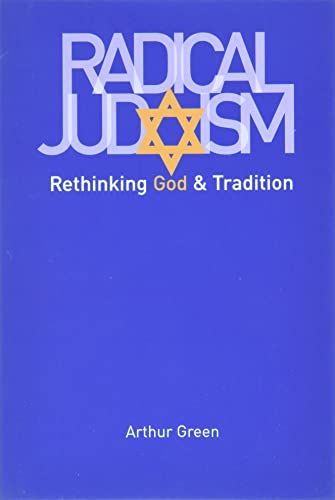
Inhaltsangabe
As featured on the cover of Tikkun magazine
How do we articulate a religious vision that embraces evolution and human authorship of Scripture? Drawing on the Jewish mystical traditions of Kabbalah and Hasidism, path-breaking Jewish scholar Arthur Green argues that a neomystical perspective can help us to reframe these realities, so they may yet be viewed as dwelling places of the sacred. In doing so, he rethinks such concepts as God, the origins and meaning of existence, human nature, and revelation to construct a new Judaism for the twenty-first century.
Die Inhaltsangabe kann sich auf eine andere Ausgabe dieses Titels beziehen.
Über die Autorin bzw. den Autor
Rabbi Arthur Green is professor and rector of the Rabbinical School of Hebrew College in Newton, MA.
Auszug. © Genehmigter Nachdruck. Alle Rechte vorbehalten.
Radical Judaism
Rethinking God and Tradition
By ARTHUR GREENYale UNIVERSITY PRESS
Copyright © 2010 Arthur Green
All rights reserved.
ISBN: 978-0-300-15232-6All rights reserved.
Contents
| Preface.................................................................... | ix |
| Introduction............................................................... | 1 |
| 1 Y-H-W-H: God and Being................................................... | 16 |
| 2 Evolution Continues: A Jewish History of "God"........................... | 34 |
| 3 Torah: Word out of Silence............................................... | 79 |
| 4 Israel: Being Human, Being Jewish........................................ | 120 |
| Notes...................................................................... | 167 |
| Glossary................................................................... | 191 |
| Index...................................................................... | 195 |
Excerpt
CHAPTER 1
Y-H-W-H: GOD AND BEING
In the Beginning
I open with a theological assertion. As a religious person I believethat the evolution of species is the greatest sacred drama of all time. Itis a tale—perhaps even the tale—in which the divine waits to bediscovered. It dwarfs all the other narratives, memories, and imagesthat so preoccupy the mind of religious traditions, including our own.We Jews, Christians, and Muslims are all overinvolved with proclaiming—orquestioning—the truth of our own particular stories. DidMoses really receive the Torah from God at Mount Sinai? Did Jesustruly rise from the tomb? Was Muhammad indeed God's chosenmessenger? We refine our debates about these forever, each groupcertain that its own narrative is at the center of universal history. Inthe modern world, where all these tales are challenged, we work outsophisticated and nonliteralist ways of proclaiming our faith in them.But there is a bigger story, infinitely bigger, and one that we all share.How did we get here, we humans, and where are we going? For morethan a century and a half, educated Westerners have understood thatthis is the tale of evolution. But we religious folk, the great tale-tellersof our respective traditions, have been guarded and cool toward thisstory and have hesitated to make it our own. The time has come toembrace it and to uncover its sacred dimensions.
I believe that "Creation," or perhaps more neutrally stated, "origins,"a topic almost entirely neglected in both Jewish and liberalChristian theology of the past century, must return as a central preoccupationin our own day. This indeed has much to do with the ecologicalagenda and the key role that religion needs to play in changingour attitudes toward the world within which we humans live. But italso emerges from our society's growing acceptance of scientific explanations—thoseof the nuclear physicist, the geologist, the evolutionarybiologist, and others—for the origins of the world we haveinherited. The finality of this acceptance, which I share, seeminglymeans the end of a long struggle between so-called scientific andreligious worldviews. This leaves those of us who speak the languageof faith in a peculiar situation. Is there then no connection betweenthe God we know and encounter daily within all existence and theemergence and history of our universe? Does the presence of eternitywe feel (whether we call ourselves "believers" or not) when we standatop great mountains or at the ocean water's edge exist only withinour minds? Is our faith nothing more than one of those big molluskshells we used to put up against our ears, convinced we could hear inthem the ocean's roar? Is our certainty of divine presence, so palpableto the religious soul, merely a poetic affirmation, corresponding tonothing in the reality described by science? We accept the scientificaccount of how we got here, or at least understand that the conversationabout that process and its stages lies within the domain of science.Yet we cannot absent God from it entirely. Even if we have leftbehind the God of childhood, the One who assures and guarantees"fairness" in life, the presence of divinity within nature remains essentialto our perception of reality. A God who has no place in theprocess of "how we got here" is a God who begins in the human mind,a mere idea of God, a post-Kantian construct created to guaranteemorality, to assure us of the potential for human goodness, or forsome other noble purpose. But that is not God. The One of which Ispeak here indeed goes back to origins and stands prior to them,though perhaps not in a clearly temporal sense. A God who underliesall being, who is and dwells within (rather than "who controls" or"oversees") the evolutionary process is the One about which—orabout "Whom"—we tell the great sacred tale, the story of existence.
I thus insist on the centrality of "Creation," but I do so from theposition of one who is not quite a theist, as understood in the classicalWestern sense. I do not affirm a Being or a Mind that exists separatefrom the universe and acts upon it intelligently and willfully. Thisputs me quite far from the contemporary "creationists" or from whatis usually understood as "intelligent design" (but see more on thisbelow). My theological position is that of a mystical panentheist, onewho believes that God is present throughout all of existence, thatBeing or Y-H-W-H underlies and unifies all that is. At the same time(and this is panentheism as distinct from pantheism), this whole ismysteriously and infinitely greater than the sum of its parts, andcannot be fully known or reduced to its constituent beings. "Transcendence"in the context of such a faith does not refer to a God "outthere" or "over there" somewhere beyond the universe, since I do notknow the existence of such a "there." Transcendence means ratherthat God—or Being—is so fully present in the here and now of eachmoment that we could not possibly grasp the depth of that presence.Transcendence thus dwells within immanence. There is no ultimateduality here, no "God and world," no "God, world, and self," onlyone Being and its many faces. Those who seek consciousness of itcome to know that it is indeed eyn sof, without end. There is no end toits unimaginable depth, but so too there is no border, no limit, separatingthat unfathomable One from anything that is. Infinite Being inevery instant flows through all finite beings. "Know this day and set itupon your heart that Y-H-W-H is elohim" (Deut. 4:39)—that Godwithin you is the transcendent. And the verse concludes: "There isnothing else."
By mystical panentheism I mean that this underlying oneness ofbeing is accessible to human experience and reveals itself to humans—indeed, it reveals itself everywhere, always—as the deeper levels ofthe human mind become open to it. Access to it requires a lifting ofveils, a shifting of attention to those inner realms of human consciousnesswhere mystics, and not a few poets, have always chosen toabide. The "radical otherness" of God, so insisted upon by Westerntheology, is not an ontological otherness but an otherness of perspective.To open one's eyes to God is to see Being—the only Being thereis—in a radically different way. Such a unitive view of reality is entirelyother (ganz andere, in theological German) from the...
„Über diesen Titel“ kann sich auf eine andere Ausgabe dieses Titels beziehen.
Suchergebnisse für Radical Judaism: Rethinking God and Tradition (Franz...

Beispielbild für diese ISBN
Radical Judaism: Rethinking God and Tradition (The Franz Rosenzweig Lecture Series)
Verlag:
Yale University Press (edition ), 2010
ISBN 10: 0300152329
ISBN 13: 9780300152326
Gebraucht
Paperback
Anbieter: BooksRun, Philadelphia, PA, USA
Verkäuferbewertung 5 von 5 Sternen

Paperback. Zustand: Very Good. It's a well-cared-for item that has seen limited use. The item may show minor signs of wear. All the text is legible, with all pages included. It may have slight markings and/or highlighting. Bestandsnummer des Verkäufers 0300152329-11-1
Gebraucht kaufen
EUR 7,29
Versand gratis
Versand innerhalb von USA
Versand innerhalb von USA
Anzahl: 2 verfügbar
Foto des Verkäufers
Radical Judaism: Rethinking God and Tradition (The Franz Rosenzweig Lecture Series)
Anbieter: -OnTimeBooks-, Phoenix, AZ, USA
Verkäuferbewertung 5 von 5 Sternen
Zustand: very_good. Gently read. May have name of previous ownership, or ex-library edition. Binding tight; spine straight and smooth, with no creasing; covers clean and crisp. Minimal signs of handling or shelving. 100% GUARANTEE! Shipped with delivery confirmation, if you're not satisfied with purchase please return item! Ships USPS Media Mail. Bestandsnummer des Verkäufers OTV.0300152329.VG
Gebraucht kaufen
EUR 8,36
Versand gratis
Versand innerhalb von USA
Versand innerhalb von USA
Anzahl: 1 verfügbar
Foto des Verkäufers
Radical Judaism: Rethinking God and Tradition (The Franz Rosenzweig Lecture Series)
Anbieter: Greenworld Books, Arlington, TX, USA
Verkäuferbewertung 5 von 5 Sternen
Zustand: good. Fast Free Shipping â" Good condition. It may show normal signs of use, such as light writing, highlighting, or library markings, but all pages are intact and the book is fully readable. A solid, complete copy that's ready to enjoy. Bestandsnummer des Verkäufers GWV.0300152329.G
Gebraucht kaufen
EUR 8,76
Versand gratis
Versand innerhalb von USA
Versand innerhalb von USA
Anzahl: 1 verfügbar
Beispielbild für diese ISBN
Radical Judaism : Rethinking God and Tradition
Anbieter: Better World Books, Mishawaka, IN, USA
Verkäuferbewertung 5 von 5 Sternen
Zustand: Good. Pages intact with minimal writing/highlighting. The binding may be loose and creased. Dust jackets/supplements are not included. Stock photo provided. Product includes identifying sticker. Better World Books: Buy Books. Do Good. Bestandsnummer des Verkäufers 5470136-6
Gebraucht kaufen
EUR 10,08
Versand gratis
Versand innerhalb von USA
Versand innerhalb von USA
Anzahl: 1 verfügbar
Foto des Verkäufers
Radical Judaism: Rethinking God and Tradition (The Franz Rosenzweig Lecture Series)
Anbieter: EdmondDantes Bookseller, Minneapolis, MN, USA
Verkäuferbewertung 5 von 5 Sternen
Soft cover. Zustand: Fair. Softcover Paperback with only minor reading wear; underlining throughout. In stock. Ships from MN, USA. Bestandsnummer des Verkäufers 025267
Gebraucht kaufen
EUR 7,31
EUR 4,00 Versand
Versand innerhalb von USA
Versand innerhalb von USA
Anzahl: 1 verfügbar
Foto des Verkäufers
Radical Judaism: Rethinking God and Tradition
Anbieter: Southampton Books, Sag Harbor, NY, USA
Verkäuferbewertung 5 von 5 Sternen
Paperback. Zustand: Very Good. First Edition, Third Printing. Not price-clipped. Published by Yale University Press, 2010. Octavo. Paperback. Book is very good with previous owner's name on back of front cover and shelf/edgewear. 100% positive feedback. 30 day money back guarantee. NEXT DAY SHIPPING! Excellent customer service. Please email with any questions. All books packed carefully and ship with free delivery confirmation/tracking. All books come with free bookmarks. Ships from Sag Harbor, New York. Bestandsnummer des Verkäufers 379643
Gebraucht kaufen
EUR 18,33
EUR 4,44 Versand
Versand innerhalb von USA
Versand innerhalb von USA
Anzahl: 1 verfügbar
Beispielbild für diese ISBN
Radical Judaism: Rethinking God and Tradition (The Franz Rosenzweig Lecture Series)
Anbieter: Textbooks_Source, Columbia, MO, USA
Verkäuferbewertung 5 von 5 Sternen
paperback. Zustand: Good. Ships in a BOX from Central Missouri! May not include working access code. Will not include dust jacket. Has used sticker(s) and some writing or highlighting. UPS shipping for most packages, (Priority Mail for AK/HI/APO/PO Boxes). Bestandsnummer des Verkäufers 001124024U
Gebraucht kaufen
EUR 21,73
EUR 3,55 Versand
Versand innerhalb von USA
Versand innerhalb von USA
Anzahl: 10 verfügbar
Foto des Verkäufers
Radical Judaism: Rethinking God and Tradition (The Franz Rosenzweig Lecture Series)
Verlag:
Yale University Press, 2010
ISBN 10: 0300152329
ISBN 13: 9780300152326
Gebraucht
Paperback
Erstausgabe
Anbieter: Southampton Books, Sag Harbor, NY, USA
Verkäuferbewertung 5 von 5 Sternen
Paperback. Zustand: Like New. First Edition. First Edition, Later Printing. Published by Yale University Press, 2010. Octavo. Paperback. Book is like new. Bestandsnummer des Verkäufers 574772
Gebraucht kaufen
EUR 27,49
EUR 4,44 Versand
Versand innerhalb von USA
Versand innerhalb von USA
Anzahl: 1 verfügbar
Beispielbild für diese ISBN
Radical Judaism: Rethinking God and Tradition
Anbieter: Brook Bookstore On Demand, Napoli, NA, Italien
Verkäuferbewertung 5 von 5 Sternen
Zustand: new. Bestandsnummer des Verkäufers 91cbf91a474bebb539034827dfb4bc20
Neu kaufen
EUR 31,81
EUR 4,00 Versand
Versand von Italien nach USA
Versand von Italien nach USA
Anzahl: 7 verfügbar
Beispielbild für diese ISBN
Radical Judaism: Rethinking God and Tradition (Franz Rosenzweig Lecture Series) (The Franz Rosenzweig Lecture Series)
Verlag:
Yale University Press 2010-04-06, 2010
ISBN 10: 0300152329
ISBN 13: 9780300152326
Neu
Paperback
Anbieter: Chiron Media, Wallingford, Vereinigtes Königreich
Verkäuferbewertung 5 von 5 Sternen
Paperback. Zustand: New. Brand new book, sourced directly from publisher. Dispatch time is 3-4 days from our warehouse. Book will be sent in robust, secure packaging to ensure it reaches you securely. Bestandsnummer des Verkäufers 6666-WLY-9780300152326
Neu kaufen
EUR 30,72
EUR 5,92 Versand
Versand von Vereinigtes Königreich nach USA
Versand von Vereinigtes Königreich nach USA
Anzahl: 6 verfügbar