
Verwandte Artikel zu Endowed by Our Creator: The Birth of Religious Freedom...
Inhaltsangabe
Rejecting the extreme arguments of today's debates, the author examines what the framers of the Constitution actually said about religious freedom
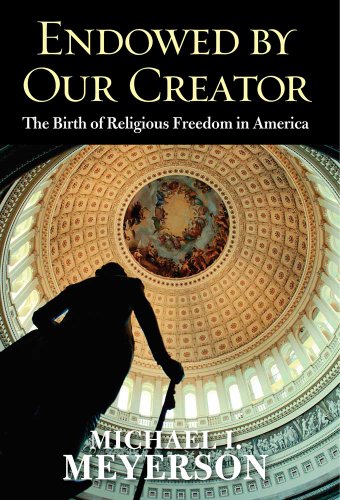
The debate over the framers' concept of freedom of religion has become heated and divisive. This scrupulously researched book sets aside the half-truths, omissions, and partisan arguments, and instead focuses on the actual writings and actions of Washington, Adams, Jefferson, Madison, and others. Legal scholar Michael I. Meyerson investigates how the framers of the Constitution envisioned religious freedom and how they intended it to operate in the new republic.Endowed by Our Creator shows that the framers understood that the American government should not acknowledge religion in a way that favors any particular creed or denomination. Nevertheless, the framers believed that religion could instill virtue and help to unify a diverse nation. They created a spiritual public vocabulary, one that could communicate to all--including agnostics and atheists--that they were valued members of the political community. Through their writings and their decisions, the framers affirmed that respect for religious differences is a fundamental American value. Now it is for us, Meyerson concludes, to determine whether religion will be used to alienate and divide or to inspire and unify our religiously diverse nation.
Die Inhaltsangabe kann sich auf eine andere Ausgabe dieses Titels beziehen.
Über die Autorin bzw. den Autor
Michael I. Meyerson is Wilson H. Elkins Professor of Law and Piper & Marbury Faculty Fellow, University of Baltimore School of Law. He is the author of Liberty's Blueprint, a history of the writing of the Federalist Papers. He lives in Ellicott City, MD.
Auszug. © Genehmigter Nachdruck. Alle Rechte vorbehalten.
Endowed by Our Creator
The Birth of Religious Freedom in AmericaBy Michael I. MeyersonYale UNIVERSITY PRESS
Copyright © 2012 Michael I. MeyersonAll right reserved.
ISBN: 978-0-300-16632-3
Contents
Acknowledgments.....................................................................ixIntroduction: The Great Seal........................................................1CHAPTER 1: Before the Beginning.....................................................14CHAPTER 2: A Tolerant, Protestant Nation............................................43CHAPTER 3: The Second American Revolution...........................................94CHAPTER 4: "We Have Become a Nation": Drafting the Constitution.....................128CHAPTER 5: Adding the First Amendment...............................................151CHAPTER 6: Freedom of Religion in the New Nation....................................180CHAPTER 7: Original Wisdom..........................................................236List of Abbreviations...............................................................277Notes...............................................................................281Bibliography........................................................................335Index...............................................................................359
Chapter One
Before the Beginning* * *
The creation of an American understanding of religious freedom began with the widely varied experiences of the thirteen colonies. The colonies were devoutly religious, but they were each, in varying degrees, narrowly sectarian and excluded from full legal, political, and social equality any denomination that did not meet their particular definition of a "true religion." At no time during America's founding was there a "Christian" colony, state, or nation, if the word "Christian" is understood to include Catholics and numerous other disfavored denominations.
In his 1749 novel The History of Tom Jones: A Foundling, the British author Henry Fielding illustrates both the narrow-mindedness of the time and the danger for modern readers who mechanically apply modern meanings to historic texts. Fielding's character, Parson Thwackum, declares: "When I mention religion, I mean the Christian religion, and not only the Christian religion but the Protestant religion; and not only the Protestant religion, but the Church of England." This conflating of the specific with the general enabled the dominant religious group in each colony to cloak its restricted perspective in the guise of universalism.
For example, the first charter for the colony of Virginia, in 1606, described one goal of the settlement as the "propagating of Christian Religion" to the "Infidels and Savages, living in those Parts." This was not understood as an open invitation to diverse interpretations of the "Christian Religion." In an ordinance passed a few months after the charter was written, James I instructed the settlers to train all Virginia residents "in true religion and virtue." To ensure that there was no confusion as to what "true religion" meant, the instructions added that settlers were "to employ their utmost care to advance all things appertaining to the Order and Administration of Divine Service according to the form and discipline of the Church of England."
The Second Charter of Virginia, signed May 23, 1609, made clear that the phrase "true religion" excluded Catholics. The charter declared that since a primary goal for the colony was to convert people "unto the true Worship of God and Christian Religion, ... [it] would be loath that any Person should be permitted to pass that Wee suspected to affect the Superstition of the Chh of Rome."
In 1610, a harsh set of laws known today as "Dale's Code" went into effect. The penalty for blasphemy included inserting a "bodkin," that is, an awl, through the tongue of the offender. Subsequent Virginia laws mandated that ministers "conforme themselves in all thinges according to the cannons of the church of England." Dissenting clerics were exiled: "All nonconformists upon notice of them shall be compelled to depart the collony with all conveniencie." Catholic priests were given even less time to leave the colony, with the law declaring it illegal for "any popish priest ... to remain above five days after warning given."
In the north, those who settled in Plymouth and Massachusetts had fled England because they believed that the Church of England itself was too similar to the Catholic Church. The Puritans "wanted to get rid of everything they deemed papist and make the Church of England biblical to its core." They were termed "Puritans" because they wanted to "purify" the Church of England of all vestiges of its Catholic heritage. They were preceded in the New World by a group of 102 Puritans who had given up hope of reforming the Church of England and wanted to separate from it entirely. These separatists, also known as "pilgrims," were the ones who landed at Plymouth Rock in 1620.
For a variety of economic and social reasons, the Plymouth Plantation did not exert a strong influence beyond its borders. But the Massachusetts Bay Colony, which subsumed Plymouth in 1690, became a dominant force in the nation's religious and governmental policy from its founding through the American Revolution and beyond.
Massachusetts was founded by its 1620 charter in order "to advance the enlargement of Christian religion." As in the Virginia charter, "Christian" excluded those suspected of believing in the "Superstition of the Chh of Rome." The Massachusetts Puritans, however, took their religious mandate far more strictly than the Virginians did.
The Massachusetts colony was seen by its founders as a holy mission. When John Winthrop, in transit to the new colony aboard the Arbella in 1630, declared that they would be "as a city upon a hill," he meant that the rest of the world would watch to see whether they could achieve their goal: "to improve our lives to doe more service to the Lord; the comforte and encrease of the body of Christe, whereof we are members; ... to serve the Lord and worke out our Salvation under the power and purity of his holy ordinances."
Unlike Virginia, this "city upon a hill" would not be governed by the rules of the Church of England. The Puritans hoped to create a community that had purified its religion of the trappings to which they had long objected. John Cotton, a Puritan minister, explained in 1634 that one of the prime reasons they had crossed the Atlantic was the opportunity to worship according to their precise understanding of the Bible: "It hath been no small inducement to us, to choose rather to remove hither, than to stay there, that we might enjoye the liberty, not of some ordinances of God, but of all and all in purity."
Connecticut was founded on the same strict principles. In 1639, the congregations of the towns of Dorchester, Watertown, and Wethersfield agreed to combine, signing the Fundamental Orders of Connecticut. Believing that "the word of God requires that to mayntayne the peace and union of such a people there should be an orderly and decent Government established according to God," they agreed to confederate "to mayntayne and presearve the liberty and purity of the gospell of our Lord Jesus which we now professe, as also the disciplyne of the Churches, which according to the truth of the said gospell is now practised amongst us."
Purity of religion required that those who differed in their views of the word of God be removed from the body politic. In 1637, Anne...
„Über diesen Titel“ kann sich auf eine andere Ausgabe dieses Titels beziehen.
Suchergebnisse für Endowed by Our Creator: The Birth of Religious Freedom...

Beispielbild für diese ISBN
Endowed by Our Creator: The Birth of Religious Freedom in America
Anbieter: ThriftBooks-Atlanta, AUSTELL, GA, USA
Verkäuferbewertung 5 von 5 Sternen

Hardcover. Zustand: As New. No Jacket. Pages are clean and are not marred by notes or folds of any kind. ~ ThriftBooks: Read More, Spend Less. Bestandsnummer des Verkäufers G030016632XI2N00
Gebraucht kaufen
EUR 10,78
Versand gratis
Versand innerhalb von USA
Versand innerhalb von USA
Anzahl: 1 verfügbar
Beispielbild für diese ISBN
Endowed by Our Creator: The Birth of Religious Freedom in America
Anbieter: ThriftBooks-Dallas, Dallas, TX, USA
Verkäuferbewertung 5 von 5 Sternen
Hardcover. Zustand: Very Good. No Jacket. May have limited writing in cover pages. Pages are unmarked. ~ ThriftBooks: Read More, Spend Less. Bestandsnummer des Verkäufers G030016632XI4N00
Gebraucht kaufen
EUR 10,78
Versand gratis
Versand innerhalb von USA
Versand innerhalb von USA
Anzahl: 1 verfügbar
Beispielbild für diese ISBN
Endowed by Our Creator : The Birth of Religious Freedom in America
Anbieter: Better World Books, Mishawaka, IN, USA
Verkäuferbewertung 5 von 5 Sternen
Zustand: Very Good. Former library copy. Pages intact with possible writing/highlighting. Binding strong with minor wear. Dust jackets/supplements may not be included. Includes library markings. Stock photo provided. Product includes identifying sticker. Better World Books: Buy Books. Do Good. Bestandsnummer des Verkäufers 4762639-75
Gebraucht kaufen
EUR 11,69
Versand gratis
Versand innerhalb von USA
Versand innerhalb von USA
Anzahl: 2 verfügbar
Foto des Verkäufers
Endowed by Our Creator: The Birth of Religious Freedom in America
Anbieter: GLENN DAVID BOOKS, Wyomissing, PA, USA
Verkäuferbewertung 5 von 5 Sternen
Hardcover. Zustand: Very Good+. Zustand des Schutzumschlags: Very Good. This is a American History Hardcover Book in Very Good+ condition with a Very Good jacket. c2012, First Edition, 1st Printing. Looks Very, Very lightly read. The cover is very bright & very clean with a little light top spine end wrinkle. It is in very nice condition both inside and out. it has with very nice edges and just a little light corner bumps. The pages are Tight & unmarked & clean. The jacket, with price is also Very bright & very clean. There is a little light shelf wear and some light edge wrinkle. 368 pages. Not a remainder. All books are Securely packaged and Promptly Mailed. #22641-624. Bestandsnummer des Verkäufers 022641
Gebraucht kaufen
EUR 7,34
EUR 4,45 Versand
Versand innerhalb von USA
Versand innerhalb von USA
Anzahl: 1 verfügbar
Foto des Verkäufers
Endowed by Our Creator: The Birth of Religious Freedom in America
Anbieter: Goodwill of Greater Milwaukee and Chicago, Racine, WI, USA
Verkäuferbewertung 5 von 5 Sternen
Zustand: acceptable. Book is considered to be in acceptable condition. The actual cover image may not match the stock photo. Book may have one or more of the following defects: noticeable wear on the cover dust jacket or spine; curved, dog eared or creased page s ; writing or highlighting inside or on the edges; sticker s or other adhesive on cover; CD DVD may not be included; and book may be a former library copy. Bestandsnummer des Verkäufers SEWV.030016632X.A
Gebraucht kaufen
EUR 10,79
EUR 2,67 Versand
Versand innerhalb von USA
Versand innerhalb von USA
Anzahl: 1 verfügbar
Beispielbild für diese ISBN
Endowed By Our Creator: The Birth of Religious Freedom in the United States.
Anbieter: NightsendBooks, Concord, CA, USA
Verkäuferbewertung 5 von 5 Sternen
Hardcover. Zustand: Like New. Zustand des Schutzumschlags: Near Fine. This copy is LIKE NEW; the text is clear, bright, and unmarked; binding is tight. Apparent first edition (unstated but earliest appearance of the book). STATED FIRST PRINTING. The jacket is near fine: absolutely intact, including perfect color and design, but small smudge top rear. We have a five star rating because of our fulfilment success and because our descriptions are accurate. On foreign sales, because of the heavy weight of this book, we have to charge extra for shipping: however, we will only charge the difference between our regular shipping rate and the extra charge that the U.S.Post Office asks to ship the book. We guarantee: NO NASTY SURPRISES. Bestandsnummer des Verkäufers 008848
Gebraucht kaufen
EUR 13,32
EUR 3,52 Versand
Versand innerhalb von USA
Versand innerhalb von USA
Anzahl: 1 verfügbar
Foto des Verkäufers
Endowed by Our Creator: The Birth of Religious Freedom in America
Verlag:
Yale University Press, New Haven, 2012
ISBN 10: 030016632X
ISBN 13: 9780300166323
Gebraucht
Hardcover
Anbieter: PsychoBabel & Skoob Books, Didcot, Vereinigtes Königreich
Verkäuferbewertung 5 von 5 Sternen
Hardcover. Zustand: Very Good. Zustand des Schutzumschlags: Very Good. Hardcover in excellent condition. AM. Used. Bestandsnummer des Verkäufers 452679
Gebraucht kaufen
EUR 12,68
EUR 14,73 Versand
Versand von Vereinigtes Königreich nach USA
Versand von Vereinigtes Königreich nach USA
Anzahl: 1 verfügbar
Beispielbild für diese ISBN
Endowed by Our Creator: The Birth of Religious Freedom in America
Anbieter: Textbooks_Source, Columbia, MO, USA
Verkäuferbewertung 5 von 5 Sternen
hardcover. Zustand: Good. Ships in a BOX from Central Missouri! May not include working access code. Will not include dust jacket. Has used sticker(s) and some writing or highlighting. UPS shipping for most packages, (Priority Mail for AK/HI/APO/PO Boxes). Bestandsnummer des Verkäufers 001540515U
Gebraucht kaufen
EUR 27,98
EUR 3,56 Versand
Versand innerhalb von USA
Versand innerhalb von USA
Anzahl: Mehr als 20 verfügbar
Beispielbild für diese ISBN
Endowed by Our Creator: The Birth of Religious Freedom in America
Anbieter: Textbooks_Source, Columbia, MO, USA
Verkäuferbewertung 5 von 5 Sternen
hardcover. Zustand: New. Ships in a BOX from Central Missouri! UPS shipping for most packages, (Priority Mail for AK/HI/APO/PO Boxes). Bestandsnummer des Verkäufers 001540515N
Neu kaufen
EUR 32,46
EUR 3,56 Versand
Versand innerhalb von USA
Versand innerhalb von USA
Anzahl: 1 verfügbar
Beispielbild für diese ISBN
Endowed by Our Creator: The Birth of Religious Freedom in America
Verlag:
Yale University Press, New Haven, CT, 2012
ISBN 10: 030016632X
ISBN 13: 9780300166323
Gebraucht
Hardcover
Erstausgabe
Signiert
Anbieter: Ground Zero Books, Ltd., Silver Spring, MD, USA
Verkäuferbewertung 5 von 5 Sternen
Hardcover. First edition. First printing [stated]. x, [4], 368, [2] p. Notes. Bibliography. Index. The debate over the framers' concept of freedom of religion has become heated and divisive. This scrupulously researched book sets aside the half-truths, omissions, and partisan arguments, and instead focuses on the actual writings and actions of Washington, Adams, Jefferson, Madison, and others. Legal scholar Michael I. Meyerson investigates how the framers of the Constitution envisioned religious freedom and how they intended it to operate in the new republic. "Endowed by Our Creator" shows that the framers understood that the American government should not acknowledge religion in a way that favours any particular creed or denomination. Nevertheless, the framers believed that religion could instill virtue and help to unify a diverse nation. They created a spiritual public vocabulary, one that could communicate to all-including agnostics and atheists-that they were valued members of the political community. Through their writings and their decisions, the framers affirmed that respect for religious differences is a fundamental American value, Meyerson concludes. Now it is for us to determine whether religion will be used to alienate and divide, or to inspire and unify our religiously diverse nation. Very good in very good dust jacket. Signed by author. DJ has slight sticker residue. Bestandsnummer des Verkäufers 66816
Gebraucht kaufen
EUR 50,50
EUR 4,46 Versand
Versand innerhalb von USA
Versand innerhalb von USA
Anzahl: 1 verfügbar