
Verwandte Artikel zu Addiction Proof Your Child: A Realistic Approach to...
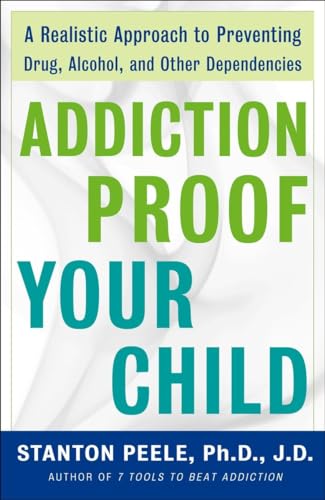
Addiction Proof Your Child: A Realistic Approach to Preventing Drug, Alcohol, and Other Dependencies - Softcover
Inhaltsangabe
Renowned addiction expert Stanton Peele offers an unorthodox yet effective method that helps parents combat addiction. This practical guide takes a calming, realistic approach, explaining how to impart the fundamental values that will protect children and prevent experimentation from evolving into dependency.
“Dr. Peele offers a smart, readable, commonsense guide for parents concerned about their children’s drug and alcohol use. Persuasively rebutting the alarmist view advanced by the ‘experts,’ he shows the importance of reinforcing children’s independence, promoting constructive values, and fostering the ability to learn from mistakes. He also shows how to teach youth to recognize the risks in overusing substances and suggests safeguards for the small minority who are at greatest risk for addiction.”—Aaron T. Beck, professor of psychiatry, University of Pennsylvania
Die Inhaltsangabe kann sich auf eine andere Ausgabe dieses Titels beziehen.
Über die Autorin bzw. den Autor
Stanton Peele, PhD, JD, is the author of the groundbreaking books Love and Addiction, Diseasing of America, and The Truth About Addiction and Recovery. An adjunct professor at the New York University School of Social Work and a senior fellow at the Drug Policy Alliance, he has won the Mark Keller Award from the Rutgers Center of Alcohol Studies and the lifetime scholarship award from the Drug Policy Alliance. Visit his website at www.peele.net.
Auszug. © Genehmigter Nachdruck. Alle Rechte vorbehalten.
THE PROBLEM IS ADDICTION, NOT DRUGS
People become addicted to experiences that protect them from life challenges they can't deal with. It is not possible to say that any one thing causes addiction. Most kids who use drugs and alcohol don't become addicted to them. On the other hand, they can get addicted to very typical, common activities--such as eating, the Internet, other media, games, even medications they are prescribed for other problems.
The core of an addiction is that people become enmeshed in an activity that interferes with their functioning and, for children, thwarts their growth. If your children avoid regular involvements and experiences, if they can't cope with their lives, and if you fear that, left to their own devices, they will either collapse or go haywire, your children face addictive problems.
Disagreements about the nature of addiction make for vast differences in how we go about combating it. I do not find it helpful to regard addiction as a disease, which is the prevalent view these days. Although many people, including scientists, now believe that a wide range of things can be addictive, they wrongly persist in seeing addiction as a biological phenomenon beyond people's control.
By contrast, I was one of the first proponents of the view that addiction is not limited to drugs. But its very universality makes it clear that addiction can't be traced to a specific neurological mechanism. If sex or gambling addictions are defined by changes in the brain, why do so many people who find these involvements alluring for a moment, or even enthralling for some time, then simply move on to other activities? As we shall see, the exact same thing is true of "addictive" drugs.
Addiction can be especially debilitating for the young, but young people are more likely than not to outgrow it. The way out of addiction is to develop a range of skills and engage fully in life. The disease mythology is particularly unhelpful for young people. Telling adolescents that they have inherited addiction as part of their biological makeup encourages them to get stuck in the problem, rather than motivating them to overcome it.
Although my view of addiction is not the conventional one, my way of thinking has been adopted by many and is gaining influence in the field. My approach includes recognizing that addiction is not limited to drugs, that people overcome addiction when they are motivated and when their lives improve, and that successful therapy for addiction builds on people's own motivation to change while teaching them better ways of coping.
DEFINING ADDICTION
At the same time that not all drug use is addictive, addiction does not have to involve drugs. People can become addicted to powerful experiences such as sex, love, gambling, shopping, food--indeed, any experience that can absorb their feelings and consciousness. Addiction to the Internet is now in the spotlight, and before that came addiction to television and then video games.
Addictions provide quick, sure, easy-to-obtain gratifications, and advances in the electronic age such as the Internet, cell phone, iPod, and BlackBerry bring more addictive possibilities. Two addictions intertwined with the Internet are pornography and gambling. People become enmeshed in these experiences in isolation, rejecting everything else in their lives. A typical Internet pornography addiction case reads like this:
My son is addicted to pornography. He can't stop looking at porn. He stays up on his computer all night. In the morning he can't stay awake, and he often doesn't go to school. I'm at my wits' end.
Likewise, we frequently hear of people who cannot stop gambling or shopping, often going deeply in debt. Such addicts, as adults, may steal, go to prison, and lose their families as a result.
To come to grips with how widespread addictive experiences can be, consider that love relationships can become addictive. We are all aware of this phenomenon, which is captured in popular song lyrics such as "Why must I be a teenager in love?" But these cases can be remarkably debilitating:
About a year ago I fell in love with someone I believed was "The One." Ever since then my whole life has been about him--and, as time went by, I've become more and more depressed.
I have always been easily addicted. But before this whole thing started I was a very happy and energetic person with a lot of interests who enjoyed living and loved talking to people. During the time we were together I just threw all of my life away: my friends, my schooling, my dreams. He became the only thing that mattered to me. I continued to feel this way even when I realized that he didn't really accept me.
At some stage we decided it would be best if we stopped dating and tried to be friends, but after a short time I realized I couldn't do that.
Now, I am depressed all the time. I've thought about him every second of my life for the past year. I can hardly sleep, I can hardly get out of bed in the morning. I feel like being alone most of the time. I have no energy, I nearly always feel sick. I find it hard to enjoy anything at all. I can't get him out of my head.
I described addictive love in 1975 in my book Love and Addiction. But because this idea is so shocking, it keeps resurfacing as though it were new. A woman wrote in the New York Times in 2006: "This is what love addiction did to my life: I dropped out of college, quit my job, stopped talking to my family and friends. There was no booze to blame for my blackouts, vomiting and bed-wetting."1
If we want to understand all kinds of self-destructive behaviors, we need a broader conception of addiction than the simple idea that some drugs are addictive: Addiction is a way of relating to the world. It is a response to an experience people get from some activity or object. They become absorbed in this experience because it provides them with essential emotional rewards, but it progressively limits and harms their lives. Six criteria define an addictive experience:
*It is powerful and absorbs people's feelings and thoughts.
*It can be predictably and reliably produced.
*It provides people with essential sensations and emotions (such as feeling good about themselves, or the absence of worry or pain).
*It produces these feelings only temporarily, for the duration of the experience.
*It ultimately degrades other involvements and satisfactions.
*Finally, since they are getting less from their lives when away from the addiction, people are forced increasingly to return to the addictive experience as their only source of satisfaction.
ADDICTIONS VERSUS NORMAL EXPERIENCE
Watching television every night, drinking daily (for an adult), and having an active social life are not necessarily addictions. Broadening the definition of addiction does not mean that everybody is addicted to something. The word is now often used casually, even humorously: a friend says he is addicted to crossword puzzles, a baby is addicted to his pacifier, a teenager to her cell phone.
Addictions are harmful, perhaps overwhelmingly so--as in the cases of pornography and love addiction described above. People may joke that they are addicted to exercise or coffee or work, and they can be. But it is only when these things seriously detract from their ability to function that people are genuinely addicted--for example, they can't stop exercising after they have suffered an injury, or they drink coffee throughout the day even though it prevents them from sleeping, or they are so preoccupied with work that they neglect their families.
Here's a case in which being well-balanced saved a man's life:
Peter was in the south tower of the World Trade Center when the north tower was struck. His floor was...
„Über diesen Titel“ kann sich auf eine andere Ausgabe dieses Titels beziehen.
Suchergebnisse für Addiction Proof Your Child: A Realistic Approach to...

Beispielbild für diese ISBN
Addiction Proof Your Child: A Realistic Approach to Preventing Drug, Alcohol, and Other Dependencies
Verlag:
Three Rivers Press, 2007
ISBN 10: 0307237575
ISBN 13: 9780307237576
Gebraucht
Soft cover
Erstausgabe
Anbieter: RiLaoghaire, Knoxville, TN, USA
Verkäuferbewertung 5 von 5 Sternen

Soft cover. Zustand: Good. 1st Edition. 258 numbered pages; medium tan to text; a few marks inside covers; slightly cocked spine; light to medium wear to corners and edges of cover; a few minor creases to cover; minor rub to cover; old price on cover; several minor dings to cover; a few minor marks to cover; weighs 7.4 ounces; measures 7.9 by 5.2 by .65 inches; 102225; Renowned addiction expert Stanton Peele offers an unorthodox yet effective method that helps parents combat addiction. This practical guide takes a calming, realistic approach, explaining how to impart the fundamental values that will protect children and prevent experimentation from evolving into dependency. Bestandsnummer des Verkäufers 23258
Gebraucht kaufen
EUR 1,73
EUR 4,33 Versand
Versand innerhalb von USA
Versand innerhalb von USA
Anzahl: 1 verfügbar
Beispielbild für diese ISBN
Addiction Proof Your Child: A Realistic Approach to Preventing Drug, Alcohol, and Other Dependencies
Verlag:
Harmony/Rodale/Convergent, 2007
ISBN 10: 0307237575
ISBN 13: 9780307237576
Gebraucht
Softcover
Anbieter: World of Books (was SecondSale), Montgomery, IL, USA
Verkäuferbewertung 5 von 5 Sternen
Zustand: Good. Item in good condition. Textbooks may not include supplemental items i.e. CDs, access codes etc. Bestandsnummer des Verkäufers 00104982076
Gebraucht kaufen
EUR 6,11
Versand gratis
Versand innerhalb von USA
Versand innerhalb von USA
Anzahl: 2 verfügbar
Beispielbild für diese ISBN
Addiction Proof Your Child : A Realistic Approach to Preventing Drug, Alcohol, and Other Dependencies
Verlag:
Potter/Ten Speed/Harmony/Rodale, 2007
ISBN 10: 0307237575
ISBN 13: 9780307237576
Gebraucht
Softcover
Erstausgabe
Anbieter: Better World Books, Mishawaka, IN, USA
Verkäuferbewertung 5 von 5 Sternen
Zustand: Good. 1st Edition. Former library copy. Pages intact with minimal writing/highlighting. The binding may be loose and creased. Dust jackets/supplements are not included. Includes library markings. Stock photo provided. Product includes identifying sticker. Better World Books: Buy Books. Do Good. Bestandsnummer des Verkäufers GRP33953223
Gebraucht kaufen
EUR 6,12
Versand gratis
Versand innerhalb von USA
Versand innerhalb von USA
Anzahl: 2 verfügbar
Beispielbild für diese ISBN
Addiction Proof Your Child: A Realistic Approach to Preventing Drug, Alcohol, and Other Dependencies
Anbieter: World of Books Inc, Montgomery, IL, USA
Verkäuferbewertung 4 von 5 Sternen

Paperback. Zustand: Good. Renowned addiction expert Stanton Peele offers an unorthodox yet effective method that helps parents combat addiction. This practical guide takes a calming, realistic approach, explaining how to impart the fundamental values that will protect children and prevent experimentation from evolving into dependency. "Dr. Peele offers a smart, readable, commonsense guide for parents concerned about their children's drug and alcohol use. Persuasively rebutting the alarmist view advanced by the 'experts,' he shows the importance of reinforcing children's independence, promoting constructive values, and fostering the ability to learn from mistakes. He also shows how to teach youth to recognize the risks in overusing substances and suggests safeguards for the small minority who are at greatest risk for addiction."-Aaron T. Beck, professor of psychiatry, University of Pennsylvania. Bestandsnummer des Verkäufers CIN0307237575G
Gebraucht kaufen
EUR 7,93
Versand gratis
Versand innerhalb von USA
Versand innerhalb von USA
Anzahl: 2 verfügbar
Beispielbild für diese ISBN
Addiction-Proof Your Child: A Realistic Approach to Preventing Drug, Alcohol, and Other Dependencies
Verlag:
Harmony/Rodale/Convergent, 2007
ISBN 10: 0307237575
ISBN 13: 9780307237576
Gebraucht
Paperback
Anbieter: ThriftBooks-Atlanta, AUSTELL, GA, USA
Verkäuferbewertung 5 von 5 Sternen
Paperback. Zustand: Good. No Jacket. Pages can have notes/highlighting. Spine may show signs of wear. ~ ThriftBooks: Read More, Spend Less. Bestandsnummer des Verkäufers G0307237575I3N00
Gebraucht kaufen
EUR 9,31
Versand gratis
Versand innerhalb von USA
Versand innerhalb von USA
Anzahl: 1 verfügbar
Beispielbild für diese ISBN
Addiction-Proof Your Child: A Realistic Approach to Preventing Drug, Alcohol, and Other Dependencies
Verlag:
Harmony/Rodale/Convergent, 2007
ISBN 10: 0307237575
ISBN 13: 9780307237576
Gebraucht
Paperback
Anbieter: ThriftBooks-Reno, Reno, NV, USA
Verkäuferbewertung 5 von 5 Sternen
Paperback. Zustand: Good. No Jacket. Pages can have notes/highlighting. Spine may show signs of wear. ~ ThriftBooks: Read More, Spend Less. Bestandsnummer des Verkäufers G0307237575I3N00
Gebraucht kaufen
EUR 9,31
Versand gratis
Versand innerhalb von USA
Versand innerhalb von USA
Anzahl: 1 verfügbar
Beispielbild für diese ISBN
Addiction-Proof Your Child: A Realistic Approach to Preventing Drug, Alcohol, and Other Dependencies
Verlag:
Harmony/Rodale/Convergent, 2007
ISBN 10: 0307237575
ISBN 13: 9780307237576
Gebraucht
Paperback
Anbieter: ThriftBooks-Dallas, Dallas, TX, USA
Verkäuferbewertung 5 von 5 Sternen
Paperback. Zustand: Good. No Jacket. Pages can have notes/highlighting. Spine may show signs of wear. ~ ThriftBooks: Read More, Spend Less. Bestandsnummer des Verkäufers G0307237575I3N00
Gebraucht kaufen
EUR 9,31
Versand gratis
Versand innerhalb von USA
Versand innerhalb von USA
Anzahl: 1 verfügbar
Beispielbild für diese ISBN
Addiction-Proof Your Child: A Realistic Approach to Preventing Drug, Alcohol, and Other Dependencies
Verlag:
Harmony/Rodale/Convergent, 2007
ISBN 10: 0307237575
ISBN 13: 9780307237576
Gebraucht
Paperback
Anbieter: ThriftBooks-Phoenix, Phoenix, AZ, USA
Verkäuferbewertung 5 von 5 Sternen
Paperback. Zustand: Good. No Jacket. Pages can have notes/highlighting. Spine may show signs of wear. ~ ThriftBooks: Read More, Spend Less. Bestandsnummer des Verkäufers G0307237575I3N00
Gebraucht kaufen
EUR 9,31
Versand gratis
Versand innerhalb von USA
Versand innerhalb von USA
Anzahl: 1 verfügbar
Beispielbild für diese ISBN
Addiction-Proof Your Child: A Realistic Approach to Preventing Drug, Alcohol, and Other Dependencies
Verlag:
Harmony/Rodale/Convergent, 2007
ISBN 10: 0307237575
ISBN 13: 9780307237576
Gebraucht
Paperback
Anbieter: ThriftBooks-Dallas, Dallas, TX, USA
Verkäuferbewertung 5 von 5 Sternen
Paperback. Zustand: Good. No Jacket. Former library book; Pages can have notes/highlighting. Spine may show signs of wear. ~ ThriftBooks: Read More, Spend Less. Bestandsnummer des Verkäufers G0307237575I3N10
Gebraucht kaufen
EUR 9,31
Versand gratis
Versand innerhalb von USA
Versand innerhalb von USA
Anzahl: 1 verfügbar
Beispielbild für diese ISBN
Addiction Proof Your Child: A Realistic Approach to Preventing Drug, Alcohol, and Other Dependencies
Anbieter: HPB Inc., Dallas, TX, USA
Verkäuferbewertung 5 von 5 Sternen
Paperback. Zustand: Very Good. Connecting readers with great books since 1972! Used books may not include companion materials, and may have some shelf wear or limited writing. We ship orders daily and Customer Service is our top priority! Bestandsnummer des Verkäufers S_479027374
Gebraucht kaufen
EUR 6,54
EUR 3,31 Versand
Versand innerhalb von USA
Versand innerhalb von USA
Anzahl: 1 verfügbar