
Verwandte Artikel zu Practicing: A Musician's Return to Music (Rough-Cut)
Inhaltsangabe
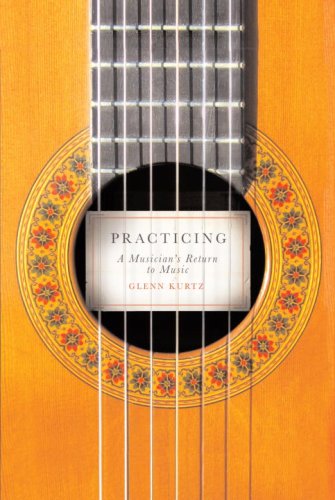
Describes how the author grew up as a young classical guitar prodigy, abandoned his instrument and his dreams of becoming a leading artist at the age of twenty-five, and rediscovered his passion for the guitar years later.
Die Inhaltsangabe kann sich auf eine andere Ausgabe dieses Titels beziehen.
Über die Autorin bzw. den Autor
Glenn Kurtz holds a Ph.D. in comparative literature from Stanford University and has taught at San Francisco State University, California College of the Arts, and Stanford. He divides his time between San Francisco and New York.
Auszug. © Genehmigter Nachdruck. Alle Rechte vorbehalten.
Sitting Down
I am sitting down to practice. I open the case and take out my instrument, a classical guitar made from the door of a Spanish church. I strike a tuning fork against my knee and hold it to my ear, then gently pluck an open string. During the night the guitar has drifted out of tune. It tries to pull the tuning fork with it, and I feel the friction of discordant vibrations against my eardrum. I turn the tuning peg slightly, bracing it between my thumb and index finger, until the two sounds converge. Another barely perceptible adjustment, and the vibrations melt together, becoming one. From string to string, I repeat the process, resolving discord with minute twists of my wrist. Then I check high notes against low, middle against outer. Finally I play a chord, sounding all six strings together. Each note rubs the others just right, and the instrument shivers with delight. The feeling is unmistakable, intoxicating. When a guitar is perfectly in tune, its strings, its whole body will resonate in sympathetic vibration, the true concord of well-tuned sounds. It is an ancient, hopeful metaphor, an instrument in tune, speaking of pleasure on earth and order in the cosmos, the fragility of beauty, and the quiver in our longing for love.
With a metal emery board, then with very fine sandpaper, I file the nails on my right hand. Even the tiniest ridges can catch on a string and make its tone raspy. In 1799 Portuguese guitarist Antonio Abreu suggested trimming the nails with scissors, then smoothing them on a sharpening stone to remove “rough edges that might impede the execution of flourishes and lively scales.” Some guitarists disagree heatedly with this advice, preferring to play with the fingertips alone. For support, they quote Miguel Fuenllana, who in 1554 stated that “to strike with the nails is imperfection. Only the finger, the living thing, can communicate the intention of the spirit.” But to my ear, the spirit of music speaks with many voices, and a combination of fingernail and flesh sounds best. I run my thumb over my fingertips. They are as smooth as crystal.
I shift the guitar into its proper position, settle its weight, and adjust my body to the familiar contours. And then I look around me. My chair is by a window in the living room; my footstool and music stand are in front of me. The window shade is partly drawn so that the San Francisco sunlight falls at my feet but not on my instrument, which would warp in the heat. Outside, people with briefcases and regular jobs are walking down the hill to work. Students are arriving at the school across the street. I listen to their voices and footsteps. Then I take a deep breath, letting them go. I draw myself in. I’m alone in the apartment, and my work is here. I begin.
At first I just play chords. The sounds feel bulky, as do my hands. I concentrate on the simplest task, to play all the notes at precisely the same moment, with one thought, one motion. It takes a few minutes; sometimes, on bad days, it takes all morning. I take my time. But I cannot proceed without this unity of thought, motion, and sound.
Slowly the effort wakes my fingers. Slowly they warm. As the muscles loosen, I break the chords into arpeggios: the same notes, but now spread out, each with its own place, its own demands. Arpeggios make the fingers of both hands work together in different combinations. I play deliberately, building a triangle of sound—fingertip, ear, fingertip—until my hands become aware of each other.
My attention warms and sharpens, and I shape the notes more carefully. I remember now that music is vibration, a disturbance in the air. I remember that music is a kind of breathing, an exchange of energy and excitement. I remember that music is physical, not just in the production of sounds, in the instrumentalist’s technique, but as an experience. Making music changes my body, eliciting shivers, sobs, or the desire to dance. I become aware of myself, of these sensations that lie dormant until music brings them out. And in an instant the pleasure, the effort, the ambition and intensity of playing grip me and shake me awake. I feel as if I’ve been wandering aimlessly until now, as if all the time I’m not practicing, I’m a sleepwalker.
I calm myself and concentrate. Give the sounds time, let the instrument vibrate. I have to hear the sounds I want before I make them, and I have to let the sounds be what they are. Then I have to hear the difference between what I have in mind and what comes from the strings.
It’s easy to get carried away. The grandeur, the depth and beauty of music are always present in the practice room. Holding the guitar, I feel music’s power at my fingertips, as if I might pluck a string and change the world. For centuries people believed that music was the force that moved the planets. Looking into the night sky, astronomers saw the harmony of heaven, and philosophers heard the music of the spheres. Musicians were prophets then, and according to Cicero the most talented might gain entry to heaven while still alive simply “by imitating this harmony on stringed instruments.” Every artist must sometimes believe that art is the doorway to the divine. Perhaps it is. But it’s dangerous for a musician to philosophize instead of practicing. The grandeur of music, to be heard, must be played. When I hold the guitar, I may aspire to play perfect harmonies. But first I have to play well.
I bring myself back to the work at hand. I listen to the strings, while testing fine gradations in the angle, speed, and strength of my touch. I vary the dynamics and articulation, vary the intensity and color of the notes. If I am to play well, I must gather the guitar’s many voices, let each one sing out. After a few more minutes of arpeggios, my fingers grow warm and capable. The notes are clear and distinct, and I play the simple chords again, very softly at first, then louder and more urgently. Again, softly, then filling, expanding, releasing. Once more, until gradually the sounds from the instrument near what I hear in my head.
Listening, drawing sound, motion, and thought together, I find my concentration. My imagination opens and reaches out. And in that reaching I begin to recognize myself. My hands feel like my hands and not the mitts I usually walk around with. I recognize my instrument’s tone; this is how I sound, for now. I recognize my body; I feel alert and able. I feel like a musician again, a classical guitarist. I feel ready to work, ready to play.
“For the past eighty years I have started each day in the same manner,” wrote the cellist Pablo Casals in his memoir, Joys and Sorrows. “I go to the piano, and I play two preludes and fugues of Bach. It fills me with awareness of the wonder of life, with a feeling of the incredible marvel of being a human being.”
Try to describe your experience of music, and you’ll quickly reach the limits of words. Music carries us away, and we grope for the grandest terms in our vocabulary just to hint at the marvel of the flight, the incredible marvel, the wonder. “Each day,” Casals continues, “it is something new, fantastic, and unbelievable.” I imagine him leaning forward in excitement, a round-faced bald man in his eighties, gesturing with his hands, then meeting my eyes to see if I’ve understood. Fantastic and unbelievable. The words say little. But yes, I think I understand.
I’m sitting down to practice, and like Casals, I’m grasping for words to equal my experience. Alone in the practice room, I hold my instrument silently. Every day it is the same task, yet something new. I delve down, seeking what hides waiting in the notes, what lies dormant in myself that...
„Über diesen Titel“ kann sich auf eine andere Ausgabe dieses Titels beziehen.
Suchergebnisse für Practicing: A Musician's Return to Music (Rough-Cut)

Beispielbild für diese ISBN
Practicing: A Musician's Return to Music
Anbieter: World of Books (was SecondSale), Montgomery, IL, USA
Verkäuferbewertung 5 von 5 Sternen

Zustand: Good. Item in good condition. Textbooks may not include supplemental items i.e. CDs, access codes etc. Bestandsnummer des Verkäufers 00107403682
Gebraucht kaufen
EUR 4,52
Versand gratis
Versand innerhalb von USA
Versand innerhalb von USA
Anzahl: 1 verfügbar
Beispielbild für diese ISBN
Practicing: A Musician's Return to Music
Anbieter: World of Books (was SecondSale), Montgomery, IL, USA
Verkäuferbewertung 5 von 5 Sternen
Zustand: Very Good. Item in very good condition! Textbooks may not include supplemental items i.e. CDs, access codes etc. Bestandsnummer des Verkäufers 00106865814
Gebraucht kaufen
EUR 4,52
Versand gratis
Versand innerhalb von USA
Versand innerhalb von USA
Anzahl: 1 verfügbar
Foto des Verkäufers
Practicing: A Musician's Return to Music
Anbieter: ZBK Books, Carlstadt, NJ, USA
Verkäuferbewertung 5 von 5 Sternen
Zustand: good. Fast & Free Shipping â" Good condition. It may show normal signs of use, such as light writing, highlighting, or library markings, but all pages are intact and the book is fully readable. A solid, complete copy that's ready to enjoy. Bestandsnummer des Verkäufers ZWV.030726615X.G
Gebraucht kaufen
EUR 5,35
Versand gratis
Versand innerhalb von USA
Versand innerhalb von USA
Anzahl: 1 verfügbar
Beispielbild für diese ISBN
Practicing: A Musician's Return to Music
Anbieter: ThriftBooks-Atlanta, AUSTELL, GA, USA
Verkäuferbewertung 5 von 5 Sternen
Hardcover. Zustand: Good. No Jacket. Missing dust jacket; Pages can have notes/highlighting. Spine may show signs of wear. ~ ThriftBooks: Read More, Spend Less. Bestandsnummer des Verkäufers G030726615XI3N01
Gebraucht kaufen
EUR 6,01
Versand gratis
Versand innerhalb von USA
Versand innerhalb von USA
Anzahl: 1 verfügbar
Beispielbild für diese ISBN
Practicing: A Musician's Return to Music
Anbieter: ThriftBooks-Reno, Reno, NV, USA
Verkäuferbewertung 5 von 5 Sternen
Hardcover. Zustand: Very Good. No Jacket. Missing dust jacket; May have limited writing in cover pages. Pages are unmarked. ~ ThriftBooks: Read More, Spend Less. Bestandsnummer des Verkäufers G030726615XI4N01
Gebraucht kaufen
EUR 6,01
Versand gratis
Versand innerhalb von USA
Versand innerhalb von USA
Anzahl: 1 verfügbar
Beispielbild für diese ISBN
Practicing: A Musician's Return to Music
Anbieter: ThriftBooks-Dallas, Dallas, TX, USA
Verkäuferbewertung 5 von 5 Sternen
Hardcover. Zustand: Very Good. No Jacket. Former library book; May have limited writing in cover pages. Pages are unmarked. ~ ThriftBooks: Read More, Spend Less. Bestandsnummer des Verkäufers G030726615XI4N10
Gebraucht kaufen
EUR 6,01
Versand gratis
Versand innerhalb von USA
Versand innerhalb von USA
Anzahl: 1 verfügbar
Beispielbild für diese ISBN
Practicing: A Musician's Return to Music
Anbieter: ThriftBooks-Reno, Reno, NV, USA
Verkäuferbewertung 5 von 5 Sternen
Hardcover. Zustand: Very Good. No Jacket. May have limited writing in cover pages. Pages are unmarked. ~ ThriftBooks: Read More, Spend Less. Bestandsnummer des Verkäufers G030726615XI4N00
Gebraucht kaufen
EUR 6,01
Versand gratis
Versand innerhalb von USA
Versand innerhalb von USA
Anzahl: 1 verfügbar
Beispielbild für diese ISBN
Practicing: A Musician's Return to Music
Anbieter: ThriftBooks-Dallas, Dallas, TX, USA
Verkäuferbewertung 5 von 5 Sternen
Hardcover. Zustand: Good. No Jacket. Pages can have notes/highlighting. Spine may show signs of wear. ~ ThriftBooks: Read More, Spend Less. Bestandsnummer des Verkäufers G030726615XI3N00
Gebraucht kaufen
EUR 6,01
Versand gratis
Versand innerhalb von USA
Versand innerhalb von USA
Anzahl: 1 verfügbar
Beispielbild für diese ISBN
Practicing: A Musician's Return to Music
Anbieter: ThriftBooks-Atlanta, AUSTELL, GA, USA
Verkäuferbewertung 5 von 5 Sternen
Hardcover. Zustand: Good. No Jacket. Pages can have notes/highlighting. Spine may show signs of wear. ~ ThriftBooks: Read More, Spend Less. Bestandsnummer des Verkäufers G030726615XI3N00
Gebraucht kaufen
EUR 6,01
Versand gratis
Versand innerhalb von USA
Versand innerhalb von USA
Anzahl: 1 verfügbar
Beispielbild für diese ISBN
Practicing: A Musician's Return to Music
Anbieter: ThriftBooks-Phoenix, Phoenix, AZ, USA
Verkäuferbewertung 5 von 5 Sternen
Hardcover. Zustand: Very Good. No Jacket. Former library book; May have limited writing in cover pages. Pages are unmarked. ~ ThriftBooks: Read More, Spend Less. Bestandsnummer des Verkäufers G030726615XI4N10
Gebraucht kaufen
EUR 6,01
Versand gratis
Versand innerhalb von USA
Versand innerhalb von USA
Anzahl: 1 verfügbar