
Inhaltsangabe
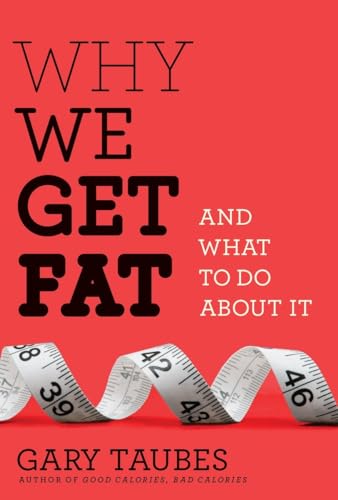
An eye-opening, myth-shattering examination of what makes us fat, from acclaimed science writer Gary Taubes.
In his New York Times best seller, Good Calories, Bad Calories, Taubes argued that our diet’s overemphasis on certain kinds of carbohydrates—not fats and not simply excess calories—has led directly to the obesity epidemic we face today. The result of thorough research, keen insight, and unassailable common sense, Good Calories, Bad Calories immediately stirred controversy and acclaim among academics, journalists, and writers alike. Michael Pollan heralded it as “a vitally important book, destined to change the way we think about food.”
Building upon this critical work in Good Calories, Bad Calories and presenting fresh evidence for his claim, Taubes now revisits the urgent question of what’s making us fat—and how we can change—in this exciting new book. Persuasive, straightforward, and practical, Why We Get Fat makes Taubes’s crucial argument newly accessible to a wider audience.
Taubes reveals the bad nutritional science of the last century, none more damaging or misguided than the “calories-in, calories-out” model of why we get fat, and the good science that has been ignored, especially regarding insulin’s regulation of our fat tissue. He also answers the most persistent questions: Why are some people thin and others fat? What roles do exercise and genetics play in our weight? What foods should we eat, and what foods should we avoid?
Packed with essential information and concluding with an easy-to-follow diet, Why We Get Fat is an invaluable key in our understanding of an international epidemic and a guide to what each of us can do about it.
Die Inhaltsangabe kann sich auf eine andere Ausgabe dieses Titels beziehen.
Über die Autorin bzw. den Autor
Gary Taubes is a contributing correspondent for Science magazine, and his writing has also appeared in The Atlantic, The New York Times Magazine, and Esquire. His work has been included in The Best of the Best American Science Writing (2010), and has received three Science in Society Journalism Awards from the National Association of Science Writers, the only print journalist so recognized. He is currently a Robert Wood Johnson Foundation Investigator in Health Policy Research at the University of California, Berkeley School of Public Health. He lives in Berkeley.
Auszug. © Genehmigter Nachdruck. Alle Rechte vorbehalten.
INTRODUCTION
The Original Sin
In 1934, a young German pediatrician named Hilde Bruch moved to America, settled in New York City, and was “startled,” as she later wrote, by the number of fat children she saw—“ really fat ones, not only in clinics, but on the streets and subways, and in schools.” Indeed, fat children in New York were so conspicuous that other European immigrants would ask Bruch about it, assuming that she would have an answer. What is the matter with American children? they would ask. Why are they so bloated and blown up? Many would say they’d never seen so many children in such a state.
Today we hear such questions all the time, or we ask them ourselves, with the continual reminders that we are in the midst of an epidemic of obesity (as is the entire developed world). Similar questions are asked about fat adults. Why are they so bloated and blown up? Or you might ask yourself: Why am I?
But this was New York City in the mid- 1930s. This was two decades before the first Kentucky Fried Chicken and McDonald’s franchises, when fast food as we know it today was born. This was half a century before supersizing and high- fructose corn
syrup. More to the point, 1934 was the depths of the Great Depression, an era of soup kitchens, bread lines, and unprecedented
unemployment. One in every four workers in the United States was unemployed. Six out of every ten Americans were living in
poverty. In New York City, where Bruch and her fellow immigrants were astonished by the adiposity of the local children, one in four children were said to be malnourished. How could this be?
A year after arriving in New York, Bruch established a clinic at Columbia University’s College of Physicians and Surgeons to treat obese children. In 1939, she published the first of a series of reports on her exhaustive studies of the many obese children she had treated, although almost invariably without success. From interviews with her patients and their families, she learned that these obese children did indeed eat excessive amounts of food—no matter how much either they or their parents might initially deny it. Telling them to eat less, though, just didn’t work, and no amount of instruction or compassion, counseling, or exhortations— of either children or parents—seemed to help. It was hard to avoid, Bruch said, the simple fact that these children had, after all, spent their entire lives trying to eat in moderation and so control their weight, or at least thinking about eating less than they did, and yet they remained obese. Some of these children, Bruch reported, “made strenuous efforts to lose weight, practically giving up on living to achieve it.” But maintaining a lower weight involved “living on a continuous semi-starvation diet,” and they just couldn’t do it, even though obesity made them miserable and social outcasts.
One of Bruch’s patients was a fine- boned girl in her teens, “literally disappearing in mountains of fat.” This young girl had spent her life fighting both her weight and her parents’ attempts to help her slim down. She knew what she had to do, or so she believed, as did her parents—she had to eat less—and the struggle to do this defined her existence. “I always knew that life depended on your figure,” she told Bruch. “I was always unhappy and depressed when gaining [weight]. There was nothing to live for. . . . I actually hated myself. I just could not stand it. I didn’t want to look at myself. I hated mirrors. They showed how fat I was. . . . It never made me feel happy to eat and get fat—but I never could see a solution for it and so I kept on getting fatter.”
Like Bruch’s fine- boned girl, those of us who are overweight or obese will spend much of our lives trying to eat less, or at least eat not too much. Sometimes we succeed, sometimes we fail, but the fight goes on. For some, like Bruch’s patients, the battle begins in childhood. For others, it starts in college with the freshman twenty, that cushion of fat that appears around waist and hips
while spending the first year away from home. Still others begin to realize in their thirties or forties that being lean is no longer the effortless achievement it once was.
Should we be fatter than the medical authorities would prefer, and should we visit a doctor for any reason, that doctor is likely to
suggest more or less forcefully that we do something about it. Obesity and overweight, so we’ll be told, are associated with an increased risk of virtually every chronic disease that ails us—heart disease, stroke, diabetes, cancer, dementia, asthma. We’ll be instructed to exercise regularly, to diet, to eat less, as though the thought of doing so, the desire to do so, would never otherwise have crossed our minds. “More than in any other illness,” as Bruch said about obesity, “the physician is called upon only to do a special trick, to make the patient do something—stop eating— after it has already been proved that he cannot do it.”
The physicians of Bruch’s era weren’t thoughtless, and the doctors of today are not, either. They merely have a flawed belief system—a paradigm—that stipulates that the reason we get fat is clear and incontrovertible, as is the cure. We get fat, our physicians tell us, because we eat too much and/or move too little, and so the cure is to do the opposite. If nothing else, we should eat “not too much,” as Michael Pollan famously prescribes in his best-selling book In Defense of Food, and this will suffice. At least we won’t get fatter still. This is what Bruch described in 1957 as the “prevalent American attitude that the problem [of obesity] is simply one of eating more than the body needs,” and now it’s the prevalent attitude worldwide.
We can call this the “calories- in/ calories- out” or the “overeating” paradigm of excess fat—the “energy balance” paradigm, if
we want to get technical. “The fundamental cause of obesity and overweight,” as the World Health Organization says, “is an energy imbalance between calories consumed on one hand, and calories expended on the other hand.” We get fat when we take in more energy than we expend (a positive energy balance, in the scientific terminology), and we get lean when we expend more than we take in (a negative energy balance). Food is energy, and we measure that energy in the form of calories. So, if we take in more calories than we expend, we get fatter. If we take in fewer calories, we get leaner.
This way of thinking about our weight is so compelling and so pervasive that it is virtually impossible nowadays not to believe it. Even if we have plenty of evidence to the contrary—no matter how much of our lives we’ve spent consciously trying to eat less and exercise more without success—it’s more likely that we’ll question our own judgment and our own willpower than we will this notion that our adiposity is determined by how many calories we consume and expend.
My favorite example of this thinking came from a wellrespected exercise physiologist, a co- author of a set of physical-activity and health guidelines that were published in August 2007 by the American Heart Association and the American College of Sports Medicine. This fellow told me that he personally had been “short, fat, and bald” when he first took up distance running in the 1970s, and now he was in his late sixties and was “short, fatter, and bald.” In the intervening years, he said, he had gained thirty-odd pounds and run maybe...
„Über diesen Titel“ kann sich auf eine andere Ausgabe dieses Titels beziehen.
Weitere beliebte Ausgaben desselben Titels

Suchergebnisse für Why We Get Fat: And What to Do About It (Borzoi Books)...

Beispielbild für diese ISBN
Why We Get Fat: And What to Do About It
Anbieter: World of Books (was SecondSale), Montgomery, IL, USA
Verkäuferbewertung 5 von 5 Sternen

Zustand: Good. Item in good condition. Textbooks may not include supplemental items i.e. CDs, access codes etc. Bestandsnummer des Verkäufers 00081418624
Gebraucht kaufen
EUR 3,50
Versand gratis
Versand innerhalb von USA
Versand innerhalb von USA
Anzahl: 18 verfügbar
Beispielbild für diese ISBN
Why We Get Fat: And What to Do About It
Anbieter: World of Books (was SecondSale), Montgomery, IL, USA
Verkäuferbewertung 5 von 5 Sternen
Zustand: Very Good. Item in very good condition! Textbooks may not include supplemental items i.e. CDs, access codes etc. Bestandsnummer des Verkäufers 00106009318
Gebraucht kaufen
EUR 3,50
Versand gratis
Versand innerhalb von USA
Versand innerhalb von USA
Anzahl: 2 verfügbar
Beispielbild für diese ISBN
Why We Get Fat: And What to Do About It
Anbieter: Orion Tech, Kingwood, TX, USA
Verkäuferbewertung 5 von 5 Sternen
hardcover. Zustand: Fair. Bestandsnummer des Verkäufers 0307272702-4-31059513
Gebraucht kaufen
EUR 3,50
Versand gratis
Versand innerhalb von USA
Versand innerhalb von USA
Anzahl: 4 verfügbar
Beispielbild für diese ISBN
Why We Get Fat: And What to Do About It
Anbieter: Orion Tech, Kingwood, TX, USA
Verkäuferbewertung 5 von 5 Sternen
Hardcover. Zustand: Good. Bestandsnummer des Verkäufers 0307272702-3-23673115
Gebraucht kaufen
EUR 3,50
Versand gratis
Versand innerhalb von USA
Versand innerhalb von USA
Anzahl: 1 verfügbar
Beispielbild für diese ISBN
Why We Get Fat: And What to Do About It
Anbieter: Gulf Coast Books, Cypress, TX, USA
Verkäuferbewertung 5 von 5 Sternen
Hardcover. Zustand: Good. Bestandsnummer des Verkäufers 0307272702-3-23867029
Gebraucht kaufen
EUR 3,50
Versand gratis
Versand innerhalb von USA
Versand innerhalb von USA
Anzahl: 1 verfügbar
Foto des Verkäufers
Why We Get Fat: And What to Do About It
Anbieter: 3Brothers Bookstore, Egg harbor township, NJ, USA
Verkäuferbewertung 5 von 5 Sternen
Zustand: acceptable. Books may contain multiple pages with notes and highlighting. Supplements such as Access Codes, Cd's, etc. are not guaranteed with used book purchases. Bestandsnummer des Verkäufers EVV.0307272702.A
Gebraucht kaufen
EUR 3,84
Versand gratis
Versand innerhalb von USA
Versand innerhalb von USA
Anzahl: 1 verfügbar
Foto des Verkäufers
Why We Get Fat: And What to Do About It
Anbieter: Zoom Books Company, Lynden, WA, USA
Verkäuferbewertung 5 von 5 Sternen
Zustand: very_good. Book is in very good condition and may include minimal underlining highlighting. The book can also include "From the library of" labels. May not contain miscellaneous items toys, dvds, etc. . We offer 100% money back guarantee and 24 7 customer service. Bestandsnummer des Verkäufers ZBV.0307272702.VG
Gebraucht kaufen
EUR 3,98
Versand gratis
Versand innerhalb von USA
Versand innerhalb von USA
Anzahl: 2 verfügbar
Foto des Verkäufers
Why We Get Fat: And What to Do About It
Anbieter: Reliant Bookstore, El Dorado, KS, USA
Verkäuferbewertung 5 von 5 Sternen
Zustand: very_good. This book is in excellent condition. There may be minimal writing on the inside cover or cover page. Cover image on the book may vary from photo. Ships out quickly in a secure plastic mailer. Bestandsnummer des Verkäufers RDV.0307272702.VG
Gebraucht kaufen
EUR 4,41
Versand gratis
Versand innerhalb von USA
Versand innerhalb von USA
Anzahl: 2 verfügbar
Foto des Verkäufers
Why We Get Fat: And What to Do About It
Anbieter: Reliant Bookstore, El Dorado, KS, USA
Verkäuferbewertung 5 von 5 Sternen
Zustand: good. This book is in good condition with very minimal damage. Pages may have minimal notes or highlighting. Cover image on the book may vary from photo. Ships out quickly in a secure plastic mailer. Bestandsnummer des Verkäufers RDV.0307272702.G
Gebraucht kaufen
EUR 4,41
Versand gratis
Versand innerhalb von USA
Versand innerhalb von USA
Anzahl: 1 verfügbar
Foto des Verkäufers
Why We Get Fat: And What to Do About It
Anbieter: Greenworld Books, Arlington, TX, USA
Verkäuferbewertung 5 von 5 Sternen
Zustand: very_good. Fast Free Shipping â" Very Good condition book with a firm cover and clean pages. Shows normal use and some light wear or limited notes markings. A solid, nice copy to enjoy. Bestandsnummer des Verkäufers GWV.0307272702.VG
Gebraucht kaufen
EUR 4,68
Versand gratis
Versand innerhalb von USA
Versand innerhalb von USA
Anzahl: 4 verfügbar