
Verwandte Artikel zu Thinking in Pictures, Expanded Edition: My Life with...
Inhaltsangabe
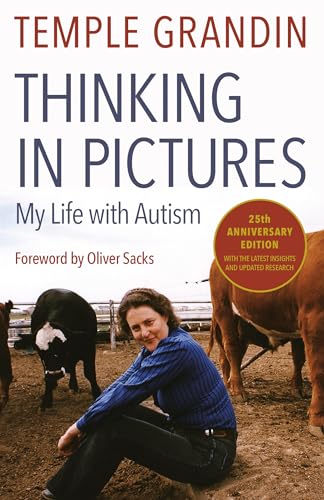
The 25th anniversary edition of this seminal work on autism and neurodiversity provides “a uniquely fascinating view” (Deborah Tannen, author of You Just Don’t Understand) of the differences in our brains, and features updated research and insights. With a foreword by Oliver Sacks.
Originally published in 1995 as an unprecedented look at autism, Grandin writes from the dual perspectives of a scientist and an autistic person to give a report from “the country of autism.” Introducing a groundbreaking model which analyzes people based on their patterns of thought, Grandin “charts the differences between her life and the lives of those who think in words” (The Philadelphia Inquirer).
For the new edition, Grandin has written a new afterword addressing recent developments in the study of autism, including new diagnostic criteria, advancements in genetic research, updated tips, insights into working with children and young people with autism, and more.
Die Inhaltsangabe kann sich auf eine andere Ausgabe dieses Titels beziehen.
Über die Autorin bzw. den Autor
Temple Grandin is a professor of animal science at Colorado State University and the author of the New York Times bestsellers Animals in Translation, Animals Make Us Human, The Autistic Brain, and Thinking in Pictures, which became an HBO movie starring Claire Danes. Dr. Grandin has been a pioneer in improving the welfare of farm animals as well as an outspoken advocate for the autism community. She resides in Fort Collins, Colorado.
Von der hinteren Coverseite
The captivating subject of Oliver Sack's "Anthropologist on Mars, here is Temple Grandin's personal account of living with autism extraordinary gift of animal empathy has transformed her world and ours.
Temple Grandin is renowned throughout the world as a designer of livestock holding equipment. Her unique empathy for animals has her to create systems which are humane and cruel free, setting the highest standards for the industry the treatment and handling of animals. She also happens to be autistic. Here, in Temple Grandin's own words, is the story what it is like to live with autism. Temple is among the few people who have broken through many the neurological impairments associated with autism. Throughout her life, she has developed unique coping strategies, including her famous "squeeze machine," modeled after seeing the calming effect squeeze chutes on cattle. She describes her pain isolation growing up "different" and her discovery visual symbols to interpret the "ways of the natives" "Thinking in Pictures also gives information from the frontlines of autism, including treatme medication, and diagnosis, as well as Temple's insight into genius, savants, sensory phenomena, etc. Ultimately, it is Temple's unique ability describe the way her visual mind works and how she first made the connection between her impairment and animal temperament that is the basis of extraordinary gift and phenomenal success.
"From the Hardcover edition.
Auszug. © Genehmigter Nachdruck. Alle Rechte vorbehalten.
Chapter 1
1
Thinking in Pictures
Autism and Visual Thought
I THINK IN PICTURES. Words are like a second language to me. I translate both spoken and written words into full-color movies, complete with sound, which run like a VCR tape in my head. When somebody speaks to me, his words are instantly translated into pictures. Language-based thinkers often find this phenomenon difficult to understand, but in my job as an equipment designer for the livestock industry, visual thinking is a tremendous advantage.
Visual thinking has enabled me to build entire systems in my imagination. During my career I have designed all kinds of equipment, ranging from corrals for handling cattle on ranches to systems for handling cattle and hogs during veterinary procedures and slaughter. I have worked for many major livestock companies. In fact, one third of the cattle and hogs in the United States are handled in equipment I have designed. Some of the people I’ve worked for don’t even know that their systems were designed by someone with autism. I value my ability to think visually, and I would never want to lose it.
One of the most profound mysteries of autism has been the remarkable ability of most autistic people to excel at visual spatial skills while performing so poorly at verbal skills. When I was a child and a teenager, I thought everybody thought in pictures. I had no idea that my thought processes were different. In fact, I did not realize the full extent of the differences until very recently. At meetings and at work I started asking other people detailed questions about how they accessed information from their memories. From their answers I learned that my visualization skills far exceeded those of most other people.
I credit my visualization abilities with helping me understand the animals I work with. Early in my career I used a camera to help give me the animals’ perspective as they walked through a chute for their veterinary treatment. I would kneel down and take pictures through the chute from the cow’s eye level. Using the photos, I was able to figure out which things scared the cattle, such as shadows and bright spots of sunlight. Back then I used black-and-white film, because twenty years ago scientists believed that cattle lacked color vision. Today, research has shown that cattle can see colors, but the photos provided the unique advantage of seeing the world through a cow’s viewpoint. They helped me figure out why the animals refused to go in one chute but willingly walked through another.
Every design problem I’ve ever solved started with my ability to visualize and see the world in pictures. I started designing things as a child, when I was always experimenting with new kinds of kites and model airplanes. In elementary school I made a helicopter out of a broken balsa-wood airplane. When I wound up the propeller, the helicopter flew straight up about a hundred feet. I also made bird-shaped paper kites, which I flew behind my bike. The kites were cut out from a single sheet of heavy drawing paper and flown with thread. I experimented with different ways of bending the wings to increase flying performance. Bending the tips of the wings up made the kite fly higher. Thirty years later, this same design started appearing on commercial aircraft.
Now, in my work, before I attempt any construction, I test-run the equipment in my imagination. I visualize my designs being used in every possible situation, with different sizes and breeds of cattle and in different weather conditions. Doing this enables me to correct mistakes prior to construction. Today, everyone is excited about the new virtual reality computer systems in which the user wears special goggles and is fully immersed in video game action. To me, these systems are like crude cartoons. My imagination works like the computer graphics programs that created the lifelike dinosaurs in Jurassic Park. When I do an equipment simulation in my imagination or work on an engineering problem, it is like seeing it on a videotape in my mind. I can view it from any angle, placing myself above or below the equipment and rotating it at the same time. I don’t need a fancy graphics program that can produce three-dimensional design simulations. I can do it better and faster in my head.
I create new images all the time by taking many little parts of images I have in the video library in my imagination and piecing them together. I have video memories of every item I’ve ever worked with—steel gates, fences, latches, concrete walls, and so forth. To create new designs, I retrieve bits and pieces from my memory and combine them into a new whole. My design ability keeps improving as I add more visual images to my library. I add videolike images from either actual experiences or translations of written information into pictures. I can visualize the operation of such things as squeeze chutes, truck loading ramps, and all different types of livestock equipment. The more I actually work with cattle and operate equipment, the stronger my visual memories become.
I first used my video library in one of my early livestock design projects, creating a dip vat and cattle-handling facility for John Wayne’s Red River feed yard in Arizona. A dip vat is a long, narrow, seven-foot-deep swimming pool through which cattle move in single file. It is filled with pesticide to rid the animals of ticks, lice, and other external parasites. In 1978, existing dip vat designs were very poor. The animals often panicked because they were forced to slide into the vat down a steep, slick concrete decline. They would refuse to jump into the vat, and sometimes they would flip over backward and drown. The engineers who designed the slide never thought about why the cattle became so frightened.
The first thing I did when I arrived at the feedlot was to put myself inside the cattle’s heads and look out through their eyes. Because their eyes are on the sides of their heads, cattle have wide-angle vision, so it was like walking through the facility with a wide-angle video camera. I had spent the past six years studying how cattle see their world and watching thousands move through different facilities all over Arizona, and it was immediately obvious to me why they were scared. Those cattle must have felt as if they were being forced to jump down an airplane escape slide into the ocean.
Cattle are frightened by high contrasts of light and dark as well as by people and objects that move suddenly. I’ve seen cattle that were handled in two identical facilities easily walk through one and balk in the other. The only difference between the two facilities was their orientation to the sun. The cattle refused to move through the chute where the sun cast harsh shadows across it. Until I made this observation, nobody in the feedlot industry had been able to explain why one veterinary facility worked better than the other. It was a matter of observing the small details that made a big difference. To me, the dip vat problem was even more obvious.
My first step in designing a better system was collecting all the published information on existing dip vats. Before doing anything else, I always check out what is considered state-of-the-art so I don’t waste time reinventing the wheel. Then I turned to livestock publications, which usually have very limited information, and my library of video memories, all of which contained bad designs. From experience with other types of equipment, such as unloading ramps for trucks, I had learned...
„Über diesen Titel“ kann sich auf eine andere Ausgabe dieses Titels beziehen.
Suchergebnisse für Thinking in Pictures, Expanded Edition: My Life with...

Beispielbild für diese ISBN
Thinking in Pictures, Expanded Edition: My Life with Autism
Anbieter: Your Online Bookstore, Houston, TX, USA
Verkäuferbewertung 5 von 5 Sternen

Paperback. Zustand: Good. Bestandsnummer des Verkäufers 0307275655-3-24271499
Gebraucht kaufen
EUR 3,96
Versand gratis
Versand innerhalb von USA
Versand innerhalb von USA
Anzahl: 1 verfügbar
Beispielbild für diese ISBN
Thinking in Pictures, Expanded Edition: My Life with Autism
Anbieter: World of Books (was SecondSale), Montgomery, IL, USA
Verkäuferbewertung 5 von 5 Sternen
Paperback. Zustand: Fair. The 25th anniversary edition of this seminal work on autism and neurodiversity provides "a uniquely fascinating view" (Deborah Tannen, author of You Just Don't Understand) of the differences in our brains, and features updated research and insights. With a foreword by Oliver Sacks. Originally published in 1995 as an unprecedented look at autism, Grandin writes from the dual perspectives of a scientist and an autistic person to give a report from "the country of autism." Introducing a groundbreaking model which analyzes people based on their patterns of thought, Grandin "charts the differences between her life and the lives of those who think in words" (The Philadelphia Inquirer). For the new edition, Grandin has written a new afterword addressing recent developments in the study of autism, including new diagnostic criteria, advancements in genetic research, updated tips,insights into working with children and young people with autism, and more. Bestandsnummer des Verkäufers 00110351189
Gebraucht kaufen
EUR 3,97
Versand gratis
Versand innerhalb von USA
Versand innerhalb von USA
Anzahl: 2 verfügbar
Beispielbild für diese ISBN
Thinking in Pictures, Expanded Edition: My Life with Autism
Anbieter: World of Books (was SecondSale), Montgomery, IL, USA
Verkäuferbewertung 5 von 5 Sternen
Paperback. Zustand: Good. The 25th anniversary edition of this seminal work on autism and neurodiversity provides "a uniquely fascinating view" (Deborah Tannen, author of You Just Don't Understand) of the differences in our brains, and features updated research and insights. With a foreword by Oliver Sacks. Originally published in 1995 as an unprecedented look at autism, Grandin writes from the dual perspectives of a scientist and an autistic person to give a report from "the country of autism." Introducing a groundbreaking model which analyzes people based on their patterns of thought, Grandin "charts the differences between her life and the lives of those who think in words" (The Philadelphia Inquirer). For the new edition, Grandin has written a new afterword addressing recent developments in the study of autism, including new diagnostic criteria, advancements in genetic research, updated tips,insights into working with children and young people with autism, and more. Bestandsnummer des Verkäufers 00098370798
Gebraucht kaufen
EUR 3,97
Versand gratis
Versand innerhalb von USA
Versand innerhalb von USA
Anzahl: Mehr als 20 verfügbar
Foto des Verkäufers
Thinking in Pictures, Expanded Edition: My Life with Autism
Anbieter: Dream Books Co., Denver, CO, USA
Verkäuferbewertung 5 von 5 Sternen
Zustand: good. Gently used with minimal wear on the corners and cover. A few pages may contain light highlighting or writing, but the text remains fully legible. Dust jacket may be missing, and supplemental materials like CDs or codes may not be included. May be ex-library with library markings. Ships promptly! Bestandsnummer des Verkäufers 4EKGU9006P5N_ns
Gebraucht kaufen
EUR 3,99
Versand gratis
Versand innerhalb von USA
Versand innerhalb von USA
Anzahl: 4 verfügbar
Foto des Verkäufers
Thinking in Pictures, Expanded Edition: My Life with Autism
Anbieter: Zoom Books Company, Lynden, WA, USA
Verkäuferbewertung 5 von 5 Sternen
Zustand: good. Book is in good condition and may include underlining highlighting and minimal wear. The book can also include "From the library of" labels. May not contain miscellaneous items toys, dvds, etc. . We offer 100% money back guarantee and 24 7 customer service. Bestandsnummer des Verkäufers ZBV.0307275655.G
Gebraucht kaufen
EUR 4,06
Versand gratis
Versand innerhalb von USA
Versand innerhalb von USA
Anzahl: 1 verfügbar
Foto des Verkäufers
Thinking in Pictures, Expanded Edition: My Life with Autism
Anbieter: Zoom Books Company, Lynden, WA, USA
Verkäuferbewertung 5 von 5 Sternen
Zustand: very_good. Book is in very good condition and may include minimal underlining highlighting. The book can also include "From the library of" labels. May not contain miscellaneous items toys, dvds, etc. . We offer 100% money back guarantee and 24 7 customer service. Bestandsnummer des Verkäufers ZBV.0307275655.VG
Gebraucht kaufen
EUR 4,06
Versand gratis
Versand innerhalb von USA
Versand innerhalb von USA
Anzahl: 1 verfügbar
Foto des Verkäufers
Thinking in Pictures, Expanded Edition: My Life with Autism
Anbieter: Zoom Books Company, Lynden, WA, USA
Verkäuferbewertung 5 von 5 Sternen
Zustand: like_new. Bestandsnummer des Verkäufers ZBV.0307275655.LN
Gebraucht kaufen
EUR 4,06
Versand gratis
Versand innerhalb von USA
Versand innerhalb von USA
Anzahl: 1 verfügbar
Foto des Verkäufers
Thinking in Pictures, Expanded Edition: My Life with Autism
Anbieter: 2nd Life Books, Burlington, NJ, USA
Verkäuferbewertung 5 von 5 Sternen
Zustand: very_good. Used book in very good condition. May have some minor wear. May NOT include discs, or access code or other supplemental material. Ships directly from Amazon and is eligible for Prime or super saver FREE shipping. We ship Monday-Saturday and respond to inquiries within 24 hours. Bestandsnummer des Verkäufers BXM.EKGL
Gebraucht kaufen
EUR 1,29
EUR 3,57 Versand
Versand innerhalb von USA
Versand innerhalb von USA
Anzahl: 1 verfügbar
Beispielbild für diese ISBN
Thinking in Pictures, Expanded Edition: My Life with Autism
Verlag:
Vintage (edition Reissue,Anniversary), 2006
ISBN 10: 0307275655
ISBN 13: 9780307275653
Gebraucht
Paperback
Anbieter: BooksRun, Philadelphia, PA, USA
Verkäuferbewertung 5 von 5 Sternen
Paperback. Zustand: Very Good. Reissue,Anniversary. It's a well-cared-for item that has seen limited use. The item may show minor signs of wear. All the text is legible, with all pages included. It may have slight markings and/or highlighting. Bestandsnummer des Verkäufers 0307275655-11-1
Gebraucht kaufen
EUR 4,90
Versand gratis
Versand innerhalb von USA
Versand innerhalb von USA
Anzahl: 3 verfügbar
Foto des Verkäufers
Thinking in Pictures, Expanded Edition: My Life with Autism
Anbieter: Greenworld Books, Arlington, TX, USA
Verkäuferbewertung 5 von 5 Sternen
Zustand: good. Fast Free Shipping â" Good condition. It may show normal signs of use, such as light writing, highlighting, or library markings, but all pages are intact and the book is fully readable. A solid, complete copy that's ready to enjoy. Bestandsnummer des Verkäufers GWV.0307275655.G
Gebraucht kaufen
EUR 4,95
Versand gratis
Versand innerhalb von USA
Versand innerhalb von USA
Anzahl: 3 verfügbar