
Verwandte Artikel zu Defend the Realm: The Authorized History of MI5
Inhaltsangabe
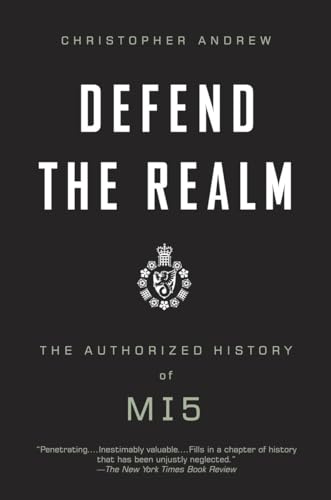
For over 100 years, the agents of MI5 have defended Britain against enemy subversion. Their work has remained shrouded in secrecy—until now. This first-ever authorized account reveals the British Security Service as never before: its inner workings, its clandestine operations, its failures and its triumphs.
Die Inhaltsangabe kann sich auf eine andere Ausgabe dieses Titels beziehen.
Über die Autorin bzw. den Autor
Christopher Andrew is Britain’s leading historian of intelligence, professor of modern and contemporary history and chair of the faculty of history at Cambridge University. He is also chair of the British Intelligence Study Group, coeditor of Intelligence and National Security, former visiting professor at Harvard, Toronto, and the Australian National University, and a regular presenter of BBC Radio and TV documentaries. His thirteen previous books include The Mitrokhin Archive, volumes 1 and 2, and a number of groundbreaking studies on the use and abuse of secret intelligence in modern history.
Auszug. © Genehmigter Nachdruck. Alle Rechte vorbehalten.
Introduction
The Origins of the Secret Service Bureau
The Security Service (MI5) and the Secret Intelligence Service (SIS orMI6) began operations in October 1909 as a single organization, the Secret Service Bureau, based in premises rented by a private detective, retired Chief Inspector Edward ‘Tricky’ Drew, at 64 Victoria Street, London SW1, opposite the Army and Navy Stores. The Bureau was staffed initially by only two officers, the fifty-year-old Commander Mansfield Cumming RN and an army captain fourteen years his junior, Vernon Kell, who met for the first time on 4 October when, according to Cumming’s diary, they ‘had a yarn over the future and agreed to work together for the success of the cause’. Cumming and Kell later parted company to become the first heads of, respectively, SIS and MI5. For several months, however, they were based in the same room, struggling, with minimal resources, ‘to deal both
with espionage in this country and with our foreign agents abroad’.
The Secret Service Bureau owed its foundation to the recommendations of a sub-committee of the Committee of Imperial Defence, the chief defence planning council of the realm, which had been instructed in March 1909 by the Liberal government of Herbert Asquith to consider ‘the nature and extent of foreign espionage that is at present taking place within this country and the danger to which it may expose us’. It reported on 24 July: ‘The evidence which was produced left no doubt in the minds of the
subcommittee that an extensive system of German espionage exists in this country and that we have no organisation for keeping in touch with that espionage and for accurately determining its extent or objectives.’ Most continental high commands would have been surprised to discover that British intelligence was in such an enfeebled state. There was a widespread myth that, ever since the days when a secret service run by Queen Elizabeth I’s Secretary of State, Sir Francis Walsingham, had successfully uncovered a number of Catholic plots, British intelligence, like the British Empire, had grown steadily in size and influence, spreading its tentacles across the globe.
The myth was encouraged by Edwardian spy novelists. The most prolific and successful of them, William Le Queux, allegedly Queen Alexandra’s favourite novelist, assured his readers: ‘The British Secret Service, although never so prominently before the public as those unscrupulous agents provocateurs of France and Russia, is nevertheless equally active. It works in silence and secrecy, yet many are its successful counterplots against the machinations of England’s enemies.’6 Le Queux (pronounced ‘Kew’) was a Walter Mitty figure who fantasized that he had played a personal part in some of these successes. In Secrets of the Foreign Office published in 1903, Le Queux, thinly disguised as Duckworth Drew, ‘secret agent in the employ of the Foreign Office, and, next to his Majesty’s Secretary of State for Foreign Affairs, one of the most powerful and important pillars of England’s supremacy’, quickly gets the better of the long-serving French Foreign Minister, The´ophile Delcasse´ (equally thinly disguised as Monsieur Delanne). Delcasse´, alias Delanne, ‘admitted that he longed to smoke one of my excellent light-coloured Corona Superbos’. But there was more to Drew’s cigars than met the Minister’s inattentive eye: ‘To this day Monsieur le Ministre is in ignorance that that particular Corona had been carefully prepared by me with a solution of cocculus indicus . . .’ Outwitted by the
cunningly prepared Corona, the disoriented Delanne revealed the secrets Drew (sometimes considered an Edwardian prototype of James Bond) had come to collect.8 Such fantasies found a ready market. Like Thomas Hardy and H. G. Wells, both vastly superior writers, Le Queux was paid the top rate of 12 guineas per thousand words and published far more than either.
At the opposite extreme of literary merit from Le Queux, Rudyard Kipling gave an equally optimistic assessment of British successes in the intelligence duel with Russia on India’s North-West Frontier. In Kim (probably the finest of all spy novels, though it transcends the world of espionage), unseen but ubiquitous agents of the British Raj play ‘the Great Game that never ceases day and night throughout India’. And they do so with a subtlety quite beyond the capacity of Tsarist Russia, ‘the dread Power of
the North’, and its French ally, whose emissaries are ‘smitten helpless’. So far as theWar Office were concerned, the myth of a far-flung intelligence network, whether promulgated by Kipling or by lesser literary talents, had the incidental advantage of avoiding public revelation of British intelligence weakness. ‘The only consolation’, they concluded in 1907, ‘is that every foreign government implicitly believes that we already have a thoroughly organised and efficient European Secret Service.’
All that Britain actually had were small and underfunded military and naval intelligence departments, both with little capacity to collect secret intelligence, and the Metropolitan Police Special Branch (MPSB), founded in 1883 to counter the threat to the capital from Fenian (Irish Republican) terrorism, which had moved on to small-scale investigation of other terrorist and subversive threats but had minimal expertise in counterespionage. The three agencies had little influence in Whitehall. Spenser Wilkinson, first Chichele Professor ofWar at Oxford University, compared the War Office’s use of their Intelligence Department (ID) during the Boer War (1899–1902) to a man who ‘kept a small brain for occasional use in his waistcoat pocket and ran his head by clockwork’. Although the 1903 Royal Commission on the War in South Africa concluded that the ID had been ‘undermanned for the work of preparation for a great war’,14 once the war was over the pressure for intelligence reform and more resources declined.
Within the Directorate of Military Operations at the War Office, however, two diminutive departments, MO2 and MO3, were established in 1903 with responsibility for, respectively, foreign intelligence and counterespionage. MO3 was the direct predecessor of MI5. Superintendent William Melville, who had been head of the Met’s Special Branch for the previous decade, was recruited to carry out secret investigations for both MO2 and MO3, later becoming chief detective of the Security Service during its first eight years. Since he qualified for a police pension of £240 and received an additional £400 from the War Office, the terms were
financially attractive. Melville’s appointment was not publicly announced. Officially, he simply retired from the Special Branch. The Times reported that Scotland Yard had lost the services of ‘the most celebrated detective of the day’.15 The award of the MVO (Member of the Royal Victorian Order) to Melville on his official retirement in 1903 also recognized his role in overseeing, with very limited resources, the security of Queen Victoria, King Edward VII and other members of the Royal Family both at home and during their continental travels at a time when European heads of state were more regularly threatened with assassination by revolutionary and anarchist groups than at any time before or since. Those assassinated on the continent included a Russian tsar, a French president, an empress of Austria-Hungary, a king of Italy, prime ministers of Spain and Russia, but no British royal or minister. Among foreign royals whose security Melville helped to protect during visits to...
„Über diesen Titel“ kann sich auf eine andere Ausgabe dieses Titels beziehen.
Suchergebnisse für Defend the Realm: The Authorized History of MI5

Beispielbild für diese ISBN
Defend the Realm: The Authorized History of MI5
Verlag:
Vintage (edition Reprint), 2010
ISBN 10: 0307275817
ISBN 13: 9780307275813
Gebraucht
Paperback
Anbieter: BooksRun, Philadelphia, PA, USA
Verkäuferbewertung 5 von 5 Sternen

Paperback. Zustand: Fair. Reprint. The item might be beaten up but readable. May contain markings or highlighting, as well as stains, bent corners, or any other major defect, but the text is not obscured in any way. Bestandsnummer des Verkäufers 0307275817-7-1
Gebraucht kaufen
EUR 6,80
Versand gratis
Versand innerhalb von USA
Versand innerhalb von USA
Anzahl: 1 verfügbar
Beispielbild für diese ISBN
Defend the Realm: The Authorized History of MI5
Anbieter: Bookmonger.Ltd, HILLSIDE, NJ, USA
Verkäuferbewertung 5 von 5 Sternen
paperback. Zustand: Very Good. Crease on cover and a few pages*. Bestandsnummer des Verkäufers mon0000666131
Gebraucht kaufen
EUR 3,40
EUR 3,49 Versand
Versand innerhalb von USA
Versand innerhalb von USA
Anzahl: 1 verfügbar
Beispielbild für diese ISBN
Defend the Realm: The Authorized History of MI5
Anbieter: ThriftBooks-Atlanta, AUSTELL, GA, USA
Verkäuferbewertung 5 von 5 Sternen
Paperback. Zustand: Good. No Jacket. Pages can have notes/highlighting. Spine may show signs of wear. ~ ThriftBooks: Read More, Spend Less. Bestandsnummer des Verkäufers G0307275817I3N00
Gebraucht kaufen
EUR 6,98
Versand gratis
Versand innerhalb von USA
Versand innerhalb von USA
Anzahl: 1 verfügbar
Beispielbild für diese ISBN
Defend the Realm: The Authorized History of MI5
Anbieter: ThriftBooks-Reno, Reno, NV, USA
Verkäuferbewertung 5 von 5 Sternen
Paperback. Zustand: Good. No Jacket. Pages can have notes/highlighting. Spine may show signs of wear. ~ ThriftBooks: Read More, Spend Less. Bestandsnummer des Verkäufers G0307275817I3N00
Gebraucht kaufen
EUR 6,98
Versand gratis
Versand innerhalb von USA
Versand innerhalb von USA
Anzahl: 1 verfügbar
Beispielbild für diese ISBN
Defend the Realm: The Authorized History of MI5
Anbieter: ThriftBooks-Dallas, Dallas, TX, USA
Verkäuferbewertung 5 von 5 Sternen
Paperback. Zustand: Good. No Jacket. Pages can have notes/highlighting. Spine may show signs of wear. ~ ThriftBooks: Read More, Spend Less. Bestandsnummer des Verkäufers G0307275817I3N00
Gebraucht kaufen
EUR 6,98
Versand gratis
Versand innerhalb von USA
Versand innerhalb von USA
Anzahl: 1 verfügbar
Beispielbild für diese ISBN
Defend the Realm: The Authorized History of MI5
Anbieter: ThriftBooks-Dallas, Dallas, TX, USA
Verkäuferbewertung 5 von 5 Sternen
Paperback. Zustand: Fair. No Jacket. Readable copy. Pages may have considerable notes/highlighting. ~ ThriftBooks: Read More, Spend Less. Bestandsnummer des Verkäufers G0307275817I5N00
Gebraucht kaufen
EUR 6,98
Versand gratis
Versand innerhalb von USA
Versand innerhalb von USA
Anzahl: 1 verfügbar
Beispielbild für diese ISBN
Defend the Realm: The Authorized History of MI5
Anbieter: Wonder Book, Frederick, MD, USA
Verkäuferbewertung 5 von 5 Sternen
Zustand: Good. Good condition. A copy that has been read but remains intact. May contain markings such as bookplates, stamps, limited notes and highlighting, or a few light stains. NOT AVAILABLE FOR SHIPMENT OUTSIDE OF THE UNITED STATES. Bestandsnummer des Verkäufers D06F-02470
Gebraucht kaufen
EUR 7,53
Versand gratis
Versand innerhalb von USA
Versand innerhalb von USA
Anzahl: 1 verfügbar
Beispielbild für diese ISBN
Defend the Realm : The Authorized History of MI5
Verlag:
Knopf Doubleday Publishing Group, 2010
ISBN 10: 0307275817
ISBN 13: 9780307275813
Gebraucht
Softcover
Anbieter: Better World Books, Mishawaka, IN, USA
Verkäuferbewertung 5 von 5 Sternen
Zustand: Very Good. Former library copy. Pages intact with possible writing/highlighting. Binding strong with minor wear. Dust jackets/supplements may not be included. Includes library markings. Stock photo provided. Product includes identifying sticker. Better World Books: Buy Books. Do Good. Bestandsnummer des Verkäufers 55636645-6
Gebraucht kaufen
EUR 7,78
Versand gratis
Versand innerhalb von USA
Versand innerhalb von USA
Anzahl: 1 verfügbar
Beispielbild für diese ISBN
Defend the Realm : The Authorized History of MI5
Verlag:
Knopf Doubleday Publishing Group, 2010
ISBN 10: 0307275817
ISBN 13: 9780307275813
Gebraucht
Softcover
Anbieter: Better World Books, Mishawaka, IN, USA
Verkäuferbewertung 5 von 5 Sternen
Zustand: Very Good. Pages intact with possible writing/highlighting. Binding strong with minor wear. Dust jackets/supplements may not be included. Stock photo provided. Product includes identifying sticker. Better World Books: Buy Books. Do Good. Bestandsnummer des Verkäufers 17082345-75
Gebraucht kaufen
EUR 7,78
Versand gratis
Versand innerhalb von USA
Versand innerhalb von USA
Anzahl: 1 verfügbar
Beispielbild für diese ISBN
Defend the Realm: The Authorized History of MI5
Anbieter: HPB-Ruby, Dallas, TX, USA
Verkäuferbewertung 5 von 5 Sternen
paperback. Zustand: Very Good. Connecting readers with great books since 1972! Used books may not include companion materials, and may have some shelf wear or limited writing. We ship orders daily and Customer Service is our top priority! Bestandsnummer des Verkäufers S_453698505
Gebraucht kaufen
EUR 6,05
EUR 3,27 Versand
Versand innerhalb von USA
Versand innerhalb von USA
Anzahl: 1 verfügbar