
Verwandte Artikel zu Everything Explained That Is Explainable: On the Creation...
Everything Explained That Is Explainable: On the Creation of the Encyclopaedia Britannica's Celebrated Eleventh Edition, 1910-1911 - Softcover
Inhaltsangabe
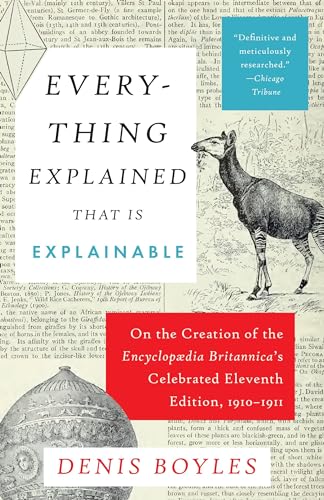
Everything Explained That Is Explainable is the audacious, utterly improbable story of the publication of the Eleventh Edition of the legendary Encyclopædia Britannica. It is the tale of a young American entrepreneur who rescued a dying publication with the help of a floundering newspaper, and in so doing produced a series of books that forever changed the face of publishing. Thanks to the efforts of 1,500 contributors, among them a young staff of university graduates as well as some of the most distinguished names of the day, the Eleventh Edition combined scholarship and readability in a way no previous encyclopedia had (or ever has again). Denis Boyles’s work of cultural history pulls back the curtain on the 44-million-word testament to the age of reason that has profoundly shaped the way we see the world.
Die Inhaltsangabe kann sich auf eine andere Ausgabe dieses Titels beziehen.
Über die Autorin bzw. den Autor
Denis Boyles is the author of more than a dozen books of poetry, travel, humor, essays, and criticism. He is a veteran magazine editor, and currently a coeditor of The Fortnightly Review. Boyles teaches journalism and political science at the Institut Catholique d’Études Supérieures in La Roche-sur-Yon, France.
www.denisboyles.com
Auszug. © Genehmigter Nachdruck. Alle Rechte vorbehalten.
chapter 1
Plymouth 1896
HOOPER, HORACE EVERETT (1859–1922), American publisher and book distributor, joined the other passengers on the first-class deck as his steamer passed the lighthouses of the treacherous south coast of England. First, the Wolf Rock light, standing alone on its sea-level stone perch, then the distant Lizard light, said to be the equal of a million candles, and visible from sixty miles away. To transatlantic passengers, such as our man, lately of Chicago, the long journey was nearly over. Just a few miles ahead was Rame Head, the light and marker for Plymouth harbor.
From what we know about him, it’s easy to imagine a man like Hooper—a square, solid man, with a walrus mustache and thick, theatrical eyebrows—anxiously pacing a little square of the deck as other passengers, participating in a time-honored traveler’s tradition, gathered quietly for a sunrise view of the Old World. Distant steeples, churchyards crowded with the bodies of storm-wrecked sailors, white-sand arcs below the green cliffs of the shore—none of these would have interested him. He was the worst kind of tourist. He was a man in a hurry. He was thirty-seven years old and he had lived his entire life in a rush. He walked quickly, thought as he walked, talked as he thought, his voice pitched high in the syncopated, sharply chipped rat-a-tat-tat of mid-Massachusetts—Worcester, “Whista,” to be exact—where he had been born and raised. He wanted to get to London and he was sick of the sea. He had boarded his ship in New York with more ideas than he needed. During the weeklong crossing, they had multiplied crazily, creating a wild architecture for a plan he was eager to put in play.
His ship was filled with Americans rich and poor. Even in the depths of the depression that gripped America in 1896, jumping on a steamer to cross the Atlantic was a mainstream indulgence; a ticket to Europe cost about as much as an average bicycle. Thousands of passengers boarded these ships every week, gladly paying £10 for a first-class passage (and only half that for steerage). American wealth in those days wasn’t deep; many of those wealthy enough to ride in a cabin next to Hooper’s were the recent descendants of European immigrants who had struck it rich selling groceries or hardware. They were returning to a continent their families had forsworn only a few decades earlier. Now their children and grandchildren were coming back by the boatload, literally, to lord it over the unfortunate uncles and cousins who had opted to remain behind.
Hooper may not have been the richest man on board. But it’s likely that the upper decks of Hooper’s ship were filled with those whose own American pedigree might not have come close to his, descended as he was from Joan Beaufort, the fifteenth-century queen of Scotland. John Leverett, who had been born in England in 1616 but died in office as governor of Massachusetts in 1679, was an ancestor on Hooper’s mother’s side; the Leverett name is still potent in New England. Hooper’s father, William Robert, was descended from Robert “King” Hooper, a hard-selling merchant born in Marblehead in 1709 to a candlemaker. For at least one early part of his life, Horace was called Horace Leverett Hooper.
Although born in Massachusetts, Horace’s own father, an attorney and sometime journalist and editor at the Worcester Spy, was an important member of pre–Civil War Yankee society. William planned for his children—six in all, including the three boys, Horace, Franklin, and Louis—to be educated properly and launched in the professions. Horace, the oldest, was secured a place at Princeton Preparatory School, where he did well, but only during baseball season and even then only as shortstop. When the family moved to Washington, D.C., to join his father, who had taken up a clerk’s position in the Lincoln administration, young Horace went too and took a job in a bookstore. Instead of pursuing his father’s somewhat conventional ambitions for him—university, the law, perhaps government service—he took an unexpected turn, for he had fallen in love with books, if not with the conventional means of gaining an education from them. After a year or so selling books in Washington, he and a friend, Sam Alexander, another boy from Worcester, headed west. It was 1876, the year of the Battle of the Little Bighorn. Hooper was seventeen years old. Hooper and Alexander traveled across the plains to Colorado and took up lodging in Denver City, the county seat of Arapahoe County.
Hooper was a young New Englander a long way from home with little to his name but a bona fide genealogy, a lot of ambition, and a sincere passion for books and bookselling. Barely out of his teens in 1881, he met and married Mary Alice Woodbury, the daughter of Roger Williams Woodbury, the New Hampshire–born founder of the Denver Daily Times, and settled comfortably into the community. Twin boys, William Everett Hooper and Roger Woodbury Hooper, were born in 1884.
For a young man leaving the East Coast during the Indian Wars and traveling west, the anticipation of meeting a new kind of American would surely have been great. In the imaginations of boys like Hooper, western Americans were completely unlike the people one would encounter in Worcester or Washington. They would be big, rough, perhaps justifiably disliked by the original inhabitants, at home on a horse, with a professional interest in cattle.
Cowpoke dreams notwithstanding, the western American a boy would be most likely to encounter first would be a salesman. Door to door and town to town was the preferred means of marketing and distribution in the years following the Civil War. Preachers, judges, doctors, and dentists all rode circuits making regular visits to communities far and wide; far more ubiquitous were the missionaries of mercantilism—men, almost exclusively, young and old, who carried western America’s retail sector in black suitcases and in small order books, making elaborate pitches for very simple objects, and especially books.
Soon, Hooper had established a distribution business called Western Book and Stationery, making books available not only to other agents but also to retail counters in various western towns. For himself, he set up a business pushing a line of books that would seem almost comically unsuited to his clientele, who were not city-dwelling book browsers but settler families living in harsh conditions in remote areas and for whom a distant post office was the only, tenuous, link with the wider world. Hooper’s starting inventory included reference works abandoned by their publishers—dictionaries and encyclopedias, republished classics, including “unauthorized” versions of books published in Great Britain left unprotected by the copyright laws then in effect.
Although it beggars many modern imaginations, publishing and selling books was very good business back then, highly profitable on the publisher’s part, and for readers an essential part of life. In the western states, the postwar settlement pattern was everywhere the same: wherever the railway passed, small communities were built that took as their civic models the big cities in the East. Thus, small towns featured not only homes, shops, and churches but also schools, colleges, opera houses, and libraries. Literary circles were everywhere books could be found. Public education had been ubiquitous since the 1850s—in fact, by 1890 America’s literacy rate was among the world’s highest. Social aspirations required even the poorest settlers to seek cultural equality by owning one of the badges of literacy—a bound set of Dickens or Shakespeare, Mark Twain’s...
„Über diesen Titel“ kann sich auf eine andere Ausgabe dieses Titels beziehen.
Suchergebnisse für Everything Explained That Is Explainable: On the Creation...

Beispielbild für diese ISBN
Everything Explained That Is Explainable: On the Creation of the Encyclopaedia Britannica's Celebrated Eleventh Edition, 1910-1911
Verlag:
Knopf Doubleday Publishing Group, 2017
ISBN 10: 0307389782
ISBN 13: 9780307389787
Gebraucht
paperback
Anbieter: Half Price Books Inc., Dallas, TX, USA
Verkäuferbewertung 5 von 5 Sternen

paperback. Zustand: Very Good. Connecting readers with great books since 1972! Used books may not include companion materials, and may have some shelf wear or limited writing. We ship orders daily and Customer Service is our top priority! Bestandsnummer des Verkäufers S_460660140
Gebraucht kaufen
EUR 8,28
EUR 3,34 Versand
Versand innerhalb von USA
Versand innerhalb von USA
Anzahl: 1 verfügbar
Beispielbild für diese ISBN
Everything Explained That Is Explainable : On the Creation of the Encyclopaedia Britannica's Celebrated Eleventh Edition, 1910-1911 (Paperback)
Anbieter: Lakeside Books, Benton Harbor, MI, USA
Verkäuferbewertung 5 von 5 Sternen
Zustand: New. Brand New! Not Overstocks or Low Quality Book Club Editions! Direct From the Publisher! We're not a giant, faceless warehouse organization! We're a small town bookstore that loves books and loves it's customers! Buy from Lakeside Books! Bestandsnummer des Verkäufers OTF-S-9780307389787
Neu kaufen
EUR 18,39
EUR 3,56 Versand
Versand innerhalb von USA
Versand innerhalb von USA
Anzahl: Mehr als 20 verfügbar
Foto des Verkäufers
Everything Explained That Is Explainable
Verlag:
Knopf Doubleday Publishing Group, 2017
ISBN 10: 0307389782
ISBN 13: 9780307389787
Neu
Softcover
Anbieter: GreatBookPrices, Columbia, MD, USA
Verkäuferbewertung 5 von 5 Sternen
Zustand: New. Bestandsnummer des Verkäufers 29151593-n
Neu kaufen
EUR 19,62
EUR 2,35 Versand
Versand innerhalb von USA
Versand innerhalb von USA
Anzahl: Mehr als 20 verfügbar
Foto des Verkäufers
Everything Explained That Is Explainable (Paperback or Softback)
Verlag:
Vintage 9/19/2017, 2017
ISBN 10: 0307389782
ISBN 13: 9780307389787
Neu
Paperback or Softback
Anbieter: BargainBookStores, Grand Rapids, MI, USA
Verkäuferbewertung 5 von 5 Sternen
Paperback or Softback. Zustand: New. Everything Explained That Is Explainable. Book. Bestandsnummer des Verkäufers BBS-9780307389787
Beispielbild für diese ISBN
Everything Explained That Is Explainable: On the Creation of the Encyclopaedia Britannica's Celebrated Eleventh Edition, 1910-1911
Verlag:
Knopf Doubleday Publishing Group, 2017
ISBN 10: 0307389782
ISBN 13: 9780307389787
Neu
Softcover
Anbieter: California Books, Miami, FL, USA
Verkäuferbewertung 5 von 5 Sternen
Zustand: New. Bestandsnummer des Verkäufers I-9780307389787
Neu kaufen
EUR 23,88
Versand gratis
Versand innerhalb von USA
Versand innerhalb von USA
Anzahl: Mehr als 20 verfügbar
Foto des Verkäufers
Everything Explained That Is Explainable
Verlag:
Knopf Doubleday Publishing Group, 2017
ISBN 10: 0307389782
ISBN 13: 9780307389787
Gebraucht
Softcover
Anbieter: GreatBookPrices, Columbia, MD, USA
Verkäuferbewertung 5 von 5 Sternen
Zustand: As New. Unread book in perfect condition. Bestandsnummer des Verkäufers 29151593
Gebraucht kaufen
EUR 22,56
EUR 2,35 Versand
Versand innerhalb von USA
Versand innerhalb von USA
Anzahl: Mehr als 20 verfügbar
Beispielbild für diese ISBN
Everything Explained That Is Explainable (Paperback)
Verlag:
Random House USA Inc, New York, 2017
ISBN 10: 0307389782
ISBN 13: 9780307389787
Neu
Paperback
Anbieter: Grand Eagle Retail, Bensenville, IL, USA
Verkäuferbewertung 5 von 5 Sternen
Paperback. Zustand: new. Paperback. Everything Explained That Is Explainable is the audacious, utterly improbable story of the publication of the Eleventh Edition of the legendary Encyclopaedia Britannica. It is the tale of a young American entrepreneur who rescued a dying publication with the help of a floundering newspaper, and in so doing produced a series of books that forever changed the face of publishing. Thanks to the efforts of 1,500 contributors, among them a young staff of university graduates as well as some of the most distinguished names of the day, the Eleventh Edition combined scholarship and readability in a way no previous encyclopedia had (or ever has again). Denis Boyless work of cultural history pulls back the curtain on the 44-million-word testament to the age of reason that has profoundly shaped the way we see the world. Shipping may be from multiple locations in the US or from the UK, depending on stock availability. Bestandsnummer des Verkäufers 9780307389787
Foto des Verkäufers
Everything Explained That Is Explainable
Anbieter: Rarewaves.com USA, London, LONDO, Vereinigtes Königreich
Verkäuferbewertung 5 von 5 Sternen
Paperback. Zustand: New. Bestandsnummer des Verkäufers LU-9780307389787
Neu kaufen
EUR 38,39
Versand gratis
Versand von Vereinigtes Königreich nach USA
Versand von Vereinigtes Königreich nach USA
Anzahl: Mehr als 20 verfügbar
Beispielbild für diese ISBN
Everything Explained That Is Explainable
Anbieter: PBShop.store UK, Fairford, GLOS, Vereinigtes Königreich
Verkäuferbewertung 5 von 5 Sternen
PAP. Zustand: New. New Book. Shipped from UK. Established seller since 2000. Bestandsnummer des Verkäufers L2-9780307389787
Neu kaufen
EUR 34,19
EUR 6,93 Versand
Versand von Vereinigtes Königreich nach USA
Versand von Vereinigtes Königreich nach USA
Anzahl: Mehr als 20 verfügbar
Beispielbild für diese ISBN
Everything Explained That Is Explainable
Anbieter: Revaluation Books, Exeter, Vereinigtes Königreich
Verkäuferbewertung 5 von 5 Sternen
Paperback. Zustand: Brand New. reprint edition. 442 pages. 8.25x5.25x1.25 inches. In Stock. Bestandsnummer des Verkäufers x-0307389782
Neu kaufen
EUR 31,11
EUR 11,80 Versand
Versand von Vereinigtes Königreich nach USA
Versand von Vereinigtes Königreich nach USA
Anzahl: 2 verfügbar