
Verwandte Artikel zu The Master Switch: The Rise and Fall of Information...
Inhaltsangabe
A New Yorker and Fortune Best Book of the Year
"A must-read for all Americans who want to remain the ones deciding what they can read, watch, and listen to.” —Arianna Huffington
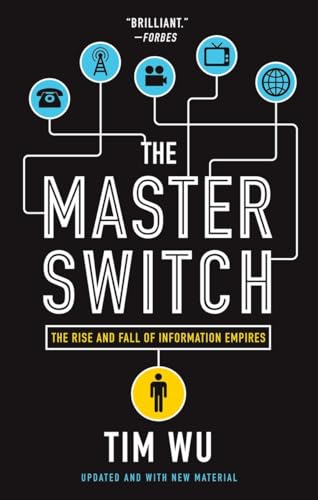
Analyzing the strategic maneuvers of today’s great information powers—Apple, Google, and an eerily resurgent AT&T—Tim Wu uncovers a time-honored pattern in which invention begets industry and industry begets empire.
It is easy to forget that every development in the history of the American information industry—from the telephone to radio to film—once existed in an open and chaotic marketplace inhabited by entrepreneurs and utopians, just as the Internet does today. Each of these, however, grew to be dominated by a monopolist or cartel.
In this pathbreaking book, Tim Wu asks: will the Internet follow the same fate? Could the Web—the entire flow of American information—come to be ruled by a corporate leviathan in possession of "the master switch"? Here, Tim Wu shows how a battle royale for the Internet’s future is brewing, and this is one war we dare not tune out.
Die Inhaltsangabe kann sich auf eine andere Ausgabe dieses Titels beziehen.
Über die Autorin bzw. den Autor
Tim Wu is an author, policy advocate and professor at Columbia University, currently serving as Senior Advisor to the United States Federal Trade Commission. In 2006, he was recognized as one of fifty leaders in science and technology by Scientific American magazine, and in the following year, 01238 magazine listed him as one of Harvard’s one hundred most influential graduates. He writes for Slate, where he won the Lowell Thomas gold medal for travel journalism, and he has contributed to The New Yorker, Time, The New York Times, The Washington Post, and Forbes.
Auszug. © Genehmigter Nachdruck. Alle Rechte vorbehalten.
Chapter 1
Exactly forty years before Bell's National Geographic banquet, Alexander Bell was in his laboratory in the attic of a machine shop in Boston, trying once more to coax a voice out of a wire. His efforts had proved mostly futile, and the Bell Company was little more than a typically hopeless start-up.
Bell was a professor and an amateur inventor, with little taste for business: his expertise and his day job was teaching the deaf. His main investor and the president of the Bell Company was Gardiner Green Hubbard, a patent attorney and prominent critic of the telegraph monopoly Western Union. It is Hubbard who was responsible for Bell's most valuable asset: its telephone patent, filed even before Bell had a working prototype. Besides Hubbard, the company had one employee, Bell's assistant, Thomas Watson. That was it.
If the banquet revealed Bell on the cusp of monopoly, here is the opposite extreme from which it began: a stirring image of Bell and Watson toiling in their small attic laboratory. It is here that the Cycle begins: in a lonely room where one or two men are trying to solve a concrete problem. So many revolutionary innovations start small, with outsiders, amateurs, and idealists in attics or garages. This motif of Bell and Watson alone will reappear throughout this account, at the origins of radio, television, the personal computer, cable, and companies like Google and Apple. The importance of these moments makes it critical to understand the stories of lone inventors.
Over the twentieth century, most innovation theorists and historians became somewhat skeptical of the importance of creation stories like Bell's. These thinkers came to believe the archetype of the heroic inventor had been over-credited in the search for a compelling narrative. As William Fisher puts it, "Like the romantic ideal of authorship, the image of the inventor has proved distressingly durable." These critics undeniably have a point: even the most startling inventions are usually arrived at, simultaneously, by two or more people. If that's true, how singular could the genius of the inventor really be?
There could not be a better example than the story of the telephone itself. On the very day that Alexander Bell was registering his invention, another man, Elisha Gray, was also at the patent office filing for the very same breakthrough.* The coincidence takes some of the luster off Bell's "eureka." And the more you examine the history, the worse it looks. In 1861, sixteen years before Bell, a German man named Johann Philip Reis presented a primitive telephone to the Physical Society of Frankfurt, claiming that "with the help of the galvanic current, [the inventor] is able to reproduce at a distance the tones of instruments and even, to a certain degree, the human voice." Germany has long considered Reis the telephone's inventor. Another man, a small-town Pennsylvania electrician named Daniel Drawbaugh, later claimed that by 1869 he had a working telephone in his house. He produced prototypes and seventy witnesses who testified that they had seen or heard his invention at that time. In litigation before the Supreme Court in 1888, three Justices concluded that "overwhelming evidence" proved that "Drawbaugh produced and exhibited in his shop, as early as 1869, an electrical instrument by which he transmitted speech. . . ."
There was, it is fair to say, no single inventor of the telephone. And this reality suggests that what we call invention, while not easy, is simply what happens once a technology's development reaches the point where the next step becomes available to many people. By Bell's time, others had invented wires and the telegraph, had discovered electricity and the basic principles of acoustics. It lay to Bell to assemble the pieces: no mean feat, but not a superhuman one. In this sense, inventors are often more like craftsmen than miracle workers.
Indeed, the history of science is full of examples of what the writer Malcolm Gladwell terms "simultaneous discovery"-so full that the phenomenon represents the norm rather than the exception. Few today know the name Alfred Russel Wallace, yet he wrote an article proposing the theory of natural selection in 1858, a year before Charles Darwin published The Origin of Species. Leibnitz and Newton developed calculus simultaneously. And in 1610 four others made the same lunar observations as Galileo.
Is the loner and outsider inventor, then, merely a figment of so much hype, with no particular significance? No, I would argue his significance is enormous; but not for the reasons usually imagined. The inventors we remember are significant not so much as inventors, but as founders of "disruptive" industries, ones that shake up the technological status quo. Through circumstance or luck, they are exactly at the right distance both to imagine the future and to create an independent industry to exploit it.
Let's focus, first, on the act of invention. The importance of the outsider here owes to his being at the right remove from the prevailing currents of thought about the problem at hand. That distance affords a perspective close enough to understand the problem, yet far enough for greater freedom of thought, freedom from, as it were, the cognitive distortion of what is as opposed to what could be. This innovative distance explains why so many of those who turn an industry upside down are outsiders, even outcasts.
To understand this point we need grasp the difference between two types of innovation: "sustaining" and "disruptive," the distinction best described by innovation theorist Clayton Christensen. Sustaining innovations are improvements that make the product better, but do not threaten its market. The disruptive innovation, conversely, threatens to displace a product altogether. It is the difference between the electric typewriter, which improved on the typewriter, and the word processor, which supplanted it.
Another advantage of the outside inventor is less a matter of the imagination than of his being a disinterested party. Distance creates a freedom to develop inventions that might challenge or even destroy the business model of the dominant industry. The outsider is often the only one who can afford to scuttle a perfectly sound ship, to propose an industry that might challenge the business establishment or suggest a whole new business model. Those closer to-often at the trough of- existing industries face a remarkably constant pressure not to invent things that will ruin their employer. The outsider has nothing to lose.
But to be clear, it is not mere distance, but the right distance that matters; there is such a thing as being too far away. It may be that Daniel Drawbaugh actually did invent the telephone seven years before Bell. We may never know; but even if he did, it doesn't really matter, because he didn't do anything with it. He was doomed to remain an inventor, not a founder, for he was just too far away from the action to found a disruptive industry. In this sense, Bell's alliance with Hubbard, a sworn enemy of Western Union, the dominant monopolist, was all-important. For it was Hubbard who made Bell's invention into an effort to unseat Western Union.
I am not saying, by any means, that invention is solely the province of loners and that everyone else's inspiration is suppressed. But this isn't a book about better mousetraps. The Cycle is powered by disruptive innovations that upend once thriving industries, bankrupt the dominant powers, and change the world. Such innovations are exceedingly rare, but they are what makes the Cycle go.
Let's return to Bell in his Boston laboratory. Doubtless he had some critical assets, including a knowledge of acoustics. His laboratory notebook, which can be read online, suggests a certain diligence. But his greatest advantage was neither of...
„Über diesen Titel“ kann sich auf eine andere Ausgabe dieses Titels beziehen.
Suchergebnisse für The Master Switch: The Rise and Fall of Information...

Beispielbild für diese ISBN
The Master Switch: The Rise and Fall of Information Empires
Anbieter: World of Books (was SecondSale), Montgomery, IL, USA
Verkäuferbewertung 5 von 5 Sternen

Paperback. Zustand: Good. A New Yorker and Fortune Best Book of the Year "A must-read for all Americans who want to remain the ones deciding what they can read, watch, and listen to." --Arianna Huffington Analyzing the strategic maneuvers of today's great information powers--Apple, Google, and an eerily resurgent AT&T--Tim Wu uncovers a time-honored pattern in which invention begets industry and industry begets empire. It is easy to forget that every development in the history of the American information industry--from the telephone to radio to film--once existed in an open and chaotic marketplace inhabited by entrepreneurs and utopians, just as the Internet does today. Each of these, however, grew to be dominated by a monopolist or cartel. In this pathbreaking book, Tim Wu asks: will the Internet follow the same fate? Could the Web--the entire flow of American information--come to be ruled by a corporate leviathan in possession of "the master switch"? Here, Tim Wu shows how a battle royale for the Internet's future is brewing, and this is one war we dare not tune out. Bestandsnummer des Verkäufers 00106490144
Gebraucht kaufen
EUR 5,31
Versand gratis
Versand innerhalb von USA
Versand innerhalb von USA
Anzahl: 9 verfügbar
Beispielbild für diese ISBN
The Master Switch: The Rise and Fall of Information Empires
Anbieter: World of Books (was SecondSale), Montgomery, IL, USA
Verkäuferbewertung 5 von 5 Sternen
Paperback. Zustand: Fair. A New Yorker and Fortune Best Book of the Year "A must-read for all Americans who want to remain the ones deciding what they can read, watch, and listen to." --Arianna Huffington Analyzing the strategic maneuvers of today's great information powers--Apple, Google, and an eerily resurgent AT&T--Tim Wu uncovers a time-honored pattern in which invention begets industry and industry begets empire. It is easy to forget that every development in the history of the American information industry--from the telephone to radio to film--once existed in an open and chaotic marketplace inhabited by entrepreneurs and utopians, just as the Internet does today. Each of these, however, grew to be dominated by a monopolist or cartel. In this pathbreaking book, Tim Wu asks: will the Internet follow the same fate? Could the Web--the entire flow of American information--come to be ruled by a corporate leviathan in possession of "the master switch"? Here, Tim Wu shows how a battle royale for the Internet's future is brewing, and this is one war we dare not tune out. Bestandsnummer des Verkäufers 00109703801
Gebraucht kaufen
EUR 5,31
Versand gratis
Versand innerhalb von USA
Versand innerhalb von USA
Anzahl: 1 verfügbar
Foto des Verkäufers
The Master Switch: The Rise and Fall of Information Empires
Anbieter: Bay State Book Company, North Smithfield, RI, USA
Verkäuferbewertung 5 von 5 Sternen
Zustand: good. The book is in good condition with all pages and cover intact, including the dust jacket if originally issued. The spine may show light wear. Pages may contain some notes or highlighting, and there might be a "From the library of" label. Boxed set packaging, shrink wrap, or included media like CDs may be missing. Bestandsnummer des Verkäufers BSM.1DSW1
Gebraucht kaufen
EUR 5,32
Versand gratis
Versand innerhalb von USA
Versand innerhalb von USA
Anzahl: 1 verfügbar
Foto des Verkäufers
The Master Switch: The Rise and Fall of Information Empires
Anbieter: Bay State Book Company, North Smithfield, RI, USA
Verkäuferbewertung 5 von 5 Sternen
Zustand: good. The book is in good condition with all pages and cover intact, including the dust jacket if originally issued. The spine may show light wear. Pages may contain some notes or highlighting, and there might be a "From the library of" label. Boxed set packaging, shrink wrap, or included media like CDs may be missing. Bestandsnummer des Verkäufers BSM.1DYC5
Gebraucht kaufen
EUR 5,32
Versand gratis
Versand innerhalb von USA
Versand innerhalb von USA
Anzahl: 1 verfügbar
Beispielbild für diese ISBN
The Master Switch: The Rise and Fall of Information Empires
Anbieter: BRT Resales, DeLand, FL, USA
Verkäuferbewertung 5 von 5 Sternen
Soft cover. Zustand: Very Good. Very Good Paperback 9780307390998. Bestandsnummer des Verkäufers Ay16
Gebraucht kaufen
EUR 5,42
Versand gratis
Versand innerhalb von USA
Versand innerhalb von USA
Anzahl: 1 verfügbar
Beispielbild für diese ISBN
The Master Switch : The Rise and Fall of Information Empires
Verlag:
Knopf Doubleday Publishing Group, 2011
ISBN 10: 0307390993
ISBN 13: 9780307390998
Gebraucht
Softcover
Anbieter: Better World Books, Mishawaka, IN, USA
Verkäuferbewertung 5 von 5 Sternen
Zustand: Very Good. Pages intact with possible writing/highlighting. Binding strong with minor wear. Dust jackets/supplements may not be included. Stock photo provided. Product includes identifying sticker. Better World Books: Buy Books. Do Good. Bestandsnummer des Verkäufers 4714337-6
Gebraucht kaufen
EUR 6,08
Versand gratis
Versand innerhalb von USA
Versand innerhalb von USA
Anzahl: 1 verfügbar
Beispielbild für diese ISBN
The Master Switch : The Rise and Fall of Information Empires
Verlag:
Knopf Doubleday Publishing Group, 2011
ISBN 10: 0307390993
ISBN 13: 9780307390998
Gebraucht
Softcover
Anbieter: Better World Books, Mishawaka, IN, USA
Verkäuferbewertung 5 von 5 Sternen
Zustand: Good. Pages intact with minimal writing/highlighting. The binding may be loose and creased. Dust jackets/supplements are not included. Stock photo provided. Product includes identifying sticker. Better World Books: Buy Books. Do Good. Bestandsnummer des Verkäufers 4855583-6
Gebraucht kaufen
EUR 6,08
Versand gratis
Versand innerhalb von USA
Versand innerhalb von USA
Anzahl: 4 verfügbar
Beispielbild für diese ISBN
The Master Switch : The Rise and Fall of Information Empires
Verlag:
Knopf Doubleday Publishing Group, 2011
ISBN 10: 0307390993
ISBN 13: 9780307390998
Gebraucht
Softcover
Anbieter: Better World Books: West, Reno, NV, USA
Verkäuferbewertung 5 von 5 Sternen
Zustand: Very Good. Pages intact with possible writing/highlighting. Binding strong with minor wear. Dust jackets/supplements may not be included. Stock photo provided. Product includes identifying sticker. Better World Books: Buy Books. Do Good. Bestandsnummer des Verkäufers 4714337-6
Gebraucht kaufen
EUR 6,08
Versand gratis
Versand innerhalb von USA
Versand innerhalb von USA
Anzahl: 1 verfügbar
Beispielbild für diese ISBN
The Master Switch : The Rise and Fall of Information Empires
Verlag:
Knopf Doubleday Publishing Group, 2011
ISBN 10: 0307390993
ISBN 13: 9780307390998
Gebraucht
Softcover
Anbieter: Better World Books, Mishawaka, IN, USA
Verkäuferbewertung 5 von 5 Sternen
Zustand: Good. Former library copy. Pages intact with minimal writing/highlighting. The binding may be loose and creased. Dust jackets/supplements are not included. Includes library markings. Stock photo provided. Product includes identifying sticker. Better World Books: Buy Books. Do Good. Bestandsnummer des Verkäufers 4841172-6
Gebraucht kaufen
EUR 6,08
Versand gratis
Versand innerhalb von USA
Versand innerhalb von USA
Anzahl: 1 verfügbar
Beispielbild für diese ISBN
The Master Switch : The Rise and Fall of Information Empires
Verlag:
Knopf Doubleday Publishing Group, 2011
ISBN 10: 0307390993
ISBN 13: 9780307390998
Gebraucht
Softcover
Anbieter: Better World Books: West, Reno, NV, USA
Verkäuferbewertung 5 von 5 Sternen
Zustand: Very Good. Former library copy. Pages intact with possible writing/highlighting. Binding strong with minor wear. Dust jackets/supplements may not be included. Includes library markings. Stock photo provided. Product includes identifying sticker. Better World Books: Buy Books. Do Good. Bestandsnummer des Verkäufers GRP86342145
Gebraucht kaufen
EUR 6,08
Versand gratis
Versand innerhalb von USA
Versand innerhalb von USA
Anzahl: 1 verfügbar