
Verwandte Artikel zu King of Capital: The Remarkable Rise, Fall, and Rise...
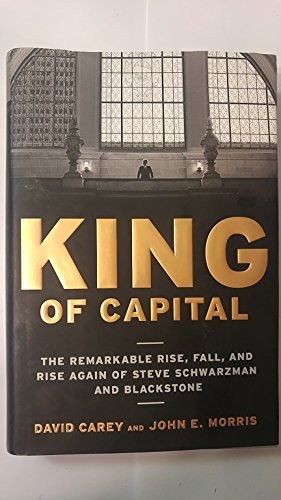
King of Capital: The Remarkable Rise, Fall, and Rise Again of Steve Schwarzman and Blackstone - Hardcover
Inhaltsangabe
Strippers and Flippers . . . or a New Positive Force Helping to Drive the Economy . . .
The untold story of Steve Schwarzman and Blackstone, the financier and his financial powerhouse that avoided the self-destructive tendencies of Wall Street. David Carey and John Morris show how Blackstone (and other private equity firms) transformed themselves from gamblers, hostile-takeover artists, and ‘barbarians at the gate’ into disciplined, risk-conscious investors.
The financial establishment—banks and investment bankers such as Citigroup, Bear Stearns, Lehman, UBS, Goldman Sachs, Merrill Lynch, Morgan Stanley—were the cowboys, recklessly assuming risks, leveraging up to astronomical levels and driving the economy to the brink of disaster.
Blackstone is now ready to break out once again since it is sitting on billions of dollars
that can be invested at a time when the market is starved for capital.
The story of a financial revolution—the greatest untold success story on Wall Street: Not only have Blackstone and a small coterie of competitors wrested control of corporations around the globe, but they have emerged as a major force on Wall Street, challenging the likes of Goldman Sachs and Morgan Stanley for dominance.
Great human interest story: How Blackstone went from two guys and a secretary to being one of Wall Street’s most powerful institutions, far outgrowing its much older rival KKR; and how Steve Schwarzman, with a pay packet one year of $398 million and $684 million from the Blackstone IPO, came to epitomize the spectacular new financial fortunes amassed in the 2000s.
Controversial: Analyzes the controversies surrounding Blackstone and whether it and other private equity firms suck the lifeblood out of companies to enrich themselves—or whether they are a force that helps make the companies they own stronger and thereby better competitors.
The story by two insiders with access: Insightful and hard-hitting, filled with never-before-revealed details about the workings of a heretofore secretive company that was the personal fiefdom of Schwarzman and Peter Peterson.
Forward-looking: How Blackstone and private equity will drive the economy and provide a model for how financing will work.
Die Inhaltsangabe kann sich auf eine andere Ausgabe dieses Titels beziehen.
Über die Autorin bzw. den Autor
DAVID CAREY is senior writer for The Deal, a news service and magazine covering private equity and mergers and acquisitions. Before joining The Deal he was the editor of Corporate Finance magazine and wrote for Adweek, Fortune, Institutional Investor, and Financial World.
JOHN E. MORRIS, now an editor with Dow Jones Investment Banker, was for many years an assistant managing editor at The Deal in New York and London and before that was an editor and writer at The American Lawyer magazine.
To find out more visit: www.king-of-capital.com
Auszug. © Genehmigter Nachdruck. Alle Rechte vorbehalten.
CHAPTER 1
The Debutants
"More Rumors About His Party Than About His Deals,” blared the front-page headline in the New York Times in late January 2007. It was a curtain-raiser for what was shaping up to be the social event of the season, if not the era. By then, the buzz had been building for weeks.
Stephen Schwarzman, cofounder of the Blackstone Group, the world’s largest private equity firm, was about to turn sixty and was planning a fête. The financier’s lavish holiday parties were already well known in Manhattan’s moneyed circles. One year Schwarzman and his wife decorated their twenty-four-room, two-floor spread in Park Avenue’s toniest apartment building to resemble Schwarzman’s favorite spot in St. Tropez, near their summer home on the French Riviera. For his birthday, he decided to top that, taking over the Park Avenue Armory, a fortified brick edifice that occupies a full square block amid the metropolis’s most expensive addresses.
On the night of February 13 limousines queued up and the boldface names in tuxedos and evening dresses poured out and filed past an encampment of reporters into the hangarlike armory. TV perennial Barbara Walters was there, Donald and Melania Trump, media diva Tina Brown, Cardinal Egan of the Archdiocese of New York, Sir Howard Stringer, the head of Sony, and a few hundred other luminaries, including the chief executives of some of the nation’s biggest banks: Jamie Dimon of JPMorgan Chase, Stanley O’Neal of Merrill Lynch, Lloyd Blankfein of Goldman Sachs, and Jimmy Cayne of Bear Stearns.
Inside the cavernous armory hung “a huge indoor canopy . . . with a darkened sky of sparkling stars suspended above a grand chandelier,” mimicking the living room in Schwarzman’s $30 million apartment nearby, the New York Post reported the next day. The decor was copied, the paper observed, “even down to a grandfather clock and Old Masters paintings on the wall.”
R&B star Patti LaBelle was on hand to sing “Happy Birthday.” Beneath an immense portrait of the financier— also a replica of one hanging in his apartment— the headliners, singer Rod Stewart and comic Martin Short, strutted and joked into the late hours. Schwarzman had chosen the armory, Short quipped, because it was more intimate than his apartment. Stewart alone was known to charge $1 million for such appearances.
The $3 million gala was a self-coronation for the brash new king of a new Gilded Age, an era when markets were flush and crazy wealth saturated Wall Street and especially the private equity realm, where Schwarzman held sway as the CEO of Blackstone Group.
As soon became clear, the birthday affair was merely a warm-up for a more extravagant coming-out bash: Blackstone’s initial public offering. By design or by luck, the splash of Schwarzman’s party magnified the awe and intrigue when Blackstone revealed its plan to go public five weeks later, on March 22. No other private equity firm of Blackstone’s size or stature had attempted such a feat, and Blackstone’s move made official what was already plain to the financial world: Private equity—the business of buying companies with an eye to selling them a few years later at a profit—had moved from the outskirts of the economy to its very center. Blackstone’s clout was so great and its prospects so promising that the Chinese government soon came knocking, asking to buy 10 percent of the company.
When Blackstone’s shares began trading on June 22 they soared from $31 to $38, as investors clamored to own a piece of the business. At the closing price, the company was worth a stunning $38 billion—one-third as much as Goldman Sachs, the undisputed leader among Wall Street investment banks.
Going public had laid bare the fantastic profits that Schwarzman’s company was throwing off. So astounding and sensitive were those figures that Blackstone had been reluctant to reveal them even to its own bankers, and it was not until a few weeks before the stock was offered to investors that Blackstone disclosed what its executives made. Blackstone had produced $2.3 billion of profits in 2006 for the firm’s sixty partners— a staggering $38 million apiece. Schwarzman personally had taken home $398 million that year.
That was just pay. The initial public offering, or IPO, yielded a second windfall for Schwarzman and his partners. Of the $7.1 billion Black-stone raised selling 23.6 percent of the company to public investors and the Chinese government, $4.1 billion went to the Blackstone partners themselves. Schwarzman personally collected $684 million selling a small fraction of his stake. His remaining shares were worth $9.4 billion, ensuring his place among the richest of the rich. Peter Peterson, Blackstone’s eighty- year- old, semiretired cofounder, garnered $1.9 billion.
The IPO took place amid a financial revolution in which Blackstone and a coterie of competitors were wresting control of corporations around the globe. The private equity, or leveraged buyout, industry was flexing its muscle on a scale not seen since the 1980s. Blackstone, Kohlberg Kravis Roberts and Company, Carlyle Group, Apollo Global Management, Texas Pacific Group, and a half-dozen others, backed by tens of billions of dollars from pension funds, university endowments, and other big investors, had been inching their way up the corporate ladder, taking over $10 billion companies, then $20 billion, $30 billion, and $40 billion companies. By 2007 private equity was behind one of every five mergers worldwide and there seemed to be no limit to its ambition. There was even talk that a buyout firm might swallow Home Depot for $100 billion.
Private equity now permeated the economy. You couldn’t purchase a ticket on Orbitz.com, visit a Madame Tussauds wax museum, or drink an Orangina without lining Blackstone’s pockets. If you bought coffee at Dunkin’ Donuts or a teddy bear at Toys “R” Us, slept on a Simmons mattress, skimmed the waves on a Sea- Doo jet ski, turned on a Grohe designer faucet, or purchased razor blades at a Boots pharmacy in London, some other buyout firm was benefiting. Blackstone alone owned all or part of fifty-one companies employing a half-million people and generating $171 billion in sales every year, putting it on a par with the tenth-largest corporation in the world.
The reach of private equity was all the more astonishing for the fact that these firms had tiny staffs and had long operated in the shadows, seldom speaking to the press or revealing details of their investments. Goldman Sachs had 30,500 employees and its profits were published every quarter. Blackstone, despite its vast industrial and real estate holdings, had a mere 1,000 employees and its books were private until it went public. Some of its competitors that controlled multibillion-dollar companies had only the sketchiest of websites.
Remarkably, Blackstone, Kohlberg Kravis, Carlyle, Apollo, TPG, and most other big private equity houses remained under the control of their founders, who still called the shots internally and, ultimately, at the companies they owned. Had there been any time since the robber barons of the nineteenth century when so much wealth and so many...
„Über diesen Titel“ kann sich auf eine andere Ausgabe dieses Titels beziehen.
Suchergebnisse für King of Capital: The Remarkable Rise, Fall, and Rise...

Beispielbild für diese ISBN
King of Capital: The Remarkable Rise, Fall, and Rise Again of Steve Schwarzman and Blackstone
Anbieter: World of Books (was SecondSale), Montgomery, IL, USA
Verkäuferbewertung 5 von 5 Sternen

Zustand: Good. Item in good condition. Textbooks may not include supplemental items i.e. CDs, access codes etc. Bestandsnummer des Verkäufers 00108582009
Gebraucht kaufen
EUR 24,38
Versand gratis
Versand innerhalb von USA
Versand innerhalb von USA
Anzahl: 1 verfügbar
Beispielbild für diese ISBN
King of Capital: The Remarkable Rise, Fall, and Rise Again of Steve Schwarzman and Blackstone
Verlag:
Crown Business (edition ), 2010
ISBN 10: 0307452999
ISBN 13: 9780307452993
Gebraucht
Hardcover
Anbieter: BooksRun, Philadelphia, PA, USA
Verkäuferbewertung 5 von 5 Sternen
Hardcover. Zustand: Very Good. With dust jacket. It's a well-cared-for item that has seen limited use. The item may show minor signs of wear. All the text is legible, with all pages included. It may have slight markings and/or highlighting. Bestandsnummer des Verkäufers 0307452999-11-1-29
Gebraucht kaufen
EUR 24,39
Versand gratis
Versand innerhalb von USA
Versand innerhalb von USA
Anzahl: 1 verfügbar
Beispielbild für diese ISBN
King of Capital: The Remarkable Rise, Fall, and Rise Again of Steve Schwarzman and Blackstone
Anbieter: More Than Words, Waltham, MA, USA
Verkäuferbewertung 5 von 5 Sternen
Zustand: Very Good. A bright, square, and overall a nice copy. Bestandsnummer des Verkäufers WAL-U-5e-01372
Gebraucht kaufen
EUR 20,97
EUR 3,48 Versand
Versand innerhalb von USA
Versand innerhalb von USA
Anzahl: 1 verfügbar
Beispielbild für diese ISBN
King of Capital: The Remarkable Rise, Fall, and Rise Again of Steve Schwarzman and Blackstone
Anbieter: World of Books Inc, Montgomery, IL, USA
Verkäuferbewertung 2 von 5 Sternen

Hardback. Zustand: Good. The financial establishment-banks and investment bankers, such as Citigroup, Bear Stearns, Lehman, UBS, Goldman Sachs, Merrill Lynch, and Morgan Stanley-were the cowboys, recklessly assuming risks, leveraging up to astronomical levels, and driving the economy to the brink of disaster. In King of Capital, David Carey and John E. Morris show how Blackstone (and other private equity firms) transformed themselves from gamblers, hostile-takeover artists, and barbarians at the gate into disciplined, risk-conscious investors. This is the greatest untold success story on Wall Street. Not only have Blackstone and a small coterie of competitors wrested control of corporations around the globe, but they have emerged as a major force on Wall Street, challenging the likes of Goldman Sachs and Morgan Stanley for dominance. And since it is sitting on billions of dollars that can be invested at a time when the market is starved for capital, Blackstone is now ready to break out once again. Insightful and hard-hitting, King of Capital is filled with never-before-revealed details about the workings of a heretofore secretive company that was the personal fiefdom of Steve Schwarzman and Peter Peterson. A great human interest story, as well, it tells how Blackstone went from two guys and a secretary to being one of Wall Street's most powerful institutions-far outgrowing its much older rival KR-and how Schwarzman, with a pay packet one year of $398 million and $684 million from the Blackstone IPO, came to epitomize the spectacular new financial fortunes amassed in the 2000s. Bestandsnummer des Verkäufers CIN0307452999G
Gebraucht kaufen
EUR 26,18
Versand gratis
Versand innerhalb von USA
Versand innerhalb von USA
Anzahl: 1 verfügbar
Beispielbild für diese ISBN
King of Capital: The Remarkable Rise, Fall, and Rise Again of Steve Schwarzman and Blackstone
Verlag:
Crown Publishing Group, Division of Random House Inc, 2010
ISBN 10: 0307452999
ISBN 13: 9780307452993
Gebraucht
Hardcover
Anbieter: WorldofBooks, Goring-By-Sea, WS, Vereinigtes Königreich
Verkäuferbewertung 5 von 5 Sternen
Hardback. Zustand: Very Good. The book has been read, but is in excellent condition. Pages are intact and not marred by notes or highlighting. The spine remains undamaged. Bestandsnummer des Verkäufers GOR006077884
Gebraucht kaufen
EUR 23,21
EUR 6,53 Versand
Versand von Vereinigtes Königreich nach USA
Versand von Vereinigtes Königreich nach USA
Anzahl: 1 verfügbar
Beispielbild für diese ISBN
King of Capital: The Remarkable Rise, Fall, and Rise Again of Steve Schwarzman and Blackstone
Verlag:
Crown Publishing Group, Division of Random House Inc, 2010
ISBN 10: 0307452999
ISBN 13: 9780307452993
Gebraucht
Hardcover
Anbieter: AwesomeBooks, Wallingford, Vereinigtes Königreich
Verkäuferbewertung 5 von 5 Sternen
Hardcover. Zustand: Very Good. King of Capital: The Remarkable Rise, Fall, and Rise Again of Steve Schwarzman and Blackstone This book is in very good condition and will be shipped within 24 hours of ordering. The cover may have some limited signs of wear but the pages are clean, intact and the spine remains undamaged. This book has clearly been well maintained and looked after thus far. Money back guarantee if you are not satisfied. See all our books here, order more than 1 book and get discounted shipping. . Bestandsnummer des Verkäufers 7719-9780307452993
Gebraucht kaufen
EUR 27,38
EUR 4,80 Versand
Versand von Vereinigtes Königreich nach USA
Versand von Vereinigtes Königreich nach USA
Anzahl: 1 verfügbar
Beispielbild für diese ISBN
King of Capital: The Remarkable Rise, Fall, and Rise Again of Steve Schwarzman and Blackstone
ISBN 10: 0307452999
ISBN 13: 9780307452993
Gebraucht
Hardcover
Anbieter: Bahamut Media, Reading, Vereinigtes Königreich
Verkäuferbewertung 5 von 5 Sternen
Hardcover. Zustand: Very Good. Shipped within 24 hours from our UK warehouse. Clean, undamaged book with no damage to pages and minimal wear to the cover. Spine still tight, in very good condition. Remember if you are not happy, you are covered by our 100% money back guarantee. Bestandsnummer des Verkäufers 6545-9780307452993
Gebraucht kaufen
EUR 27,38
EUR 8,14 Versand
Versand von Vereinigtes Königreich nach USA
Versand von Vereinigtes Königreich nach USA
Anzahl: 1 verfügbar
Beispielbild für diese ISBN
King of Capital : The Remarkable Rise, Fall, and Rise Again of Steve Schwarzman and Blackstone
Verlag:
Crown Publishing Group, The, 2010
ISBN 10: 0307452999
ISBN 13: 9780307452993
Gebraucht
Hardcover
Erstausgabe
Anbieter: Better World Books, Mishawaka, IN, USA
Verkäuferbewertung 5 von 5 Sternen
Zustand: Good. First Edition. Former library copy. Pages intact with minimal writing/highlighting. The binding may be loose and creased. Dust jackets/supplements are not included. Includes library markings. Stock photo provided. Product includes identifying sticker. Better World Books: Buy Books. Do Good. Bestandsnummer des Verkäufers GRP89796409
Gebraucht kaufen
EUR 39,59
Versand gratis
Versand innerhalb von USA
Versand innerhalb von USA
Anzahl: 1 verfügbar
Beispielbild für diese ISBN
King of Capital: The Remarkable Rise, Fall, and Rise Again of Steve Schwarzman and Blackstone
Verlag:
Crown Publishing Group, Division of Random House Inc, 2010
ISBN 10: 0307452999
ISBN 13: 9780307452993
Neu
Hardcover
Anbieter: DeckleEdge LLC, Albuquerque, NM, USA
Verkäuferbewertung 5 von 5 Sternen
Zustand: New. Bestandsnummer des Verkäufers AH301
Beispielbild für diese ISBN
King of Capital: The Remarkable Rise, Fall, and Rise Again of Steve Schwarzman and Blackstone
Anbieter: Revaluation Books, Exeter, Vereinigtes Königreich
Verkäuferbewertung 5 von 5 Sternen
Hardcover. Zustand: Brand New. 400 pages. 10.00x6.50x1.50 inches. In Stock. Bestandsnummer des Verkäufers 0307452999
Neu kaufen
EUR 124,64
EUR 14,58 Versand
Versand von Vereinigtes Königreich nach USA
Versand von Vereinigtes Königreich nach USA
Anzahl: 1 verfügbar