
Verwandte Artikel zu All Your Base Are Belong to Us: How Fifty Years of...
Inhaltsangabe
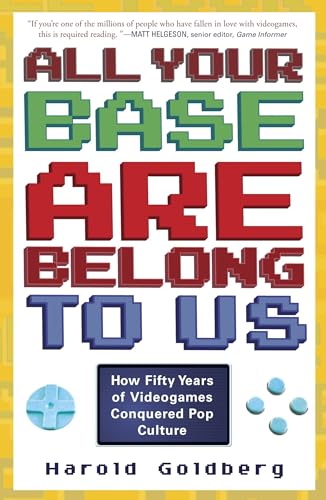
Through the stories of gaming's greatest innovations and most beloved creations, journalist Harold Goldberg captures the creativity, controversy--and passion--behind the videogame's meteoric rise to the top of the pop-culture pantheon.
Over the last fifty years, video games have grown from curiosities to fads to trends to one of the world's most popular forms of mass entertainment. But as the gaming industry grows in numerous directions and everyone talks about the advance of the moment, few explore and seek to understand the forces behind this profound evolution. How did we get from Space Invaders to Grand Theft Auto? How exactly did gaming become a $50 billion industry and a dominant pop culture form? What are the stories, the people, the innovations, and the fascinations behind this incredible growth?
Through extensive interviews with gaming's greatest innovators, both its icons and those unfairly forgotten by history, All Your Base Are Belong To Us sets out to answer these questions, exposing the creativity, odd theories--and passion--behind the twenty-first century's fastest-growing medium.
Go inside the creation of:
Grand Theft Auto * World of Warcraft * Bioshock * Kings Quest * Bejeweled * Madden Football * Super Mario Brothers * Myst * Pong * Donkey Kong * Crash Bandicoot * The 7th Guest * Tetris * Shadow Complex * Everquest * The Sims * And many more!
Die Inhaltsangabe kann sich auf eine andere Ausgabe dieses Titels beziehen.
Über die Autorin bzw. den Autor
HAROLD GOLDBERG has reviewed video games for fifteen years for such publications as Wired, Entertainment Weekly, Boys' Life, The Village Voice, and Radar, and for three years penned a widely syndicated gaming column. He has also written on a variety of other subjects for the New York Times, Vanity Fair, Esquire, New York, and Rolling Stone. In addition to his journalism, Goldberg served as editor-in-chief of Sony Online Entertainment during the launch of EverQuest.
Auszug. © Genehmigter Nachdruck. Alle Rechte vorbehalten.
1.
A SPACE ODYSSEY
In 1966, Ralph Baer, a short, bespectacled man with a deep, radio-quality voice and a sharp wit, had been a successful engineer for thirty years, overseeing as many as five hundred employees at Sanders, a large New Hampshire manufacturer whose primary contract was with the United States Defense Department. Much of Baer’s work revolved around airborne radar and antisubmarine warfare electronics. In the late summer of that year, he was sitting on a step outside of the busy Port Authority Bus Terminal in Manhattan, waiting patiently for a colleague and about to head to Madison Avenue for a meeting with a Sanders client. Manhattan’s traffic ebbed and flowed and taxis honked and the passing parade went by. Suddenly, Baer began furiously writing notes with a number 2 pencil on a spiral-bound yellow legal pad. It was like some spirit, some videogame ghost, was doing the writing. When he was done, he had a title page and four single-spaced pages of notes. His brainstorm produced a passel of ideas for an ingenious “game box” he initially called Channel Let’s Play! In that detailed outline, he described Action Games, Board Skill Games, Artistic Games, Instructional Games, Board Change Games, Card Games, and Sports Games, all of which could be played on any of the 40 million cathode-ray-tube TV sets that were ubiquitous in America at the time. He even detailed add-ons, like a pump controller that would allow players to become firemen and put out blazes around a virtual house displayed on-screen.
It wasn’t the first time Baer had come up with an idea for games on TV. Fifteen years earlier, in 1951, he worked at another defense contractor, the Loral Corporation, and suggested a rudimentary checkers game. But he didn’t think about games on TV again until that day in 1966, probably because his boss at Loral thought a game inside a TV was a ludicrous idea.
Let’s Play! was a much grander and more complex idea that would take a lot of time, manpower, and money to create properly. On that summer day in Manhattan, Baer didn’t know how much time or money. But Herb Campman, Sanders’s chief of research and development, believed in the concept and gave Baer a budget of $2,000 for research and $500 for materials. Baer, a complete work addict, would soon be on his way to becoming the father of videogames.
Little has been written about how Baer’s early life informed his later work. In fact, Baer was infected by the invention bug when young, not long after his family left Cologne in the 1930s. As a kid growing up in Germany, Baer didn’t realize the war was coming. He played with a stick and a hoop outdoors. At night, he and his sister performed puppet shows in their bedroom, laughing and laughing as they transported themselves into worlds of their own creation. The childish plays took Baer’s mind off the schoolkids who bullied him and hit him in the face for being a Jew. After packing their possessions into a half dozen three-by-four-foot wooden crates, in August 1938 the teenage Baer and his family fled Hitler’s Germany for New York City, via a ship that docked in Rotterdam. Many of his Jewish relatives weren’t so lucky and were killed. Baer was too young to comprehend the danger; as the ship steamed toward Ellis Island, he spent most of his time in a swimming pool or playing Monopoly with his sister in the game room. Even then, games intrigued him.
The family settled into a courtyard apartment near the Bronx Zoo, and Baer worked at a factory for $12 a week, putting buttons onto cosmetic cases. In the winter, the sixteen-year-old made his first invention: a machine that sped up the process of making leatherette goods. He got the engineering bug when he saw an ad for a correspondence course that read “Big Money Servicing Radios. Be a Genuine ‘Radiotrician.’ ” Baer was so excited about this new radio technology that he began to have dreams about resistors, coils, and capacitors. In a small store on Lexington Avenue, he listened to the radios he fixed, hearing the news of the Blitz on London and the invasion of Poland by the Germans.
By April 1942, Baer was an engineer in World War II as well, learning to prepare roads and bridges for infantry grunts and armored troops. He also laid and removed mines by gingerly digging around in the earth with a bayonet. Life as an engineer turned to life overseas in Bristol, England, teaching military intelligence courses, where he led classes for GIs on subjects such as recognizing German uniforms, ranks, organizational affiliations, and weapons handling. In Tidworth, he and his team created a military intelligence school that trained 120,000 Americans. Part of the school was an immense exhibit hall that included a huge cache of German weapons and vehicles. Ensconced in an industrial hangarlike edifice, the museum was featured in the November 3, 1944, issue of YANKS magazine. In his spare time, Baer secretly wrote a comprehensive manual on weaponry. He kept inventing, even fashioning AM radios from German mine detectors.
The organizational skills Baer learned in the military would serve him well as he began work on his videogame machine. Too, his experiences in the army imbued him with a self-confidence and talent for communication that helped him open up to those above him in rank. He may have been a nerd who cared more about technology than girls, but he was a surprisingly charismatic nerd who didn’t hide away a good idea when he truly believed he had one; he had chutzpah.
His design skills improved as he worked on radio equipment in college in Chicago, and on radar equipment and amplifiers at Transitron, a small company in what is now New York’s Tribeca neighborhood. Soon, Baer was chief engineer and then vice president at Transitron; he moved up the ranks because he was able to get things done quickly and accurately. By the time Sanders Associates made him a chief engineer, he was more of a manager than an inventor. Yet he yearned to get his hands dirty.
The $2,500 Baer received from his boss for developing Let’s Play! may not seem like much now. But in 1966, the sum was enough to purchase a new car, was one third of the amount most Americans earned yearly, and was more than half the cost of the average home. Baer had two men assigned to the project to do the hourly work. Bill Harrison, a hip-looking, conscientious engineering associate, built the prototypes. Bill Rusch, a cranky, temperamental powerhouse who had studied at MIT, came up with the idea of a “machine-controlled ball that would interact with player-controlled ‘paddles.’ ” Both men were already on Sanders’s payroll.
The project was top secret and time-consuming, so much so that Rusch brought a guitar to work so he could blow off steam--leading some curious wall-listeners in the company to believe that Baer was working on some sort of technologically advanced musical instrument, perhaps for the Beatles. But Baer’s boss, Herb Campman, didn’t care about rock ’n’ roll. He gave Baer the money for a sensible reason: He felt the company could eventually make games that would work well in training the military. He was not wrong.
Baer and his wife, Dena, would occasionally canoe in the Merrimack River and walk hand in hand through the Manchester, New Hampshire, snow as it fell. They loved the quaint town. But the weather could be as hostile as the tundra-like blizzards that fell in Capcom’s treacherous Lost Planet. The heavy snows just made Baer work harder. The game box became a consuming project that bordered on obsession. Inventors are like that: zealous to the exclusion of others. It was that way with surveyor George R. Carey, who had the idea for an early TV, the...
„Über diesen Titel“ kann sich auf eine andere Ausgabe dieses Titels beziehen.
Suchergebnisse für All Your Base Are Belong to Us: How Fifty Years of...

Beispielbild für diese ISBN
All Your Base Are Belong to Us: How Fifty Years of Videogames Conquered Pop Culture
Anbieter: World of Books (was SecondSale), Montgomery, IL, USA
Verkäuferbewertung 5 von 5 Sternen

Paperback. Zustand: Good. Through the stories of gaming's greatest innovations and most beloved creations, journalist Harold Goldberg captures the creativity, controversy--and passion--behind the videogame's meteoric rise to the top of the pop-culture pantheon. Over the last fifty years, video games have grown from curiosities to fads to trends to one of the world's most popular forms of mass entertainment. But as the gaming industry grows in numerous directions and everyone talks about the advance of the moment, few explore and seek to understand the forces behind this profound evolution. How did we get from Space Invaders to Grand Theft Auto? How exactly did gaming become a $50 billion industry and a dominant pop culture form? What are the stories, the people, the innovations, and the fascinations behind this incredible growth? Through extensive interviews with gaming's greatest innovators, both its icons and those unfairly forgotten by history, All Your Base Are Belong To Us sets out to answer these questions, exposing the creativity, odd theories--and passion--behind the twenty-first century's fastest-growing medium. Go inside the creation of: Grand Theft Auto * World of Warcraft * Bioshock * Kings Quest * Bejeweled * Madden Football * Super Mario Brothers * Myst * Pong * Donkey Kong * Crash Bandicoot * The 7th Guest * Tetris * Shadow Complex * Everquest * The Sims * And many more! Bestandsnummer des Verkäufers 00104328515
Gebraucht kaufen
EUR 3,91
Versand gratis
Versand innerhalb von USA
Versand innerhalb von USA
Anzahl: 4 verfügbar
Beispielbild für diese ISBN
All Your Base Are Belong to Us: How Fifty Years of Videogames Conquered Pop Culture
Anbieter: World of Books (was SecondSale), Montgomery, IL, USA
Verkäuferbewertung 5 von 5 Sternen
Paperback. Zustand: Fair. Through the stories of gaming's greatest innovations and most beloved creations, journalist Harold Goldberg captures the creativity, controversy--and passion--behind the videogame's meteoric rise to the top of the pop-culture pantheon. Over the last fifty years, video games have grown from curiosities to fads to trends to one of the world's most popular forms of mass entertainment. But as the gaming industry grows in numerous directions and everyone talks about the advance of the moment, few explore and seek to understand the forces behind this profound evolution. How did we get from Space Invaders to Grand Theft Auto? How exactly did gaming become a $50 billion industry and a dominant pop culture form? What are the stories, the people, the innovations, and the fascinations behind this incredible growth? Through extensive interviews with gaming's greatest innovators, both its icons and those unfairly forgotten by history, All Your Base Are Belong To Us sets out to answer these questions, exposing the creativity, odd theories--and passion--behind the twenty-first century's fastest-growing medium. Go inside the creation of: Grand Theft Auto * World of Warcraft * Bioshock * Kings Quest * Bejeweled * Madden Football * Super Mario Brothers * Myst * Pong * Donkey Kong * Crash Bandicoot * The 7th Guest * Tetris * Shadow Complex * Everquest * The Sims * And many more! Bestandsnummer des Verkäufers CIN0307463559A
Gebraucht kaufen
EUR 3,91
Versand gratis
Versand innerhalb von USA
Versand innerhalb von USA
Anzahl: 1 verfügbar
Foto des Verkäufers
All Your Base Are Belong to Us: How Fifty Years of Videogames Conquered Pop Culture
Anbieter: 3Brothers Bookstore, Egg harbor township, NJ, USA
Verkäuferbewertung 5 von 5 Sternen
Zustand: good. Books may contain some notes and highlighting. Supplements such as Access Codes, Cd's Dust Jackets, etc. are not guaranteed with used book purchases. Bestandsnummer des Verkäufers EVV.0307463559.G
Gebraucht kaufen
EUR 3,92
Versand gratis
Versand innerhalb von USA
Versand innerhalb von USA
Anzahl: 1 verfügbar
Foto des Verkäufers
All Your Base Are Belong to Us: How Fifty Years of Videogames Conquered Pop Culture
Anbieter: Zoom Books East, Glendale Heights, IL, USA
Verkäuferbewertung 5 von 5 Sternen
Zustand: good. Book is in good condition and may include underlining highlighting and minimal wear. The book can also include "From the library of" labels. May not contain miscellaneous items toys, dvds, etc. . We offer 100% money back guarantee and 24 7 customer service. Bestandsnummer des Verkäufers ZEV.0307463559.G
Gebraucht kaufen
EUR 4,06
Versand gratis
Versand innerhalb von USA
Versand innerhalb von USA
Anzahl: 1 verfügbar
Foto des Verkäufers
All Your Base Are Belong to Us: How Fifty Years of Videogames Conquered Pop Culture
Anbieter: Greenworld Books, Arlington, TX, USA
Verkäuferbewertung 5 von 5 Sternen
Zustand: very_good. Fast Free Shipping â" Very Good condition book with a firm cover and clean pages. Shows normal use and some light wear or limited notes markings. A solid, nice copy to enjoy. Bestandsnummer des Verkäufers GWV.0307463559.VG
Gebraucht kaufen
EUR 4,53
Versand gratis
Versand innerhalb von USA
Versand innerhalb von USA
Anzahl: 2 verfügbar
Foto des Verkäufers
All Your Base Are Belong to Us: How Fifty Years of Videogames Conquered Pop Culture
Anbieter: ZBK Books, Carlstadt, NJ, USA
Verkäuferbewertung 5 von 5 Sternen
Zustand: good. Fast & Free Shipping â" Good condition. It may show normal signs of use, such as light writing, highlighting, or library markings, but all pages are intact and the book is fully readable. A solid, complete copy that's ready to enjoy. Bestandsnummer des Verkäufers ZWV.0307463559.G
Gebraucht kaufen
EUR 4,53
Versand gratis
Versand innerhalb von USA
Versand innerhalb von USA
Anzahl: 1 verfügbar
Foto des Verkäufers
All Your Base Are Belong to Us: How Fifty Years of Videogames Conquered Pop Culture
Anbieter: Greenworld Books, Arlington, TX, USA
Verkäuferbewertung 5 von 5 Sternen
Zustand: good. Fast Free Shipping â" Good condition. It may show normal signs of use, such as light writing, highlighting, or library markings, but all pages are intact and the book is fully readable. A solid, complete copy that's ready to enjoy. Bestandsnummer des Verkäufers GWV.0307463559.G
Gebraucht kaufen
EUR 4,53
Versand gratis
Versand innerhalb von USA
Versand innerhalb von USA
Anzahl: 1 verfügbar
Beispielbild für diese ISBN
All Your Base Are Belong to Us: How Fifty Years of Videogames Conquered Pop Culture
Anbieter: Evergreen Goodwill, Seattle, WA, USA
Verkäuferbewertung 5 von 5 Sternen
paperback. Zustand: Good. Bestandsnummer des Verkäufers mon0000174389
Gebraucht kaufen
EUR 1,46
EUR 3,56 Versand
Versand innerhalb von USA
Versand innerhalb von USA
Anzahl: 2 verfügbar
Beispielbild für diese ISBN
All Your Base Are Belong to Us: How Fifty Years of Videogames Conquered Pop Culture
Anbieter: World of Books Inc, Montgomery, IL, USA
Verkäuferbewertung 4 von 5 Sternen

Paperback. Zustand: Good. Through the stories of gaming's greatest innovations and most beloved creations, journalist Harold Goldberg captures the creativity, controversy--and passion--behind the videogame's meteoric rise to the top of the pop-culture pantheon. Over the last fifty years, video games have grown from curiosities to fads to trends to one of the world's most popular forms of mass entertainment. But as the gaming industry grows in numerous directions and everyone talks about the advance of the moment, few explore and seek to understand the forces behind this profound evolution. How did we get from Space Invaders to Grand Theft Auto? How exactly did gaming become a $50 billion industry and a dominant pop culture form? What are the stories, the people, the innovations, and the fascinations behind this incredible growth? Through extensive interviews with gaming's greatest innovators, both its icons and those unfairly forgotten by history, All Your Base Are Belong To Us sets out to answer these questions, exposing the creativity, odd theories--and passion--behind the twenty-first century's fastest-growing medium. Go inside the creation of: Grand Theft Auto * World of Warcraft * Bioshock * Kings Quest * Bejeweled * Madden Football * Super Mario Brothers * Myst * Pong * Donkey Kong * Crash Bandicoot * The 7th Guest * Tetris * Shadow Complex * Everquest * The Sims * And many more! Bestandsnummer des Verkäufers CIN0307463559G
Gebraucht kaufen
EUR 5,75
Versand gratis
Versand innerhalb von USA
Versand innerhalb von USA
Anzahl: 4 verfügbar
Beispielbild für diese ISBN
All Your Base Are Belong to Us: How Fifty Years of Videogames Conquered Pop Culture
Anbieter: World of Books Inc, Montgomery, IL, USA
Verkäuferbewertung 4 von 5 Sternen
Paperback. Zustand: Fair. Through the stories of gaming's greatest innovations and most beloved creations, journalist Harold Goldberg captures the creativity, controversy--and passion--behind the videogame's meteoric rise to the top of the pop-culture pantheon. Over the last fifty years, video games have grown from curiosities to fads to trends to one of the world's most popular forms of mass entertainment. But as the gaming industry grows in numerous directions and everyone talks about the advance of the moment, few explore and seek to understand the forces behind this profound evolution. How did we get from Space Invaders to Grand Theft Auto? How exactly did gaming become a $50 billion industry and a dominant pop culture form? What are the stories, the people, the innovations, and the fascinations behind this incredible growth? Through extensive interviews with gaming's greatest innovators, both its icons and those unfairly forgotten by history, All Your Base Are Belong To Us sets out to answer these questions, exposing the creativity, odd theories--and passion--behind the twenty-first century's fastest-growing medium. Go inside the creation of: Grand Theft Auto * World of Warcraft * Bioshock * Kings Quest * Bejeweled * Madden Football * Super Mario Brothers * Myst * Pong * Donkey Kong * Crash Bandicoot * The 7th Guest * Tetris * Shadow Complex * Everquest * The Sims * And many more! Bestandsnummer des Verkäufers CIN0307463559A
Gebraucht kaufen
EUR 5,75
Versand gratis
Versand innerhalb von USA
Versand innerhalb von USA
Anzahl: 1 verfügbar