
Verwandte Artikel zu The Washingtons: George and Martha: Partners in Friendship...
Inhaltsangabe
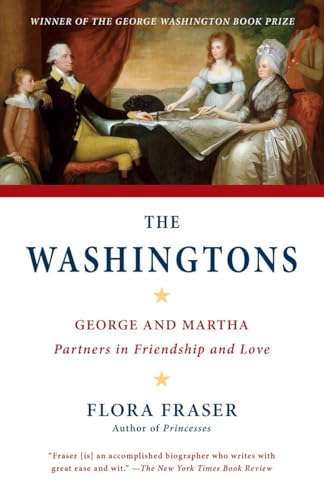
In these pages, acclaimed historian Flora Fraser unfurls the story of George and Martha, brilliantly narrating the lives of an extraordinarily dedicated, accomplished, and historic couple. When they married in colonial Virginia in 1759, he was an awkward but ambitious young officer, she, a graceful, wealthy young widow. They were devoted to one another, and George was as a father to Martha’s children by her first husband. She endowed Washington with the confidence—and resources—that would aid him when elected commander-in-chief of the Continental army. During the war, Martha resolutely supported her husband, ‘the General,’ joining him every winter in headquarters; she was essential to his well-being and was a redoubtable, vastly admired figure.
After the American victory, George was elected our first president and Martha became an impeccable first First Lady. During his presidency, the two established the tenets and traditions of our highest office. This is the story of a pioneering partnership—and an enthralling narrative of our nation’s emergence onto the world stage.
Die Inhaltsangabe kann sich auf eine andere Ausgabe dieses Titels beziehen.
Über die Autorin bzw. den Autor
Flora Fraser is author of Beloved Emma: The Life of Emma, Lady Hamilton; The Unruly Queen: The Life of Queen Caroline; Princesses: The Six Daughters of George III; and Pauline Bonaparte: Venus of Empire. The Washingtons won the George Washington Book Prize. She is chair of the Elizabeth Longford Prize for Historical Biography, established in 2003 in affectionate memory of her biographer grandmother. She lives in London.
Auszug. © Genehmigter Nachdruck. Alle Rechte vorbehalten.
1
Colonial Colonel
“no prospect of preferment”
George Washington, anxious by nature, was fractious in the spring of 1758 at Mount Vernon, his plantation home on the Potomac River in northern Virginia. Six years earlier the young man had seen his older half-brother Lawrence waste away from “decay,” as tuberculosis was then termed, and die at Mount Vernon while still in his early thirties. Now George himself had, as he wrote on March 4, 1758, to Colonel John Stanwix, a British officer serving in America and formerly his commander, “some reason to apprehend an approaching decay.” While serving with his regiment in northwestern Virginia the previous year, he had suffered for months from a “bloody flux,” or dysentery. In November he had retreated to Mount Vernon, a home that he rented from his brother’s widow. Here he dieted on medicinal jellies and brooded on his misfortunes. He wrote to Stanwix in March that his constitution was greatly injured: “nothing can retrieve it but the greatest care, and most circumspect conduct.”
To compound his dejection, as he informed Stanwix, Washington saw “no prospect of preferment”—or promotion—“in a military life.” He had served in the Virginia Regiment since it was raised in 1754, and he was now its colonel. But he had failed, like so many “provincial” or colonial officers, to win a commission in the regular British army. First settled by the Virginia Company in 1607, Virginia had come under the direct rule of James I of England in 1625. Within America the colony was often named the “Old Dominion.” It was the fifth dominion that the Crown claimed, Scotland, Ireland, and France, besides England, being the others. After the 1707 Act of Union united the English and Scottish thrones as the kingdom of Great Britain, Virginia’s seal featured the words “En Dat Virginia Quartam”—Virginia Makes a Fourth. (Ireland was to remain a separate kingdom until 1801, at which time the claim to France was finally dropped.) Twelve other colonies on the American eastern seaboard were established, the last being Georgia in 1733. New Hampshire, Massachusetts, Connecticut, and Rhode Island were known as the New England colonies. New York, with Pennsylvania and Delaware, constituted the middle colonies. Virginia and Maryland were known together as the Chesapeake colonies or, with North and South Carolina and Georgia, as the southern colonies. Britain had other colonies, too, on the Atlantic coast of America, both north and south of the thirteen colonies, as the above-named were known. Newfoundland and Nova Scotia were among those to the north; East Florida and West Florida, with other colonies in the British West Indies—notably Jamaica, Barbados, and the Bahamas—lay to the south. Meanwhile, Canada and Louisiana were part of colonial New France.
In principle, there was nothing to prevent colonial subjects from serving in the British army. In practice, the War Office in London advanced the claims of young Englishmen with “interest”—an influential patron—in the metropolis. As a result of his ill health and poor military prospects, as Washington now wrote to inform Stanwix, he meant to quit his command and retire from all public business. It was a dismal outlook for one who had turned twenty-six on February 22 of this year and who had exulted, till his recent illness, in physical strength and stamina. George had been born at Pope’s Creek, Westmoreland County, on land near that originally settled by a Washington ancestor in 1657. His birth date was February 11, 1732, according to the Julian calendar that Britain and its colonies then followed. After the Gregorian calendar was adopted in 1752, entailing a loss of eleven days in that year, Washington gave the date of his birth as the eleventh, Old Style. But he kept its anniversary on the twenty-second, New Style.
Washington’s physical strength was to become legendary later in his life. At Home House, the small plantation outside Fredericksburg, Virginia, to which his parents moved when he was young, he could pitch a stone across the wide Rappahannock River, according to “Parson” Weems. Mason Locke Weems is also author of the story that, when aged six, George swung at his father’s cherry tree with a hatchet and could not tell a lie. Though Weems published his narrative in 1800, the year after Washington’s death, the infant Hercules of myth was father of the flesh-and-blood man. George Mercer, the colonel’s aide-de-camp in the Virginia Regiment, reportedly wrote in a letter of 1760 that Washington was “straight as an Indian, measuring 6 feet 2 inches in his stockings.” His frame, according to this letter, was “padded with well developed muscles, indicating great strength.” This impression of “great strength” Washington conveyed for most of his life.
When Washington wrote to Stanwix, in the spring of 1758, both health and strength were in abeyance. Upon his arrival at Mount Vernon the previous November, he had outlined to a neighbor, Mrs. George William Fairfax of Belvoir, the regimen that a local reverend, who doubled as physician, had prescribed for him: “He forbids the use of meats, and substitutes jellies and such kind of food . . . I have no person that has been used to making these kind of things, and no directions.” George’s younger brother John Augustine, with his wife, Hannah, looked after Mount Vernon and kept house while its tenant served with his regiment. Now, in his sister-in-law’s absence, George applied to Sally Fairfax: “I find myself under a necessity of applying to you for your receipt [recipe] book for a little while, and indeed for such materials to make jellies as you think I may—not just at this time—have. For I can’t get hartshorn shavings [gelatin] anywhere.” Of hyson, or green, tea, he wrote: “I am quite out, and cannot get a supply anywhere in these parts.” He begged also a bottle or two of “mountain or canary [sweet] wine.” The Reverend Charles Green had ordered him to take a glass or two each day, mixed with “water of gum arabic.”
The bachelor colonel had been confident that Sally Fairfax, whose husband was away on business in England, would provide. Not only did the Mount Vernon lands share a border with those of Belvoir, where her father-in-law, Colonel William, had built a handsome brick mansion in the 1730s. Lawrence Washington had married William Fairfax’s daughter Ann in 1743, when she was fourteen. Furthermore, in that same year Lawrence and George’s father, Augustine Washington, had died unexpectedly at home in Fredericksburg. Over the succeeding years George—aged eleven when his father died—completed a sketchy education in Fredericksburg and spent time increasingly at Mount Vernon. At Belvoir, Colonel William took an interest in the boy, and George Washington responded with enthusiasm.
Fairfax was a man of influence as well as one with close connections to the English nobility, being cousin and land agent to Thomas, 6th Lord Fairfax of Cameron. He also served on the Governor’s Council in Williamsburg and was at one time its president. As senior colonial official in the county, besides, he commanded, with the rank of colonel, the local militia. This was the home guard composed of able-bodied men in the neighborhood, who were formally under the command of the resident royal governor, or deputizing lieutenant governor. As in other colonies, they turned out, bearing arms, a few times a year for training by an adjutant. About a quarter of...
„Über diesen Titel“ kann sich auf eine andere Ausgabe dieses Titels beziehen.
Suchergebnisse für The Washingtons: George and Martha: Partners in Friendship...

Beispielbild für diese ISBN
The Washingtons : George and Martha: Partners in Friendship and Love
Verlag:
Knopf Doubleday Publishing Group, 2016
ISBN 10: 0307474437
ISBN 13: 9780307474438
Gebraucht
Softcover
Anbieter: Better World Books, Mishawaka, IN, USA
Verkäuferbewertung 5 von 5 Sternen

Zustand: Very Good. Reprint. Former library copy. Pages intact with possible writing/highlighting. Binding strong with minor wear. Dust jackets/supplements may not be included. Includes library markings. Stock photo provided. Product includes identifying sticker. Better World Books: Buy Books. Do Good. Bestandsnummer des Verkäufers 15273123-75
Gebraucht kaufen
EUR 8,29
Versand gratis
Versand innerhalb von USA
Versand innerhalb von USA
Anzahl: 1 verfügbar
Beispielbild für diese ISBN
The Washingtons : George and Martha: Partners in Friendship and Love
Verlag:
Knopf Doubleday Publishing Group, 2016
ISBN 10: 0307474437
ISBN 13: 9780307474438
Gebraucht
Softcover
Anbieter: Better World Books, Mishawaka, IN, USA
Verkäuferbewertung 5 von 5 Sternen
Zustand: Good. Reprint. Pages intact with minimal writing/highlighting. The binding may be loose and creased. Dust jackets/supplements are not included. Stock photo provided. Product includes identifying sticker. Better World Books: Buy Books. Do Good. Bestandsnummer des Verkäufers 19203069-6
Gebraucht kaufen
EUR 8,29
Versand gratis
Versand innerhalb von USA
Versand innerhalb von USA
Anzahl: 1 verfügbar
Foto des Verkäufers
The Washingtons: George and Martha: Partners in Friendship and Love
Verlag:
Knopf Doubleday Publishing Group, 2016
ISBN 10: 0307474437
ISBN 13: 9780307474438
Gebraucht
Softcover
Anbieter: Greenworld Books, Arlington, TX, USA
Verkäuferbewertung 5 von 5 Sternen
Zustand: good. Fast Free Shipping â" Good condition. It may show normal signs of use, such as light writing, highlighting, or library markings, but all pages are intact and the book is fully readable. A solid, complete copy that's ready to enjoy. Bestandsnummer des Verkäufers GWV.0307474437.G
Gebraucht kaufen
EUR 10,63
Versand gratis
Versand innerhalb von USA
Versand innerhalb von USA
Anzahl: 1 verfügbar
Beispielbild für diese ISBN
The Washingtons: George and Martha: Partners in Friendship and Love
Verlag:
Knopf Doubleday Publishing Group, 2016
ISBN 10: 0307474437
ISBN 13: 9780307474438
Gebraucht
paperback
Anbieter: Midtown Scholar Bookstore, Harrisburg, PA, USA
Verkäuferbewertung 5 von 5 Sternen
paperback. Zustand: Very Good. Very Good paperback with light shelfwear - NICE! Standard-sized. Bestandsnummer des Verkäufers mon0000355422
Gebraucht kaufen
EUR 8,26
EUR 5,35 Versand
Versand innerhalb von USA
Versand innerhalb von USA
Anzahl: 1 verfügbar
Beispielbild für diese ISBN
The Washingtons: George and Martha: Partners in Friendship and Love
Anbieter: Wize Books USA, Davis, CA, USA
Verkäuferbewertung 5 von 5 Sternen
Soft cover. Zustand: New. Zustand des Schutzumschlags: New. New Softcover book. All books Ship NEXT DAY from Wize Books (m-f) excluding holidays, when ordered before 2 PM PST with tracking and guarantee. Bestandsnummer des Verkäufers B3297 Nx 3.4 0.4-14
Neu kaufen
EUR 13,73
EUR 4,80 Versand
Versand innerhalb von USA
Versand innerhalb von USA
Anzahl: 1 verfügbar
Beispielbild für diese ISBN
The Washingtons: George and Martha: Partners in Friendship and Love
Verlag:
Knopf Doubleday Publishing Group, 2016
ISBN 10: 0307474437
ISBN 13: 9780307474438
Neu
Softcover
Anbieter: Lakeside Books, Benton Harbor, MI, USA
Verkäuferbewertung 5 von 5 Sternen
Zustand: New. Brand New! Not Overstocks or Low Quality Book Club Editions! Direct From the Publisher! We're not a giant, faceless warehouse organization! We're a small town bookstore that loves books and loves it's customers! Buy from Lakeside Books! Bestandsnummer des Verkäufers OTF-S-9780307474438
Neu kaufen
EUR 17,54
EUR 3,56 Versand
Versand innerhalb von USA
Versand innerhalb von USA
Anzahl: Mehr als 20 verfügbar
Foto des Verkäufers
Washingtons : George and Martha: Partners in Friendship and Love
Verlag:
Knopf Doubleday Publishing Group, 2016
ISBN 10: 0307474437
ISBN 13: 9780307474438
Neu
Softcover
Anbieter: GreatBookPrices, Columbia, MD, USA
Verkäuferbewertung 5 von 5 Sternen
Zustand: New. Bestandsnummer des Verkäufers 26432224-n
Neu kaufen
EUR 18,77
EUR 2,35 Versand
Versand innerhalb von USA
Versand innerhalb von USA
Anzahl: Mehr als 20 verfügbar
Foto des Verkäufers
The Washingtons: George and Martha: Partners in Friendship and Love (Paperback or Softback)
Verlag:
Anchor Books 10/18/2016, 2016
ISBN 10: 0307474437
ISBN 13: 9780307474438
Neu
Paperback or Softback
Anbieter: BargainBookStores, Grand Rapids, MI, USA
Verkäuferbewertung 5 von 5 Sternen
Paperback or Softback. Zustand: New. The Washingtons: George and Martha: Partners in Friendship and Love. Book. Bestandsnummer des Verkäufers BBS-9780307474438
Foto des Verkäufers
Washingtons : George and Martha: Partners in Friendship and Love
Verlag:
Knopf Doubleday Publishing Group, 2016
ISBN 10: 0307474437
ISBN 13: 9780307474438
Gebraucht
Softcover
Anbieter: GreatBookPrices, Columbia, MD, USA
Verkäuferbewertung 5 von 5 Sternen
Zustand: As New. Unread book in perfect condition. Bestandsnummer des Verkäufers 26432224
Gebraucht kaufen
EUR 21,77
EUR 2,35 Versand
Versand innerhalb von USA
Versand innerhalb von USA
Anzahl: Mehr als 20 verfügbar
Foto des Verkäufers
The Washingtons (Paperback)
Verlag:
Random House USA Inc, New York, 2016
ISBN 10: 0307474437
ISBN 13: 9780307474438
Neu
Paperback
Anbieter: Grand Eagle Retail, Bensenville, IL, USA
Verkäuferbewertung 5 von 5 Sternen
Paperback. Zustand: new. Paperback. In these pages, acclaimed historian Flora Fraser unfurls the story of George and Martha, brilliantly narrating the lives of an extraordinarily dedicated, accomplished, and historic couple. When they married in colonial Virginia in 1759, he was an awkward but ambitious young officer, she, a graceful, wealthy young widow. They were devoted to one another, and George was as a father to Marthas children by her first husband. She endowed Washington with the confidenceand resourcesthat would aid him when elected commander-in-chief of the Continental army. During the war, Martha resolutely supported her husband, the General, joining him every winter in headquarters; she was essential to his well-being and was a redoubtable, vastly admired figure. After the American victory, George was elected our first president and Martha became an impeccable first First Lady. During his presidency, the two established the tenets and traditions of our highest office. This is the story of a pioneering partnershipand an enthralling narrative of our nations emergence onto the world stage. Shipping may be from multiple locations in the US or from the UK, depending on stock availability. Bestandsnummer des Verkäufers 9780307474438