
Verwandte Artikel zu The Eternal Nazi: From Mauthausen to Cairo, the Relentless...
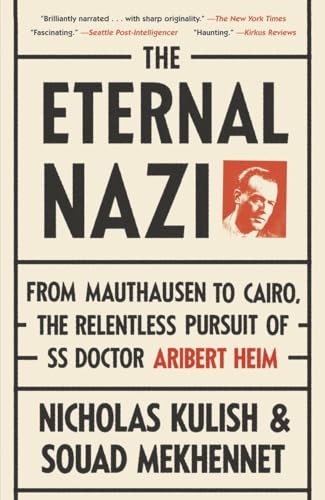
The Eternal Nazi: From Mauthausen to Cairo, the Relentless Pursuit of SS Doctor Aribert Heim - Softcover
Inhaltsangabe
The tall foreigner living on Port Said Street in a Cairo hotel lived a simple life, reading books and writing letters, known as Uncle Tarek to neighborhood children. They did not know that he was actually Aribert Heim—the concentration camp doctor and fugitive from justice who became the most wanted Nazi war criminal in the world.
Dr. Aribert Heim worked at the Mauthausen concentration camp for only a few months in 1941 but left a horrifying mark on the memories of survivors. In the chaos of the postwar period, Heim was able to slip away from his dark past. But certain rare individuals in Germany were unwilling to let Nazi war criminals go unpunished. Among them was a police investigator named Alfred Aedtner, whose quest took him across Europe and across decades, and into a close alliance with legendary Nazi hunter Simon Wiesenthal. This is the incredible story of how Aribert Heim evaded capture, living in a working-class neighborhood of the Egyptian capital, praying in Arabic, beloved by an adopted Muslim family, while inspiring a manhunt that outlived him by many years. He became the “Eternal Nazi,” a symbol of Germany’s evolving attitude toward the sins of its past, which finally crested in a desire to see justice done at almost any cost.
Die Inhaltsangabe kann sich auf eine andere Ausgabe dieses Titels beziehen.
Über die Autorin bzw. den Autor
Nicholas Kulish is a correspondent for The New York Times. He was the paper’s Berlin bureau chief from 2007 to 2013.
Souad Mekhennet is a journalist and reports for The Washington Post and ZDF German television. She is an associate at the Weatherhead Center for International Affairs at Harvard University and a fellow at Johns Hopkins School of Advanced International Studies, and she previously worked for The New York Times.
Auszug. © Genehmigter Nachdruck. Alle Rechte vorbehalten.
Chapter 1
They called it zero hour. Six years of conflict culminated with incendiary bombing raids, artillery shelling, tanks rolling through the countryside. Cities were reduced to rubble. The death and destruction Nazi Germany had visited upon the rest of Europe came home to the Reich with a vengeance. The Allies had won, but the Continent was near chaos. Europe was full of desperate souls on the move. There were caravans of displaced persons clogging the roads in every direction: forced laborers returning to Poland; prisoners of war returning to France and Britain; nearly twelve million ethnic Germans expelled from Poland, Czechoslovakia, Yugoslavia, and elsewhere, seeking refuge in Germany and Austria. Most haunting by far were the survivors of the concentration camps, who emerged from their imprisonment like walking skeletons. Soon the world realized that the crimes committed in the name of Nazi Germany went far beyond ordinary violations of the rules of war.
The Supreme Headquarters, Allied Expeditionary Force, prepared a comprehensive list of suspected war criminals. It was known as the Central Registry of War Criminals and Security Suspects, or CROWCASS. The first version of the list contained 70,000 names. By some estimates 160,000 people should have been included. The question facing the Allies was how to find and punish even those 70,000 perpetrators in the chaos of the months after Nazi capitulation. The Americans alone had to deal with some 7.7 million German military personnel in custody, including regular Wehrmacht soldiers; members of the paramilitary wing of the Nazi Party, the Sturmabteilung, or SA, which had played a key role in Hitler’s rise to power; high members of government who had enacted deadly policies; and members of Hitler’s dreaded vanguard, the Schutzstaffel, better known as the SS. Separating them proved difficult.
One clue as to who was who came from a mandatory blood-type tattoo under the left arm of all SS members. Captured soldiers were lined up and inspected for the telltale mark. But the method was not always effective. Two of the most notorious Nazi war criminals, Adolf Eichmann and Josef Mengele, were not detected. Seventeen people named Josef Mengele served in the German armed forces, and when captured, the Auschwitz doctor gave his last name as Memling, a famous Bavarian painter. He did not have the SS tattoo and claimed to be a regular doctor with the Wehrmacht. He ultimately fled custody, as did Eichmann. Neither was forced to stand in the dock for the postwar trials that began in Nuremberg.
The pursuit of war criminals was just one of the Allies’ responsibilities and not necessarily the most urgent. Germany was reeling from a total defeat rather than a negotiated surrender. People were starving, crops needed harvesting, and millions of POWs without jobs were released within months. The U.S. Third Army had released more than half a million prisoners by June 8; the Twelfth Army group freed an average of 30,000 prisoners a day. Meanwhile, the British sent home some 300,000 Germans as part of Operation Barleycorn, specifically so that they could save the harvest. That number grew to more than a million by August 1945 so that former soldiers could also work in mining and transport. There were untold tons of rubble to clear, bridges to rebuild, unexploded bombs to remove. The telecommunication network, postal service, highways, railways, and even local public transport systems had to be rebuilt.
On June 29, 1945, the Allied Supreme Headquarters issued Disbandment Directive No. 5, which authorized a general discharge of German prisoners not in “automatic arrest categories” such as SS members and war criminals. Captured soldiers were simply looked over by a doctor and given a questionnaire to fill out. Interviews were brief. If a soldier was discharged, he received half a loaf of black bread and roughly a pound of lard as rations for the journey home. With such speed and great numbers it was unavoidable that some war criminals would be among those set free.
One of the men kept in custody was Hauptsturmführer Aribert Ferdinand Heim, an Austrian doctor with the Waffen-SS, the military wing of the SS that had grown into a parallel German army. Though a prisoner, he continued to serve as a doctor, treating wounded Germans at the 8279th General Hospital, near Carentan, France, about twenty miles away from Normandy’s Omaha Beach. The hospital was actually a giant tent complex, previously an American field hospital before the United States handed it over to the Germans. When the Red Cross visited in May 1945, there were 1,417 wounded or sick soldiers there. The Red Cross inspector found the conditions to be “excellent” and said that German soldiers had even volunteered that the treatment there was better than it had been on the German side in the last few years of the war.
The tents could be hot during the day and frigid at night, but there were operating rooms, X-ray machines, and a laboratory. The facility was well stocked with surgical equipment and medicine, according to the Red Cross observer. In essence, the German doctors themselves ran the hospital, with four American officers overseeing their work. “On a professional level,” the Red Cross assessor wrote, “the cooperation between the American and the German doctors is good.” That included Heim. His American superiors were impressed with his skill and dependability. In a recommendation, the American captain Edward S. Jones wrote that Heim’s work in the surgical section “had been excellent and essential for the care of the POW patients.”
Heim struck up friendly acquaintanceships with fellow doctors and even a German pastor, Werner Ernst Linz. The pastor observed how Heim “practiced his medicinal arts in a very responsible manner for the well-being of the soldiers entrusted to him.” Dr. Heim was particularly “self-sacrificing” in treating sexually transmitted diseases, doing everything he could to help his patients, Linz wrote in a letter of recommendation.
Though he traveled widely during the war, Heim ended up right where he had begun, in France. After Germany annexed Austria in 1938, Austrians had the same duty to serve as their new compatriots. Heim insisted under questioning that he had been drafted into the Waffen-SS against his will. His first assignment after earning his medical degree in Vienna at the age of twenty-five had been as a driver during the German invasion of France in 1940. Heim assisted in the resettlement of ethnic Germans in Yugoslavia and worked on earthquake relief in Romania. He had served at the frigid northern reaches of the eastern front in Norway and Finland and been wounded in action.
Just eight days after the first American soldier crossed the Rhine on March 7, 1945, Heim’s unit was captured at Buchholz in western Germany. Heim was fortunate to find himself a prisoner of war on the American side, rather than facing a trip to Siberia courtesy of the Soviets. He was sent to the prisoner-of-war camp in France.
He was not on the CROWCASS list of wanted war criminals, but as a former member of the Waffen-SS he was in the Allied automatic arrest category, and it was not easy to secure release. Arrest and prosecution would have been certain but for an omission. For all the places Heim went over the course of the war, one post was missing from his file—through oversight or intentional removal, it was unclear—a small town in Austria called Mauthausen.
Chapter 2
Less than nine months after he was liberated from six years in concentration camps in Germany and Austria, Dr. Arthur A. Becker was in Vienna working as a special investigator for the U.S. Army’s War Crimes Investigating Team 6836. He...
„Über diesen Titel“ kann sich auf eine andere Ausgabe dieses Titels beziehen.
Suchergebnisse für The Eternal Nazi: From Mauthausen to Cairo, the Relentless...

Beispielbild für diese ISBN
The Eternal Nazi: From Mauthausen to Cairo, the Relentless Pursuit of SS Doctor Aribert Heim
Verlag:
Knopf Doubleday Publishing Group, 2014
ISBN 10: 0307475212
ISBN 13: 9780307475213
Gebraucht
Paperback
Anbieter: ThriftBooks-Atlanta, AUSTELL, GA, USA
Verkäuferbewertung 5 von 5 Sternen

Paperback. Zustand: As New. No Jacket. Pages are clean and are not marred by notes or folds of any kind. ~ ThriftBooks: Read More, Spend Less. Bestandsnummer des Verkäufers G0307475212I2N00
Gebraucht kaufen
EUR 6,39
Versand gratis
Versand innerhalb von USA
Versand innerhalb von USA
Anzahl: 1 verfügbar
Beispielbild für diese ISBN
The Eternal Nazi : From Mauthausen to Cairo, the Relentless Pursuit of SS Doctor Aribert Heim
Verlag:
Knopf Doubleday Publishing Group, 2014
ISBN 10: 0307475212
ISBN 13: 9780307475213
Gebraucht
Softcover
Anbieter: Better World Books, Mishawaka, IN, USA
Verkäuferbewertung 5 von 5 Sternen
Zustand: Good. Reprint. Pages intact with minimal writing/highlighting. The binding may be loose and creased. Dust jackets/supplements are not included. Stock photo provided. Product includes identifying sticker. Better World Books: Buy Books. Do Good. Bestandsnummer des Verkäufers 388677-6
Gebraucht kaufen
EUR 6,57
Versand gratis
Versand innerhalb von USA
Versand innerhalb von USA
Anzahl: 1 verfügbar
Beispielbild für diese ISBN
The Eternal Nazi : From Mauthausen to Cairo, the Relentless Pursuit of SS Doctor Aribert Heim
Verlag:
Knopf Doubleday Publishing Group, 2014
ISBN 10: 0307475212
ISBN 13: 9780307475213
Gebraucht
Softcover
Anbieter: Better World Books, Mishawaka, IN, USA
Verkäuferbewertung 5 von 5 Sternen
Zustand: Very Good. Reprint. Pages intact with possible writing/highlighting. Binding strong with minor wear. Dust jackets/supplements may not be included. Stock photo provided. Product includes identifying sticker. Better World Books: Buy Books. Do Good. Bestandsnummer des Verkäufers 5648968-6
Gebraucht kaufen
EUR 6,57
Versand gratis
Versand innerhalb von USA
Versand innerhalb von USA
Anzahl: 1 verfügbar
Beispielbild für diese ISBN
The Eternal Nazi: From Mauthausen to Cairo, the Relentless Pursuit of SS Doctor Aribert Heim
Anbieter: Midtown Scholar Bookstore, Harrisburg, PA, USA
Verkäuferbewertung 5 von 5 Sternen
paperback. Zustand: Good. Good paperback, bumped/creased with shelfwear; may have previous owner's name inside. Standard-sized. Bestandsnummer des Verkäufers mon0000185511
Gebraucht kaufen
EUR 2,75
EUR 5,36 Versand
Versand innerhalb von USA
Versand innerhalb von USA
Anzahl: 1 verfügbar
Beispielbild für diese ISBN
The Eternal Nazi Format: Paperback
Anbieter: INDOO, Avenel, NJ, USA
Verkäuferbewertung 5 von 5 Sternen
Zustand: New. Bestandsnummer des Verkäufers 9780307475213
Neu kaufen
EUR 15,64
Versand gratis
Versand innerhalb von USA
Versand innerhalb von USA
Anzahl: Mehr als 20 verfügbar
Foto des Verkäufers
The Eternal Nazi (Paperback)
Verlag:
Random House USA Inc, New York, 2014
ISBN 10: 0307475212
ISBN 13: 9780307475213
Neu
Paperback
Anbieter: Grand Eagle Retail, Bensenville, IL, USA
Verkäuferbewertung 5 von 5 Sternen
Paperback. Zustand: new. Paperback. The compelling story of the hunt for Aribert Heim, whose decades-long flight from justice turned a mid-level SS officer and concentration camp doctor into the most wanted Nazi war criminal in the world.The tall foreigner living on Port Said Street in a Cairo hotel lived a simple life, reading books and writing letters, known as Uncle Tarek to neighborhood children. They did not know that he was actually Aribert Heim-the concentration camp doctor and fugitive from justice who became the most wanted Nazi war criminal in the world.Dr. Aribert Heim worked at the Mauthausen concentration camp for only a few months in 1941 but left a horrifying mark on the memories of survivors. In the chaos of the postwar period, Heim was able to slip away from his dark past. But certain rare individuals in Germany were unwilling to let Nazi war criminals go unpunished. Among them was a police investigator named Alfred Aedtner, whose quest took him across Europe and across decades, and into a close alliance with legendary Nazi hunter Simon Wiesenthal. This is the incredible story of how Aribert Heim evaded capture, living in a working-class neighborhood of the Egyptian capital, praying in Arabic, beloved by an adopted Muslim family, while inspiring a manhunt that outlived him by many years. He became the "Eternal Nazi," a symbol of Germany's evolving attitude toward the sins of its past, which finally crested in a desire to see justice done at almost any cost. From Mauthausen to Cairo the Relentless Pursuit of SS Doctor Aribet Heim. The compelling story of the hunt for Aribert Heim, whose decades-long flight from justice turned a mid-level SS officer and concentration camp doctor into the most wanted Nazi war criminal in the world. Shipping may be from multiple locations in the US or from the UK, depending on stock availability. Bestandsnummer des Verkäufers 9780307475213
Beispielbild für diese ISBN
The Eternal Nazi Format: Paperback
Anbieter: INDOO, Avenel, NJ, USA
Verkäuferbewertung 5 von 5 Sternen
Zustand: As New. Unread copy in mint condition. Bestandsnummer des Verkäufers RH9780307475213
Gebraucht kaufen
EUR 15,76
Versand gratis
Versand innerhalb von USA
Versand innerhalb von USA
Anzahl: Mehr als 20 verfügbar
Foto des Verkäufers
The Eternal Nazi
Anbieter: Rarewaves USA, HEBRON, KY, USA
Verkäuferbewertung 5 von 5 Sternen
Paperback. Zustand: New. Bestandsnummer des Verkäufers LU-9780307475213
Beispielbild für diese ISBN
The Eternal Nazi: From Mauthausen to Cairo, the Relentless Pursuit of SS Doctor Aribert Heim
Anbieter: Books From California, Simi Valley, CA, USA
Verkäuferbewertung 4 von 5 Sternen

Paperback. Zustand: Good. minor wear and creasing. Bestandsnummer des Verkäufers mon0003810378
Gebraucht kaufen
EUR 11,43
EUR 4,45 Versand
Versand innerhalb von USA
Versand innerhalb von USA
Anzahl: 1 verfügbar
Beispielbild für diese ISBN
The Eternal Nazi: From Mauthausen to Cairo, the Relentless Pursuit of SS Doctor Aribert Heim
Anbieter: Massive Bookshop, Erving, MA, USA
Verkäuferbewertung 4 von 5 Sternen
Paperback. Zustand: New. Bestandsnummer des Verkäufers 9780307475213
Neu kaufen
EUR 16,55
EUR 4,24 Versand
Versand innerhalb von USA
Versand innerhalb von USA
Anzahl: 10 verfügbar