
Verwandte Artikel zu Brain Candy: Science, Paradoxes, Puzzles, Logic, and...
Inhaltsangabe
Feed Your Brain
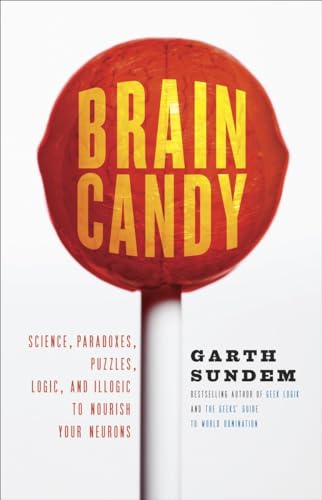
Tastier than a twizzler yet more protein-packed than a spinach smoothie, Brain Candy is guaranteed to entertain your brain—even as it reveals hundreds of secrets behind what’s driving that electric noodle inside your skull.
These delicious and nutritious pages are packed with bits of bite-sized goodness swiped from the bleeding edge of brain science (including the reason why reading these words is changing your hippocampus at this very moment!) Shelved alongside these succulent neurological nuggets are challenging puzzles and paradoxes, eye-opening perception tests and hacks, fiendish personality quizzes and genius testers, and a grab bag of recurring treats including Eye Hacks, Algebraic Eight Ball, iDread, Wild Kingdom, and Logic of Illogic.
Should you look between these covers and inhale the deliciously cherry-flavored scents of knowledge within, you will grow your grey matter while discovering:
• Why you should be writing bad poetry
• The simple keys to brain training
• What trust smells like
• The origins of human morality
• Why expensive wine always tastes better
• The truth about brain sweat
• How your diet might be making you dumb
• The secrets of game theory
• Why economists hate psychology
• The mental benefits of coffee and cigarettes
• How to really spot a liar
• Why you can’t make me eat pie
• The benefits of daydreaming
• Four simple secrets to persuasion
• Why your barin’s fzzuy ligoc alowls you to raed this
• How to brainwash friends and family
• The science of body language
• What pigeons know about art
…And much, much more.
Die Inhaltsangabe kann sich auf eine andere Ausgabe dieses Titels beziehen.
Über die Autorin bzw. den Autor
GARTH SUNDEM is the bestselling author of Geeks’ Guide to World Domination and Geek Logik. He and his wife live in California with their two kids and a large Labrador.
Auszug. © Genehmigter Nachdruck. Alle Rechte vorbehalten.
COUNTRY MUSIC KILLS
Does country music make you want to grab a lariat and hang yourself from the nearest old elm tree? If so, you're not alone. Social psychologists Steven Stack and Jim Gundlach found that the more a city's radio stations play country music, the higher the white suicide rate.
Seriously.
Theirs was a big study, encompassing forty-nine metropolitan areas, and was careful to control for factors like Southernness, poverty, divorce, and gun availability. In other words, all else equal, country music kills. This was especially true when country music represented a city's sub- rather than its mainstream culture.
COOL NEUROSURGERY PAST AND PRESENT: TREPANATION THROUGH TIME
Today, trepanation, or drilling a hole in the head, is commonly used to release the pressure of swelling inside the skull. Throughout history, it's been used to treat epilepsy, migraines, mood disorders, and pretty much any other head condition that seemed to surgeons of the time as if it could be improved by seeing the light of day.
SELF-TREPANATION
In the autobiographical book Bore Hole, Joey Mellen describes his attempts at self-trepanation. Attempts numbers one and two are unsuccessful, resulting in hospital visits and psychiatric evaluations, but no hole. He writes the following of his third attempt: "After some time there was an ominous sounding schlurp and the sound of bubbling. I drew the trepan out and the gurgling continued. It sounded like air bubbles running under the skull as they were pressed out. I looked at the trepan and there was a bit of bone in it. At last!"
Later, Mellen filmed the self-trepanation of his girlfriend, Amanda Feilding, for a film they called Heartbeat in the Brain.
Note: While it certainly sounds fun, most doctors recommend against self-trepanation.
INTRO TO GAME THEORY: PRISONER'S DILEMMA
Game theory was developed by big-brained people attempting world domination. For their efforts, they earned Nobel Prizes and a screaming throng of teenage fans à la mid-1960s Beatles. (OK, maybe just the first, but it's worth picturing hysterical fans throwing underwear while chanting Nash! Nash! Nash!)
Basically, game theory attempts to explain how people act in competitive or collaborative situations. And, more usefully in pursuit of said world domination, it also attempts to define your best strategy in light of your opponents' likely actions.
Take, for example, this oldie but goody drawn from the hallowed halls of game theory (1950, Merrill Flood and Albert W. Tucker):
Two suspects are arrested. The police have insufficient evidence for a conviction, and, having separated the prisoners, visit each of them to offer the same deal. If one testifies for the prosecution against the other and the other remains silent, the betrayer goes free and the silent accomplice receives the full ten-year sentence. If both remain silent, both prisoners are sentenced to only six months in jail for a minor charge. If each betrays the other, each receives a five-year sentence. Each prisoner must choose to betray the other or to remain silent. Each one is assured that the other would not know about the betrayal before the end of the investigation. How should the prisoners act?
Check the back of this book for the answer-it's as good as the puzzle itself.
SOCIAL CONTAGION: HAPPINESS AND OBESITY ARE CATCHING
Social scientists Nicholas Christakis and James Fowler followed about two-thirds of the residents of Framingham, Massachusetts, as they got happy, sad, fit, and obese, and started or quit smoking. And they asked these couple-thousand residents about their friends: who did they hang out with? Now imagine a diagram showing a huge net of people who know people. Within this net, the scientists found clusters of obesity, happiness, and smoking. In other words, if your friends are happy, you're happy, and if your friends are obese, you're likely to be too.
That's pretty intuitive: like attracts like.
But what's interesting is that Christakis and Fowler watched these patterns change: if your slender friend puts on a couple pounds, you're likely to put on a couple pounds too. And so happiness, obesity, and smoking pass through a population like a contagious virus.
What's your risk of infection? Well, the data from Framingham show that if a friend becomes obese, you're 57 percent more likely to become obese too. And you're at risk even if a friend of a friend gains weight-in fact, you're exactly 20 percent more likely to gain weight too (but only when measured against friends of the same gender). The good doctors measured alcohol consumption too, and found that a man changing his drinking habits has little effect on his friends, but that when a woman starts to drink more, both her male and female friends will drink more, themselves.
So why gamble on your friends' behaviors? Why not hole up in a cabin in Montana where your happiness is self-sufficient? It turns out that happiness is more catching than sadness. Specifically, a happy friend boots your mood by 9 percent, while an unhappy friend lowers it by 7 percent. As long as you're not specifically picking unhappy friends, the happiness gamble of extending your social network as widely as possible should pay off.
You can read much more about social contagion in the duo's very cool book, Connected: The Surprising Power of Our Social Networks and How They Shape Our Lives.
TOO DUMB TO KNOW IT
To be blunt, it's possible to be so dumb that you're unaware of your own idiocy (look to the left, look to the right . . . you get the point; that is, unless you're dumb). Put another way, many dumb people think they're smart. This, of course, is dumb.
How dumb are they? (Insert punch line here.)
In the classic study of overconfident idiots, Justin Kruger and David Dunning of Cornell University found that subjects scoring in the lowest quartile on tests of humor, grammar, and logic were also the most faulty in their self-assessments, predicting they would score in the 62nd percentile, when in fact they scored in the 12th.
Photocopy. Cut. And post this near your office watercooler.
SMARTER EVERY DAY
IQ is supposedly an objective measure of innate intelligence. It's how smart you are.
Period.
But then why is humanity's IQ increasing? Are our brains getting better? Our blossoming genius is so profound that every twenty years or so we need a new, harder IQ test just to keep up. (The average person from the year 1900 would score near 70 on today's test, or on the edge of profound mental retardation.)
People have suggested that this phenomenon is created by better diets, improved schooling, smaller families, or more liberal child-rearing techniques.
But is there something else going on here?
It turns out that only specific parts of the IQ test show significant increases: modern humans are better than our forebears at spotting abstract patterns and at reordering scrambled pictures, but we are no better than Jefferson, Washington, and Abigail Adams at memorizing sequences of numbers, and our scores for vocabulary and general knowledge are similar.
It turns out the question of increasing IQ is one of priorities and not one of intelligence. While modern humans place value on spotting abstract patterns and connecting widely disparate ideas, our ancestors thought abstract reasoning was silly, preferring a "show me the corn" focus on concrete reasoning.
And so researchers watch with interest today's shifting priorities. Specifically, we increasingly devalue the ability to store information. No longer does schooling focus on memorizing dates and places and the Declaration of Independence. To a large degree, we've off-loaded the storage function of our brains to Google. If we can so easily get...
„Über diesen Titel“ kann sich auf eine andere Ausgabe dieses Titels beziehen.
Suchergebnisse für Brain Candy: Science, Paradoxes, Puzzles, Logic, and...

Beispielbild für diese ISBN
Brain Candy: Science, Paradoxes, Puzzles, Logic, and Illogic to Nourish Your Neurons
Anbieter: Orion Tech, Kingwood, TX, USA
Verkäuferbewertung 5 von 5 Sternen

Paperback. Zustand: Good. Bestandsnummer des Verkäufers 0307588033-3-18413750
Gebraucht kaufen
EUR 3,67
Versand gratis
Versand innerhalb von USA
Versand innerhalb von USA
Anzahl: 1 verfügbar
Beispielbild für diese ISBN
Brain Candy: Science, Paradoxes, Puzzles, Logic, and Illogic to Nourish Your Neurons
Anbieter: World of Books (was SecondSale), Montgomery, IL, USA
Verkäuferbewertung 5 von 5 Sternen
Zustand: Acceptable. Item in acceptable condition! Textbooks may not include supplemental items i.e. CDs, access codes etc. Bestandsnummer des Verkäufers 00107493015
Gebraucht kaufen
EUR 3,68
Versand gratis
Versand innerhalb von USA
Versand innerhalb von USA
Anzahl: 1 verfügbar
Beispielbild für diese ISBN
Brain Candy: Science, Paradoxes, Puzzles, Logic, and Illogic to Nourish Your Neurons
Anbieter: World of Books (was SecondSale), Montgomery, IL, USA
Verkäuferbewertung 5 von 5 Sternen
Zustand: Good. Item in good condition. Textbooks may not include supplemental items i.e. CDs, access codes etc. Bestandsnummer des Verkäufers 00104678156
Gebraucht kaufen
EUR 3,68
Versand gratis
Versand innerhalb von USA
Versand innerhalb von USA
Anzahl: 2 verfügbar
Beispielbild für diese ISBN
Brain Candy: Science, Paradoxes, Puzzles, Logic, and Illogic to Nourish Your Neurons
Anbieter: World of Books (was SecondSale), Montgomery, IL, USA
Verkäuferbewertung 5 von 5 Sternen
Zustand: Very Good. Item in very good condition! Textbooks may not include supplemental items i.e. CDs, access codes etc. Bestandsnummer des Verkäufers 00108381973
Gebraucht kaufen
EUR 3,68
Versand gratis
Versand innerhalb von USA
Versand innerhalb von USA
Anzahl: 1 verfügbar
Foto des Verkäufers
Brain Candy: Science, Paradoxes, Puzzles, Logic, and Illogic to Nourish Your Neurons
Anbieter: Zoom Books East, Glendale Heights, IL, USA
Verkäuferbewertung 5 von 5 Sternen
Zustand: very_good. Book is in very good condition and may include minimal underlining highlighting. The book can also include "From the library of" labels. May not contain miscellaneous items toys, dvds, etc. . We offer 100% money back guarantee and 24 7 customer service. Bestandsnummer des Verkäufers ZEV.0307588033.VG
Gebraucht kaufen
EUR 3,96
Versand gratis
Versand innerhalb von USA
Versand innerhalb von USA
Anzahl: 1 verfügbar
Foto des Verkäufers
Brain Candy: Science, Paradoxes, Puzzles, Logic, and Illogic to Nourish Your Neurons
Anbieter: Greenworld Books, Arlington, TX, USA
Verkäuferbewertung 5 von 5 Sternen
Zustand: good. Fast Free Shipping â" Good condition. It may show normal signs of use, such as light writing, highlighting, or library markings, but all pages are intact and the book is fully readable. A solid, complete copy that's ready to enjoy. Bestandsnummer des Verkäufers GWV.0307588033.G
Gebraucht kaufen
EUR 4,42
Versand gratis
Versand innerhalb von USA
Versand innerhalb von USA
Anzahl: 1 verfügbar
Beispielbild für diese ISBN
Brain Candy: Science, Paradoxes, Puzzles, Logic, and Illogic to Nourish Your Neurons
Anbieter: BooksRun, Philadelphia, PA, USA
Verkäuferbewertung 5 von 5 Sternen
Paperback. Zustand: Very Good. 1. It's a well-cared-for item that has seen limited use. The item may show minor signs of wear. All the text is legible, with all pages included. It may have slight markings and/or highlighting. Bestandsnummer des Verkäufers 0307588033-11-1
Gebraucht kaufen
EUR 4,43
Versand gratis
Versand innerhalb von USA
Versand innerhalb von USA
Anzahl: 1 verfügbar
Beispielbild für diese ISBN
Brain Candy: Science, Paradoxes, Puzzles, Logic, and Illogic to Nourish Your Neurons
Anbieter: World of Books Inc, Montgomery, IL, USA
Verkäuferbewertung 4 von 5 Sternen

Paperback. Zustand: Good. Feed Your Brain Tastier than a twizzler yet more protein-packed than a spinach smoothie, Brain Candy is guaranteed to entertain your brain--even as it reveals hundreds of secrets behind what's driving that electric noodle inside your skull. These delicious and nutritious pages are packed with bits of bite-sized goodness swiped from the bleeding edge of brain science (including the reason why reading these words is changing your hippocampus at this very moment!) Shelved alongside these succulent neurological nuggets are challenging puzzles and paradoxes, eye-opening perception tests and hacks, fiendish personality quizzes and genius testers, and a grab bag of recurring treats including Eye Hacks, Algebraic Eight Ball, iDread, Wild Kingdom, and Logic of Illogic. Should you look between these covers and inhale the deliciously cherry-flavored scents of knowledge within, you will grow your grey matter while discovering: * Why you should be writing bad poetry * The simple keys to brain training * What trust smells like * The origins of human morality * Why expensive wine always tastes better * The truth about brain sweat * How your diet might be making you dumb * The secrets of game theory * Why economists hate psychology * The mental benefits of coffee and cigarettes * How to really spot a liar * Why you can't make me eat pie * The benefits of daydreaming * Four simple secrets to persuasion * Why your barin's fzzuy ligoc alowls you to raed this * How to brainwash friends and family * The science of body language * What pigeons know about art .And much, much more. Bestandsnummer des Verkäufers CIN0307588033G
Gebraucht kaufen
EUR 5,48
Versand gratis
Versand innerhalb von USA
Versand innerhalb von USA
Anzahl: 3 verfügbar
Beispielbild für diese ISBN
Brain Candy: Science, Paradoxes, Puzzles, Logic, and Illogic to Nourish Your Neurons
Anbieter: World of Books Inc, Montgomery, IL, USA
Verkäuferbewertung 4 von 5 Sternen
Paperback. Zustand: Very Good. Feed Your Brain Tastier than a twizzler yet more protein-packed than a spinach smoothie, Brain Candy is guaranteed to entertain your brain--even as it reveals hundreds of secrets behind what's driving that electric noodle inside your skull. These delicious and nutritious pages are packed with bits of bite-sized goodness swiped from the bleeding edge of brain science (including the reason why reading these words is changing your hippocampus at this very moment!) Shelved alongside these succulent neurological nuggets are challenging puzzles and paradoxes, eye-opening perception tests and hacks, fiendish personality quizzes and genius testers, and a grab bag of recurring treats including Eye Hacks, Algebraic Eight Ball, iDread, Wild Kingdom, and Logic of Illogic. Should you look between these covers and inhale the deliciously cherry-flavored scents of knowledge within, you will grow your grey matter while discovering: * Why you should be writing bad poetry * The simple keys to brain training * What trust smells like * The origins of human morality * Why expensive wine always tastes better * The truth about brain sweat * How your diet might be making you dumb * The secrets of game theory * Why economists hate psychology * The mental benefits of coffee and cigarettes * How to really spot a liar * Why you can't make me eat pie * The benefits of daydreaming * Four simple secrets to persuasion * Why your barin's fzzuy ligoc alowls you to raed this * How to brainwash friends and family * The science of body language * What pigeons know about art .And much, much more. Bestandsnummer des Verkäufers CIN0307588033VG
Gebraucht kaufen
EUR 5,48
Versand gratis
Versand innerhalb von USA
Versand innerhalb von USA
Anzahl: 1 verfügbar
Beispielbild für diese ISBN
Brain Candy: Science, Paradoxes, Puzzles, Logic, and Illogic to Nourish Your Neurons
Anbieter: HPB Inc., Dallas, TX, USA
Verkäuferbewertung 5 von 5 Sternen
paperback. Zustand: Very Good. Connecting readers with great books since 1972! Used books may not include companion materials, and may have some shelf wear or limited writing. We ship orders daily and Customer Service is our top priority! Bestandsnummer des Verkäufers S_470754565
Gebraucht kaufen
EUR 2,69
EUR 3,26 Versand
Versand innerhalb von USA
Versand innerhalb von USA
Anzahl: 1 verfügbar