
Verwandte Artikel zu Deeper Than Words: Living the Apostles' Creed
Inhaltsangabe
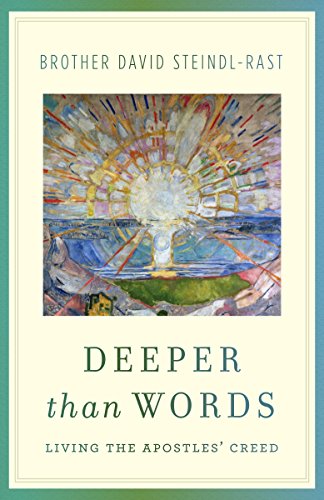
Spiritual teacher and bridge-builder Brother David Steindl-Rast translates the Apostles' Creed for today, uncovering the deeper universal truths that can be an inspiration to all people.
In Deeper than Words: Living the Apostles’ Creed, Brother David reexamines the words with which the early followers of Jesus summarized their faith. Reading line-by-line with an open perspective, he reveals the often overlooked message of trust, compassion, peace, love, and awareness contained in this widely known but rarely examined statement.
Deeper than Words moves beyond ritual and exclusivity and instead finds a deeper faith based in real human experience and the sense of limitless belonging that is shared by all people who seek to understand themselves and the world. The words of the Apostles' Creed are Christian, but its heart is a universal and timeless guide to fullness of life. From this transformation perspective, developed over a lifetime of contemplation, Brother David presents a powerful call to renewal through reconnection with the spiritual and a reawakening to shared sacred truths.
Die Inhaltsangabe kann sich auf eine andere Ausgabe dieses Titels beziehen.
Über die Autorin bzw. den Autor
BROTHER DAVID STEINDL-RAST (b. 1926) was born in Austria and came to the United States after receiving his Ph.D. in Psychology from the University of Vienna. As a member of the Benedictine Order of Catholic monks, he is known for pioneering work in interfaith dialog, especially between Christianity and Buddhism, for his promotion of the spiritual practice of gratefulness, and for his efforts to revitalize contemplative prayer life. For decades, Brother David has divided his time between periods of hermit's life and extensive lecture and retreat tours on five continents. He is author of numerous books, including the classics of spirituality Gratefulness, the Heart of Prayer and A Listening Heart, and he is the co-founder of A Network for Grateful Living, an organization dedicated to gratefulness as a transformative influence for individuals and society. Audio and video recordings of Brother David can be found at www.gratefulness.org, a website viewed by over twenty thousand visitors per day.
Auszug. © Genehmigter Nachdruck. Alle Rechte vorbehalten.
I Believe
What does this really mean?
The original version of the Creed begins with the word credo, from which the English word creed derives. The single word credo is translated by two English words, i believe. We shall take a closer look at the Latin word in the next section. Here we focuson the meaning of the "I" that speaks in the Creed. Who is that "I"?
Only when they are joined together in the phrase i believe do these two words reveal their full meaning. They define each other, as it were. When the "I" that speaks here "believes," this means infinitely more than accepting an unproven proposition aslikely; it is rather an expression of unconditional trust. Only when we know that this is what believing means can we understand which "I" is speaking here; and only this "I," in turn, can believe, in the full sense of believing. Only an "I" brave enough forthe radical confidence of unconditional trust can be our true Self. Our little ego--which we often mean when we say "I"--is incapable of the courageous trust of faith. Why? Because the opposite of faith as trust is not doubt but fearfulness, and our ego thriveson fear. The ego owes its very existence to the illusion of being separated from the whole--little me against the rest of the world. No wonder it feels isolated, insecure, and threatened. Our true Self is securely embedded in the whole of being. What couldit possibly fear? It trusts.
By saying I BELIEVE, giving both words of this phrase their full weight, we blow the sham of the ego to pieces and enter into an altogether new reality. We give expression to what it means to be fully human.
Let me express this in a somewhat whimsical image: Little X enters a little church--all perfectly harmless and uneventful. But then comes the time to recite the Creed, and Little X says, "i believe." Suddenly--for eyes focused on a deeper reality--roofand steeple of the church fly off, the walls crumble, time and space are suspended. All that is left is the one, all-embracing human Self in the eternal Now.
The Creed speaks in the language of the Christian religion, but also in the voice of a spirituality that lies deeper than any particular tradition. The I that says "i believe" is our true Self, the one authentic Self all humans have in common.
How do we know this is so?
"Know thyself!" reads the inscription above the entrance to Apollo's temple at Delphi, site of the famous oracle. But the ancient Greeks were not alone in this admonition of the key to wisdom. Any human being who reaches a certain stage of awareness isconfronted with the challenge of self-knowledge. And as soon as we embark on the journey of self-exploration, we discover the distinction between the self we observe and a bigger Self that does the observing. We need not elaborate here on the implications.Reliable guidance to self-knowledge is readily available today, say, in the books of Eckhard Tolle or through Gempo Roshi's Big Mind Process. In our context here, we need only pay attention to two facts:
1. Self-observation shows us how deeply we are entangled in what we have called the ego. We can't even stop our own thoughts or the torrent of stories by which the ego keeps up the illusion of being an independent entity. 2. The more we learn to live in the now, the more we will discover the Self. As simple a practice as being alert to the opportunity each moment offers us--opportunity to breathe, to enjoy, to learn--will make us more and more at home in that Self whichis one with all. There we experience no fear and can smile at the efforts of the ego to perpetuate itself.
Greek statues typically have a support leg and a free leg. Beginners in self-awareness stand with their support leg firmly in their ego consciousness. The goal of spiritual training is to shift our weight until the center of gravity rests in the true Self--ourBuddha nature, as Buddhists would say; other traditions use other expressions. Saint Paul writes, "I live, yet no longer I, but Christ lives in me" (Galatians 2:20).
Try to feel your way inside toward that core of yourself where you are the Watcher who is notyour thoughts but can watch them. This going-inward unveils your Self to yourself--your Christself. The more we identify with this reality, the more we become uniquely ourselves and, at the same time, one with all others. Only this Self can "believe" in thefull sense; only our true Self can trust unconditionally.
This is the reason that the Creed, although it is a community's declaration, does not begin with the word we but with I. This quintessential human Self--Purusha in Hindu mythology, IItoi (the Man in the Maze) in the myths of the Tohono O'Odham in Arizona,the Cosmic Christ, to give but three of many names--speaks in me and through me, because this is who I truly am.
Why make such a point of this?
If we understand the first two words of the Creed correctly, we know what "believing" means and which "I" is speaking here. This turns out to show that the Creed is not what most people think it is. Usually it is taken to be a proclamation of beliefs bywhich Christians distinguish themselves from all others. Rightly understood, however, it is the expression of a faith shared by all who find and acknowledge their true Self--and there is no other faith. What people call different faiths are merely differentbelief systems, different expressions of the one universal attitude of existential faith. Far from affirming differences between "us" and "the others," the Creed takes the sting out of these distinctions. It proclaims, in the language and imagery of the Christiantradition, a faith that is common to all human beings. Its very first word stands for that Self to which all spiritual traditions point the way.
Every one of these traditions is, as it were, a different door leading to the same sanctuary. The more we find the way to this inner sacred space and become at home there, the more freely will we be able to go in and out through the different doors. Wewill no longer be blocked by what seems strange to us, nor will we cling to what is familiar. Common Sense tells us how vital such an understanding is in a world still torn by wars of religion. There are still people who apparently think that one can becomea better Christian at the expense of being fully human--truly humane. Anyone who puts Christian ideology above the concern for human beings could serve as an example for this incorrect understanding. Thus, what could be more urgent than to realize that theChristian profession of faith makes full humanness its cornerstone? Since it is the quintessential human who speaks in the Creed, we will apply this insight to the text as a whole and find what each of its statements means in universal terms. Actually, if you just said i believe, and really knew what you meant by it, allthat the Creed spells out would be summed up in that one phrase.
Personal reflections
Nothing is more difficult than to believe--truly to believe--in the love of another human being. Nothing is more natural than love, yet nothing is more unbelievable. That your friend loves you goes without saying, yet, for that very reason, saying so mustultimately remain unconvincing. More is needed. But what is this "more"? It is the trust--the faith--that must be supplied by the one who receives love.
My first experience of all this started as a childhood game, a staring contest with my cousin. We invented this game (or...
„Über diesen Titel“ kann sich auf eine andere Ausgabe dieses Titels beziehen.
Suchergebnisse für Deeper Than Words: Living the Apostles' Creed

Beispielbild für diese ISBN
Deeper Than Words: Living the Apostles' Creed
Verlag:
PRH Christian Publishing, 2010
ISBN 10: 0307589617
ISBN 13: 9780307589613
Gebraucht
Softcover
Anbieter: World of Books (was SecondSale), Montgomery, IL, USA
Verkäuferbewertung 5 von 5 Sternen

Zustand: Good. Item in good condition and has highlighting/writing on text. Used texts may not contain supplemental items such as CDs, info-trac etc. Bestandsnummer des Verkäufers 00103941264
Gebraucht kaufen
EUR 4,41
Versand gratis
Versand innerhalb von USA
Versand innerhalb von USA
Anzahl: 1 verfügbar
Beispielbild für diese ISBN
Deeper Than Words: Living the Apostles' Creed
Verlag:
PRH Christian Publishing, 2010
ISBN 10: 0307589617
ISBN 13: 9780307589613
Gebraucht
Softcover
Anbieter: World of Books (was SecondSale), Montgomery, IL, USA
Verkäuferbewertung 5 von 5 Sternen
Zustand: Good. Item in good condition. Textbooks may not include supplemental items i.e. CDs, access codes etc. Bestandsnummer des Verkäufers 00094199056
Gebraucht kaufen
EUR 4,41
Versand gratis
Versand innerhalb von USA
Versand innerhalb von USA
Anzahl: 3 verfügbar
Foto des Verkäufers
Deeper Than Words: Living the Apostles' Creed
Verlag:
PRH Christian Publishing, 2010
ISBN 10: 0307589617
ISBN 13: 9780307589613
Gebraucht
Softcover
Anbieter: Greenworld Books, Arlington, TX, USA
Verkäuferbewertung 5 von 5 Sternen
Zustand: good. Fast Free Shipping â" Good condition. It may show normal signs of use, such as light writing, highlighting, or library markings, but all pages are intact and the book is fully readable. A solid, complete copy that's ready to enjoy. Bestandsnummer des Verkäufers GWV.0307589617.G
Gebraucht kaufen
EUR 4,41
Versand gratis
Versand innerhalb von USA
Versand innerhalb von USA
Anzahl: 1 verfügbar
Beispielbild für diese ISBN
Deeper Than Words: Living the Apostles' Creed
Verlag:
PRH Christian Publishing, 2010
ISBN 10: 0307589617
ISBN 13: 9780307589613
Gebraucht
paperback
Anbieter: Evergreen Goodwill, Seattle, WA, USA
Verkäuferbewertung 5 von 5 Sternen
paperback. Zustand: Good. Bestandsnummer des Verkäufers mon0000749066
Gebraucht kaufen
EUR 1,42
EUR 3,47 Versand
Versand innerhalb von USA
Versand innerhalb von USA
Anzahl: 1 verfügbar
Beispielbild für diese ISBN
Deeper Than Words: Living the Apostles' Creed
Verlag:
PRH Christian Publishing, 2010
ISBN 10: 0307589617
ISBN 13: 9780307589613
Gebraucht
Softcover
Anbieter: More Than Words, Waltham, MA, USA
Verkäuferbewertung 5 von 5 Sternen
Zustand: Very Good. A bright, square, and overall a nice copy. Bestandsnummer des Verkäufers BOS-U-13g-01392
Gebraucht kaufen
EUR 2,03
EUR 3,47 Versand
Versand innerhalb von USA
Versand innerhalb von USA
Anzahl: 1 verfügbar
Beispielbild für diese ISBN
Deeper Than Words: Living the Apostles' Creed
Anbieter: World of Books Inc, Montgomery, IL, USA
Verkäuferbewertung 2 von 5 Sternen

Paperback. Zustand: Good. Spiritual teacher and bridge-builder Brother David Steindl-Rast translates the Apostles' Creed for today, uncovering the deeper universal truths that can be an inspiration to all people. In Deeper than Words: Living the Apostles Creed, Brother David reexamines the words with which the early followers of Jesus summarized their faith. Reading line-by-line with an open perspective, he reveals the often overlooked message of trust, compassion, peace, love, and awareness contained in this widely known but rarely examined statement. Deeper than Words moves beyond ritual and exclusivity and instead finds a deeper faith based in real human experience and the sense of limitless belonging that is shared by all people who seek to understand themselves and the world. The words of the Apostles' Creed are Christian, but its heart is a universal and timeless guide to fullness of life. From this transformation perspective, developed over a lifetime of contemplation, Brother David presents a powerful call to renewal through reconnection with the spiritual and a reawakening to shared sacred truths. Bestandsnummer des Verkäufers CIN0307589617G
Gebraucht kaufen
EUR 6,20
Versand gratis
Versand innerhalb von USA
Versand innerhalb von USA
Anzahl: 4 verfügbar
Beispielbild für diese ISBN
Deeper Than Words: Living the Apostles' Creed
Verlag:
Prh Christian Publishing, 2010
ISBN 10: 0307589617
ISBN 13: 9780307589613
Gebraucht
Paperback
Anbieter: ThriftBooks-Reno, Reno, NV, USA
Verkäuferbewertung 5 von 5 Sternen
Paperback. Zustand: Good. No Jacket. Pages can have notes/highlighting. Spine may show signs of wear. ~ ThriftBooks: Read More, Spend Less. Bestandsnummer des Verkäufers G0307589617I3N00
Gebraucht kaufen
EUR 6,30
Versand gratis
Versand innerhalb von USA
Versand innerhalb von USA
Anzahl: 1 verfügbar
Beispielbild für diese ISBN
Deeper Than Words: Living the Apostles' Creed
Verlag:
Prh Christian Publishing, 2010
ISBN 10: 0307589617
ISBN 13: 9780307589613
Gebraucht
Paperback
Anbieter: ThriftBooks-Atlanta, AUSTELL, GA, USA
Verkäuferbewertung 5 von 5 Sternen
Paperback. Zustand: Good. No Jacket. Pages can have notes/highlighting. Spine may show signs of wear. ~ ThriftBooks: Read More, Spend Less. Bestandsnummer des Verkäufers G0307589617I3N00
Gebraucht kaufen
EUR 6,30
Versand gratis
Versand innerhalb von USA
Versand innerhalb von USA
Anzahl: 1 verfügbar
Beispielbild für diese ISBN
Deeper Than Words: Living the Apostles' Creed
Verlag:
Prh Christian Publishing, 2010
ISBN 10: 0307589617
ISBN 13: 9780307589613
Gebraucht
Paperback
Anbieter: ThriftBooks-Phoenix, Phoenix, AZ, USA
Verkäuferbewertung 5 von 5 Sternen
Paperback. Zustand: Good. No Jacket. Pages can have notes/highlighting. Spine may show signs of wear. ~ ThriftBooks: Read More, Spend Less. Bestandsnummer des Verkäufers G0307589617I3N00
Gebraucht kaufen
EUR 6,30
Versand gratis
Versand innerhalb von USA
Versand innerhalb von USA
Anzahl: 1 verfügbar
Beispielbild für diese ISBN
Deeper Than Words: Living the Apostles' Creed
Verlag:
Prh Christian Publishing, 2010
ISBN 10: 0307589617
ISBN 13: 9780307589613
Gebraucht
Paperback
Anbieter: ThriftBooks-Dallas, Dallas, TX, USA
Verkäuferbewertung 5 von 5 Sternen
Paperback. Zustand: Good. No Jacket. Pages can have notes/highlighting. Spine may show signs of wear. ~ ThriftBooks: Read More, Spend Less. Bestandsnummer des Verkäufers G0307589617I3N00
Gebraucht kaufen
EUR 6,30
Versand gratis
Versand innerhalb von USA
Versand innerhalb von USA
Anzahl: 1 verfügbar