
Pray for Me: The Life and Spiritual Vision of Pope Francis, First Pope from the Americas - Hardcover
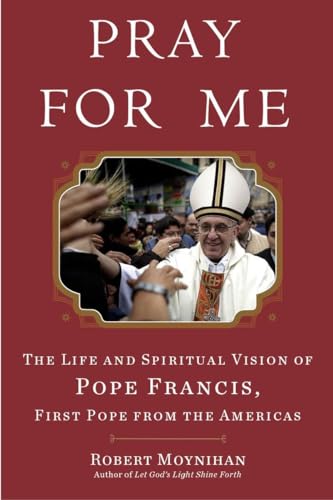
Inhaltsangabe
From the founder and editor of Inside the Vatican magazine, the world's most well-informed, comprehensive monthly on the Roman Catholic Church, comes this enlightening introduction to the life and spiritual teachings of Jorge Mario Bergoglio, now Pope Francis, the first Pope of the Americas.
On March, 13, 2013, 115 Cardinals elected for the first time a Pope from outside of Europe. Pope Francis, a native of Argentina, is not just the first Pope from the Southern Hemisphere, he is also the first Jesuit to ever hold the Chair of Peter. This means a bridging of the Northern and Southern hemispheres and religious traditions in a way we've never seen before, signifying a new global vision for the 1.2 billion people who call themselves Catholic.
Now a leading expert on the papacy provides the ultimate introduction to this new Pope, including biographical information and an absorbing collection of Jorge Mario Bergoglio most persuasive words.
Die Inhaltsangabe kann sich auf eine andere Ausgabe dieses Titels beziehen.
Über die Autorin bzw. den Autor
DR. ROBERT MOYNIHAN is founder and editor of Inside the Vatican magazine, a monthly journal on Church and world affairs from Rome. He is regarded as one of the world's leading Vatican analysts.He received his Ph.D. in medieval studies from Yale University and divides his time between Rome and Front Royal, Virginia.
Auszug. © Genehmigter Nachdruck. Alle Rechte vorbehalten.
Chapter 1
The Head and the Heart
Pray for me.
-Pope Francis, March 13, 2013, from the balcony of
St. Peter's Basilica immediately after his election
The initial silence of the new pope struck all who saw him. And during those moments, as Pope Francis stood there smiling, seeming almost awkward, the world formed its first, and inevitably lasting, impression of the new bishop of Rome. It was a good impression. In his silence, Francis seemed to express a modesty, a humility, that the crowd below appreciated. Still, they desired to know him better, to understand who he was and what he intended to do.
But, for a moment, that desire was frustrated by the new pope's evident desire to remain "hidden" for just a little while longer, though the cameras of the world were trained upon him. And in that tension between words and silence, between a desire to know and a wish to remain hid- den, a bond was formed between Francis and the people of St. Peter's Square.
How such things happen is not easy to explain. But be- fore he said anything at all, the people had already begun to understand him, and to appreciate him. In his silence, in his modesty, in what appeared to be even a certain clumsiness, he was revealing, it seemed, his humanity, his sensitivity, and so spontaneous cries sprang up: "Viva il Papa!" "Long live the pope!"
A connection was formed. A type of communion. And we sensed that hidden from our sight were great depths of emotion, and great depths of thought, which were the source of a simplicity that drew us already into a relation- ship with him. Francis was not polished. He was not re- hearsed. He was simply himself. A man dressed in white, standing in silence.
He had emerged as the leader of the Catholic Church at a very delicate moment. The previous pope, Benedict XVI, had stepped down from his post just two weeks before, fly- ing in a helicopter from the Vatican to Castel Gandolfo, fifteen miles outside of Rome, in an unprecedented decision that had left many in the Church confused and uncertain.
One could not look at Francis standing there, smiling, seemingly at peace, without thinking: There is something in him, deep down, which motivates him, which energizes him, which informs his life. But we could not know at that moment what that "something" was. We were only to discover it slowly during the days that followed.
And so those first days of the new pope became in some ways like a detective story, where each action, each word of Francis, gave us a clue to who he is, and why. The mystery was: What is the source of this man's humility and strength? And the answer was: his faith.
We would discover later that he was drawing not upon the advice of clerical advisers, or media "spinmeisters," but upon deep wells of personal faith, wells whose sources were in the faith of his grandparents and parents and brothers and sisters, and his parish priest when he was a child, in the Marian piety of his youth, and in the books he had read, in the teachings of St. Augustine, St. Francis of Assisi, and St. Ignatius of Loyola, in the whole, rich culture of Argentine Catholicism in the 1930s and 1940s, leading to an unfor- gettable experience in 1953 of what he described as "God's mercy" toward him. It was then that he decided to commit his life to the cause of God in this fallen world.
In a talk on the Virgin Mary given on December 8, 2012, Pope Emeritus Benedict wrote something about Mary that seemed to describe also this initial moment of the new pope's silence: "I consider it important to focus on the final sentence of Luke's Annunciation narrative. 'And the angel departed from her.' The great hour of Mary's encounter with God's messenger-in which her whole life is changed- comes to an end, and she remains there alone, with a task that truly surpasses all human capacity." Benedict added: "May Mary Immaculate teach us to listen in silence to the voice of God, and receive his Grace which frees from sin and every selfishness so that we can taste true joy."
These words could serve as a preface to those first mo- ments of encounter with the new pope. Here we were, rather unknowingly beginning a journey of exploration into the heart, mind, and soul of the man who had just taken that unusual papal name Francis.
During the hour before the new pope appeared before the world and the citizens of Rome, he made a telephone call to Pope Emeritus Benedict XVI, to tell him he would visit him soon. Then, when all was ready, the cardinal proto-deacon Jean-Louis Tauran came to the balcony and at 8:12 p.m., one hour and six minutes after the white smoke, announced the name of the new pope.
The College of Cardinals had chosen Cardinal Jorge Mario Bergoglio, S.J., age seventy-six, archbishop of Buenos Aires, Argentina, to become the 266th pope of the Roman Catholic Church. Francis was only two years younger than Benedict XVI had been when he was elected, in 2005, but he was eighteen years older than Pope John Paul II, the prede- cessor of Benedict, who was fifty-eight when he was elected, in 1978.
The new pope's choice of a name was the first clue we had to his character, even before the new pontiff spoke a word. By choosing Francis instead of other possible names (Pius XIII, John XXIV, Paul VII, John Paul III, Bene- dict XVII, or even Leo XIV), the new pope was signaling that he would chart his own course, break new ground- and that he would do so in great simplicity, and out of deep love for the poor of this world.
At 8:22 p.m.-ten minutes after the announcement by Car- dinal Tauran-Pope Francis, preceded by the cross, ap- peared on the loggia of the basilica, to greet the people and to impart his first apostolic blessing, Urbi et Orbi (to the city of Rome and to the world). Beside him on the balcony stood Cardinal Cláudio Hummes, O.F.M., of Brazil. This was un- usual, against normal protocol. Normally only the pope's vicar for Rome (Cardinal Vallini), and the Vatican secretary of state (Cardinal Bertone), along with the papal master of ceremonies (Monsignor Marini), would be expected to stand with the new pope on the balcony. Later we would learn that Pope Francis had insisted that Hummes stand with him at that moment. This, too, seemed a clue to the man and his program, for Hummes has criticized the spread of global capitalism, claiming it has contributed to "misery and pov- erty affecting millions around the world." And Pope Francis would later reveal that he had been inspired to take his name from St. Francis of Assisi by Hummes, his good friend, who had whispered to him after his election but before his choice of a name, "Don't forget the poor." At the very least, it showed how Francis could privilege a personal friendship at a moment of great solemnity.
"Brothers and sisters, good evening.
You know that the duty of the conclave was to give a bishop to Rome. It seems that my brother cardinals went almost to the end of the world to get him. But here we are.
I thank you for your welcome. The diocesan community of Rome has its bishop. Thank you!
First of all, I would like to say a prayer for our Bishop Emeritus Benedict XVI. Let us all pray together for him, that the Lord will bless him and that our Lady will protect him."
The crowd then joined him as he prayed for Benedict, in Italian, the Our Father, the Hail Mary, and the Glory Be to the Father.
"And now let us begin this journey," Francis said.
Bishop and people. This journey of the Church of Rome which presides in charity over all the Churches. A journey of brotherhood, of love, of trust between us.
Let us always...
„Über diesen Titel“ kann sich auf eine andere Ausgabe dieses Titels beziehen.
Suchergebnisse für Pray for Me: The Life and Spiritual Vision of Pope...

Foto des Verkäufers
Pray for Me: The Life and Spiritual Vision of Pope Francis, First Pope from the Americas
Anbieter: Greenworld Books, Arlington, TX, USA
Verkäuferbewertung 5 von 5 Sternen

Zustand: good. Fast Free Shipping â" Good condition. It may show normal signs of use, such as light writing, highlighting, or library markings, but all pages are intact and the book is fully readable. A solid, complete copy that's ready to enjoy. Bestandsnummer des Verkäufers GWV.0307590755.G
Gebraucht kaufen
EUR 5,19
Versand gratis
Versand innerhalb von USA
Versand innerhalb von USA
Anzahl: 1 verfügbar
Beispielbild für diese ISBN
Pray for Me: The Life and Spiritual Vision of Pope Francis, First Pope from the Americas
Anbieter: World of Books (was SecondSale), Montgomery, IL, USA
Verkäuferbewertung 5 von 5 Sternen
Zustand: Good. Item in good condition. Textbooks may not include supplemental items i.e. CDs, access codes etc. Bestandsnummer des Verkäufers 00041090801
Gebraucht kaufen
EUR 5,22
Versand gratis
Versand innerhalb von USA
Versand innerhalb von USA
Anzahl: 2 verfügbar
Beispielbild für diese ISBN
Pray for Me: The Life and Spiritual Vision of Pope Francis, First Pope from the Americas
Anbieter: World of Books (was SecondSale), Montgomery, IL, USA
Verkäuferbewertung 5 von 5 Sternen
Zustand: Very Good. Item in very good condition! Textbooks may not include supplemental items i.e. CDs, access codes etc. Bestandsnummer des Verkäufers 00088651654
Gebraucht kaufen
EUR 5,22
Versand gratis
Versand innerhalb von USA
Versand innerhalb von USA
Anzahl: 1 verfügbar
Foto des Verkäufers
Pray for Me: The Life and Spiritual Vision of Pope Francis, First Pope from the Americas
Anbieter: Faith In Print, Cumming, GA, USA
Verkäuferbewertung 5 von 5 Sternen
Hard Back. Zustand: Very Good. Zustand des Schutzumschlags: Very Good. very good clean copy. clean boards. pages clean and unmarked. dust jacket is very good as well. 234 pages. Bestandsnummer des Verkäufers 022243
Gebraucht kaufen
EUR 2,67
EUR 3,07 Versand
Versand innerhalb von USA
Versand innerhalb von USA
Anzahl: 1 verfügbar
Beispielbild für diese ISBN
Pray for Me: The Life and Spiritual Vision of Pope Francis, First Pope from the Americas
Anbieter: ThriftBooks-Atlanta, AUSTELL, GA, USA
Verkäuferbewertung 5 von 5 Sternen
Hardcover. Zustand: Very Good. No Jacket. May have limited writing in cover pages. Pages are unmarked. ~ ThriftBooks: Read More, Spend Less. Bestandsnummer des Verkäufers G0307590755I4N00
Gebraucht kaufen
EUR 5,86
Versand gratis
Versand innerhalb von USA
Versand innerhalb von USA
Anzahl: 1 verfügbar
Foto des Verkäufers
Pray for Me: The Life and Spiritual Vision of Pope Francis, First Pope from the Americas
Anbieter: Blue Vase Books, Interlochen, MI, USA
Verkäuferbewertung 5 von 5 Sternen
Zustand: good. The item shows wear from consistent use, but it remains in good condition and works perfectly. All pages and cover are intact including the dust cover, if applicable . Spine may show signs of wear. Pages may include limited notes and highlighting. May NOT include discs, access code or other supplemental materials. Bestandsnummer des Verkäufers BVV.0307590755.G
Gebraucht kaufen
EUR 5,86
Versand gratis
Versand innerhalb von USA
Versand innerhalb von USA
Anzahl: 1 verfügbar
Beispielbild für diese ISBN
Pray for Me : The Life and Spiritual Vision of Pope Francis, First Pope from the Americas
Verlag:
Doubleday Religious Publishing Group, The, 2013
ISBN 10: 0307590755
ISBN 13: 9780307590756
Gebraucht
Hardcover
Anbieter: Better World Books, Mishawaka, IN, USA
Verkäuferbewertung 5 von 5 Sternen
Zustand: Good. Pages intact with minimal writing/highlighting. The binding may be loose and creased. Dust jackets/supplements are not included. Stock photo provided. Product includes identifying sticker. Better World Books: Buy Books. Do Good. Bestandsnummer des Verkäufers 3173874-6
Gebraucht kaufen
EUR 5,91
Versand gratis
Versand innerhalb von USA
Versand innerhalb von USA
Anzahl: 1 verfügbar
Beispielbild für diese ISBN
Pray for Me : The Life and Spiritual Vision of Pope Francis, First Pope from the Americas
Verlag:
Doubleday Religious Publishing Group, The, 2013
ISBN 10: 0307590755
ISBN 13: 9780307590756
Gebraucht
Hardcover
Anbieter: Better World Books, Mishawaka, IN, USA
Verkäuferbewertung 5 von 5 Sternen
Zustand: Very Good. Former library copy. Pages intact with possible writing/highlighting. Binding strong with minor wear. Dust jackets/supplements may not be included. Includes library markings. Stock photo provided. Product includes identifying sticker. Better World Books: Buy Books. Do Good. Bestandsnummer des Verkäufers GRP95599918
Gebraucht kaufen
EUR 5,91
Versand gratis
Versand innerhalb von USA
Versand innerhalb von USA
Anzahl: 1 verfügbar
Beispielbild für diese ISBN
Pray for Me: The Life and Spiritual Vision of Pope Francis, First Pope from the Americas
Anbieter: Wonder Book, Frederick, MD, USA
Verkäuferbewertung 5 von 5 Sternen
Zustand: Very Good. Very Good condition. Very Good dust jacket. A copy that may have a few cosmetic defects. May also contain light spine creasing or a few markings such as an owner's name, short gifter's inscription or light stamp. Bestandsnummer des Verkäufers O08E-02139
Gebraucht kaufen
EUR 6,86
Versand gratis
Versand innerhalb von USA
Versand innerhalb von USA
Anzahl: 3 verfügbar
Beispielbild für diese ISBN
Pray for Me: The Life and Spiritual Vision of Pope Francis, First Pope from the Americas
Anbieter: HPB-Emerald, Dallas, TX, USA
Verkäuferbewertung 5 von 5 Sternen
hardcover. Zustand: Very Good. Connecting readers with great books since 1972! Used books may not include companion materials, and may have some shelf wear or limited writing. We ship orders daily and Customer Service is our top priority! Bestandsnummer des Verkäufers S_460986923
Gebraucht kaufen
EUR 4,52
EUR 3,29 Versand
Versand innerhalb von USA
Versand innerhalb von USA
Anzahl: 1 verfügbar