
Verwandte Artikel zu The Foremost Good Fortune
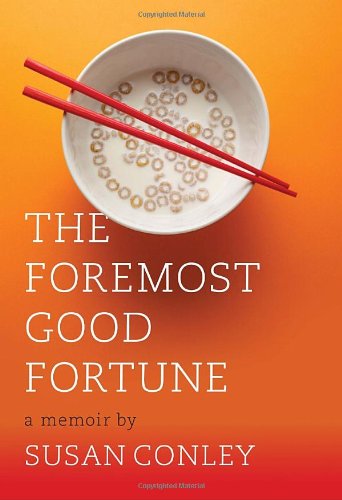
Inhaltsangabe
Susan Conley, her husband, and their two young sons say good-bye to their friends, family, and house in Maine for a two-year stint in a high-rise apartment in Beijing, prepared to embrace the inevitable onslaught of new experiences that such a move entails. But Susan can’t predict just how much their lives will change.
While her husband is consumed with his job, Susan works on finishing her novel and confronting the challenges of day-to-day life in an utterly foreign country: determining the proper way to buy apples at a Chinese megamarket; bribing her little boys to ride the school bus; fielding invitations to mysterious “sweater parties” and tracking down the faux-purse empire of the infamous Bag Lady; and getting stuck in an elevator, unable to call for help in Mandarin.
Despite the distractions, there are many occasions for joy. From road trips to the Great Wall and bartering for a “starter Buddha” at the raucous flea market to lighting fireworks in the streets for the Chinese New Year and feasting on the world’s best dumplings in back-alley restaurants, they gradually turn their unfamiliar environs into a true home.
Then Susan learns she has cancer. After undergoing treatment in Boston, she returns to Beijing, again as a foreigner—but this time, it’s her own body in which she feels a stranger. Set against the eternally fascinating backdrop of modern China and full of insight into the trickiest questions of motherhood—How do you talk to children about death? When is it okay to lie?—this wry and poignant memoir is a celebration of family and a candid exploration of mortality and belonging.
Die Inhaltsangabe kann sich auf eine andere Ausgabe dieses Titels beziehen.
Über die Autorin bzw. den Autor
Susan Conley lived in Beijing for more than two years, and returned to Portland, Maine, with her husband and two sons in December 2009. She is cofounder and executive director of the Telling Room, a writers’ workshop and literary hub for the region. She was an associate editor at Ploughshares and has led creative writing seminars at Emerson College in Boston. Her work has been published inThe New York Times Magazine as well as The Paris Review, Harvard Review,Ploughshares, and other literary magazines. She is currently working on a novel and settling back into life in the States.
Auszug. © Genehmigter Nachdruck. Alle Rechte vorbehalten.
Here's the setup: I'm in the passenger seat of a blue Buick minivan driving through downtown Beijing at three o'clock on a blistering afternoon. A fifty-three-year-old Beijing local named Lao Wu is driving. He will always be the one driving in this story. He wears pressed high-waisted blue jeans and a sharp tan Windbreaker. Driving is his job; that is to say, he's a full-time driver. When Lao Wu came back home from the fields after the Cultural Revolution, the high schools had been closed. That was the week he learned to drive a Mack truck, and he's been driving ever since.
This is my third day in Beijing, and jet lag still pulls me down by my ankles. I lean back in the seat, my mind thick with sleep, and the van slows so I can count twenty waitresses lined up outside the Din Tai Fung dumpling house. The girls wear blue cotton qipaos and do jumping jacks on the sidewalk, then they salute a head waitress who stands on a small, black wooden box. Next they let out a cheer and march in a circle on the sidewalk. The head waitress calls out more instructions (how to fold the napkins? How to take a drink order?) and the girls yell back in a call and response. Then they salute their leader one more time and march into the restaurant.
People don't march much where I'm from. Maybe the occasional high- school band at the annual Bath Memorial Day parade. But marching is very much the way here-some kind of simulation of the hard-nosed Chinese army way of life? Some kind of leftover from the Communist heyday? Except we're still in the Communist heyday, aren't we?
At the apartment complex where we live there are more marching guards. They salute me every time I come back to the building. It's creepy. I want to tell them I'm not their senior officer. No. I am a forty-year-old American wife and mother of two who can't remember how to pronounce the number eight in Mandarin. This is a problem, because eight is where we live. It's China's luckiest number, and let me say right now that numerology is intrinsic to the whole China operation. Numbers here have secret, mystical powers. There are no fourth floors in China because when spoken, the Chinese character for the number 4 sounds too much like the character for death. So what good fortune that our apartment sits on the lucky eighth floor of a building called Park Avenue, across the street from Beijing's biggest city park. It's mostly Chinese families at Park Avenue-well-off Beijingren, the term used for people born and raised in the capital. Many are people who somehow got out during Mao's reign and have returned because China's prospects now look so good. There's also a big handful of Taiwanese here and Hong Kong Chinese and a smattering of Europeans.
We could have lived in Palm Springs or Champagne Villas, Yosemite or Central Park, Park Place or the Beijing Riviera-vast compounds whose names move beyond kitsch into the surreal. To get through the front door of our apartment lobby, we say "Ni hao" to the teenaged guard. He says, "Ni hao" back and salutes us. Then we say "Xie xie," which means thank you, and he says "Bu keqi" (you're welcome), and lets us on the elevator. He salutes us one more time to make sure. We play out this Beckett-like scene of absurdity many times a day, until the humor in it has dried up and flown away on the winds of the Gobi Desert.
Tony has come to introduce credit-rating systems to the Chinese state- owned banks. This means that he meets with senior financial officers, trying to explain in Mandarin why buying complicated American computer programs is crucial to China's success. Sometimes Tony has to pinch himself to make sure it's him and not an imposter wearing that blue banker's suit. Because when Tony lived in Beijing the first time, he had a different gig.
In 1985 Tony took a backpack and a Nikon and headed out on China's trains photographing border zones-places the government here officially calls "ethnic minority regions." Tony started in Yunnan where it meets up with Laos and Burma, and then went northwest to Xinjiang Province where it rubs shoulders with today's "stans": Pakistan, Uzbekistan, Kazakhstan. Next he went south to Tibet and got an early visa for Lhasa. He'd been schooled in Mandarin and had a knack for conversing with strangers, for hitching rides and getting out of pinches with Chinese police. In many towns he was the first laowai the locals had seen. He'd arrive in a village and make friends there and find it hard to leave.
Years ago in San Francisco, when it got so I always wanted to be in the same room with Tony, he gave me one of the photos he took on that trip. Some of the prints had won awards in galleries by then. Mine was of two women sitting in a crop of Hami melons by the side of a dusty road. I hung it in my bedroom and it marked the beginning of my own quiet fascination with Asia. The natural beauty of those women startled me, so did the way they looked right into Tony's camera. The photo made me want to understand him more. He knew himself well. There was a quiet self-sufficiency. Where did that come from?
I have never been to China. I do not speak the language. I've bought a Chinese desk. My plan in Beijing is to finish a novel-two hundred pages of a rough draft set in Paris. The boys are here to go to school. It is what boys do. Or at least that's what I keep telling them they do. Their school is a twenty-minute highway ride south of our apartment. It sits down the road from the underpass that marks one of Beijing's busiest intersections: a six-way juggernaut of rickshaws, one-speeds, VW Santanas, and horses and wagons. Today, a horde of teenage vendors has set up shop on the sidewalks to sell chestnuts and lychees, and baked sweet potatoes. These streets are not pedestrian friendly-they're long blocks of strip malls and food stalls and mid-rises in all stages of rehab and post hab. Throngs of people walk in the roads buying and selling like mad. There's Tsingtao beer for sale, and turtles, and athletic socks, and phone chargers. How strange and dazzling.
The more I stare, the more arbitrary those marching waitresses back down the road begin to seem-like some kind of imposed order. Finger in the dam. There's so much humanity here; a dozen men take a snooze on the strip of concrete below the overpass. There's a woman walking just ahead in a bright Mickey Mouse T-shirt who pauses to blow her nose into the gutter. To the right of the gridlock, hundreds of people wait in line for buses. A large floral display stands next to the ticket kiosk-something you might see in a Macy's Thanksgiving Day parade, made entirely of yellow chrysanthemums that spell out the words "Beijing 2008 Games." Next to the sign a woman sells slices of yellow Hami melon on wooden skewers. A line of black Audis weaves in front of our van with their lights on and a rose garland battened to each hood. Lao Wu smiles and points to the bride and groom who ride in front of the procession in a blue Hummer.
I've never seen so many people riding bicycles, and I can't stop staring. They're helmetless and willing to risk their lives dodging cars. Many women wear black office pumps and knee-length polyester dresses; men are in nylon business slacks with white-collared shirts. At first, the joke would seem to be on the cars, because they can't get through the mess. But it's the cars that will prevail here-there are one thousand more on the road every day, which makes the bicycles begin to look like living artifacts.
We're creeping through a series of traffic lights, and I'm sure the words I hear on the radio are in English. I ask Lao Wu to turn up the volume by making a circular motion with my right hand. "Ying yu?" I say excitedly. Is it English? Then I repeat, "Ying yu?" and then I'm hit with a rolling wave of homesickness.
"No," Lao Wu says decisively. "Han yu." Chinese.
But I'm sure I can hear English...
„Über diesen Titel“ kann sich auf eine andere Ausgabe dieses Titels beziehen.
Suchergebnisse für The Foremost Good Fortune

Beispielbild für diese ISBN
The Foremost Good Fortune
Verlag:
Knopf (edition First Edition), 2011
ISBN 10: 0307594068
ISBN 13: 9780307594068
Gebraucht
Hardcover
Erstausgabe
Anbieter: BooksRun, Philadelphia, PA, USA
Verkäuferbewertung 5 von 5 Sternen

Hardcover. Zustand: Very Good. First Edition. With dust jacket. It's a well-cared-for item that has seen limited use. The item may show minor signs of wear. All the text is legible, with all pages included. It may have slight markings and/or highlighting. Bestandsnummer des Verkäufers 0307594068-8-1-29
Gebraucht kaufen
EUR 4,95
Versand gratis
Versand innerhalb von USA
Versand innerhalb von USA
Anzahl: 2 verfügbar
Foto des Verkäufers
The Foremost Good Fortune
Anbieter: Bay State Book Company, North Smithfield, RI, USA
Verkäuferbewertung 5 von 5 Sternen
Zustand: very_good. Bestandsnummer des Verkäufers BSM.18G55
Gebraucht kaufen
EUR 5,24
Versand gratis
Versand innerhalb von USA
Versand innerhalb von USA
Anzahl: 1 verfügbar
Beispielbild für diese ISBN
The Foremost Good Fortune
Anbieter: BookHolders, Towson, MD, USA
Verkäuferbewertung 5 von 5 Sternen
Zustand: Good. [ No Hassle 30 Day Returns ][ Ships Daily ] [ Underlining/Highlighting: NONE ] [ Writing: NONE ] [ Edition: First ] Publisher: Knopf Pub Date: 2/8/2011 Binding: Hardcover Pages: 288 First edition. Bestandsnummer des Verkäufers 3467953
Gebraucht kaufen
EUR 5,30
Versand gratis
Versand innerhalb von USA
Versand innerhalb von USA
Anzahl: 1 verfügbar
Beispielbild für diese ISBN
The Foremost Good Fortune
Verlag:
Knopf Doubleday Publishing Group, 2011
ISBN 10: 0307594068
ISBN 13: 9780307594068
Gebraucht
Hardcover
Anbieter: Better World Books, Mishawaka, IN, USA
Verkäuferbewertung 5 von 5 Sternen
Zustand: Good. Former library copy. Pages intact with minimal writing/highlighting. The binding may be loose and creased. Dust jackets/supplements are not included. Includes library markings. Stock photo provided. Product includes identifying sticker. Better World Books: Buy Books. Do Good. Bestandsnummer des Verkäufers 3173612-6
Gebraucht kaufen
EUR 6,14
Versand gratis
Versand innerhalb von USA
Versand innerhalb von USA
Anzahl: 2 verfügbar
Beispielbild für diese ISBN
The Foremost Good Fortune
Anbieter: Wonder Book, Frederick, MD, USA
Verkäuferbewertung 5 von 5 Sternen
Zustand: Very Good. Signed Copy . Very Good dust jacket. Signed/Inscribed by author on title page. Bestandsnummer des Verkäufers S21F-02386
Gebraucht kaufen
EUR 6,21
Versand gratis
Versand innerhalb von USA
Versand innerhalb von USA
Anzahl: 1 verfügbar
Beispielbild für diese ISBN
The Foremost Good Fortune
Anbieter: Wonder Book, Frederick, MD, USA
Verkäuferbewertung 5 von 5 Sternen
Zustand: As New. Like New condition. Very Good dust jacket. A near perfect copy that may have very minor cosmetic defects. Bestandsnummer des Verkäufers M12O-00157
Gebraucht kaufen
EUR 6,21
Versand gratis
Versand innerhalb von USA
Versand innerhalb von USA
Anzahl: 1 verfügbar
Beispielbild für diese ISBN
The Foremost Good Fortune
Anbieter: Wonder Book, Frederick, MD, USA
Verkäuferbewertung 5 von 5 Sternen
Zustand: Very Good. Very Good condition. Like New dust jacket. A copy that may have a few cosmetic defects. May also contain light spine creasing or a few markings such as an owner's name, short gifter's inscription or light stamp. Bestandsnummer des Verkäufers J07B-02277
Gebraucht kaufen
EUR 6,21
Versand gratis
Versand innerhalb von USA
Versand innerhalb von USA
Anzahl: 1 verfügbar
Beispielbild für diese ISBN
The Foremost Good Fortune
Anbieter: ThriftBooks-Dallas, Dallas, TX, USA
Verkäuferbewertung 5 von 5 Sternen
Hardcover. Zustand: Very Good. No Jacket. May have limited writing in cover pages. Pages are unmarked. ~ ThriftBooks: Read More, Spend Less. Bestandsnummer des Verkäufers G0307594068I4N00
Gebraucht kaufen
EUR 6,84
Versand gratis
Versand innerhalb von USA
Versand innerhalb von USA
Anzahl: 1 verfügbar
Beispielbild für diese ISBN
The Foremost Good Fortune
Anbieter: St Vincent de Paul of Lane County, Eugene, OR, USA
Verkäuferbewertung 5 von 5 Sternen
Zustand: Good. hardcover 100% of proceeds go to charity! Good condition with all pages in tact. Item shows signs of use and may have cosmetic defects. Bestandsnummer des Verkäufers 2JJ-004-0658
Gebraucht kaufen
EUR 4,43
EUR 3,44 Versand
Versand innerhalb von USA
Versand innerhalb von USA
Anzahl: 1 verfügbar
Beispielbild für diese ISBN
The Foremost Good Fortune
Anbieter: GoldBooks, Denver, CO, USA
Verkäuferbewertung 5 von 5 Sternen
Hardcover. Zustand: new. New Copy. Customer Service Guaranteed. Bestandsnummer des Verkäufers 8D15_13_0307594068