
Verwandte Artikel zu The Madonna on the Moon
Inhaltsangabe
Winner of the European Book Award
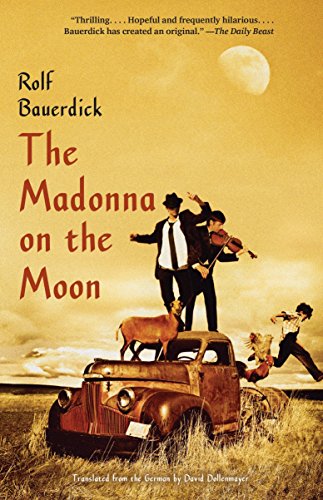
November, 1957. The Soviets have just launched the Sputnik, and communism rules in Eastern Europe, but the village of Baia Luna, nestled in the Carpathian mountains, is a world unto itself, populated with gypsy-philosophers and mysterious priests. But for fifteen-year-old Pavel Botev, this world begins to come apart the day teacher asks him to hang a photo of the new party secretary, then whispers a startling directive into his ear.
“Send this man straight to hell. Exterminate him.” The next morning, she has disappeared. Once a priest turns up murdered, Pavel sets out on a journey for answers—one that leads him into the frontiers of a new life. By turns grippingly realist and enchantingly surreal, The Madonna on the Moon announces the arrival of an important new voice in fiction.
Die Inhaltsangabe kann sich auf eine andere Ausgabe dieses Titels beziehen.
Über die Autorin bzw. den Autor
Rolf Bauerdick was born in 1957. He studied literature and theology before turning to journalism and photography. His work has been awarded numerous prizes, among them Germany's prestigious Hansel Mieth Prize. His articles have been published in Der Spiegel,Geo, and Playboy, among other publications. He lives in a converted flour mill in Northern Germany with his wife and children. The Madonna on the Moon, his first novel, won the European Book Award.
Translated from the German by David Dollenmayer.
Auszug. © Genehmigter Nachdruck. Alle Rechte vorbehalten.
Chapter One
Baia Luna, New York, and Angela Barbulescu’s Fear
“He’s flying! He’s flying! Long live Socialism! Three cheers for the party!”
The three Brancusi brothers, Liviu, Roman, and Nico, burst into our taproom one evening about eight in a splendid mood, their chests swelling with pride and the cash to stand a few rounds burn- ing holes in their pockets.
“Who’s flying?” asked my grandfather Ilja.
“The dog of course! Laika! The first animal in space! Aboard Sputnik II! Brandy, Pavel! Zuika for everybody! But avanti! It’s on us.” Liviu was playing the big shot, and I could foresee I’d have to run myself ragged the next few hours.
“Gr-gr-gr-gravity has been co-co-conquered! Now nothing can hold back pr-pr-progress. Sp-Sputnik beeps and Laika b-barks all around the w-w-world,” Roman stammered, as he always did when his tongue couldn’t keep up with his excitement.
“Progress, yes sir,” Nico, the youngest Brancusi, fell in with his stammering brother. “A toast to the Union of Soviet Socialist Republics! Side by side we will be victorious! We will conquer the heavens!”
“You can keep your schnapps to yourselves.” The Saxons Hermann Schuster and Karl Koch threw on their coats and left the taproom.
Trouble hung in the air that November 5, 1957. It was a Tuesday and the eve of my grandfather Ilja’s fifty-fifth birthday. I was fifteen. In the mornings I reluctantly attended the eighth (and final) grade, in the afternoons I killed time, and evenings and Sundays I helped my grandfather, waiting on his clientele in our family’s tavern. I should mention that it wasn’t an inn in the ordinary sense of the word. Ilja, my mother Kathalina, and Aunt Antonia ran a shop by day whose inventory provided the housewives of Baia Luna with the basic necessities. By night, we moved a few tables and chairs into the shop and transformed it into a pub for the men.
All I understood of the Brancusis’ blabber about progress was that a dog was zooming across the sky in a beeping Sputnik that managed to do without jet engines and rotating propellers and had nothing in common with ordinary airplanes. At the price, however, of never being able to return to earth. Satellites had escaped the rules of gravity and were on their way to eternal flight in space.
While the men in the bar were getting hot under the collar discussing the whys and wherefores of the newfangled airships, my grandfather Ilja was unmoved: “Weightlessness—not bad. My compliments. But the Russian beeping won’t fill my belly.”
Dimitru Carolea Gabor stood up and took the floor. Some of the men lowered their chins in contempt. After all, didn’t people say the Gypsy had his feet in the clouds and thought with his tongue? Dimitru clutched his right fist to his heart as if taking an oath. He stood there like a rock and swore that the chirping flying contraption was the work of the Supreme Comrade of all Comrades, Joseph Vissarionovich Stalin himself. While still alive, he’d ordered a whole armada of Sputniks to be built. “Sly machines camouflaged as harmless balls of tin, under way on secret missions, and now they even have a dog onboard. I don’t quite get the point of that yapper among the stars, but I’ll tell you something: those aluminum spiders aren’t poking their antennae into the sky just for fun. The Supreme Soviet has something up its sleeve. That beeping, that cosmic cicada, robs peaceful human beings of their sleep and of their sanity, too. And you know what that means? If you’re crazy, you turn into a zombie, and the world revolution just goose-steps right past you. And then, comrades”—Dimitru stared at the three Brancusis—“then you’ve finally achieved the equality of the entire proletariat. The idiot among equals thinks everyone’s smart.”
“In your case, the beeping seems to be working already.” Liviu tapped his finger on his forehead to mock the crazy Gypsy. “You Blacks are nothing to write home about, anyway. Why don’t you do something productive for a change? Under Stalin, you all would’ve been—”
“Right! Exactamente! What’d I tell you?” Dimitru interrupted him. “Joseph was a sly dog. But he had problems getting every- one proletarianized. Big problems. Because his policy of state control just couldn’t achieve the equality of all the Soviets. Sure, the Supreme Comrade really tried hard: bigger jails, higher prison walls, bread and water, half rations. He tried to rub out the last vestiges of inequality with more and more gallows and firing squads. But what did that achieve? Joseph had to keep expanding the labor camps for the unequal. The boundaries of the prisons grew incalculably vast. Today no one knows who’s in and who’s out. What a dilemma. The Supreme Soviet can’t keep track of it all anymore. That’s why they need Sputnik. The beeping eliminates the mind and the will. And where there’s no will, there’s no—”
“Who needs this bullshit?” yelled Nico Brancusi. Purple with rage, he jumped up and glared around at the assembled company. “Who wants to hear this crap, goddamnit!” From way back in his throat he hocked up a loogie and spat it onto the floorboards with the words, “Gypsy lies! Black talk!”
Dimitru drummed his fingers nervously on the table.
“It’s the truth,” he said. “If my calculations are correct, Sputnik will be flying over the Transmontanian Carpathians between the forty-sixth degree of latitude and the twenty-fourth degree of longitude in the morning hours of my friend Ilja’s special day. It’ll be beeping right over our heads. I’m telling you, Sputnik is the beginning of the end. And you, Comrade Nico, you can offer your naked ass to whoever you want, that’s your business. But I’m a Gypsy, and you’ll never find a Gypsy in bed with the Bolsheviks.”
Nico went for the Gypsy’s throat, but his brothers held him back. Dimitru emptied his glass, belched, and after whispering to grandfather, “Five on the dot. I’ll be waiting for you,” left the tavern without a backward glance.
I didn’t know what to think about all the excitement. I went to bed but had a hard time falling asleep. The Gypsy had probably catapulted himself out of the track of logical thought again (as so often in the past) with his hair-raising speculations about the beeping Sputnik.
But my bedtime prayer (which admittedly I usually forgot) suddenly gave me pause. “Our Father, who art in heaven, hallowed be thy name. Thy kingdom come . . .” Now, at fifteen, I was already clear that the kingdom of heaven was not about to arrive in the foreseeable future, at least not in Baia Luna. But it was different with the Sputnik. The kingdom of heaven might not be expanding on earth, but on the other hand, man was heading for the heavens. Or at least an earthly creature was: a dog. Surely the beast would soon be dead of starvation. But what was a dead mutt doing in the infinity of space anyway? Up where the Lord God and his hosts reigned, as our aged parish priest Johannes Baptiste thundered from his pulpit every Sunday.
Night was already drawing to a close when the floorboards in the hall creaked. I heard cautious footsteps, as if someone didn’t want to be heard. Grandfather was taking great pains not to wake up my mother Kathalina, Aunt Antonia, and...
„Über diesen Titel“ kann sich auf eine andere Ausgabe dieses Titels beziehen.
Suchergebnisse für The Madonna on the Moon

Beispielbild für diese ISBN
The Madonna on the Moon
Anbieter: BooksRun, Philadelphia, PA, USA
Verkäuferbewertung 5 von 5 Sternen

Paperback. Zustand: Very Good. It's a well-cared-for item that has seen limited use. The item may show minor signs of wear. All the text is legible, with all pages included. It may have slight markings and/or highlighting. Bestandsnummer des Verkäufers 0307739759-11-1
Gebraucht kaufen
EUR 5,52
Versand gratis
Versand innerhalb von USA
Versand innerhalb von USA
Anzahl: 1 verfügbar
Beispielbild für diese ISBN
The Madonna on the Moon
Verlag:
Knopf Doubleday Publishing Group, 2014
ISBN 10: 0307739759
ISBN 13: 9780307739759
Gebraucht
Softcover
Anbieter: Better World Books, Mishawaka, IN, USA
Verkäuferbewertung 5 von 5 Sternen
Zustand: Good. Former library copy. Pages intact with minimal writing/highlighting. The binding may be loose and creased. Dust jackets/supplements are not included. Includes library markings. Stock photo provided. Product includes identifying sticker. Better World Books: Buy Books. Do Good. Bestandsnummer des Verkäufers 68199951-6
Gebraucht kaufen
EUR 8,91
Versand gratis
Versand innerhalb von USA
Versand innerhalb von USA
Anzahl: 1 verfügbar
Beispielbild für diese ISBN
The Madonna on the Moon
Anbieter: vladimir belskiy, Alexandria, VA, USA
Verkäuferbewertung 2 von 5 Sternen

Zustand: New. Bestandsnummer des Verkäufers K3-434H-M516
Foto des Verkäufers
Madonna on the Moon
Anbieter: GreatBookPrices, Columbia, MD, USA
Verkäuferbewertung 5 von 5 Sternen
Zustand: As New. Unread book in perfect condition. Bestandsnummer des Verkäufers 20802415
Gebraucht kaufen
EUR 12,34
EUR 2,28 Versand
Versand innerhalb von USA
Versand innerhalb von USA
Anzahl: Mehr als 20 verfügbar
Beispielbild für diese ISBN
The Madonna on the Moon Format: Paperback
Anbieter: INDOO, Avenel, NJ, USA
Verkäuferbewertung 5 von 5 Sternen
Zustand: As New. Unread copy in mint condition. Bestandsnummer des Verkäufers RH9780307739759
Gebraucht kaufen
EUR 14,69
Versand gratis
Versand innerhalb von USA
Versand innerhalb von USA
Anzahl: Mehr als 20 verfügbar
Foto des Verkäufers
Madonna on the Moon
Anbieter: GreatBookPrices, Columbia, MD, USA
Verkäuferbewertung 5 von 5 Sternen
Zustand: New. Bestandsnummer des Verkäufers 20802415-n
Neu kaufen
EUR 12,42
EUR 2,28 Versand
Versand innerhalb von USA
Versand innerhalb von USA
Anzahl: Mehr als 20 verfügbar
Beispielbild für diese ISBN
The Madonna on the Moon Format: Paperback
Anbieter: INDOO, Avenel, NJ, USA
Verkäuferbewertung 5 von 5 Sternen
Zustand: New. Brand New. Bestandsnummer des Verkäufers 9780307739759
Neu kaufen
EUR 14,78
Versand gratis
Versand innerhalb von USA
Versand innerhalb von USA
Anzahl: Mehr als 20 verfügbar
Foto des Verkäufers
The Madonna on the Moon
Anbieter: Rarewaves USA, HEBRON, KY, USA
Verkäuferbewertung 5 von 5 Sternen
Paperback. Zustand: New. Bestandsnummer des Verkäufers LU-9780307739759
Foto des Verkäufers
The Madonna on the Moon (Paperback)
Verlag:
Random House USA Inc, New York, 2014
ISBN 10: 0307739759
ISBN 13: 9780307739759
Neu
Paperback
Anbieter: Grand Eagle Retail, Bensenville, IL, USA
Verkäuferbewertung 5 von 5 Sternen
Paperback. Zustand: new. Paperback. Winner of the European Book AwardNovember, 1957. The Soviets have just launched the Sputnik, and communism rules in Eastern Europe, but the village of Baia Luna, nestled in the Carpathian mountains, is a world unto itself, populated with gypsy-philosophers and mysterious priests. But for fifteen-year-old Pavel Botev, this world begins to come apart the day teacher asks him to hang a photo of the new party secretary, then whispers a startling directive into his ear. Send this man straight to hell. Exterminate him. The next morning, she has disappeared. Once a priest turns up murdered, Pavel sets out on a journey for answersone that leads him into the frontiers of a new life. By turns grippingly realist and enchantingly surreal, The Madonna on the Moon announces the arrival of an important new voice in fiction. Shipping may be from multiple locations in the US or from the UK, depending on stock availability. Bestandsnummer des Verkäufers 9780307739759
Beispielbild für diese ISBN
The Madonna on the Moon
Anbieter: Massive Bookshop, Erving, MA, USA
Verkäuferbewertung 4 von 5 Sternen

Paperback. Zustand: New. Bestandsnummer des Verkäufers 9780307739759
Neu kaufen
EUR 15,05
EUR 4,10 Versand
Versand innerhalb von USA
Versand innerhalb von USA
Anzahl: 10 verfügbar