
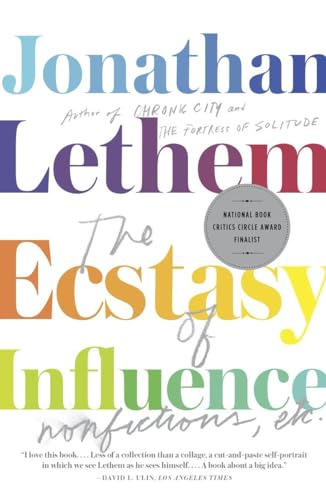
Verwandte Artikel zu The Ecstasy of Influence: Nonfictions, Etc. (Vintage...
Inhaltsangabe
National Book Critics Circle Award Finalist
A New York Times Notable Book
A Best Book of the Year —Austin American-Statesman
Includes a new, previously uncollected piece: "My Internet"
In The Ecstasy of Influence, the incomparable Jonathan Lethem has compiled a career-spanning collection of occasional pieces—essays, memoir, liner notes, fiction, and criticism—which also doubles as a novelist’s manifesto, self-portrait, and confession. The result is an insightful, charming, and entertaining grab bag that covers everything from great novels to old films to graffiti to cyberculture.
Die Inhaltsangabe kann sich auf eine andere Ausgabe dieses Titels beziehen.
Über die Autorin bzw. den Autor
JONATHAN LETHEM is the New York Times bestselling author of eight novels, including Chronic City, The Fortress of Solitude, and Motherless Brooklyn.. A recipient of the MacArthur Fellowship and winner of the National Book Critics Circle Award, Lethem has also published his stories and essays in The New Yorker, Harper’s, Rolling Stone, Esquire, and The New York Times, among others.
www.jonathanlethem.com
Auszug. © Genehmigter Nachdruck. Alle Rechte vorbehalten.
Postmodernism as Liberty Valance
Notes on a Ritual Killing
1. Spoiler alert. John Ford’s The Man Who Shot Liberty Valance is an allegorical Western that I am now going to totally pretzel into an allegory for something else entirely. Actually I’ll reverse it: The original allegorizes the taming of the western frontier, the coming of modernity in the form of the lawbooks and the locomotive, and memorializes what was lost (a loss the film sees as inevitable). My version allegorizes the holding at bay, for the special province of literary fiction, of contemporary experience in all its dismaying or exhilarating particulars, as well as a weird persistent denial of a terrific number of artistic strategies for illuminating that experience. The avoidance, that’s to say, of any forthright address of what’s called postmodernity, and what’s lost in avoiding it (a sacrifice I see as at best pointless, an empty rehearsal of anxieties, and at worst hugely detrimental for fiction).
2. The chewy center of TMWSLV is a gunfight. A man stands in the main street of a western town and (apparently) kills another man. The victim—for this is, technically, murder—represents chaos and anxiety and fear to all who know him, and has been regarded as unkillable, almost in the manner of a monster or zombie from another movie genre; his dispatch is regarded by the local population with astonished relief and gratitude, such that they will shower the killer with regard (he’s destined to become his party’s nominee for vice president of the United States). The secret the movie reveals: The killer was not the man in the street, but another.
3. The three persons in TMWSLV: James Stewart a.k.a. “Ransom Stoddard,” the upstanding, even priggish young lawyer from the east, defined by his naïve sincerity and dedication to the rule of law; John Wayne a.k.a. “Tom Doniphon,” cynical veteran of the frontier, who tends to an isolationist-libertarian approach toward civilization but is essentially lovable and will become heartbreaking by film’s end; and Lee Marvin a.k.a. “Liberty Valance,” a sadistic, amoral thug who delights in sowing chaos and exposing the fragility of social convention (by terrorizing family restaurants, newspaper offices, elections, etc.).
4. Stewart/Stoddard believes he’s “the man who killed Liberty Valance” (he stood, after all, in the center of town, visible to all, with a gun in his hand). More important, the witnesses believe he’s the one. In fact, it was Wayne/Doniphon who did the deed, while hidden in a shadowy alley, after having elaborately conspired to goad the helpless and pacifistic Stewart/Stoddard into his public role as a gun-toting defender of public peace against the savage anarchy of Marvin/Valance.
5. Liberty Valance, i.e., “Free Persuasion”—what an absurd, obvious, Pynchonian name! But then, the characters in Dickens and Henry James have odd names, too.
6. “Venturing back in time isn’t the only option for novelists loath to address the mass media that most Americans marinate in. There are also those populations cut off from the mainstream for cultural reasons, such as recent immigrants and their families. And then there are those at the geographical margins . . . It’s remarkable how many recent American literary novels and short stories are set on ranches . . . The American novelist is buffeted by two increasingly contradictory imperatives. The first comes as the directive to depict ‘The Way We Live Now’ . . . Cliché it may be, but the notion that no one is better suited to explain the dilemmas of contemporary life than the novelist persists . . . [The] other designated special province of the literary novelist: museum-quality depth. The further literature is driven to the outskirts of the culture, the more it is cherished as a sanctuary from everything coarse, shallow and meretricious in that culture. If these two missions seem incompatible, that’s because they are. To encompass both . . . you must persuade your readers that you have given them what they want by presenting them with what they were trying to get away from when they came to you in the first place.”
—Laura Miller, The Guardian
7. Let’s wade into the unpleasantness around the term “postmodernism”: Nobody agrees on its definition, but in literary conversations the word is often used as finger-pointing to a really vast number of things that might be seen as threatening to canonical culture: author-killing theories generated by French critics, collapsings of high and low cultural preserves into a value-neutral fog, excessive reference to various other media and/or mediums, especially electronic ones (ironically, even a Luddishly denunciatory take on certain media and/or mediums may be suspect merely for displaying an excess of familiarity with same), an enthusiasm for “metafiction” (a word that ought to be reserved for a specific thing that starts with Cervantes, but isn’t), for antinarrative, for pop-culture references or generic forms, for overt (as opposed to politely passive) “intertextuality,” for unreliable narration, for surrealism or magic realism or hysterical realism or some other brand of “opposed- to- realism” affiliation, for “irony” (another term that’s been abused out of its effective contour and function, and its abusers have fewer excuses than do those of postmodernism), etc. etc. etc. Now, any writer espousing, let alone employing, all of the above things would be a gorgon-headed monster, surely deserving rapid assassination for the safety of the literary community in general. (Or maybe not, maybe they’d be splendid.) But—and I present this as axiomatic—such a person, and such writing, is impossible to consider seriously because all of the modes denounced under the banner of “postmodernist” are incompatible: You can’t, just for instance, exalt disreputable genres like the crime story and also want to do away with narrative.
8. The reverse person, a literary person inclined toward or at least compelled by none of the above-named modes or gestures—and I present this not as axiomatic but as an obnoxious opinion—would be dull beyond belief. They basically would have declined the entire twentieth century (and interesting parts of several others). You’ve read our entire menu, sir? And nothing was of interest? Really, nothing?
9. “ . . . as a phenomenon, postmodernism is either specifically aesthetic or more generally cultural; it is either revolutionary or reactionary; it is either the end of ideology or the inescapable conclusion of ideology . . . It is expressed in architecture, art, literature, the media, science, religion and fashion, and at the same time it is equivalent to none of these. It is both a continuation and intensification of what has gone before and a radical break with all traces of the past. It is, above all, simultaneously critical and complicit.”
—Kathleen Fitzpatrick, The Anxiety of Obsolescence
“Critical debates about postmodernism constitute postmodernism itself.”
—Stephen Connor, Postmodernist Culture
10. I suggested that abusers of the word “postmodernism” had...
„Über diesen Titel“ kann sich auf eine andere Ausgabe dieses Titels beziehen.
Suchergebnisse für The Ecstasy of Influence: Nonfictions, Etc. (Vintage...

Beispielbild für diese ISBN
The Ecstasy of Influence: Nonf
Verlag:
Knopf Doubleday Publishing Group, 2012
ISBN 10: 0307744507
ISBN 13: 9780307744500
Gebraucht
Softcover
Anbieter: World of Books (was SecondSale), Montgomery, IL, USA
Verkäuferbewertung 5 von 5 Sternen

Zustand: Good. Item in good condition. Textbooks may not include supplemental items i.e. CDs, access codes etc. Bestandsnummer des Verkäufers 00107481878
Gebraucht kaufen
EUR 3,39
Versand gratis
Versand innerhalb von USA
Versand innerhalb von USA
Anzahl: 6 verfügbar
Beispielbild für diese ISBN
The Ecstasy of Influence: Nonf
Verlag:
Knopf Doubleday Publishing Group, 2012
ISBN 10: 0307744507
ISBN 13: 9780307744500
Gebraucht
Softcover
Anbieter: World of Books (was SecondSale), Montgomery, IL, USA
Verkäuferbewertung 5 von 5 Sternen
Zustand: Very Good. Item in very good condition! Textbooks may not include supplemental items i.e. CDs, access codes etc. Bestandsnummer des Verkäufers 00109816518
Gebraucht kaufen
EUR 3,58
Versand gratis
Versand innerhalb von USA
Versand innerhalb von USA
Anzahl: 1 verfügbar
Beispielbild für diese ISBN
The Ecstasy of Influence: Nonfictions, Etc.
Anbieter: ThriftBooks-Reno, Reno, NV, USA
Verkäuferbewertung 5 von 5 Sternen
Paperback. Zustand: Good. No Jacket. Pages can have notes/highlighting. Spine may show signs of wear. ~ ThriftBooks: Read More, Spend Less. Bestandsnummer des Verkäufers G0307744507I3N00
Gebraucht kaufen
EUR 5,89
Versand gratis
Versand innerhalb von USA
Versand innerhalb von USA
Anzahl: 1 verfügbar
Beispielbild für diese ISBN
The Ecstasy of Influence: Nonfictions, Etc.
Anbieter: ThriftBooks-Dallas, Dallas, TX, USA
Verkäuferbewertung 5 von 5 Sternen
Paperback. Zustand: Good. No Jacket. Pages can have notes/highlighting. Spine may show signs of wear. ~ ThriftBooks: Read More, Spend Less. Bestandsnummer des Verkäufers G0307744507I3N00
Gebraucht kaufen
EUR 5,91
Versand gratis
Versand innerhalb von USA
Versand innerhalb von USA
Anzahl: 1 verfügbar
Beispielbild für diese ISBN
The Ecstasy of Influence: Nonfictions, Etc.
Anbieter: ThriftBooks-Atlanta, AUSTELL, GA, USA
Verkäuferbewertung 5 von 5 Sternen
Paperback. Zustand: Good. No Jacket. Pages can have notes/highlighting. Spine may show signs of wear. ~ ThriftBooks: Read More, Spend Less. Bestandsnummer des Verkäufers G0307744507I3N00
Gebraucht kaufen
EUR 5,91
Versand gratis
Versand innerhalb von USA
Versand innerhalb von USA
Anzahl: 1 verfügbar
Beispielbild für diese ISBN
The Ecstasy of Influence: Nonfictions, Etc.
Anbieter: ThriftBooks-Atlanta, AUSTELL, GA, USA
Verkäuferbewertung 5 von 5 Sternen
Paperback. Zustand: Good. No Jacket. Former library book; Pages can have notes/highlighting. Spine may show signs of wear. ~ ThriftBooks: Read More, Spend Less. Bestandsnummer des Verkäufers G0307744507I3N10
Gebraucht kaufen
EUR 5,91
Versand gratis
Versand innerhalb von USA
Versand innerhalb von USA
Anzahl: 1 verfügbar
Foto des Verkäufers
The Ecstasy of Influence: Nonfictions, Etc. (Vintage Contemporaries)
Verlag:
Knopf Doubleday Publishing Group, 2012
ISBN 10: 0307744507
ISBN 13: 9780307744500
Gebraucht
Softcover
Anbieter: Bay State Book Company, North Smithfield, RI, USA
Verkäuferbewertung 5 von 5 Sternen
Zustand: good. The book is in good condition with all pages and cover intact, including the dust jacket if originally issued. The spine may show light wear. Pages may contain some notes or highlighting, and there might be a "From the library of" label. Boxed set packaging, shrink wrap, or included media like CDs may be missing. Bestandsnummer des Verkäufers BSM.19YRF
Gebraucht kaufen
EUR 6,00
Versand gratis
Versand innerhalb von USA
Versand innerhalb von USA
Anzahl: 1 verfügbar
Beispielbild für diese ISBN
The Ecstasy of Influence: Nonfictions, Etc. (Vintage Contemporaries)
Verlag:
Knopf Doubleday Publishing Group, 2012
ISBN 10: 0307744507
ISBN 13: 9780307744500
Gebraucht
Softcover
Anbieter: St Vincent de Paul of Lane County, Eugene, OR, USA
Verkäuferbewertung 5 von 5 Sternen
Zustand: Good. COVER SHOWS SOME GENERAL WEAR, SUCH AS SCRATCHES, RUBBING AND CREASES. paperback 100% of proceeds go to charity! Good condition with all pages in tact. Item shows signs of use and may have cosmetic defects. Bestandsnummer des Verkäufers D-02-5257
Gebraucht kaufen
EUR 3,59
EUR 3,48 Versand
Versand innerhalb von USA
Versand innerhalb von USA
Anzahl: 1 verfügbar
Beispielbild für diese ISBN
The Ecstasy of Influence : Nonfictions, Etc
Verlag:
Knopf Doubleday Publishing Group, 2012
ISBN 10: 0307744507
ISBN 13: 9780307744500
Gebraucht
Softcover
Anbieter: Better World Books, Mishawaka, IN, USA
Verkäuferbewertung 5 von 5 Sternen
Zustand: Good. Pages intact with minimal writing/highlighting. The binding may be loose and creased. Dust jackets/supplements are not included. Stock photo provided. Product includes identifying sticker. Better World Books: Buy Books. Do Good. Bestandsnummer des Verkäufers 12889029-6
Gebraucht kaufen
EUR 8,16
Versand gratis
Versand innerhalb von USA
Versand innerhalb von USA
Anzahl: 1 verfügbar
Beispielbild für diese ISBN
The Ecstasy of Influence: Nonfictions, Etc. (Vintage Contemporaries)
Anbieter: HPB-Emerald, Dallas, TX, USA
Verkäuferbewertung 5 von 5 Sternen
Paperback. Zustand: Very Good. Connecting readers with great books since 1972! Used books may not include companion materials, and may have some shelf wear or limited writing. We ship orders daily and Customer Service is our top priority! Bestandsnummer des Verkäufers S_477779126
Gebraucht kaufen
EUR 5,74
EUR 3,27 Versand
Versand innerhalb von USA
Versand innerhalb von USA
Anzahl: 1 verfügbar