
Verwandte Artikel zu Good Strategy Bad Strategy: The Difference and Why...
Inhaltsangabe
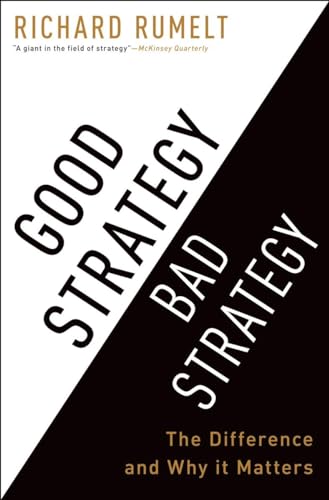
Good Strategy/Bad Strategy clarifies the muddled thinking underlying too many strategies and provides a clear way to create and implement a powerful action-oriented strategy for the real world.
Developing and implementing a strategy is the central task of a leader. A good strategy is a specific and coherent response to—and approach for—overcoming the obstacles to progress. A good strategy works by harnessing and applying power where it will have the greatest effect. Yet, Rumelt shows that there has been a growing and unfortunate tendency to equate Mom-and-apple-pie values, fluffy packages of buzzwords, motivational slogans, and financial goals with “strategy.”
In Good Strategy/Bad Strategy, he debunks these elements of “bad strategy” and awakens an understanding of the power of a “good strategy.” He introduces nine sources of power—ranging from using leverage to effectively focusing on growth—that are eye-opening yet pragmatic tools that can easily be put to work on Monday morning, and uses fascinating examples from business, nonprofit, and military affairs to bring its original and pragmatic ideas to life. The detailed examples range from Apple to General Motors, from the two Iraq wars to Afghanistan, from a small local market to Wal-Mart, from Nvidia to Silicon Graphics, from the Getty Trust to the Los Angeles Unified School District, from Cisco Systems to Paccar, and from Global Crossing to the 2007–08 financial crisis.
Reflecting an astonishing grasp and integration of economics, finance, technology, history, and the brilliance and foibles of the human character, Good Strategy/Bad Strategy stems from Rumelt’s decades of digging beyond the superficial to address hard questions with honesty and integrity.
Die Inhaltsangabe kann sich auf eine andere Ausgabe dieses Titels beziehen.
Über die Autorin bzw. den Autor
RICHARD P. RUMELT is one of the world’s most influential thinkers on strategy and management. The Economist profiled him as one of twenty-five living persons who have had the most influence on management concepts and corporate practice. McKinsey Quarterly described him as being “strategy’s strategist” and as “a giant in the field of strategy.” Throughout his career he has defined the cutting edge of strategy, initiating the systematic economic study of strategy, developing the idea that companies that focus on core skills perform best, and that superior performance is not a matter of being in the right industry but comes from a firm’s individual excellence. He is one of the founders of the resource-based view of strategy, a perspective that breaks with the market-power tradition, explaining performance in terms of unique specialized resources. Richard Rumelt received his doctoral degree from Harvard Business School, holds the Harry and Elsa Kunin Chair at the UCLA Anderson School of Management, and is a consultant to small firms such as the Samuel Goldwyn Company and giants such as Shell International, as well as to organizations in the educational and not-for-profit worlds.
Auszug. © Genehmigter Nachdruck. Alle Rechte vorbehalten.
CHAPTER ONE
GOOD STRATEGY IS UNEXPECTED
The first natural advantage of good strategy arises because other organizations often don’t have one. And because they don’t expect you to have one, either. A good strategy has coherence, coordinating actions, policies, and resources so as to accomplish an important end. Many organizations, most of the time, don’t have this. Instead, they have multiple goals and initiatives that symbolize progress, but no coherent approach to accomplishing that progress other than “spend more and try harder.”
APPLE
After the 1995 release of Microsoft’s Windows 95 multimedia operating system, Apple Inc. fell into a death spiral. On February 5, 1996, BusinessWeek put Apple’s famous trademark on its cover to illustrate its lead story: “The Fall of an American Icon.”
CEO Gil Amelio struggled to keep Apple alive in a world being rapidly dominated by Windows-Intel-based PCs. He cut staff. He reorganized the company’s many products into four groups: Macintosh, information appliances, printers and peripherals, and “alternative platforms.” A new Internet Services Group was added to the Operating Systems Group and the Advanced Technology Group.
Wired magazine carried an article titled “101 Ways to Save Apple.” It included suggestions such as “Sell yourself to IBM or Motorola,” “Invest heavily in Newton technology,” and “Exploit your advantage in the K–12 education market.” Wall Street analysts hoped for and urged a deal with Sony or Hewlett-Packard.
By September 1997, Apple was two months from bankruptcy. Steve Jobs, who had cofounded the company in 1976, agreed to return to serve on a reconstructed board of directors and to be interim CEO. Die-hard fans of the original Macintosh were overjoyed, but the general business world was not expecting much.
Within a year, things changed radically at Apple. Although many observers had expected Jobs to rev up the development of advanced products, or engineer a deal with Sun, he did neither. What he did was both obvious and, at the same time, unexpected. He shrunk Apple to a scale and scope suitable to the reality of its being a niche producer in the highly competitive personal computer business. He cut Apple back to a core that could survive.
Steve Jobs talked Microsoft into investing $150 million in Apple, exploiting Bill Gates’s concerns about what a failed Apple would mean to Microsoft’s struggle with the Department of Justice. Jobs cut all of the desktop models—there were fifteen—back to one. He cut all portable and handheld models back to one laptop. He completely cut out all the printers and other peripherals. He cut development engineers. He cut software development. He cut distributors and cut out five of the company’s six national retailers. He cut out virtually all manufacturing, moving it offshore to Taiwan. With a simpler product line manufactured in Asia, he cut inventory by more than 80 percent. A new Web store sold Apple’s products directly to consumers, cutting out distributors and dealers.
What is remarkable about Jobs’s turnaround strategy for Apple is how much it was “Business 101” and yet how much of it was unanticipated. Of course you have to cut back and simplify to your core to climb out of a financial nosedive. Of course he needed up-to-date versions of Microsoft’s Office software to work on Apple’s computers. Of course Dell’s model of Asian supply-chain manufacturing, short cycle times, and negative working capital was the state of the art in the industry and deserved emulation. Of course he stopped the development of new operating systems—he had just brought the industry’s best operating system with him from NeXT.
The power of Jobs’s strategy came from directly tackling the fundamental problem with a focused and coordinated set of actions. He did not announce ambitious revenue or profit goals; he did not indulge in messianic visions of the future. And he did not just cut in a blind ax-wielding frenzy—he redesigned the whole business logic around a simplified product line sold through a limited set of outlets.
In May 1998, while trying to help strike a deal between Apple and Telecom Italia, I had the chance to talk to Jobs about his approach to turning Apple around. He explained both the substance and coherence of his insight with a few sentences:
The product lineup was too complicated and the company was bleeding cash. A friend of the family asked me which Apple computer she should buy. She couldn’t figure out the differences among them and I couldn’t give her clear guidance, either. I was appalled that there was no Apple consumer computer priced under $2,000. We are replacing all of those desktop computers with one, the Power Mac G3. We are dropping fi ve of six national retailers—meeting their demand has meant too many models at too many price points and too much markup.
This kind of focused action is far from the norm in industry. Eighteen months earlier, I had been involved in a large-scale study, sponsored by Andersen Consulting, of strategies in the worldwide electronics industry. Working in Europe, I carried out interviews with twenty-six executives, all division managers or CEOs in the electronics and telecommunications sector. My interview plan was simple: I asked each executive to identify the leading competitor in their business. I asked how that company had become the leader—evoking their private theories about what works. And then I asked them what their own company’s current strategy was.
These executives, by and large, had no trouble describing the strategy of the leader in their sectors. The standard story was that some change in demand or technology had appeared—a “window of opportunity” had opened—and the current leader had been the first one to leap through that window and take advantage of it. Not necessarily the fi rst mover, but the first to get it right.
But when I asked about their own companies’ strategies, there was a very different kind of response. Instead of pointing to the next window of opportunity, or even mentioning its possibility, I heard a lot of look-busy doorknob polishing. They were making alliances, they were doing 360-degree feedback, they were looking for foreign markets, they were setting challenging strategic goals, they were moving software into firmware, they were enabling Internet updates of firmware, and so on. They had each told me the formula for success in the 1990s electronics industry—take a good position quickly when a new window of opportunity opens—but none said that was their focus or even mentioned it as part of their strategy.
Given that background, I was interested in what Steve Jobs might say about the future of Apple. His survival strategy for Apple, for all its skill and drama, was not going to propel Apple into the future. At that moment in time, Apple had less than 4 percent of the personal computer market. The de facto standard was Windows-Intel and there seemed to be no way for Apple to do more than just hang on to a tiny niche.
In the summer of 1998, I got an opportunity to talk with Jobs again. I said, “Steve, this turnaround at Apple has been impressive. But everything we know about the PC business says that Apple cannot really push beyond a small niche position. The network effects are just too strong to upset the Wintel standard. So what are you trying to do in the...
„Über diesen Titel“ kann sich auf eine andere Ausgabe dieses Titels beziehen.
Suchergebnisse für Good Strategy Bad Strategy: The Difference and Why...

Foto des Verkäufers
Good Strategy Bad Strategy: The Difference and Why It Matters
Anbieter: clickgoodwillbooks, Indianapolis, IN, USA
Verkäuferbewertung 4 von 5 Sternen

Zustand: acceptable. Used - Acceptable: All pages and the cover are intact, but shrink wrap, dust covers, or boxed set case may be missing. Pages may include limited notes, highlighting, or minor water damage but the text is readable. Item may be missing bundled media. Bestandsnummer des Verkäufers 3O6JUN000IJF_ns
Gebraucht kaufen
EUR 7,54
EUR 3,56 Versand
Versand innerhalb von USA
Versand innerhalb von USA
Anzahl: 1 verfügbar
Beispielbild für diese ISBN
Good Strategy Bad Strategy: The Difference and Why It Matters
Anbieter: World of Books (was SecondSale), Montgomery, IL, USA
Verkäuferbewertung 5 von 5 Sternen

Hardback. Zustand: Good. Good Strategy/Bad Strategy clarifies the muddled thinking underlying too many strategies and provides a clear way to create and implement a powerful action-oriented strategy for the real world. Developing and implementing a strategy is the central task of a leader. A good strategy is a specific and coherent response to--and approach for--overcoming the obstacles to progress. A good strategy works by harnessing and applying power where it will have the greatest effect. Yet, Rumelt shows that there has been a growing and unfortunate tendency to equate Mom-and-apple-pie values, fluffy packages of buzzwords, motivational slogans, and financial goals with "strategy." In Good Strategy/Bad Strategy, he debunks these elements of "bad strategy" and awakens an understanding of the power of a "good strategy." He introduces nine sources of power--ranging from using leverage to effectively focusing on growth--that are eye-opening yet pragmatic tools that can easily be put to work on Monday morning, and uses fascinating examples from business, nonprofit, and military affairs to bring its original and pragmatic ideas to life. The detailed examples range from Apple to General Motors, from the two Iraq wars to Afghanistan, from a small local market to Wal-Mart, from Nvidia to Silicon Graphics, from the Getty Trust to the Los Angeles Unified School District, from Cisco Systems to Paccar, and from Global Crossing to the 2007-08 financial crisis. Reflecting an astonishing grasp and integration of economics, finance, technology, history, and the brilliance and foibles of the human character, Good Strategy/Bad Strategy stems from Rumelt's decades of digging beyond the superficial to address hard questions with honesty and integrity. Bestandsnummer des Verkäufers 00106690833
Gebraucht kaufen
EUR 12,27
Versand gratis
Versand innerhalb von USA
Versand innerhalb von USA
Anzahl: 12 verfügbar
Beispielbild für diese ISBN
Good Strategy Bad Strategy: The Difference and Why It Matters
Anbieter: World of Books (was SecondSale), Montgomery, IL, USA
Verkäuferbewertung 5 von 5 Sternen
Hardback. Zustand: Very Good. Good Strategy/Bad Strategy clarifies the muddled thinking underlying too many strategies and provides a clear way to create and implement a powerful action-oriented strategy for the real world. Developing and implementing a strategy is the central task of a leader. A good strategy is a specific and coherent response to--and approach for--overcoming the obstacles to progress. A good strategy works by harnessing and applying power where it will have the greatest effect. Yet, Rumelt shows that there has been a growing and unfortunate tendency to equate Mom-and-apple-pie values, fluffy packages of buzzwords, motivational slogans, and financial goals with "strategy." In Good Strategy/Bad Strategy, he debunks these elements of "bad strategy" and awakens an understanding of the power of a "good strategy." He introduces nine sources of power--ranging from using leverage to effectively focusing on growth--that are eye-opening yet pragmatic tools that can easily be put to work on Monday morning, and uses fascinating examples from business, nonprofit, and military affairs to bring its original and pragmatic ideas to life. The detailed examples range from Apple to General Motors, from the two Iraq wars to Afghanistan, from a small local market to Wal-Mart, from Nvidia to Silicon Graphics, from the Getty Trust to the Los Angeles Unified School District, from Cisco Systems to Paccar, and from Global Crossing to the 2007-08 financial crisis. Reflecting an astonishing grasp and integration of economics, finance, technology, history, and the brilliance and foibles of the human character, Good Strategy/Bad Strategy stems from Rumelt's decades of digging beyond the superficial to address hard questions with honesty and integrity. Bestandsnummer des Verkäufers 00109372718
Gebraucht kaufen
EUR 12,27
Versand gratis
Versand innerhalb von USA
Versand innerhalb von USA
Anzahl: 1 verfügbar
Beispielbild für diese ISBN
Good Strategy Bad Strategy: The Difference and Why It Matters
Anbieter: HPB-Diamond, Dallas, TX, USA
Verkäuferbewertung 5 von 5 Sternen
Hardcover. Zustand: Very Good. Connecting readers with great books since 1972! Used books may not include companion materials, and may have some shelf wear or limited writing. We ship orders daily and Customer Service is our top priority! Bestandsnummer des Verkäufers S_486151159
Gebraucht kaufen
EUR 9,18
EUR 3,35 Versand
Versand innerhalb von USA
Versand innerhalb von USA
Anzahl: 1 verfügbar
Beispielbild für diese ISBN
Good Strategy Bad Strategy: The Difference and Why It Matters
Anbieter: HPB-Ruby, Dallas, TX, USA
Verkäuferbewertung 5 von 5 Sternen
Hardcover. Zustand: Very Good. Connecting readers with great books since 1972! Used books may not include companion materials, and may have some shelf wear or limited writing. We ship orders daily and Customer Service is our top priority! Bestandsnummer des Verkäufers S_488948839
Gebraucht kaufen
EUR 9,18
EUR 3,35 Versand
Versand innerhalb von USA
Versand innerhalb von USA
Anzahl: 1 verfügbar
Beispielbild für diese ISBN
Good Strategy Bad Strategy: The Difference and Why It Matters
Anbieter: Half Price Books Inc., Dallas, TX, USA
Verkäuferbewertung 5 von 5 Sternen
Hardcover. Zustand: Very Good. Connecting readers with great books since 1972! Used books may not include companion materials, and may have some shelf wear or limited writing. We ship orders daily and Customer Service is our top priority! Bestandsnummer des Verkäufers S_486442944
Gebraucht kaufen
EUR 9,18
EUR 3,35 Versand
Versand innerhalb von USA
Versand innerhalb von USA
Anzahl: 1 verfügbar
Beispielbild für diese ISBN
Good Strategy Bad Strategy: The Difference and Why It Matters
Anbieter: World of Books Inc, Montgomery, IL, USA
Verkäuferbewertung 4 von 5 Sternen
Hardback. Zustand: Good. Good Strategy/Bad Strategy clarifies the muddled thinking underlying too many strategies and provides a clear way to create and implement a powerful action-oriented strategy for the real world. Developing and implementing a strategy is the central task of a leader. A good strategy is a specific and coherent response to--and approach for--overcoming the obstacles to progress. A good strategy works by harnessing and applying power where it will have the greatest effect. Yet, Rumelt shows that there has been a growing and unfortunate tendency to equate Mom-and-apple-pie values, fluffy packages of buzzwords, motivational slogans, and financial goals with "strategy." In Good Strategy/Bad Strategy, he debunks these elements of "bad strategy" and awakens an understanding of the power of a "good strategy." He introduces nine sources of power--ranging from using leverage to effectively focusing on growth--that are eye-opening yet pragmatic tools that can easily be put to work on Monday morning, and uses fascinating examples from business, nonprofit, and military affairs to bring its original and pragmatic ideas to life. The detailed examples range from Apple to General Motors, from the two Iraq wars to Afghanistan, from a small local market to Wal-Mart, from Nvidia to Silicon Graphics, from the Getty Trust to the Los Angeles Unified School District, from Cisco Systems to Paccar, and from Global Crossing to the 2007-08 financial crisis. Reflecting an astonishing grasp and integration of economics, finance, technology, history, and the brilliance and foibles of the human character, Good Strategy/Bad Strategy stems from Rumelt's decades of digging beyond the superficial to address hard questions with honesty and integrity. Bestandsnummer des Verkäufers CIN0307886239G
Gebraucht kaufen
EUR 14,11
Versand gratis
Versand innerhalb von USA
Versand innerhalb von USA
Anzahl: 12 verfügbar
Beispielbild für diese ISBN
Good Strategy Bad Strategy: The Difference and Why It Matters
Anbieter: World of Books Inc, Montgomery, IL, USA
Verkäuferbewertung 4 von 5 Sternen
Hardback. Zustand: Very Good. Good Strategy/Bad Strategy clarifies the muddled thinking underlying too many strategies and provides a clear way to create and implement a powerful action-oriented strategy for the real world. Developing and implementing a strategy is the central task of a leader. A good strategy is a specific and coherent response to--and approach for--overcoming the obstacles to progress. A good strategy works by harnessing and applying power where it will have the greatest effect. Yet, Rumelt shows that there has been a growing and unfortunate tendency to equate Mom-and-apple-pie values, fluffy packages of buzzwords, motivational slogans, and financial goals with "strategy." In Good Strategy/Bad Strategy, he debunks these elements of "bad strategy" and awakens an understanding of the power of a "good strategy." He introduces nine sources of power--ranging from using leverage to effectively focusing on growth--that are eye-opening yet pragmatic tools that can easily be put to work on Monday morning, and uses fascinating examples from business, nonprofit, and military affairs to bring its original and pragmatic ideas to life. The detailed examples range from Apple to General Motors, from the two Iraq wars to Afghanistan, from a small local market to Wal-Mart, from Nvidia to Silicon Graphics, from the Getty Trust to the Los Angeles Unified School District, from Cisco Systems to Paccar, and from Global Crossing to the 2007-08 financial crisis. Reflecting an astonishing grasp and integration of economics, finance, technology, history, and the brilliance and foibles of the human character, Good Strategy/Bad Strategy stems from Rumelt's decades of digging beyond the superficial to address hard questions with honesty and integrity. Bestandsnummer des Verkäufers CIN0307886239VG
Gebraucht kaufen
EUR 14,11
Versand gratis
Versand innerhalb von USA
Versand innerhalb von USA
Anzahl: 1 verfügbar
Beispielbild für diese ISBN
Good Strategy Bad Strategy : The Difference and Why It Matters
Verlag:
Crown Publishing Group, The, 2011
ISBN 10: 0307886239
ISBN 13: 9780307886231
Gebraucht
Hardcover
Anbieter: Better World Books, Mishawaka, IN, USA
Verkäuferbewertung 5 von 5 Sternen
Zustand: Fine. Used book that is in almost brand-new condition. May contain a remainder mark. Better World Books: Buy Books. Do Good. Bestandsnummer des Verkäufers 12577875-6
Gebraucht kaufen
EUR 15,95
Versand gratis
Versand innerhalb von USA
Versand innerhalb von USA
Anzahl: 1 verfügbar

Internationale Ausgabe
Good Strategy/Bad Strategy: The Difference And Why It Matters
Internationale AusgabeAnbieter: Readify Books, Newark, DE, USA
Verkäuferbewertung 5 von 5 Sternen
Paperback. Zustand: NEW. International Edition, Paperback, Brand New,ISBN and Cover image may differ but contents similar to U.S. Edition. We ship from multiple Locations including India, We ship to PO , APO and FPO adresses in U.S.A. Choose Expedited Shipping for FASTER DELIVERY.Customer Satisfaction Guaranteed. Bestandsnummer des Verkäufers IN1#9781781256176
Neu kaufen
EUR 16,09
Versand gratis
Versand innerhalb von USA
Versand innerhalb von USA
Anzahl: Mehr als 20 verfügbar