
Verwandte Artikel zu The Death of Ivan Ilyich (Vintage Classics)
Inhaltsangabe
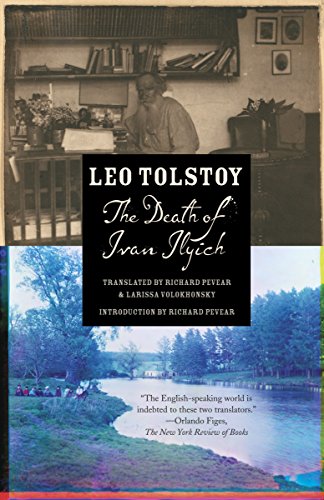
Tolstoy’s most famous novella is an intense and moving examination of death and the possibilities of redemption, here in a powerful translation by the award-winning Richard Pevear and Larissa Volokhonsky.
Ivan Ilyich is a middle-aged man who has spent his life focused on his career as a bureaucrat and emotionally detached from his wife and children. After an accident he finds himself on the brink of an untimely death, which he sees as a terrible injustice. Face to face with his mortality, Ivan begins to question everything he has believed about the meaning of life. The Death of Ivan Ilyich is a masterpiece of psychological realism and philosophical profundity that has inspired generations of readers.
Die Inhaltsangabe kann sich auf eine andere Ausgabe dieses Titels beziehen.
Über die Autorin bzw. den Autor
Count Leo Tolstoy (1828–1910) was born in central Russia. After serving in the Crimean War, he retired to his estate and devoted himself to writing, farming, and raising his large family. His novels and outspoken social polemics brought him world fame.
Richard Pevear has published translations of Alain, Yves Bonnefoy, Alberto Savinio, Pavel Florensky, and Henri Volohonsky, as well as two books of poetry. He has received fellowships or grants for translation from the National Endowment for the Arts, the Ingram Merrill Foundation, the Guggenheim Foundation, the National Endowment for the Humanities, and the French Ministry of Culture. Larissa Volokhonsky was born in Leningrad. She has translated works by the prominent Orthodox theologians Alexander Schmemann and John Meyendorff into Russian.
Together, Pevear and Volokhonsky have translated Dead Souls and The Collected Tales by Nikolai Gogol, The Complete Short Novels of Chekhov, and The Brothers Karamazov, Crime and Punishment, Notes from Underground, Demons, The Idiot, and The Adolescent by Fyodor Dostoevsky. They were twice awarded the PEN Book-of-the-Month Club Translation Prize (for their version of Dostoevsky's The Brothers Karamazov and for Tolstoy's Anna Karenina), and their translation of Dostoevsky's Demons was one of three nominees for the same prize. They are married and live in France.
Auszug. © Genehmigter Nachdruck. Alle Rechte vorbehalten.
CHAPTER 1
In the large building housing the Law Courts, during a recess in the Melvinsky proceedings, members of the court and the public prosecutor met in the office of Ivan Egorovich Shebek, where the conversation turned on the celebrated Krasov case. Fyodor Vasilyevich vehemently denied that it was subject to their jurisdiction, Ivan Egorovich clung to his own view, while Pyotr Ivanovich, who had taken no part in the dispute from the outset, glanced through a copy of the News that had just been delivered.
"Gentlemen!" he said. "Ivan Ilyich is dead."
"Really?"
"Here, read this," he said to Fyodor Vasilyevich, handing him the fresh issue, still smelling of printer's ink.
Framed in black was the following announcement: "With profound sorrow Praskovya Fyodorovna Golovina informs relatives and acquaintances that her beloved husband, Ivan Ilyich Golovin, Member of the Court of Justice, passed away on the 4th of February, 1882. The funeral will be held on Friday at one o'clock."
Ivan Ilyich had been a colleague of the gentlemen assembled here and they had all been fond of him. He had been ill for some weeks and his disease was said to be incurable. His post had been kept open for him, but it had been speculated that in the event of his death Alekseev might be appointed to his place and either Vinnikov or Shtabel succeed Alekseev. And so the first thought that occurred to each of the gentlemen in this office, learning of Ivan Ilyich's death, was what effect it would have on their own transfers and promotions or those of their acquaintances.
"Now I'm sure to get Shtabel's post or Vinnikov's," thought Fyodor Vasilyevich. "It was promised to me long ago, and the promotion will mean an increase of eight hundred rubles in salary plus an allowance for office expenses."
"I must put in a request to have my brother-in-law transferred from Kaluga," thought Pyotr Ivanovich. "My wife will be very happy. Now she won't be able to say I never do anything for her family."
"I had a feeling he'd never get over it," said Pyotr Ivanovich. "Sad."
"What, exactly, was the matter with him?"
"The doctors couldn't decide. That is, they decided, but in different ways. When I last saw him, I thought he would recover."
"And I haven't been there since the holidays. I kept meaning to go."
"Was he a man of any means?"
"His wife has a little something, I think, but nothing much."
"Well, there's no question but that we'll have to go and see her. They live so terribly far away."
"From you, that is. From your place, everything's far away."
"You see, he just can't forgive me for living on the other side of the river," said Pyotr Ivanovich, smiling at Shebek. And with that they began talking about relative distances in town and went back to the courtroom.
In addition to the speculations aroused in each man's mind about the transfers and likely job changes this death might occasion, the very fact of the death of a close acquaintance evoked in them all the usual feeling of relief that it was someone else, not they, who had died.
"Well, isn't that something--he's dead, but I'm not," was what each of them thought or felt. The closer acquaintances, the so-called friends of Ivan Ilyich, involuntarily added to themselves that now they had to fulfill the tedious demands of propriety by attending the funeral service and paying the widow a condolence call.
Fyodor Vasilyevich and Pyotr Ivanovich had been closest to him. Pyotr Ivanovich had studied law with Ivan Ilyich and considered himself indebted to him. At dinner that evening he told his wife the news of Ivan Ilyich's death, conjectured about the possibility of having her brother transferred to their district, and then, dispensing with his usual nap, he put on a dress coat and drove to Ivan Ilyich's home.
A carriage and two cabs were parked before the entrance. Downstairs in the hallway, next to the coat stand, a coffin lid decorated with silk brocade, tassels, and highly polished gilt braid was propped against the wall. Two women in black were taking off their fur coats. One of them he recognized as Ivan Ilyich's sister; the other was a stranger. Schwartz, his colleague, was just starting down the stairs, but on seeing Pyotr Ivanovich enter, he paused at the top step and winked at him as if to say: "Ivan Ilyich has really bungled--not the sort of thing you and I would do."
There was, as usual, an air of elegant solemnity about Schwartz, with his English side-whiskers and his lean figure in a dress coat, and this solemnity, always such a marked contrast to his playful personality, had a special piquancy here. So, at least, Pyotr Ivanovich thought.
Pyotr Ivanovich stepped aside to let the ladies pass and slowly followed them up the stairs. Schwartz did not proceed downward but remained on the landing. Pyotr Ivanovich understood why; obviously, he wanted to arrange where they should play whist that evening. The ladies went upstairs to the widow's quarters, while Schwartz, his lips compressed into a serious expression and his eyes gleaming playfully, jerked his brows to the right to indicate the room where the dead man lay.
Pyotr Ivanovich went in bewildered, as people invariably are, about what he was expected to do there. The one thing he knew was that on such occasions it never did any harm to cross oneself. He was not quite certain whether he ought also to bow and so he adopted a middle course: on entering the room he began to cross himself and make a slight movement resembling a bow. At the same time, to the extent that the motions of his hands and head permitted, he glanced about the room. Two young people, apparently nephews, one of them a gymnasium student, were crossing themselves as they left the room. An old woman was standing motionless. And a lady with peculiarly arched brows was whispering something to her. A church reader in a frock coat--a vigorous, resolute fellow--was reading something in a loud voice and in a tone that brooked no contradiction. The pantry boy, Gerasim, stepped lightly in front of Pyotr Ivanovich, sprinkling something about the floor. Seeing this, Pyotr Ivanovich immediately became aware of a faint odor of decomposition. On his last visit Pyotr Ivanovich had seen this peasant boy in Ivan Ilyich's study; he had acted as a sick nurse to the dying man and Ivan Ilyich had been particularly fond of him.
Pyotr Ivanovich went on crossing himself and bowing slightly in a direction midway between the coffin, the church reader, and the icons on a table in the corner. Then, when he felt he had overdone the crossing, he paused and began to examine the dead man.
The body lay, as the dead invariably do, in a peculiarly heavy manner, with its rigid limbs sunk into the bedding of the coffin and its head eternally bowed on the pillow, exhibiting, as do all dead bodies, a yellow waxen forehead (with bald patches gleaming on the sunken temples), the protruding nose beneath seeming to press down against the upper lip. Ivan Ilyich had changed a great deal, grown even thinner since Pyotr Ivanovich had last seen him, and yet, as with all dead men, his face had acquired an expression of greater beauty--above all, of greater significance--than it had in life. Its expression implied that what needed to be done had been done and done properly. Moreover, there was in this expression a reproach or a reminder to the living. This reminder seemed out of place to Pyotr Ivanovich, or at least inapplicable to him. He began to feel somewhat uncomfortable and so he crossed himself...
„Über diesen Titel“ kann sich auf eine andere Ausgabe dieses Titels beziehen.
Suchergebnisse für The Death of Ivan Ilyich (Vintage Classics)

Foto des Verkäufers
The Death of Ivan Ilyich (Vintage Classics)
Anbieter: Dream Books Co., Denver, CO, USA
Verkäuferbewertung 5 von 5 Sternen

Zustand: acceptable. This copy has clearly been enjoyedâ"expect noticeable shelf wear and some minor creases to the cover. Binding is strong, and all pages are legible. May contain previous library markings or stamps. Bestandsnummer des Verkäufers DBV.0307951332.A
Gebraucht kaufen
EUR 6,30
Versand gratis
Versand innerhalb von USA
Versand innerhalb von USA
Anzahl: 1 verfügbar
Beispielbild für diese ISBN
The Death of Ivan Ilyich
Anbieter: ThriftBooks-Dallas, Dallas, TX, USA
Verkäuferbewertung 5 von 5 Sternen
Paperback. Zustand: Fair. No Jacket. Readable copy. Pages may have considerable notes/highlighting. ~ ThriftBooks: Read More, Spend Less. Bestandsnummer des Verkäufers G0307951332I5N00
Gebraucht kaufen
EUR 7,51
Versand gratis
Versand innerhalb von USA
Versand innerhalb von USA
Anzahl: 1 verfügbar
Beispielbild für diese ISBN
The Death of Ivan Ilyich
Anbieter: ThriftBooks-Dallas, Dallas, TX, USA
Verkäuferbewertung 5 von 5 Sternen
Paperback. Zustand: As New. No Jacket. Pages are clean and are not marred by notes or folds of any kind. ~ ThriftBooks: Read More, Spend Less. Bestandsnummer des Verkäufers G0307951332I2N00
Gebraucht kaufen
EUR 7,51
Versand gratis
Versand innerhalb von USA
Versand innerhalb von USA
Anzahl: 1 verfügbar
Beispielbild für diese ISBN
The Death of Ivan Ilyich
Anbieter: ThriftBooks-Atlanta, AUSTELL, GA, USA
Verkäuferbewertung 5 von 5 Sternen
Paperback. Zustand: Very Good. No Jacket. May have limited writing in cover pages. Pages are unmarked. ~ ThriftBooks: Read More, Spend Less. Bestandsnummer des Verkäufers G0307951332I4N00
Gebraucht kaufen
EUR 7,51
Versand gratis
Versand innerhalb von USA
Versand innerhalb von USA
Anzahl: 1 verfügbar
Beispielbild für diese ISBN
The Death of Ivan Ilyich
Anbieter: ThriftBooks-Dallas, Dallas, TX, USA
Verkäuferbewertung 5 von 5 Sternen
Paperback. Zustand: Very Good. No Jacket. May have limited writing in cover pages. Pages are unmarked. ~ ThriftBooks: Read More, Spend Less. Bestandsnummer des Verkäufers G0307951332I4N00
Gebraucht kaufen
EUR 7,51
Versand gratis
Versand innerhalb von USA
Versand innerhalb von USA
Anzahl: 1 verfügbar
Beispielbild für diese ISBN
The Death of Ivan Ilyich
Anbieter: ThriftBooks-Atlanta, AUSTELL, GA, USA
Verkäuferbewertung 5 von 5 Sternen
Paperback. Zustand: Fair. No Jacket. Readable copy. Pages may have considerable notes/highlighting. ~ ThriftBooks: Read More, Spend Less. Bestandsnummer des Verkäufers G0307951332I5N00
Gebraucht kaufen
EUR 7,51
Versand gratis
Versand innerhalb von USA
Versand innerhalb von USA
Anzahl: 1 verfügbar
Beispielbild für diese ISBN
The Death of Ivan Ilyich
Anbieter: ThriftBooks-Reno, Reno, NV, USA
Verkäuferbewertung 5 von 5 Sternen
Paperback. Zustand: Fair. No Jacket. Readable copy. Pages may have considerable notes/highlighting. ~ ThriftBooks: Read More, Spend Less. Bestandsnummer des Verkäufers G0307951332I5N00
Gebraucht kaufen
EUR 7,51
Versand gratis
Versand innerhalb von USA
Versand innerhalb von USA
Anzahl: 1 verfügbar
Beispielbild für diese ISBN
The Death of Ivan Ilyich (Vintage Classics)
Anbieter: Half Price Books Inc., Dallas, TX, USA
Verkäuferbewertung 5 von 5 Sternen
Paperback. Zustand: Very Good. Connecting readers with great books since 1972! Used books may not include companion materials, and may have some shelf wear or limited writing. We ship orders daily and Customer Service is our top priority! Bestandsnummer des Verkäufers S_485394298
Gebraucht kaufen
EUR 4,48
EUR 3,27 Versand
Versand innerhalb von USA
Versand innerhalb von USA
Anzahl: 1 verfügbar
Beispielbild für diese ISBN
The Death of Ivan Ilyich (Vintage Classics)
Anbieter: HPB Inc., Dallas, TX, USA
Verkäuferbewertung 5 von 5 Sternen
Paperback. Zustand: Very Good. Connecting readers with great books since 1972! Used books may not include companion materials, and may have some shelf wear or limited writing. We ship orders daily and Customer Service is our top priority! Bestandsnummer des Verkäufers S_483915864
Gebraucht kaufen
EUR 4,48
EUR 3,27 Versand
Versand innerhalb von USA
Versand innerhalb von USA
Anzahl: 1 verfügbar
Beispielbild für diese ISBN
The Death of Ivan Ilyich (Vintage Classics)
Anbieter: Lakeside Books, Benton Harbor, MI, USA
Verkäuferbewertung 5 von 5 Sternen
Zustand: New. Brand New! Not Overstocks or Low Quality Book Club Editions! Direct From the Publisher! We're not a giant, faceless warehouse organization! We're a small town bookstore that loves books and loves it's customers! Buy from Lakeside Books! Bestandsnummer des Verkäufers OTF-S-9780307951335