
Verwandte Artikel zu The 4% Solution: Unleashing the Economic Growth America...
Inhaltsangabe
Foreword by President George W. Bush
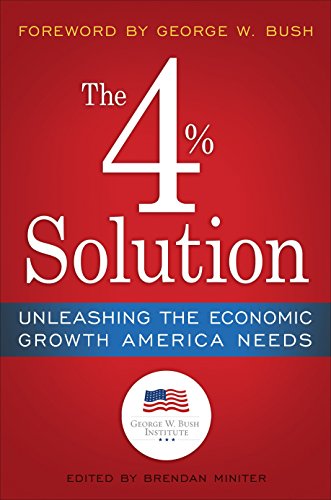
With contributions from world renowned economists and Nobel prizewinners, The 4% Solution is a blueprint for restoring America’s economic health
The United States is reaching a pivotal point in its economic history. Millions of Americans owe more on their homes than they are worth, long-term unemployment is alarmingly high, and the Congressional Budget Office is projecting a sustainable growth rate of only 2.3%—a full percentage point below the average for the past sixty years. Unless a turnaround comes quickly, the United States could be mired in debt for years to come and millions of Americans will be pushed to the sidelines of the economy.
The 4% Solution offers clear and unflinching ideas on how to revive America’s economy. It sets a positive economic goal and asks some of the top economic minds on how to achieve it. With a focus on removing government constraints, The 4% Solution defines the policies that will allow Americans to save, invest, and create the jobs that the United States needs.
The 4% Solution draws on the best minds in the business, including five Nobel laureates:
· Robert E. Lucas, Jr., on the history and future of economic growth
· Gary S. Becker on why we need immigrants in order to grow
· Edward Prescott on the cost (to growth) of the welfare state
· Vernon Smith on why housing leads us into and out of recessions
· Myron Scholes on why we need to innovate in order to grow the economy
Die Inhaltsangabe kann sich auf eine andere Ausgabe dieses Titels beziehen.
Über die Autorin bzw. den Autor
The George W. Bush Institute is the policy research arm of the Bush Presidential Center and Library in Dallas, Texas.
Auszug. © Genehmigter Nachdruck. Alle Rechte vorbehalten.
Chapter 1
Why We Grow
By Brendan Miniter
Economic growth is not an issue normally associated with the Pentagon. But on January 23, 2006, in a little-noticed ceremony, officials there handed the Defense Department’s Distinguished Public Service Award to then outgoing Federal Reserve chairman Alan Greenspan. The reason for the award: He helped unleash tremendous economic growth that had strengthened the country, led to new advances in science and technology, and demonstrated the power of a free and open economic system.
The importance of economic prosperity is hard to overstate. A growing economy produces jobs that allow workers to provide for their families, live comfortable and stable lives, and give back to their communities. A growing economy creates new opportunities for entrepreneurs. And it also creates the capital needed to support innovation and research in science and the arts. America’s economy has long produced the types of jobs that have enabled Americans to enjoy comfortable middle-class lives.
From the end of World War II until our recent “Great Recession,” the United States economy grew, on average, at a little more than 3% annually. At that rate the size of the economy doubles roughly every generation. There were, of course, recessions during that period. But nearly every economic downturn was followed by a period of significant growth. Over the past seventy years, the American economy has grown at 4% or greater about two-fifths of the time. The result has been a rapid transformation. Today most Americans have a substantially higher standard of living than previous generations. And they also carry with them an expectation for growth. Americans hold the optimistic view that it is natural for the economy to grow at a rapid pace year in and year out.
But survey the historical data stretching back long before World War II and you may be surprised to see that economic growth is a relatively new phenomenon. In an essay1 published before he won the Nobel Prize in Economics in 1995, Robert Lucas outlined the history of economic growth. His findings show that prior to the industrial revolution in the middle of the 18th century, per capita gross domestic product (GDP) growth had largely been flat around the world. Technological advancement had occurred, but the economic gains that were made were essentially offset by increases in population.
However, with the advent of the industrial revolution, economic growth managed to outrun population (industrialized economies grew, while birthrates declined) and the result was the rise of a middle class. Lucas calculates that the world economy grew at a fraction of 1% annually through the latter half of the 18th century, at about 1% annually on average through the 19th century, at about 2.4% for the first sixty years of the 20th century, and at about 4% annually after that.
Modern growth theory--the theory that looks at innovation and human ingenuity as engines for expanding the economy--is itself relatively new. Robert M. Solow, the economist often credited with advancing modern economic thought in this area, did much of his groundbreaking work in the 1950s and ’60s. Others, such as Lucas, have since developed alternative growth models, which have sparked research and debate among economists about the role of human capital, entrepreneurship, and other factors in economic growth. The short of it is that these are exciting times to be thinking about economics, growth, and the outer limits of human potential. There is a lot of cutting-edge work being done now. And it is reshaping what we know to be possible, while also forcing us to realize that much of what we have done in the past may have actually hamstrung the economy.
Consider the work of another economist who hasn’t won the Nobel Prize, but likely deserves such high honors: Gordon Tullock. Half a century ago, he worked closely with economist James Buchanan, who went on to win the Nobel for his work on something called public choice theory--a body of ideas that argues that rather than being driven by altruistic motives, government policies are often driven by hidden incentives. For example, government agencies have a strong incentive to spend all the money in their budgets, even if they have to spend it in wasteful ways, because not spending the money can lead lawmakers to cut those agencies’ budgets the following year.
The combined contributions of Tullock and Buchanan can be found in an often cited volume, The Calculus of Consent, which sorts through incentives that drive democratic systems and offers reasons why, for example, a legislature might back public policies that are not widely popular and may not even serve the greater public good. But perhaps Tullock’s most relevant work to discussions of economic growth has to do with what has been called “rent seekers”--those who seek special payment or privilege, usually from the government. His insight, accessible in a volume titled The Rent-Seeking Society, is simply that individuals or institutions often seek to profit by tilting the political landscape in their direction, rather than by creating real value.
This concept is critical to understand in today’s environment of large federal deficits and a stumbling economy. It’s often assumed that federal spending will stimulate the economy--after all, it pumps money into the system. But Tullock’s insight offers us an explanation into why government spending can actually be harmful to economic growth. Spending is funded by taxes, which pulls capital out of the productive economy. The destructive power of taxes is something that has been long discussed and seems to be well understood. Collecting taxes, however, is only part of the harm that public policies can cause. Rent seekers, as Tullock discovered, profit through the political process, not by producing a better or cheaper product. Their aim is to receive payment (or privilege) through government policy.
In some cases, rent seekers can look to gain privilege by lobbying for new regulations that, if imposed, would harm their competitors. In other cases, rent seekers can look to profit by receiving government payments or inflated prices thanks to government policies. Donald Boudreaux, an economics professor at George Mason University, brilliantly illustrated Tullock’s insight in the Christian Science Monitor in late 2008 by looking at Illinois governor Rod Blagojevich. At the time, Blagojevich was at the center of a corruption story involving naming someone to fill a vacant Senate seat.2 Boudreaux concluded that when the government can bestow a privilege or profit on someone there is a strong incentive for entrepreneurial people to spend their time figuring out how to profit off the government. “As Tullock first recognized (in a paper published in 1967),” Boudreaux wrote, “enormous amounts of resources--including human talent--are wasted in pursuit of government privileges.”
Not all payments or privileges provided by the government are problematic or even wasteful. But since the government uses a political process to decide whom it pays and how much, there is little incentive for rent seekers to push for greater efficiency or innovation. This is a problem in part because the public and the private sectors compete for the same financial and human capital. That is to say, they compete for the same pile of money and the same group of innovative entrepreneurs. So when the government spends a large volume of money, there is that much less money in the system for private entrepreneurs. And when the government has a wide variety of programs that businesses can profit from, without being efficient producers, it drains away talented entrepreneurs who would otherwise put their talents to work in the private...
„Über diesen Titel“ kann sich auf eine andere Ausgabe dieses Titels beziehen.
Suchergebnisse für The 4% Solution: Unleashing the Economic Growth America...

Beispielbild für diese ISBN
The 4% Solution: Unleashing the Economic Growth America Needs
Anbieter: Gulf Coast Books, Cypress, TX, USA
Verkäuferbewertung 5 von 5 Sternen

Hardcover. Zustand: Good. Bestandsnummer des Verkäufers 0307986144-3-19740710
Gebraucht kaufen
EUR 3,78
Versand gratis
Versand innerhalb von USA
Versand innerhalb von USA
Anzahl: 1 verfügbar
Beispielbild für diese ISBN
The 4% Solution: Unleashing th
Anbieter: World of Books (was SecondSale), Montgomery, IL, USA
Verkäuferbewertung 5 von 5 Sternen
Zustand: Good. Item in good condition. Textbooks may not include supplemental items i.e. CDs, access codes etc. Bestandsnummer des Verkäufers 00103245934
Gebraucht kaufen
EUR 3,78
Versand gratis
Versand innerhalb von USA
Versand innerhalb von USA
Anzahl: 4 verfügbar
Beispielbild für diese ISBN
The 4% Solution: Unleashing th
Anbieter: World of Books (was SecondSale), Montgomery, IL, USA
Verkäuferbewertung 5 von 5 Sternen
Zustand: Acceptable. Item in acceptable condition! Textbooks may not include supplemental items i.e. CDs, access codes etc. Bestandsnummer des Verkäufers 00101929263
Gebraucht kaufen
EUR 3,78
Versand gratis
Versand innerhalb von USA
Versand innerhalb von USA
Anzahl: 1 verfügbar
Foto des Verkäufers
The 4% Solution: Unleashing the Economic Growth America Needs
Anbieter: Zoom Books East, Glendale Heights, IL, USA
Verkäuferbewertung 5 von 5 Sternen
Zustand: very_good. Book is in very good condition and may include minimal underlining highlighting. The book can also include "From the library of" labels. May not contain miscellaneous items toys, dvds, etc. . We offer 100% money back guarantee and 24 7 customer service. Bestandsnummer des Verkäufers ZEV.0307986144.VG
Gebraucht kaufen
EUR 3,97
Versand gratis
Versand innerhalb von USA
Versand innerhalb von USA
Anzahl: 2 verfügbar
Foto des Verkäufers
The 4% Solution: Unleashing the Economic Growth America Needs
Anbieter: Greenworld Books, Arlington, TX, USA
Verkäuferbewertung 5 von 5 Sternen
Zustand: very_good. Fast Free Shipping â" Very Good condition book with a firm cover and clean pages. Shows normal use and some light wear or limited notes markings. A solid, nice copy to enjoy. Bestandsnummer des Verkäufers GWV.0307986144.VG
Gebraucht kaufen
EUR 4,59
Versand gratis
Versand innerhalb von USA
Versand innerhalb von USA
Anzahl: 1 verfügbar
Beispielbild für diese ISBN
The 4% Solution: Unleashing the Economic Growth America Needs
Anbieter: World of Books Inc, Montgomery, IL, USA
Verkäuferbewertung 4 von 5 Sternen

Hardback. Zustand: Fair. Foreword by President George W. Bush With contributions from world renowned economists and Nobel prizewinners, The 4% Solution is a blueprint for restoring America's economic health The United States is reaching a pivotal point in its economic history. Millions of Americans owe more on their homes than they are worth, long-term unemployment is alarmingly high, and the Congressional Budget Office is projecting a sustainable growth rate of only 2.3%-a full percentage point below the average for the past sixty years. Unless a turnaround comes quickly, the United States could be mired in debt for years to come and millions of Americans will be pushed to the sidelines of the economy. The 4% Solution offers clear and unflinching ideas on how to revive America's economy. It sets a positive economic goal and asks some of the top economic minds on how to achieve it. With a focus on removing government constraints, The 4% Solution defines the policies that will allow Americans to save, invest, and create the jobs that the United States needs. The 4% Solution draws on the best minds in the business, including five Nobel laureates: Robert E. Lucas, Jr., on the history and future of economic growth Gary S. Becker on why we need immigrants in order to grow Edward Prescott on the cost (to growth) of the welfare state Vernon Smith on why housing leads us into and out of recessions Myron Scholes on why we need to innovate in order to grow the economy. Bestandsnummer des Verkäufers CIN0307986144A
Gebraucht kaufen
EUR 5,58
Versand gratis
Versand innerhalb von USA
Versand innerhalb von USA
Anzahl: 1 verfügbar
Beispielbild für diese ISBN
The 4% Solution: Unleashing the Economic Growth America Needs
Anbieter: World of Books Inc, Montgomery, IL, USA
Verkäuferbewertung 4 von 5 Sternen
Hardback. Zustand: Good. Foreword by President George W. Bush With contributions from world renowned economists and Nobel prizewinners, The 4% Solution is a blueprint for restoring America's economic health The United States is reaching a pivotal point in its economic history. Millions of Americans owe more on their homes than they are worth, long-term unemployment is alarmingly high, and the Congressional Budget Office is projecting a sustainable growth rate of only 2.3%-a full percentage point below the average for the past sixty years. Unless a turnaround comes quickly, the United States could be mired in debt for years to come and millions of Americans will be pushed to the sidelines of the economy. The 4% Solution offers clear and unflinching ideas on how to revive America's economy. It sets a positive economic goal and asks some of the top economic minds on how to achieve it. With a focus on removing government constraints, The 4% Solution defines the policies that will allow Americans to save, invest, and create the jobs that the United States needs. The 4% Solution draws on the best minds in the business, including five Nobel laureates: Robert E. Lucas, Jr., on the history and future of economic growth Gary S. Becker on why we need immigrants in order to grow Edward Prescott on the cost (to growth) of the welfare state Vernon Smith on why housing leads us into and out of recessions Myron Scholes on why we need to innovate in order to grow the economy. Bestandsnummer des Verkäufers CIN0307986144G
Gebraucht kaufen
EUR 5,58
Versand gratis
Versand innerhalb von USA
Versand innerhalb von USA
Anzahl: 4 verfügbar
Beispielbild für diese ISBN
The 4% Solution : Unleashing the Economic Growth America Needs
Verlag:
Crown Publishing Group, The, 2012
ISBN 10: 0307986144
ISBN 13: 9780307986146
Gebraucht
Hardcover
Anbieter: Better World Books, Mishawaka, IN, USA
Verkäuferbewertung 5 von 5 Sternen
Zustand: Good. Pages intact with minimal writing/highlighting. The binding may be loose and creased. Dust jackets/supplements are not included. Stock photo provided. Product includes identifying sticker. Better World Books: Buy Books. Do Good. Bestandsnummer des Verkäufers 5973457-75
Gebraucht kaufen
EUR 6,21
Versand gratis
Versand innerhalb von USA
Versand innerhalb von USA
Anzahl: 1 verfügbar
Beispielbild für diese ISBN
The 4% Solution : Unleashing the Economic Growth America Needs
Verlag:
Crown Publishing Group, The, 2012
ISBN 10: 0307986144
ISBN 13: 9780307986146
Gebraucht
Hardcover
Anbieter: Better World Books, Mishawaka, IN, USA
Verkäuferbewertung 5 von 5 Sternen
Zustand: Good. Former library copy. Pages intact with minimal writing/highlighting. The binding may be loose and creased. Dust jackets/supplements are not included. Includes library markings. Stock photo provided. Product includes identifying sticker. Better World Books: Buy Books. Do Good. Bestandsnummer des Verkäufers 2258314-75
Gebraucht kaufen
EUR 6,21
Versand gratis
Versand innerhalb von USA
Versand innerhalb von USA
Anzahl: 1 verfügbar
Beispielbild für diese ISBN
The 4% Solution: Unleashing the Economic Growth America Needs
Anbieter: Wonder Book, Frederick, MD, USA
Verkäuferbewertung 5 von 5 Sternen
Zustand: Very Good. Very Good condition. Very Good dust jacket. A copy that may have a few cosmetic defects. May also contain light spine creasing or a few markings such as an owner's name, short gifter's inscription or light stamp. Bestandsnummer des Verkäufers X05I-00355
Gebraucht kaufen
EUR 6,88
Versand gratis
Versand innerhalb von USA
Versand innerhalb von USA
Anzahl: 1 verfügbar