
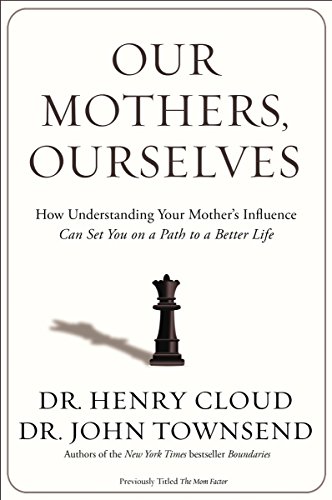
Our Mothers, Ourselves: How Understanding Your Mother's Influence Can Set You on a Path to a Better Life - Softcover
Inhaltsangabe
In Our Mothers, Ourselves, Henry Cloud and John Townsend show how understanding how our mothers have profoundly influenced our lives can set us on a path toward wholeness and growth.
No one has influenced the person you are today like your mother. The way she handled your needs as a child has shaped your worldview, your relationships, your marriage, your career, your self-image - your life. Our Mothers, Ourselves can help you identify areas that need reshaping, to make positive choices for personal change, and to establish a mature relationship with Mom today.
- The Phantom Mom
- The China Doll Mom
- The Controlling Mom
- The Trophy Mom
- The Still-the-Boss Mom
- The American Express Mom
You'll learn how your mom affected you as a child and may still be affecting you today. Our Mothers, Ourselves is a biblical, realistic, and empowering route to wholeness and growth, to deeper and more satisfying bonds with your family, friends, and spouse - and to a new, healthier way of relating to your mother.
This book was previously titled The Mom Factor.
Die Inhaltsangabe kann sich auf eine andere Ausgabe dieses Titels beziehen.
Über die Autorinnen und Autoren
Dr. Henry Cloud is a clinical psychologist, pastor to pastors, and New York Times bestselling author. His 45 books, including the iconic Boundaries, have sold over 20 million copies worldwide. Throughout his storied career as a clinician, he started treatment centers, created breakthrough new models rooted in research, and has been a leading voice on issues of mental health and leadership on a global scale. Dr. Cloud lives in Los Angeles with his wife, Tori, and their two daughters, Olivia and Lucy.
Dr. John Townsend is a nationally known leadership consultant, psychologist, and author, selling over 10 million books, including the New York Times bestselling Boundaries series. John founded the Townsend Institute for Leadership and Counseling and the Townsend Leadership Program. Dr. Townsend travels extensively for corporate consulting, speaking events, and to help develop leaders, their teams, and their families. John and his family live in Southern California and Texas. Visit DrTownsend.com.
Auszug. © Genehmigter Nachdruck. Alle Rechte vorbehalten.
The Mom Factor
Dealing with the Mother You Had, Didn't Have, or Still Contend With
By Henry Cloud, John TownsendZONDERVAN
Copyright © 1996 Henry Cloud and John Townsend
All rights reserved.
ISBN: 978-0-310-34253-3All rights reserved.
Contents
Introduction, 7,
1. What About Mom, Anyhow?, 11,
2. The Phantom Mom, 23,
3. Rebuilding Your Connection, 39,
4. The China Doll Mom, 55,
5. Getting It Together, 71,
6. The Controlling Mom, 89,
7. Becoming Your Own Person, 109,
8. The Trophy Mom, 125,
9. Getting Real, 141,
10. The Still-the-Boss Mom, 157,
11. Rebuilding Your Adulthood, 173,
12. The American Express Mom, 189,
13. Leaving Home the Right Way, 203,
14. For Women Only, 219,
15. For Men Only, 233,
16. What About Now?, 249,
Notes, 253,
CHAPTER 1
What About Mom, Anyhow?
Beth hung up the phone, frustrated, confused, and discouraged. She had just spent ninety minutes talking to her mother — ninety minutes of wasted time. As a working mother, Beth didn't have that kind of time to spare.
She had tried to explain to her mom that their vacation plans wouldn't include a visit to see her. "You know we'd love to see you," Beth said, trying to reason with her mom, "but this vacation we really wanted to see the Grand Canyon."
The silence that followed was too familiar to Beth. Hurt, distance, and coldness were the hallmarks of saying no to her mother. Beth tried to scramble and make some connection with her. "Mom, we'll make a real effort to see you on the next trip."
"That won't be necessary. I'm sure you'll be too busy for me then too." Her mother hung up, and the dial tone accented that ache in Beth's stomach that she knew too well. Again, she realized that her mother couldn't be pleased; Beth was always "not enough," or "too much" something. It was confusing: Was she really an ungrateful, selfish daughter, or did her mother have too many expectations?
Beth loved her mother deeply and desired more than anything to have a close, respectful relationship with her. She remembered the commandment to "honor thy father and mother," and thought, This is impossible. If I honor her, I dishonor my family, and if I honor my family, I dishonor her. She resigned herself to the way things always had been and went back to planning the vacation. However, emptiness now surrounded the entire project.
WHAT'S WRONG?
This scene repeats itself millions of times daily around the world. Every six seconds, another adult alternates between resentment, anger, guilt, fear, and confusion about ongoing interaction with a mother.
Most people want a comfortable, mutually satisfying friendship with that very significant person in our life — our mother. But the reality falls short of the ideal. You may experience "mother trouble" in several areas. You may feel:
• unable to communicate with her
• her lack of respect for your choices and values
• her refusal to accept your own family and friends
• a lack of freedom to have a separate life without losing her love
• disconnected from and misunderstood by her
• difficulty in saying no and confronting her
• you have to hide your real self and be perfect
• responsible to make her think that she is perfect
• guilt when you don't take care of her as she wants you to
• disillusionment and conflict over her interactions with your spouse
• guilt over not living up to her expectations and wishes
• sorrow that she can't seem to comprehend your pain s childlike in her presence
• frustration over her seeming self-absorption
• like cringing when she treats your children in familiar hurtful ways
• discouraged that this list is so long
The list could go on, but it points to a fundamental truth: Our relationship with our mother either in the past or present hasn't left us where we want to be. You may wish you and your mom were closer. And you may wish she had better prepared you for other aspects of life.
For not only does the quality of your relationship with your mother dictate how things go between the two of you, it also drastically impacts all areas of your life. Not only do we learn our patterns of intimacy, relating, and separateness from mother, but we also learn about how to handle failure, troublesome emotions, expectations and ideals, grief and loss, and many of the other components that make up our "emotional IQ" — that part of us that guarantees whether or not we will be successful at love and work. In short, the following two realities largely determine our emotional development:
1. How we were mothered
2. How we have responded to that mothering
* * *
Dave got out of the car in the flower shop parking lot. It was another apology bouquet day. His wife, Cindy, had been in tears last night when she had staged a special evening alone with him without the kids. Dinner had gone well, and she had been looking forward to an evening of intimacy and vulnerability. Yet when she looked into his eyes and asked him how he was feeling about their marriage and life in general, Dave had shut down inside. As usual he was at a loss for words and could not bridge the emotional gap between himself and his wife.
"Maybe I just don't deserve her ... a husband is supposed to love his wife, so why don't I even desire this closeness that's so important to her? What's wrong with me?" he wondered, as he plunked down another bill for the flowers. "Are flowers the best I'll ever do?"
Dave's dilemma would seem at first glance to have little to do with mothering problems. He just knew he had a problem with his wife. But the reality is that Dave's pattern of relating was working exactly as God planned: we learn from our parents about relationship. In his relationship with his mother, Dave had learned that closeness could be dangerous. For example, when he was scared or hurt, his mother would become anxious and fuss over him to the point that he felt smothered. As a result, any time his wife moved toward him in an emotional way, his walls went up, and he braced himself against emotional overinvolvement. He found himself in a lose-lose situation. While he did not like being cut off from his wife, he did not like being close either. Either position left his wife feeling unfulfilled. Until Dave dealt with his fears of intimacy, this pattern would continue.
Dave's struggle illustrates the major point of this book: What we learned in our relationship with our mother deeply affects every area of our adult life.
DOES IT HAVE TO BE THIS WAY?
Just as God's plan for us to learn patterns of relating from our mothers can end up wreaking destruction in our adult lives, so can his plan of repair bring change and growth.
As a single man, Mark had noticed patterns in his relationships similar to Dave's pattern with his wife: He couldn't sustain long-term, intimate relationships. He'd get close to an eligible woman, even consider marriage, and then inexplicably back off from the relationship, complaining that she was "too demanding," or "too serious," or "not serious enough," or whatever. For years he simply told himself that he just couldn't find the "right one," until a friend suggested that the problem might be him. In response to his friend's suggestion, Mark joined a support group that dealt with issues of intimacy and trust. It was hard work at first as those...
„Über diesen Titel“ kann sich auf eine andere Ausgabe dieses Titels beziehen.
Suchergebnisse für Our Mothers, Ourselves: How Understanding Your Mother's...

Foto des Verkäufers
Our Mothers, Ourselves: How Understanding Your Mother's Influence Can Set You on a Path to a Better Life
Anbieter: Zoom Books Company, Lynden, WA, USA
Verkäuferbewertung 5 von 5 Sternen

Zustand: very_good. Book is in very good condition and may include minimal underlining highlighting. The book can also include "From the library of" labels. May not contain miscellaneous items toys, dvds, etc. . We offer 100% money back guarantee and 24 7 customer service. Bestandsnummer des Verkäufers ZBV.0310342538.VG
Gebraucht kaufen
EUR 4,73
Versand gratis
Versand innerhalb von USA
Versand innerhalb von USA
Anzahl: 2 verfügbar
Foto des Verkäufers
Our Mothers, Ourselves: How Understanding Your Mother's Influence Can Set You on a Path to a Better Life
Anbieter: Greenworld Books, Arlington, TX, USA
Verkäuferbewertung 5 von 5 Sternen
Zustand: good. Fast Free Shipping â" Good condition. It may show normal signs of use, such as light writing, highlighting, or library markings, but all pages are intact and the book is fully readable. A solid, complete copy that's ready to enjoy. Bestandsnummer des Verkäufers GWV.0310342538.G
Gebraucht kaufen
EUR 5,32
Versand gratis
Versand innerhalb von USA
Versand innerhalb von USA
Anzahl: 1 verfügbar
Foto des Verkäufers
Our Mothers, Ourselves: How Understanding Your Mother's Influence Can Set You on a Path to a Better Life
Anbieter: Greenworld Books, Arlington, TX, USA
Verkäuferbewertung 5 von 5 Sternen
Zustand: very_good. Fast Free Shipping â" Very Good condition book with a firm cover and clean pages. Shows normal use and some light wear or limited notes markings. A solid, nice copy to enjoy. Bestandsnummer des Verkäufers GWV.0310342538.VG
Gebraucht kaufen
EUR 5,35
Versand gratis
Versand innerhalb von USA
Versand innerhalb von USA
Anzahl: 1 verfügbar
Beispielbild für diese ISBN
Our Mothers, Ourselves: How Understanding Your Mother's Influence Can Set You on a Path to a Better Life
Anbieter: ThriftBooks-Phoenix, Phoenix, AZ, USA
Verkäuferbewertung 5 von 5 Sternen
Paperback. Zustand: Very Good. No Jacket. May have limited writing in cover pages. Pages are unmarked. ~ ThriftBooks: Read More, Spend Less. Bestandsnummer des Verkäufers G0310342538I4N00
Gebraucht kaufen
EUR 5,90
Versand gratis
Versand innerhalb von USA
Versand innerhalb von USA
Anzahl: 1 verfügbar
Beispielbild für diese ISBN
Our Mothers, Ourselves: How Understanding Your Mother's Influence Can Set You on a Path to a Better Life
Anbieter: ThriftBooks-Reno, Reno, NV, USA
Verkäuferbewertung 5 von 5 Sternen
Paperback. Zustand: Very Good. No Jacket. May have limited writing in cover pages. Pages are unmarked. ~ ThriftBooks: Read More, Spend Less. Bestandsnummer des Verkäufers G0310342538I4N00
Gebraucht kaufen
EUR 5,90
Versand gratis
Versand innerhalb von USA
Versand innerhalb von USA
Anzahl: 2 verfügbar
Beispielbild für diese ISBN
Our Mothers, Ourselves: How Understanding Your Mother's Influence Can Set You on a Path to a Better Life
Anbieter: ThriftBooks-Dallas, Dallas, TX, USA
Verkäuferbewertung 5 von 5 Sternen
Paperback. Zustand: Good. No Jacket. Pages can have notes/highlighting. Spine may show signs of wear. ~ ThriftBooks: Read More, Spend Less. Bestandsnummer des Verkäufers G0310342538I3N00
Gebraucht kaufen
EUR 5,92
Versand gratis
Versand innerhalb von USA
Versand innerhalb von USA
Anzahl: 1 verfügbar
Beispielbild für diese ISBN
Our Mothers, Ourselves: How Understanding Your Mother's Influence Can Set You on a Path to a Better Life
Anbieter: ThriftBooks-Atlanta, AUSTELL, GA, USA
Verkäuferbewertung 5 von 5 Sternen
Paperback. Zustand: Good. No Jacket. Pages can have notes/highlighting. Spine may show signs of wear. ~ ThriftBooks: Read More, Spend Less. Bestandsnummer des Verkäufers G0310342538I3N00
Gebraucht kaufen
EUR 5,92
Versand gratis
Versand innerhalb von USA
Versand innerhalb von USA
Anzahl: 1 verfügbar
Beispielbild für diese ISBN
Our Mothers, Ourselves: How Understanding Your Mother's Influence Can Set You on a Path to a Better Life
Anbieter: ThriftBooks-Dallas, Dallas, TX, USA
Verkäuferbewertung 5 von 5 Sternen
Paperback. Zustand: Very Good. No Jacket. May have limited writing in cover pages. Pages are unmarked. ~ ThriftBooks: Read More, Spend Less. Bestandsnummer des Verkäufers G0310342538I4N00
Gebraucht kaufen
EUR 5,94
Versand gratis
Versand innerhalb von USA
Versand innerhalb von USA
Anzahl: 2 verfügbar
Beispielbild für diese ISBN
Our Mothers, Ourselves: How Understanding Your Mother's Influence Can Set You on a Path to a Better Life
Anbieter: ThriftBooks-Atlanta, AUSTELL, GA, USA
Verkäuferbewertung 5 von 5 Sternen
Paperback. Zustand: Very Good. No Jacket. May have limited writing in cover pages. Pages are unmarked. ~ ThriftBooks: Read More, Spend Less. Bestandsnummer des Verkäufers G0310342538I4N00
Gebraucht kaufen
EUR 5,94
Versand gratis
Versand innerhalb von USA
Versand innerhalb von USA
Anzahl: 2 verfügbar
Foto des Verkäufers
Our Mothers, Ourselves: How Understanding Your Mother's Influence Can Set You on a Path to a Better Life
Anbieter: Goodwill, Brooklyn Park, MN, USA
Verkäuferbewertung 4 von 5 Sternen

Zustand: good. All pages and cover are intact including the dust cover, if applicable . Spine may show signs of wear. Pages may include limited notes and highlighting. May include "From the library of" labels. Shrink wrap, dust covers, or boxed set case may be missing. Item may be missing bundled media. Bestandsnummer des Verkäufers MINV.0310342538.G
Gebraucht kaufen
EUR 2,53
EUR 3,49 Versand
Versand innerhalb von USA
Versand innerhalb von USA
Anzahl: 1 verfügbar