
Verwandte Artikel zu Doing the Right Thing Bible Study Participant's...
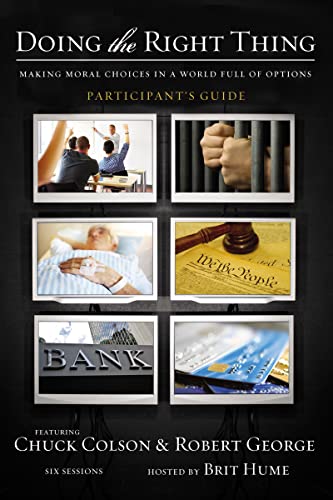
Doing the Right Thing Bible Study Participant's Guide: Making Moral Choices in a World Full of Options - Softcover
Inhaltsangabe
In this six-session small group Bible study (DVD/digital video sold separately), Doing the Right Thing, from Chuck Colson, Robert George, and an all-star panel examines how ethical and character issues relate to life at home, school, and the workplace.
Doing the Right Thing explores the ethical and moral breakdown hitting culture from all sides. Through panel discussions, interviews, and live student questions it raises ethical issues in a non-condemning but challenging way, stimulating thought, discussion, and action.
This Participant Guide encourages viewers to examine themselves and how ethical and character issues relate to their lives at home, school, and the workplace. As a result of this discussion and self-examination, participants will exhort each other and promote an ethic of virtue in their spheres of influence and in the culture at large.
This examination of ethics consists of six sessions, each designed to last approximately one hour. Each session consists of thirty minutes of video and thirty minutes of discussion.
Session topics include:
- How did we get into this mess?
- Is there truth, a moral law we all can know?
- If we know what is right, can we do it?
- What does it mean to be human?
- Ethics in the market place
- Ethics in public life
Designed for use with the Doing the Right Thing Video Study (sold separately).
Die Inhaltsangabe kann sich auf eine andere Ausgabe dieses Titels beziehen.
Über die Autorinnen und Autoren
Chuck Colson was a popular and widely known author, speaker, and radio commentator. A former presidential aide to Richard Nixon and founder of the international ministry Prison Fellowship, he wrote several books that have shaped Christian thinking on a variety of subjects, including Born Again, Loving God, How Now Shall We Live?, The Good Life, and The Faith. His radio broadcast, BreakPoint, at one point aired to two million listeners. Chuck Colson donated all of his royalties, awards, and speaking fees to Prison Fellowship Ministries.
Robert P. George is McCormick Professor of Jurisprudence and Director of the James Madison Program in American Ideals and Institutions at Princeton University. He is also the Herbert W. Vaughan Senior Fellow of the Witherspoon Institute in Princeton. He has served on the U.S. Commission on Civil Rights and the President’s Council on Bioethics, and was a Judicial Fellow at the Supreme Court of the United States, where he received the Justice Tom C. Clark Award. A graduate of Swarthmore College, he holds J.D. and M.T.S. degrees from Harvard University, and a D.Phil. from Oxford University, in addition to many honorary degrees. He is a member of the Council on Foreign Relations, and a recipient of the U.S. Presidential Citizens Medal and the Honorific Medal of the Republic of Poland for the Defense of Human Rights. His books include The Clash of Orthodoxies (2002) and Embryo: A Defense of Human Life (2008)
Auszug. © Genehmigter Nachdruck. Alle Rechte vorbehalten.
Doing the Right Thing Participant's Guide
By Chuck Colson Robert GeorgeZondervan
Copyright © 2011 Charles W. ColsonAll right reserved.
ISBN: 978-0-310-42776-6
Contents
Welcome....................................................................7Session 1 How Did We Get into This Mess?...................................9Session 2 Is There Truth, a Moral Law We All Can Know?.....................21Session 3 If We Know What Is Right, Can We Do It?..........................35Session 4 What Does It Mean to Be Human?...................................47Session 5 Ethics in the Market Place.......................................65Session 6 Ethics in Public Life............................................79Additional Resources.......................................................93
Introduction
A crisis of ethicsThe United States is facing a serious crisis of ethics.
Perhaps the most obvious example of this is the recent financial crisis, where ethical lapses very nearly brought down the global financial system. Yet it is all too easy to blame the crisis on corporate greed and wrongdoing on Wall Street. Looking more closely at the situation, we find ethical problems on all levels, including on the part of the government and even individuals who took out mortgages they could not hope to repay, along with the banks and financial firms.
But what exactly is ethics? And how have our ethical standards so deteriorated that we don't even seem to know right from wrong? What are the consequences of these failures?
Standards of behavior: universal or relative?
Maybe the simplest operating definition is that ethics are standards of behavior, presumably derived from some objective source or transcendent authority, whether it is natural law or God. These standards regulate the conduct of our behavior and our relationships with one another. When sound standards are in place, transparency and honesty generally operate in financial and commercial markets. Obviously there are exceptions, but these become the norm for behavior.
Yet many in our society today reject the very notion of ethics as something that is either objective or universal. Instead, many have embraced the idea of moral and ethical relativism. This view holds that ethics are not based on transcendent truths, but are instead dependent on the situation and the people involved. Since there is no objective standard of right and wrong, all cultures are equal, all individual values are valid, and we cannot judge the choices that other people make. Even government cannot get involved in these questions because "there is no such thing as objective moral truth."
The impossibility of relativism
Relativism is a common view of ethics in many influential circles today, including business schools and academia in general, medical research labs, law schools, and halls of government. In our pluralistic world, it seems to many to be the only option.
The problem is, it doesn't work.
First, it is obvious that ethical failures occur. The outrage against executives at the financial ser vices firms is ample evidence that we recognize wrongdoing. Yet if there is no objective ethical standard by which we can measure people's behavior, how can we even talk about unethical actions? There is no basis for judging anyone's actions as wrong or inappropriate. At best we can say they are illegal.
This leads directly to the second problem. In a world that believes in relativism, when obvious ethical lapses occur the only recourse is laws and government regulation. Yet regulations have loopholes and boundaries, whether by accident or design. No matter how carefully crafted regulations are, unethical people will find a way around the letter of the law and thus will not be restrained by them. Furthermore, increasing laws and regulations inevitably leads to an erosion of our freedoms.
So determining what ought to be and building a consensus around setting some ethical standards becomes essential for the survival of a free society. And developing this consensus and teaching it is critical for preventing the kinds of disastrous ethical failures that have caused so much havoc not only in the U.S., but internationally as well.
Video Notes Outline
I. Ethical failures and the economic collapse
II. "The dictatorship of relativism"
A. Business schools
B. Creating a culture without ethics
III. Criminality
IV. "Borrowed capital" and ethical erosion
V. Resolving ethical disputes
Selling Short is a way of making money when a stock declines in value. the short seller borrows a certain amount of stock from a broker and sells it; if the stock declines in value, the short seller buys it at the lower value, returns it to the broker, and keeps the difference in price less the borrowing fees. for example, the short seller could borrow 100 shares of a stock valued at $10 per share and sell them for $1,000; if the stock then drops to $8 per share, he could buy another 100 shares for $800, return them to the broker, and keep the $200 difference between the price he received for selling the shares and the price he paid to buy their replacements. if the stock goes up, the short seller will lose money. this is generally considered an ethical form of trade, though in the examples discussed here, the financial firms knew the assets were bad, sold them deceptively to companies that thought they were buying legitimate assets, and then shorted them to make a profit when they inevitably dropped in value. that action was clearly unethical on several levels.
Questions: For Group Discussion
1. Consider: Brit Hume suggested that the financial collapse was caused by a widespread lack of, "first, ethical behavior by the government; second, ethical behavior in financial markets; third, ethical behavior by mortgage lending banks; and fourth, ethical behavior on the part of the public." Pope Benedict said, "The events of the last two or three years have demonstrated that the ethical dimension must enter into economic activity. Now is the time to see that ethics is not something external, but internal to economic rationality and pragmatism."
Discuss: Read Exodus 20:15; Deuteronomy 25:13–16; and Luke 19:1–9. How do passages like these lead us to see that Christians should take more interest in ethics and the role of ethics in the economy?
2. Consider: Jim Grant argues that it is important to understand where the ethical failures on the part of government, business institutions, and even individuals occurred to allow for accountability and personal responsibility. Christians can sometimes be a little wary about "finger-pointing" because they don't want to "judge" others or their ethical values and practices.
Discuss: How would you explain what Jesus meant in John 7:24, where He was quoting from Leviticus 19:15? Is it possible that as Christians, through our reluctance to be involved in matters of ethical judgment, we may also bear some responsibility for the crisis of ethics? Explain.
3. Consider: Chuck Colson claims it is impossible to teach ethics in business schools today. Donovan Campbell agrees that you need to subscribe...
„Über diesen Titel“ kann sich auf eine andere Ausgabe dieses Titels beziehen.
Suchergebnisse für Doing the Right Thing Bible Study Participant's...

Beispielbild für diese ISBN
Doing the Right Thing Bible Study Participant's Guide: Making Moral Choices in a World Full of Options
Verlag:
HarperChristian Resources, 2011
ISBN 10: 0310427762
ISBN 13: 9780310427766
Gebraucht
Paperback
Anbieter: World of Books (was SecondSale), Montgomery, IL, USA
Verkäuferbewertung 5 von 5 Sternen

Paperback. Zustand: Good. In this six-session small group Bible study, Doing the Right Thing, from Chuck Colson, Robert George, and an all-star panel examines how ethical and character issues relate to life at home, school, and the workplace. Bestandsnummer des Verkäufers 00100664798
Gebraucht kaufen
EUR 5,97
Versand gratis
Versand innerhalb von USA
Versand innerhalb von USA
Anzahl: 3 verfügbar
Beispielbild für diese ISBN
Doing the Right Thing Bible Study Participant's Guide: Making Moral Choices in a World Full of Options
Verlag:
Harperchristian Resources, 2011
ISBN 10: 0310427762
ISBN 13: 9780310427766
Gebraucht
Paperback
Anbieter: ThriftBooks-Dallas, Dallas, TX, USA
Verkäuferbewertung 5 von 5 Sternen
Paperback. Zustand: Good. No Jacket. Pages can have notes/highlighting. Spine may show signs of wear. ~ ThriftBooks: Read More, Spend Less. Bestandsnummer des Verkäufers G0310427762I3N00
Gebraucht kaufen
EUR 5,98
Versand gratis
Versand innerhalb von USA
Versand innerhalb von USA
Anzahl: 1 verfügbar
Beispielbild für diese ISBN
Doing the Right Thing Participant's Guide: Making Moral Choices in a World Full of Options
Verlag:
HarperChristian Resources, 2011
ISBN 10: 0310427762
ISBN 13: 9780310427766
Gebraucht
Softcover
Anbieter: Wonder Book, Frederick, MD, USA
Verkäuferbewertung 5 von 5 Sternen
Zustand: Good. Good condition. A copy that has been read but remains intact. May contain markings such as bookplates, stamps, limited notes and highlighting, or a few light stains. Bestandsnummer des Verkäufers K14B-01228
Gebraucht kaufen
EUR 6,40
Versand gratis
Versand innerhalb von USA
Versand innerhalb von USA
Anzahl: 1 verfügbar
Beispielbild für diese ISBN
Doing the Right Thing Participant's Guide : Making Moral Choices in a World Full of Options
Verlag:
HarperChristian Resources, 2011
ISBN 10: 0310427762
ISBN 13: 9780310427766
Gebraucht
Softcover
Anbieter: Better World Books: West, Reno, NV, USA
Verkäuferbewertung 5 von 5 Sternen
Zustand: Good. Former library copy. Pages intact with minimal writing/highlighting. The binding may be loose and creased. Dust jackets/supplements are not included. Includes library markings. Stock photo provided. Product includes identifying sticker. Better World Books: Buy Books. Do Good. Bestandsnummer des Verkäufers 15396046-75
Gebraucht kaufen
EUR 6,54
Versand gratis
Versand innerhalb von USA
Versand innerhalb von USA
Anzahl: 1 verfügbar
Beispielbild für diese ISBN
Doing the Right Thing Participant's Guide : Making Moral Choices in a World Full of Options
Verlag:
HarperChristian Resources, 2011
ISBN 10: 0310427762
ISBN 13: 9780310427766
Gebraucht
Softcover
Anbieter: Better World Books: West, Reno, NV, USA
Verkäuferbewertung 5 von 5 Sternen
Zustand: Good. Pages intact with minimal writing/highlighting. The binding may be loose and creased. Dust jackets/supplements are not included. Stock photo provided. Product includes identifying sticker. Better World Books: Buy Books. Do Good. Bestandsnummer des Verkäufers 4922262-6
Gebraucht kaufen
EUR 6,54
Versand gratis
Versand innerhalb von USA
Versand innerhalb von USA
Anzahl: 1 verfügbar
Beispielbild für diese ISBN
Doing the Right Thing Bible Study Participant's Guide: Making Moral Choices in a World Full of Options
Verlag:
HarperChristian Resources, 2011
ISBN 10: 0310427762
ISBN 13: 9780310427766
Gebraucht
Paperback
Anbieter: World of Books Inc, Montgomery, IL, USA
Verkäuferbewertung 4 von 5 Sternen

Paperback. Zustand: Good. In this six-session small group Bible study, Doing the Right Thing, from Chuck Colson, Robert George, and an all-star panel examines how ethical and character issues relate to life at home, school, and the workplace. Bestandsnummer des Verkäufers CIN0310427762G
Gebraucht kaufen
EUR 7,80
Versand gratis
Versand innerhalb von USA
Versand innerhalb von USA
Anzahl: 3 verfügbar
Foto des Verkäufers
Doing the Right Thing Participant's Guide: Making Moral Choices in a World Full of Options
Anbieter: ChristianBookbag / Beans Books, Inc., Westlake, OH, USA
Verkäuferbewertung 5 von 5 Sternen
Paperback. Zustand: New. Publisher's Return. Buy multiples from our store to save on shipping. Bestandsnummer des Verkäufers 1804170183
Foto des Verkäufers
Doing the Right Thing Bible Study Participant's Guide
Verlag:
HarperChristian Resources, US, 2011
ISBN 10: 0310427762
ISBN 13: 9780310427766
Neu
Paperback
Anbieter: Rarewaves.com USA, London, LONDO, Vereinigtes Königreich
Verkäuferbewertung 5 von 5 Sternen
Paperback. Zustand: New. In this six-session small group Bible study (DVD/digital video sold separately), Doing the Right Thing, from Chuck Colson, Robert George, and an all-star panel examines how ethical and character issues relate to life at home, school, and the workplace.Doing the Right Thing explores the ethical and moral breakdown hitting culture from all sides. Through panel discussions, interviews, and live student questions it raises ethical issues in a non-condemning but challenging way, stimulating thought, discussion, and action.This Participant Guide encourages viewers to examine themselves and how ethical and character issues relate to their lives at home, school, and the workplace. As a result of this discussion and self-examination, participants will exhort each other and promote an ethic of virtue in their spheres of influence and in the culture at large.This examination of ethics consists of six sessions, each designed to last approximately one hour. Each session consists of thirty minutes of video and thirty minutes of discussion.Session topics include:How did we get into this mess?Is there truth, a moral law we all can know?If we know what is right, can we do it?What does it mean to be human?Ethics in the market placeEthics in public lifeDesigned for use with the Doing the Right Thing Video Study (sold separately). Bestandsnummer des Verkäufers LU-9780310427766
Neu kaufen
EUR 8,08
Versand gratis
Versand von Vereinigtes Königreich nach USA
Versand von Vereinigtes Königreich nach USA
Anzahl: 5 verfügbar
Foto des Verkäufers
Doing the Right Thing : Making Moral Choices in a World Full of Options: Participant's Guide
Anbieter: GreatBookPrices, Columbia, MD, USA
Verkäuferbewertung 5 von 5 Sternen
Zustand: New. Bestandsnummer des Verkäufers 12876057-n
Neu kaufen
EUR 7,88
EUR 2,35 Versand
Versand innerhalb von USA
Versand innerhalb von USA
Anzahl: 15 verfügbar
Foto des Verkäufers
Doing the Right Thing : Making Moral Choices in a World Full of Options: Participant's Guide
Verlag:
HarperChristian Resources, 2011
ISBN 10: 0310427762
ISBN 13: 9780310427766
Gebraucht
Softcover
Anbieter: GreatBookPrices, Columbia, MD, USA
Verkäuferbewertung 5 von 5 Sternen
Zustand: As New. Unread book in perfect condition. Bestandsnummer des Verkäufers 12876057
Gebraucht kaufen
EUR 7,89
EUR 2,35 Versand
Versand innerhalb von USA
Versand innerhalb von USA
Anzahl: 15 verfügbar